
CMMC penetration testing is a security test scoped to help a defense contractor prove their systems actually hold up, as part of getting CMMC certified. For MSPs with clients in the defense supply chain, it's turning into real money, because CMMC is now rolling into DoD contracts and a lot of small contractors have no idea how to prove they're secure. You can.
One bit of clarity up front, because it trips people up. CMMC does not list a penetration test as a required control. What it does is hold your client to NIST SP 800-171, which expects them to assess their controls and to find and fix vulnerabilities, and a pentest is one of the cleanest ways to show that's real and not just paperwork. MSP Pentesting runs it under your brand, channel-only. Below is how it fits CMMC, how it runs, and how you deliver it without a compliance team.
What CMMC is, in one minute
CMMC, the Cybersecurity Maturity Model Certification, is the Defense Department's way of making sure contractors that handle federal contract information and controlled unclassified information actually protect it. Level 1 is basic and self-assessed. Level 2, the one most contractors need, maps to the 110 controls in NIST SP 800-171 and, for most companies, requires a third-party assessment by a C3PAO. If your client wants to keep bidding on DoD work, they have to clear their level. No certification, no contract.
Where a pentest fits CMMC

Here's the honest version. A pentest isn't a checkbox in CMMC. What it is, is proof. It produces evidence for the security assessment and risk assessment control families, the ones that expect a contractor to actually evaluate their controls and to find and remediate vulnerabilities. It puts real findings and fixes on the record, which is exactly what those controls want to see. It proves access controls and boundary protections work instead of just existing in a policy. And for a contractor flowing requirements down from a prime, it's clean proof they can hand up the chain. Walk into a C3PAO assessment with a pentest and a remediation record, and there are far fewer surprises.
How a CMMC-focused pentest works
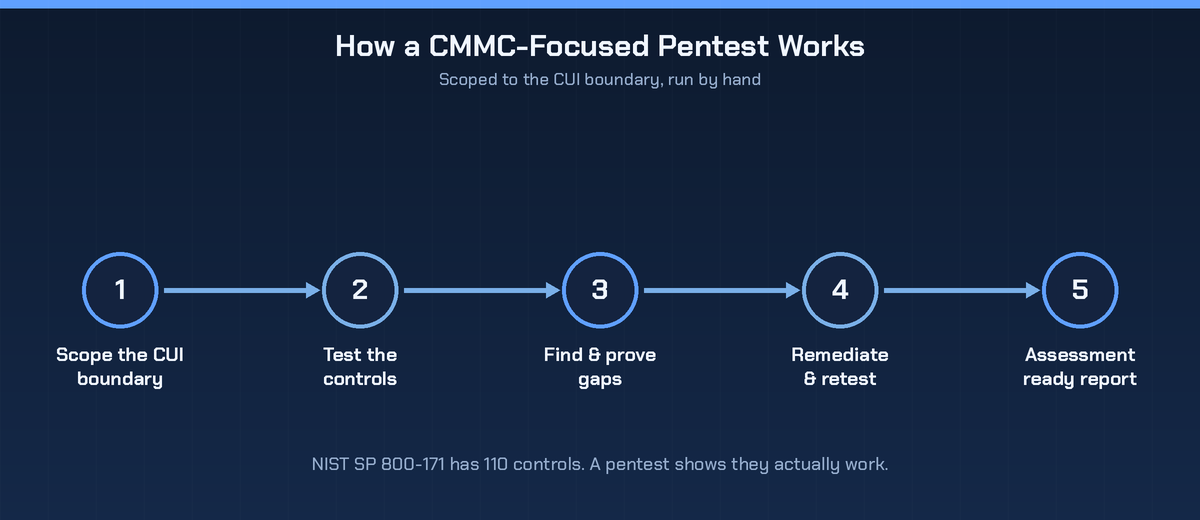
It starts by scoping to the boundary where the sensitive data lives, because that's what the assessment cares about. Then the tester works the controls the way an attacker would, finds the gaps, and proves each one instead of guessing. The client remediates, the tester retests, and the whole thing lands as a report written to line up with the controls an assessor will ask about. Scoped, proven, and assessment-ready.
Why this is an opportunity, not just a cost
Most defense subcontractors are small businesses, and small businesses lean on their MSP for everything. They don't have a security team, they can't read 800-171, and they're staring down a certification that decides whether they keep their contracts. An MSP who can quarterback CMMC readiness, pentest included, becomes almost impossible to fire. This is one of the stickiest, highest-margin services in the channel right now, and the window is open because most MSPs haven't figured out how to deliver it yet.
How MSPs deliver it without a compliance team
You don't need in-house assessors to offer this. Scope the engagement with your client, hand the testing to a channel-only partner, and the report comes back under your brand, mapped to the controls that matter. Your client sees your logo and your expertise. That's what white-label pentesting is built for, and it slots neatly next to the rest of a client's compliance work. If you already offer IT compliance consulting, CMMC testing is the natural technical piece underneath it.
What the report gives you
The report ties each finding back to the relevant NIST 800-171 control, so the client and their assessor can see the connection at a glance. It stays scoped to the boundary, ranks gaps by real risk, gives concrete remediation, and shows the retest that closed them. Branded to you, clean, and built to survive an assessor's questions. That's a deliverable a nervous contractor will pay well for, and it earns you the next engagement.
Frequently asked questions
Does CMMC require a penetration test?
No, not as a named control. But CMMC Level 2 is built on NIST SP 800-171, which expects contractors to assess controls and to find and remediate vulnerabilities, and a pentest is strong, clean evidence for exactly that. It also de-risks the C3PAO assessment.
What CMMC level needs a third-party assessment?
Level 2 requires a C3PAO third-party assessment for most contractors handling controlled unclassified information. Level 1 is self-assessed. The exact path depends on the contract.
Can an MSP handle CMMC for clients?
Yes, and MSPs are central to it, because most defense subcontractors are small and rely on their provider. Pair your services with a channel pentesting partner and you can cover the technical testing without hiring specialists.
When should a client run one?
Before the C3PAO assessment, so gaps get fixed on your timeline instead of the assessor's, and again after remediation to confirm the fixes held.
The bottom line
CMMC is here, it decides who keeps their defense contracts, and most small contractors have no idea how to prove they're secure. CMMC penetration testing gives them that proof, produces the evidence their assessment wants, and turns you into the partner they can't do without. Scope the boundary, test the controls, prove the gaps, remediate and retest, and hand the client a report with your brand on it.

.avif)
.png)
.png)
.png)

