
Cyber insurance and penetration testing are getting harder to pull apart, because insurers stopped taking a client's word that they're secure. Now they ask for proof, and a pentest is proof. For MSPs, that shift is a gift. Every renewal questionnaire your clients dread is a reason to sell them a security test, and you're the one holding it.
Here's what changed. A few brutal years of ransomware payouts made cyber insurers picky. They tightened the questionnaires, raised the bar on controls, and started denying claims when a client fudged the answers. MSP Pentesting gives you the testing to back those answers honestly, under your brand, channel-only. Below is what insurers want, how a pentest fits, and how you turn the renewal into revenue.
Why insurers care about penetration testing now
Cyber insurance used to be a checkbox and a signature. Not anymore. After paying out on wave after wave of ransomware, insurers rewrote the rules. They demand specific controls before they'll write or renew a policy, and they've gotten comfortable denying a claim when the controls on the application turn out to be fiction. A client who swears they have MFA everywhere and doesn't isn't just exposed, they may have quietly voided their own policy. Honest evidence is the safe path, and a pentest produces it.
What cyber insurers now want to see
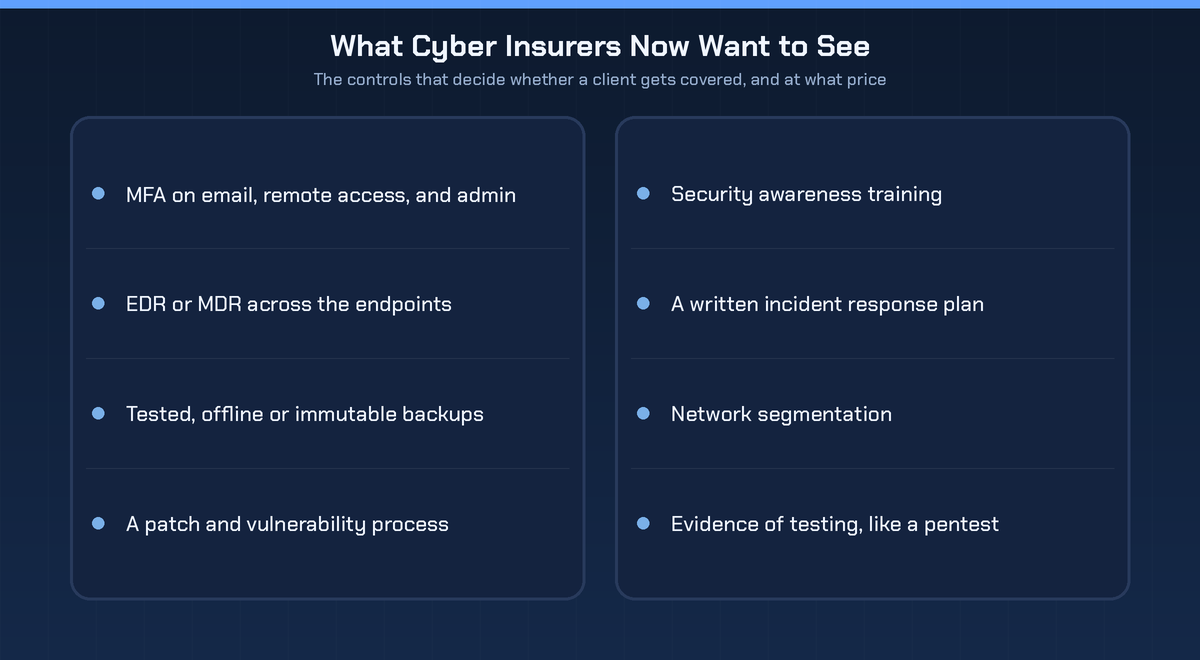
The questionnaire has gotten specific. MFA on email, remote access, and admin accounts. EDR or MDR across the endpoints. Backups that are tested and kept offline or immutable. A real patch and vulnerability process. Security awareness training. A written incident response plan. Network segmentation. And, more and more, evidence that someone actually tested all of it. A pentest touches most of that list at once, which is what turns a nervous we think we're covered into a confident here's the report.
How pentesting fits the insurance conversation

Read the insurer's questions first, because they're the spec. Test the controls against exactly what the application asks. Fix the gaps before your client signs anything, so the answers are true when they attest. Document the proof. Then walk into renewal with leverage instead of hope. A client with a clean pentest and a remediation record is a better risk on paper, and better risks get better terms.
Two ways this makes your client money, and protects them
First, stronger posture can mean better premiums and terms, because insurers reward evidence of real security over a page of optimistic answers. Second, and this is the big one, it protects the claim. The nightmare isn't the premium. It's paying premiums for years, getting hit, and then watching the claim get denied because an answer on the application didn't hold up. A pentest keeps the answers honest, which keeps the policy worth something.
Why this is the easiest pentest to sell
You don't have to manufacture urgency for this one. The insurer already did. The renewal date is the deadline, the questionnaire is the spec, and your client is already anxious about it. Show up offering to test the controls and hand them clean evidence, and you're not upselling, you're solving the problem sitting open on their desk. It's one of the warmest pentest conversations in the whole channel.
How MSPs deliver it without a security team
You don't need testers on payroll to run with this. Scope the engagement with your client, hand the testing to a channel-only partner, and the report comes back under your brand, ready to support the application. Your client sees your logo and your expertise. That's what white-label pentesting is built for, and the reseller pricing behind it lives in the partner program. Pair it with a risk assessment and you cover the whole application in one motion.
What the report gives you
The report lines up with the controls the insurer asks about, so your client can answer the questionnaire from evidence instead of memory. It ranks gaps by real risk, gives concrete fixes, and shows the retest that closed them. Branded to you, clean, and specific enough to hand to a broker. That's a document that protects the client and sells the next engagement at the same time.
Frequently asked questions
Does cyber insurance require a penetration test?
Not always by name, though more insurers now ask for testing evidence outright. Either way, every policy requires controls a pentest validates, like MFA, EDR, and tested backups, so a pentest is the cleanest way to prove them.
Can a bad application void a claim?
Yes. If the controls a client attested to on the application turn out not to be real, the insurer can deny the claim. Honest, tested evidence is what protects the policy.
Will a pentest lower premiums?
It can. Stronger, evidenced posture makes a client a better risk, and insurers price that in. Results vary by carrier, but better answers rarely hurt.
When should a client test?
Before renewal, with enough runway to fix the gaps before they sign the application. Testing after the fact defeats the purpose.
The bottom line
Cyber insurers stopped trusting and started verifying, and that makes penetration testing part of the insurance conversation whether your client likes it or not. Cyber insurance and penetration testing now go together: the test proves the controls, protects the claim, and often improves the terms. Read the insurer's ask, test the controls, fix the gaps, document the proof, and hand your client a report with your brand on it.
%20(1).png)
.avif)
.png)
.png)
.png)

