
For your clients, a compliance audit is the roadmap you build to find and deal with any issue that could land them in hot water with standards like SOC 2, HIPAA, or PCI DSS. It's a required first step for any real Governance, Risk, and Compliance (GRC) program. Auditors will always ask to see it.
Understand Compliance GRC Basics
Think of it like getting a home inspection before buying a house. You wouldn't sign the papers without knowing about a leaky roof, right? It's the same idea here. Your clients can't build a strong security program until they know where the cracks are.
This assessment is how you find those weak spots before they turn into huge fines, a massive data breach, or a PR nightmare. This is how you stop being just another vendor and become a core strategic partner. You’re not just putting out fires; you’re designing the fire prevention system.
For MSPs and vCISOs, this process shows your clients you understand their business beyond just IT tickets. It proves you're invested in their long-term success. A well-built assessment is the foundation for every other security activity you'll do for them. To get started, you can use tools like an AI-generated risk assessment form template for a solid foundation.
Align Assessments with Key Compliance Frameworks
A good GRC risk assessment is the master key that unlocks several major standards. For MSPs and vCISOs, this is a huge efficiency play. You don't need a new key for every lock like SOC 2, HIPAA, or PCI DSS.
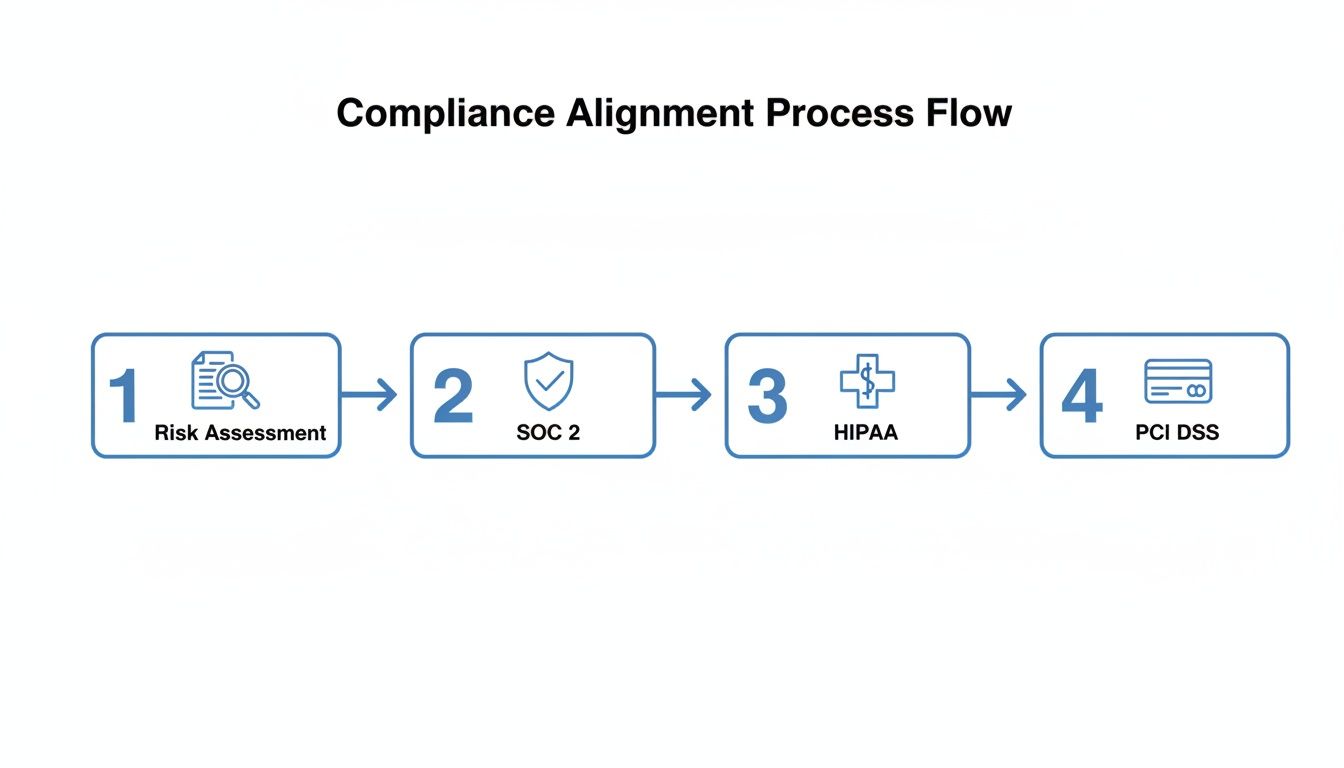
You aren’t reinventing the wheel for every audit. The hard work you do to find risks for SOC 2 is directly useful for HIPAA or PCI DSS. The basic job of finding and analyzing threats doesn't change.
What changes is the lens you're looking through. For HIPAA, you're focused on patient data. For PCI DSS, it's all about cardholder data, and for life sciences penetration testing it's the integrity of validated GxP records. Once you master this unified approach, you can offer a streamlined service that saves clients time and ends audit fatigue.
Major compliance frameworks are just different rulebooks for the same game: protecting sensitive information. Your risk assessment proves your client has done the work. A single assessment maps directly to these rules:
- SOC 2: The Trust Services Criteria, specifically CC3, Risk Assessment, is a non-negotiable part. Auditors will demand to see a documented process for identifying and responding to risks.
- HIPAA: The Security Rule, §164.308(a)(1)(ii)(A), requires a "risk analysis." This means conducting a thorough assessment of anything that could threaten electronic protected health information (ePHI).
- PCI DSS: Requirement 12.3.1 requires targeted risk analyses to identify threats and vulnerabilities. It must be done at least once a year and when the IT environment changes.
- ISO 27001: Risk assessment is the heart of Clause 6.1.2. It requires a systematic process to identify and treat information security risks.
When you show a client how one solid risk assessment satisfies all these different clauses, you stop being just a vendor. You become a strategic GRC advisor. This approach makes your services more scalable and profitable. To learn more, check out our guide on building a cybersecurity risk assessment framework.
Use a Repeatable Pentest Methodology
To make your GRC services scalable and profitable, you need a playbook. A scattered approach to compliance risk assessments won't work. A consistent, repeatable method is the only way to deliver solid results and build trust with your clients.
This is a practical, five-phase plan you can use right away. This structure helps you run effective assessments every time, making your services predictable and much easier to sell.
Phase 1: Scope and Asset Discovery
You can't protect what you don't know you have. The first step is to draw a clear line around the assessment and list everything inside it. For an MSP, you likely already have RMM tools that can inventory hardware and software.
Phase 2: Threat and Impact Analysis
Once you know what the important assets are, think about what could happen to them. Think like an attacker. This means mapping out threats, from a ransomware attack to a disgruntled employee.
Phase 3: Controls Evaluation
Now it's time to check the locks. This phase is about looking at the security controls your client already has. Are their firewalls configured correctly? Is multi-factor authentication enforced everywhere it should be?
Phase 4: Risk Scoring and Prioritization
Not all risks are created equal. Trying to fix everything at once is a recipe for failure. This phase is about scoring each risk based on its likelihood and business impact. This lets you focus your client's limited time and budget on the biggest threats.
The demand for this analysis is growing. Recent compliance statistics show a massive market need for structured assessments and validation like manual pentesting, delivered through a channel-only pentest program. This is a huge opportunity for MSPs and GRC firms.
Phase 5: Remediation Planning
A risk assessment without a clear action plan is just a report that collects dust. In this final phase, you create a detailed plan to fix the highest-priority risks. This plan needs clear recommendations, assigned owners, and realistic timelines. This is a golden opportunity to position your managed services as the solution.
Validate Your Assessment with Penetration Testing

A compliance risk assessment identifies potential security gaps on paper. But a penetration test proves whether those theoretical gaps are actually exploitable. Think of the risk assessment as a map of a minefield. The pentest is sending an expert to see which mines are live.
Auditors for frameworks like SOC 2, HIPAA, and PCI DSS want hard evidence that your client's controls can withstand an attack. A pentest provides that proof. This step elevates your GRC services from advisory to evidentiary. You're showing clients exactly how an attacker would get in.
You can't just run an automated scanner and call it a day. That's why our services are built exclusively on manual pentesting. Our team of certified ethical hackers thinks like the bad guys. Our OSCP, CEH, and CREST certified pentesters chain vulnerabilities together to find high-impact breaches that automated tools always miss.
We built our entire business around supporting yours. As a strictly channel-only partner, we never compete with our MSP or vCISO clients. Our mission is to make you the hero by providing affordable, fast, and expert white label pentesting services. You brand the reports as your own, and we do the work in the background.
The industry has a problem with inflated prices and long lead times. We are the solution. Our model is built on affordability, speed, and deep, manual analysis. With compliance complexity rising, as the full PwC survey results show, the need for fast, expert validation is through the roof.
Waiting weeks for a pentest report is a deal-breaker. Our process delivers a comprehensive report on a timeline scoped to the engagement. This speed gets your clients from assessment to remediation faster, clearing the path toward ISO 27001 or PCI DSS compliance. For more details, see our guide on penetration testing and vulnerability assessment.
Consider AI and Vendor Risk Assessments
Yesterday's compliance risk assessment playbook is already outdated. New tech is creating dangerous blind spots. This is a massive opportunity for smart MSPs and vCISOs to guide clients through what's coming next.
Take AI. Your clients are adopting AI tools without knowing the data they’re handing over or the backdoors they're opening. Our manual pentesting services are designed to dig into these new AI applications and find hidden vulnerabilities.
Another huge blind spot is third-party risk. Your clients are connected to dozens of vendors, and each one is a potential entry point for an attack. A complete risk assessment has to look beyond the client's own walls and check the security of their key vendors.
You can't just take a vendor's word that they're secure. You have to prove it. That's where our fast, affordable penetration testing comes in. Our OSCP and CREST certified pentesters will test those critical third-party links to make sure they aren’t leaving your clients wide open.
A modern compliance risk assessment is incomplete until it accounts for AI vulnerabilities and the vendor supply chain. Validating these areas with a pentest is no longer optional; it's essential for frameworks like SOC 2 and ISO 27001. For our reseller partners, this is a major value-add.
Grow Your MSP with White Label Pentesting
We are a channel-only partner. We exist to help your business grow, and we will never compete with you for your clients. We fix the things that drive MSPs and vCISOs crazy: sky-high prices, long waits for reports, and shallow pentests.
Our model provides affordable, manual penetration testing from certified pros, with reports delivered fast. We want to be the partner that empowers you, the reseller, to become the go-to GRC advisor for your clients.
Partnering with us means you can start selling a critical security service tomorrow. Our white label pentesting model is simple: you put your brand on the expert reports our OSCP, CEH, and CREST certified pentesters create. This lets you generate new revenue and deepen client trust.
We handle the complex technical work, making you the hero who delivers the security intelligence clients need for their SOC 2 or ISO 27001 audits. If you're serious about your GRC services, partnering with a dedicated pentesting firm is the logical next step, and our ranked list of the best penetration testing companies shows which ones fit a GRC practice.
Our services give you the hard proof needed to complete any compliance risk assessment. This is a game-changer for MSPs and vCISOs. You focus on strategy while we provide the deep, technical validation. Learn more about our white label penetration testing.
Answer Common Compliance Assessment Questions
We get a lot of questions from our partners about compliance risk assessments and penetration testing. Let’s clear up a few common ones so you can have confident conversations with your clients.
What’s the difference between a vulnerability scan and a pentest?
A vulnerability scan is like running a spell-checker. It's an automated tool that flags known errors. A manual penetration test is different. We have a certified ethical hacker who acts like a real attacker, exploiting vulnerabilities to find business logic flaws that automated tools miss.
Why should I partner for white label pentesting?
Building an in-house penetration testing team is incredibly expensive and a huge headache. You have to find and retain rare talent and pay for costly tools. Partnering with a channel-only provider like us is the smart play.
You get immediate access to our team of OSCP and CREST certified experts without the overhead. Our white label pentesting model lets you control the client relationship and branding. We do the heavy lifting in the background, making you the hero.
Ready to add expert, affordable penetration testing to your GRC services? Partner with MSP Pentesting and deliver the validation your clients need to achieve compliance.

.avif)
.png)
.png)
.png)

