A cybersecurity maturity assessment is the cheapest engagement you'll ever sell and the most valuable one you'll ever deliver, but only if the deliverable points at what comes next. Most of them point at nothing. They score a client against a model, produce a heat map, and die in a shared drive. MSP Pentesting builds the testing half of these under your brand, channel-only, so the roadmap you hand over has real evidence behind the red squares instead of an opinion.
Done right, this is a land-and-expand offer.
One assessment, priced low enough that a hesitant client says yes, that legitimately scopes the next three projects. Here's how to build it so that happens on purpose.
What a maturity assessment is, and what it isn't
A maturity assessment answers one question. Are the security practices here consistent, owned and repeatable, or do they depend on one person remembering?
That's it. It measures process, not posture.
Three engagements get confused constantly, and clients will happily buy the wrong one if you let them.
| Engagement | Question it answers | Primary evidence |
|---|---|---|
| Maturity assessment | Is the practice defined, owned and repeatable? | Interviews, documents, config samples |
| Risk assessment | What could hurt this business, and how badly? | Asset and threat analysis, impact ratings |
| Penetration test | Does the control actually hold under attack? | Proven exploitation path, reproducible |
A maturity assessment tells you MFA is documented and enforced by policy. A pentest tells you the legacy authentication endpoint nobody remembered is still accepting passwords.
You need both. Sell them in that order.
Pick a real model, not a made-up one
The fastest way to lose a savvy client is to show up with a five-level scale you invented, labeled Initial through Optimized, borrowed from a process-improvement model that was never about security. Buyers have seen it. Some of them have paid for it twice.
Use something you can point at.
NIST CSF 2.0
Six functions: Govern, Identify, Protect, Detect, Respond, Recover. Govern arrived in 2.0 and it's the one that matters most for this work, because governance gaps are what make everything else inconsistent.
CSF 2.0 also gives you four Tiers: Partial, Risk Informed, Repeatable, Adaptive. Read what they actually describe before you use them. Tiers rate how rigorous and integrated the risk management practice is, not how good the controls are. NIST is explicit that Tier 4 isn't the universal target, and a 40-person accounting firm sitting at Tier 2 on purpose isn't failing at anything.
The Current Profile and Target Profile structure is the part that sells. You're not telling a client they're bad. You're documenting where they are and where they decided to be.
CIS Controls v8.1
18 controls, 153 safeguards, and three Implementation Groups. IG1 is 56 foundational safeguards aimed at smaller organizations with limited security staff. IG2 adds 74 more for a total of 130. IG3 adds the last 23 to reach all 153.
This is the most practical model for a typical MSP client because the safeguards are concrete. "Establish and maintain a software inventory" is auditable in an afternoon. You can score it without a philosophy debate.
C2M2, if the client is in critical infrastructure
The Department of Energy's Cybersecurity Capability Maturity Model, currently version 2.1, covers ten domains with over 350 practices and scores each at Maturity Indicator Levels MIL0 through MIL3. It's heavier than most mid-market clients need. For an energy, water or utility client it's the model their peers already use, and turning up with it buys credibility you can't fake.
Whichever you pick, say so in writing at kickoff and don't blend models mid-engagement. Mixed scoring is how a report loses the argument in the boardroom.
Running it in three weeks
Long assessments don't produce better answers, they produce stale ones. Three weeks is enough for a client under 500 seats if you run it tightly.
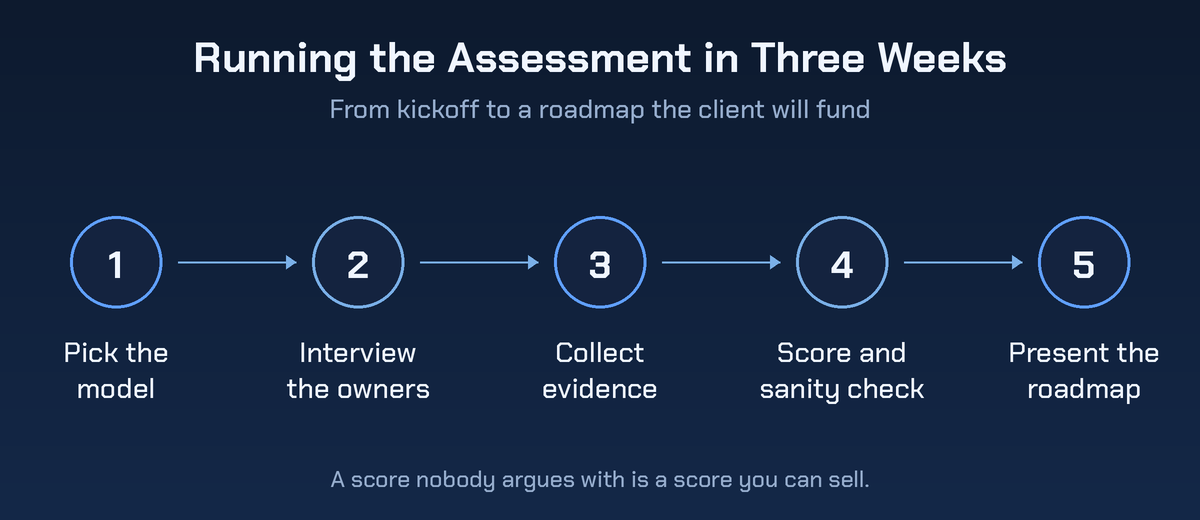
A few practical notes on each phase.
Interviews beat questionnaires. A questionnaire tells you what someone believes is true. Forty-five minutes with the person who actually does the work tells you what happens on a Tuesday. Talk to the help desk lead, not just the IT director.
Ask for evidence on everything you score above the bottom tier. If they claim quarterly access reviews, ask for the last one. If they can't produce it, the practice isn't repeatable and the score reflects that. This single rule is what separates a defensible assessment from a flattering one.
Sanity check before you present. Have someone who wasn't in the interviews read the scores cold. If they can't tell why a domain landed where it did, your evidence trail is too thin.
Score honestly, because the low scores are the pipeline
There's a temptation to be generous, especially when you're the MSP who built half of what you're grading. Resist it.
Two reasons, and the second one is the important one.
First, an inflated score is worthless the moment a real incident or a real auditor arrives, and the client remembers who wrote it.
Second, every honest gap is a scoped project. A generous score has nothing to sell. You're not scoring your own performance here, you're scoring the client's program, and those aren't the same thing. Say that out loud in the kickoff and the conflict of interest stops being awkward.
If you genuinely can't separate the two, that's exactly the case for an independent party. A white-labeled assessment delivered under your logo lets you hand over hard numbers without asking the client to trust your self-review.
The deliverable that actually sells
Most maturity reports fail at the last mile. They're accurate and useless. A client reads 40 pages, agrees with all of it, and does nothing, because nothing in the document tells them what Monday looks like.
Structure it so the next engagement is obvious.
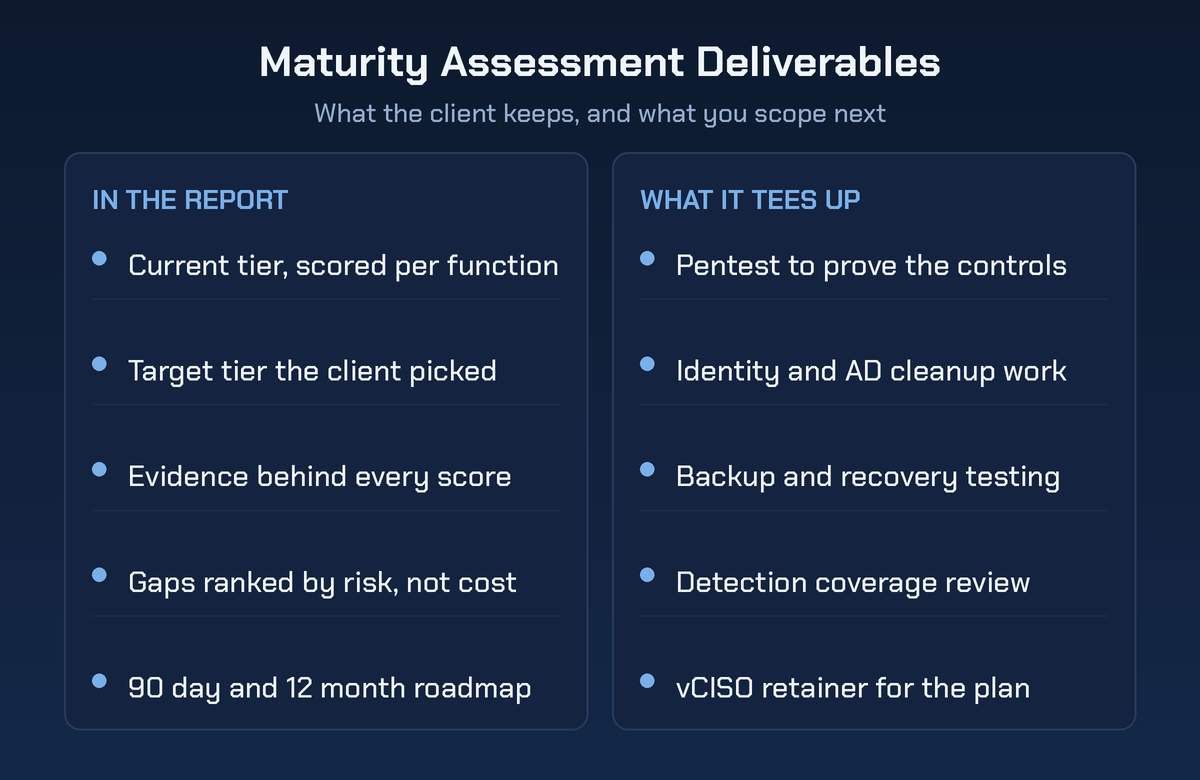
Two rules for the roadmap section.
Rank by risk, not by cost. Cost-ranked roadmaps put cheap cosmetic wins first and leave the domain controller wide open for eighteen months. Rank by what an attacker would use, then note the cost next to it.
Split the horizon. A 90 day list of things that need a decision and a 12 month list of things that need a budget. Executives approve the first one in the meeting. The second one goes into next year's planning, which is where your retainer conversation lives.
Packaging and price
Price a security maturity assessment as an entry point, not as a profit center. It's the cheapest way to earn the right to scope everything else.
Fixed fee. Always. Hourly turns a discovery engagement into a negotiation about scope creep, and you'll lose that negotiation.
Size the fee by seat count and number of locations, and publish what's included so nobody expects a pentest for the price of a review. Be explicit that this is a security gap analysis against a named model, based on interviews and evidence review, and that technical validation is separate work.
Then attach it to something. Offer the assessment fee as a credit against the first remediation project or the first quarter of a retainer. You lose nothing, and it converts the report from a purchase into a deposit.
What it teed up, and how to close it
Three follow-on engagements come out of nearly every honest assessment.
Validation. The client scored well on Protect and Detect. Prove it. A test against the controls they're proudest of is an easy sell right after they've been told they're doing fine, and it's the only way anyone finds out if the score means anything.
Identity cleanup. Almost nobody scores well on privileged access and stale accounts. It's specific, it's fixable, and it maps to a defined project with a defined end.
The retainer. Somebody has to own the 12 month list. That's a vCISO conversation, and it lands naturally because you just spent three weeks proving nobody currently owns it.
Reassess annually against the same model. Year two is where this compounds, because a client who moves from a 2.1 average to a 2.8 has something to show a board, and you have proof your program worked.
Questions MSPs ask before running their first one
How is this different from a risk assessment?
Maturity looks at process consistency. Risk looks at consequence. You can be highly mature and still carry enormous risk if your business model is inherently exposed. Most clients want both, and running a structured risk assessment alongside the maturity work gives the roadmap its ranking logic.
Can we assess a client we already manage?
Yes, with a disclosure. Tell the client in writing which domains you're responsible for, and consider bringing an outside party in for those specific areas. It costs you a little margin and buys a lot of credibility.
What if the client refuses to pick a target tier?
Then you pick a proposed one and make them argue with it. A recommended target based on their industry, contracts and insurance requirements is far easier to react to than a blank field. Nobody chooses in the abstract.
Do we need a tool for this?
No. A spreadsheet, a document template and a disciplined interview process will beat most platforms for a client under 500 seats. Buy a tool when reassessment volume makes manual tracking painful, not before.
How long before we can quote the follow-on work?
Quote it in the presentation. Not a week later. The client is never more motivated than in the hour they're looking at their own red squares, so walk in with rough numbers for the top three projects already attached.
Score it, then sell what the score found
Pick your model this week. Write the interview guide once. Run the first one on your best client at a price that's hard to refuse, and treat that report as the template for everything after it.
Then validate the parts they scored highest on, because that's where confidence and reality drift furthest apart.
Get a pentest quote and name the two lowest scores. The client already agreed those are broken, which makes them the easiest testing budget you'll ever ask for.