
Life sciences penetration testing is ordinary offensive security run inside an environment where the systems are validated, the records are regulated, and the audit trail is inspection evidence. That changes scope, timing, technique, and the report, and it's why a standard internal pentest quote gets rejected by a pharma client's quality unit before it reaches IT. MSP Pentesting delivers this work channel-only and white-labeled, so if you're the MSP, MSSP, or consultancy serving biotech and pharma clients, you can scope and sell GxP penetration testing under your own brand without building a validation practice first.
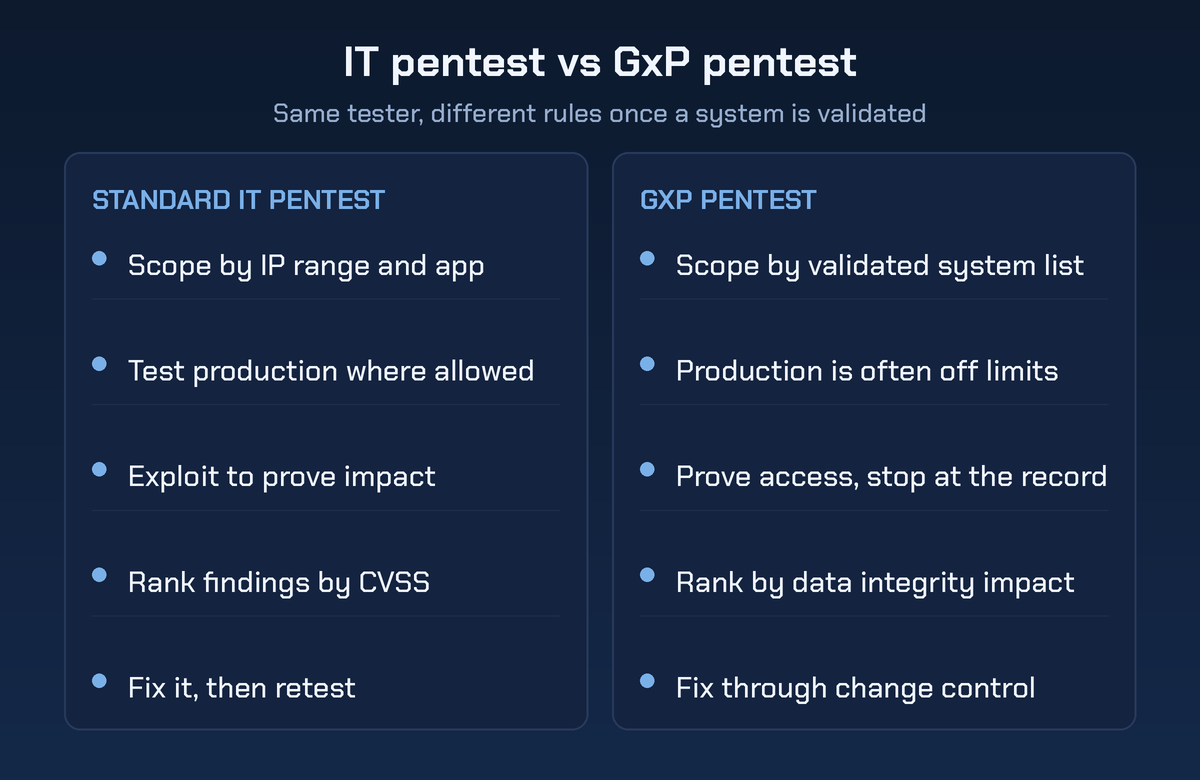
You test the same things you'd test anywhere. The difference is the rules the client's quality unit sets, and a reader who cares about data integrity more than CVSS.
Get those rules wrong and you don't just fail the engagement. You create a deviation.
What GxP means, and why the tester has to care
GxP is a family, not one rule. The x stands in for whichever practice is being regulated: Good Manufacturing Practice (GMP) for how drugs, biologics, and devices are made, Good Laboratory Practice (GLP) for nonclinical safety studies, Good Clinical Practice (GCP) for human trials, and Good Distribution Practice (GDP) for the supply chain. In the US that's 21 CFR Parts 210 and 211 for drugs, Part 820 for devices, and Part 58 for GLP; the EU equivalents live in EudraLex Volume 4.
The word that matters to you shows up across all of them: validated. A computerized system that creates, modifies, or stores GxP records has to be shown to do what it's supposed to do, with documented evidence, then kept in that state through formal change control. The method is computer system validation (CSV), and the reference most quality teams work from is ISPE's GAMP 5, second edition (2022). GAMP 5 is guidance, not regulation. Nobody gets cited for ignoring GAMP. Everybody gets cited for a system they can't prove works.
FDA's Computer Software Assurance (CSA) guidance is final: issued in September 2025 and revised in February 2026, it covers software used in medical device production and quality management systems under 21 CFR Part 820. It's a device guidance, but its risk-based approach is where pharma validation was heading anyway, and GAMP 5's second edition lines up with it.
Don't confuse any of this with medical device cybersecurity. Section 524B of the FD&C Act, added at the end of 2022, puts premarket obligations on "cyber devices": a software bill of materials, a postmarket vulnerability plan, and reasonable assurance the device is secure. That's a product regime. GxP penetration testing is about the computerized systems running the plant, the lab, and the quality system.
What 21 CFR Part 11 and Annex 11 actually ask for
You'll get asked for "21 CFR Part 11 penetration testing." Take the work, but correct the premise gently, because the auditor will.
Part 11 governs electronic records and electronic signatures. It sets the conditions under which FDA treats an electronic record as trustworthy and an electronic signature as equivalent to a handwritten one. It doesn't mention penetration testing. Not once. What it does require, in section 11.10, is validation of the system, limiting access to authorized individuals, secure computer-generated time-stamped audit trails that don't obscure earlier entries, and authority checks so only the right people can sign or alter a record. Section 11.300 adds controls over identification codes and passwords.
Read that list as a pentester and you'll recognize your own findings. Shared accounts. Service accounts with write access to the LIMS database. Audit trail settings an admin can switch off. A pentest is how the client proves those controls hold up against someone trying to defeat them. Evidence for Part 11, not a requirement of it.
EU Annex 11 is the counterpart for computerized systems under EU GMP, and the version in force is the 2011 revision. A full rewrite went out for consultation in 2025 and names cybersecurity explicitly; at the time of writing it hasn't replaced the 2011 text. European clients already think in that language: supplier oversight, access control, audit trails, change control.
The other phrase you need is ALCOA+, the data integrity standard inspectors work from: data must be attributable, legible, contemporaneous, original, and accurate, plus complete, consistent, enduring, and available. FDA defines the first five; the MHRA's GxP data integrity guidance spells out the rest. Map every finding against it. A low CVSS issue that lets someone change a batch record without attribution is a critical finding in this world.
The estate you're actually testing
A pharmaceutical penetration testing scope is two networks stacked on top of each other. The corporate side looks like any mid-market company: Active Directory or Entra, Microsoft 365, VPN, endpoints, SaaS. Then there's the regulated estate, which is where scoping gets specific.
| System | What it holds | Why a finding matters |
|---|---|---|
| MES (manufacturing execution) | Electronic batch records, recipes, equipment status | An altered batch record can block release |
| LIMS (lab information management) | Sample results, stability data, certificates of analysis | Unattributed result changes break data integrity |
| ELN (electronic lab notebook) | R&D records, method development | Originality is lost and IP walks out the door |
| QMS or eQMS | Deviations, CAPAs, change controls, e-signatures | Approvals stop being trustworthy |
| CDS and instrument PCs | Chromatography raw data, instrument control | Old OS builds, vendor remote access, writable raw data |
| EMS and BMS | Cleanroom temperature, humidity, pressure differentials | Missing environmental data affects product disposition |
| Historians and SCADA | Process data from bioreactors, fill lines, utilities | OT rules apply: availability first, passive by default |
Most of those are commercial products configured by a validation team and wired together through interfaces that were qualified once and never looked at again. The interfaces are where the good findings live.
Five constraints that make GxP testing different
1. Validated systems can't be changed without change control
Every validated system sits under a change control procedure. Install an agent, flip a setting, apply a patch, and you've made an unrecorded change to a qualified system. Best case that's a deviation QA has to investigate. Worst case it triggers a revalidation assessment on a system that took months to qualify.
So the scope has to state what the tester may and may not do to each validated system, in writing, agreed by QA. Testing itself doesn't change a system, and that's your argument: observing, authenticating, enumerating, and attempting access don't alter configuration. Exploitation that writes anything does.
2. Production is often off limits
The production MES is running a batch. Nobody is letting you throw payloads at it. The answer is a representative environment: the validation or test instance the client already keeps for change control, at the same version, configuration, integrations, and account model. A vendor demo tenant proves nothing. Where there's no non-production instance, and small biotechs often have none, you fall back to passive and read-only techniques on production plus an authenticated configuration review, and you say so in the report.
3. The audit trail is evidence, so don't pollute it
Part 11 audit trails are retained at least as long as the record itself, and regulators expect them to be reviewed. If your tester logs in with a borrowed account and creates test records, the client has entries in a regulated audit trail to explain at the next inspection. Use named, uniquely identifiable test accounts. Agree the window in advance. Timestamp every action so QA can annotate the trail. Never create, modify, or delete a GxP record in a validated system, and never touch audit trail capture without the validation lead in the loop.
4. Data integrity outranks confidentiality
Standard pentest severity is built around what an attacker can steal. Here the question is what an attacker, or a careless insider, could change without leaving a trace. A domain admin path matters because it ends at the LIMS database, not because it's domain admin. Say that in the finding.
5. The lab and the plant are OT
Instrument PCs run whatever operating system the vendor qualified the software on, which is frequently out of support and can't be patched without the vendor. Remote support tunnels are everywhere. Flat networks are normal. Treat it like any OT environment: passive discovery first, nothing active without operations in the room, and a segmentation review that shows whether a corporate compromise can reach instrument control.
How to scope it with the client
Scope with QA and the CSV lead in the room, not just IT. If IT scopes it alone, QA rejects it later.
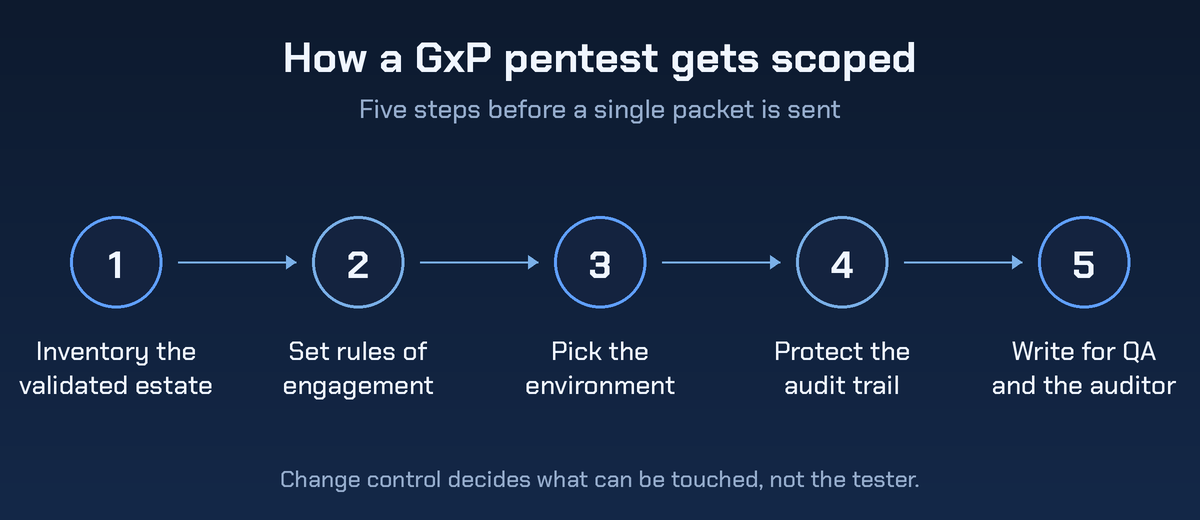
Ask for the validated system inventory and the criticality each system already carries. Ask which systems have a non-production instance and how representative it is. Ask for the change control SOP and the testing window it allows. Ask who reviews audit trails and how they want the test annotated. Ask which systems are vendor-hosted, because a cloud LIMS or eQMS means you test the client's tenant, accounts, and integrations, not the vendor's platform.
Then anchor the security framework. GxP tells the client what a valid system looks like; it doesn't hand them a security management system. That's why so many life sciences companies run ISO 27001 penetration testing alongside the validation program and point the auditor at the ISMS. And if the client handles identifiable patient data as a covered entity or business associate, think diagnostics labs, HIPAA penetration testing sits next to the GxP work rather than replacing it.
Price by validated system count, number of environments, whether authenticated testing is in scope, and how much of the estate is OT. Not by headcount.
What the deliverable has to look like
QA will file your report as a controlled document. Write it that way.
- Scope tied to system IDs. Validated systems, environment, version, and date window, so the report cross-references to the validation file.
- A methodology statement. What was done, what was deliberately not done, and why. The "not done" list is what an inspector reads first.
- Findings mapped to data integrity impact. Each one against ALCOA+ and the relevant Part 11 or Annex 11 control.
- Remediation routed through change control. Every fix to a validated system is a change record, and some need an impact assessment first. Say which.
- Retest evidence and an attestation letter. The retest closes the CAPA. The letter goes to the auditor and to customers running supplier audits.
Our pentest report template is built for that reader, and it ships under your logo.
Where the channel fits
You don't need a validation specialist on payroll to sell this. You need a tester who understands change control, and a partner who won't call your client. MSP Pentesting is white-label penetration testing for MSPs, MSSPs, GRC firms, and vCISOs, and we sell nowhere else. You scope with us, we test under your brand, and you keep the account.
FAQ
Does 21 CFR Part 11 require a penetration test?
No. Part 11 requires validated systems, limited access, authority checks, audit trails, and controls over passwords and identification codes. A penetration test is evidence that those controls resist a real attacker. Sell it as evidence, never as a Part 11 checkbox.
Can you pentest a validated system without triggering revalidation?
Yes, if the scope is written to avoid changes. Enumeration, authenticated review, and access attempts don't alter configuration. Exploitation that writes to the system, installing tools on it, or fixing something mid-test can. Findings then go through change control, and whether a fix needs revalidation is a QA decision, not yours.
Is GxP penetration testing the same as medical device cybersecurity testing?
No. Medical device cybersecurity is a product obligation under section 524B of the FD&C Act, aimed at the device and its premarket submission. GxP penetration testing covers the computerized systems the company runs: MES, LIMS, ELN, QMS, and the lab and plant networks. Some clients need both. They're scoped and reported separately.
Should the test include cloud-hosted LIMS or eQMS?
Yes, for the parts the client controls: tenant configuration, user and role model, integrations, single sign-on, and any customization. Platform-level testing is the vendor's job, and the vendor's own report belongs in the client's supplier qualification file.
Next step
Biotech penetration testing and pharma engagements are won on the scoping call, and the scoping call is won by knowing what QA will say before they say it. Bring us onto that call, or send us the validated system inventory and we'll turn it into a white-labeled pentest quote with rules of engagement written for a regulated estate.

.avif)
.png)
.png)
.png)

