
.png)
%202.png)
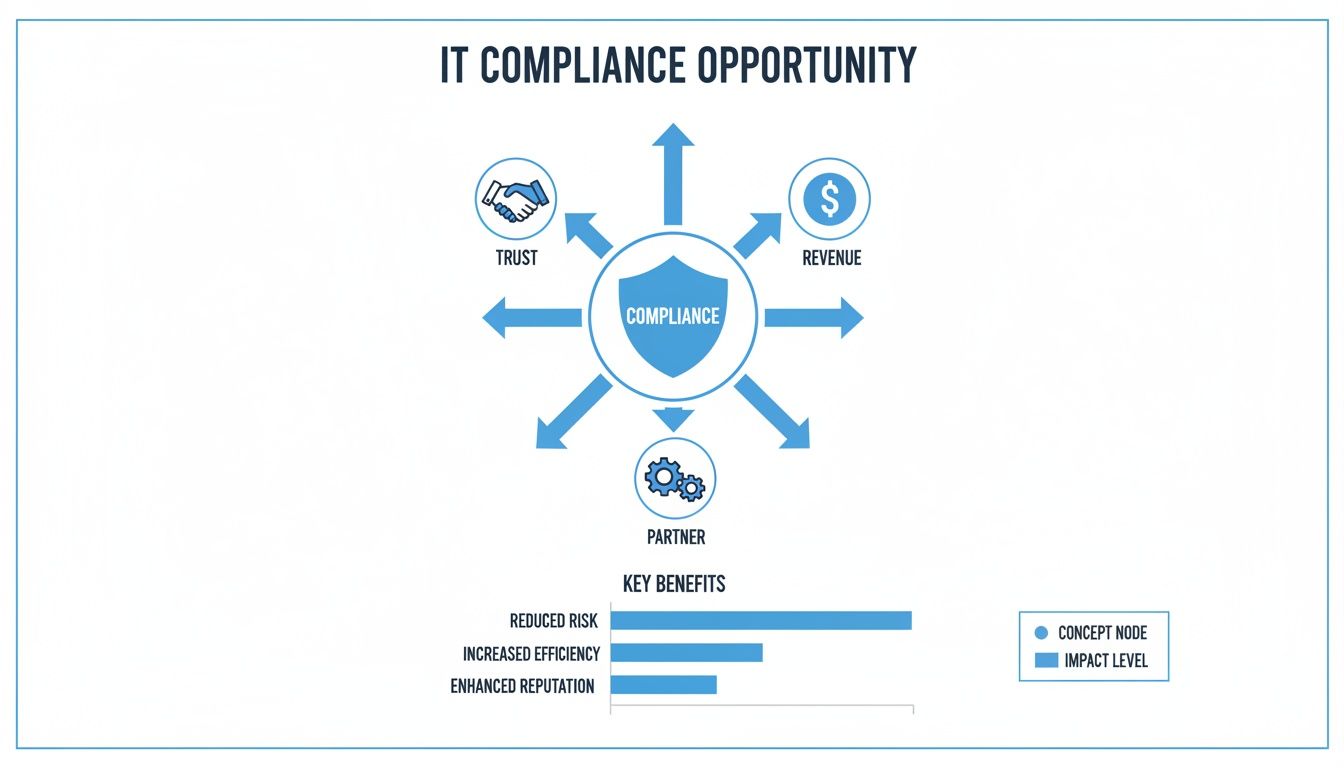
"IT compliance services" might sound complicated, but for MSPs and vCISOs, it's a massive opportunity waiting to be unlocked. It's how you shift from being just an IT provider to a vital security partner your clients depend on. These services are the rulebooks that guide how businesses protect their data, helping them meet legal and industry standards.
Why IT Compliance Services Are A Big Opportunity
Think of IT compliance not as a boring checklist, but as a direct path to making your clients more secure and profitable. Frameworks like SOC 2, HIPAA, and PCI DSS are now essential for any business handling sensitive data. This is your chance to step up and become a strategic advisor, helping clients win bigger deals and avoid massive fines.
You're no longer just fixing tech issues; you're building trust and securing long-term contracts. Offering IT compliance services turns you into an indispensable part of your client's business, locking in predictable revenue and strengthening your partnership.
How to Turn Compliance Into A Competitive Advantage
The market for compliance is growing fast. With cyberattacks on the rise and regulators getting stricter, businesses are prioritizing security and compliance more than ever. This creates a huge demand you can meet directly.
When you offer IT compliance services, you become the single source of truth for your clients' security needs. They don't need to search for a separate auditor or consultant because you provide the complete solution. This positions you as their go-to expert for everything from a risk assessment to penetration testing.
The Smart Way to Deliver Compliance Services
You see the opportunity, but building an in-house team for specialized tasks like penetration testing is tough. Hiring experts with certifications like OSCP and CEH is expensive and time-consuming. This is where partnering with a channel-only provider makes all the difference.
By teaming up for complex services like manual pentesting, you can offer a complete, expert-backed compliance solution without the high costs. You get to provide certified, affordable testing under your own brand, delivering fast and reliable results that impress your clients.
This model lets you focus on managing client relationships while we handle the technical details. We act as a silent extension of your team, providing the manual pentesting and risk assessment expertise required for frameworks like ISO 27001 and SOC 2. You deliver more value, strengthen your offerings, and grow your business.
Understanding Major IT Compliance Frameworks
Navigating compliance frameworks can feel like learning a new language. Acronyms like SOC 2, HIPAA, and PCI DSS can be confusing, but they represent critical business needs for your clients, from landing enterprise deals to avoiding costly fines. Your role is to translate this complexity into clear business value.
Think of yourself as a guide, helping clients choose the right path based on their industry and goals. The good news is, you don't need to be an auditor to lead these conversations. You just need to understand what each framework protects and why it's important. Getting compliance right is a powerful way to build trust and open doors to new revenue.
To simplify things, here’s a quick overview of the most common frameworks you'll encounter.
A Quick Guide to Compliance Frameworks
This table breaks down the most common frameworks, explaining their purpose and who needs them.
FrameworkPrimary GoalWho It's ForKey Requirement ExampleSOC 2Prove security controls for customer data.SaaS, Cloud Providers, Service OrganizationsIndependent audit of controls based on Trust Services Criteria.HIPAAProtect patient health information (PHI).Healthcare providers, business associates handling PHIConducting regular security risk assessments.PCI DSSSecure credit card and cardholder data.Any business that processes, stores, or transmits card data.Regular network vulnerability scans and penetration tests.ISO 27001Establish a formal InfoSec Management System (ISMS).Global companies, enterprises seeking a respected standard.A documented ISMS that covers people, processes, and tech.
Use this as a starting point to ask the right questions and guide clients toward the framework that fits their needs.
How SOC 2 Helps Businesses Prove Trust
When your client wants to land a major contract, the first question they'll face is, "How do we know our data is safe with you?" A SOC 2 report provides the answer. It’s an independent audit that verifies a company has strong security controls to protect customer data.
SOC 2 is built on five Trust Services Criteria: Security, Availability, Processing Integrity, Confidentiality, and Privacy. For any SaaS or service provider, a SOC 2 report is a powerful symbol of trust that shows they take security seriously. If you want to dive deeper, you can learn more about how to get SOC 2 certification.
Why HIPAA Protects Patient Health Information
If your client operates in the healthcare space, from a dental clinic to a medical billing company, HIPAA is non-negotiable. This regulation is all about protecting patient health information (PHI). Failing a HIPAA audit can lead to fines that could shut down a small business.
A key requirement is a regular risk assessment to identify potential PHI exposure. This often requires technical validation through services like penetration testing to ensure digital safeguards are strong enough to prevent a breach.
PCI DSS Secures All Cardholder Data
Does your client accept credit cards? If so, they must comply with the Payment Card Industry Data Security Standard (PCI DSS). This framework is designed to prevent credit card fraud by securing cardholder data wherever it is stored or transmitted.
PCI DSS compliance is mandatory. It requires businesses to maintain a secure network, encrypt data, and implement strong access controls. Regular vulnerability scanning and penetration testing are often required to remain compliant.
Non-compliance can result in large fines, loss of merchant accounts, and severe reputational damage after a breach.
Why ISO 27001 Is a Global Standard
For clients with an international presence or those seeking a globally recognized security program, ISO 27001 is the ultimate benchmark. It provides a comprehensive framework for establishing and managing an Information Security Management System (ISMS).
ISO 27001 goes beyond technology, covering people and processes to ensure the entire organization is aligned on protecting information. Certification signals to the global market that a company is a trustworthy partner, opening doors to new opportunities worldwide.
Building Your IT Compliance Service Offering
Knowing the frameworks is the first step; building a profitable service is the next. A strong compliance program combines assessments, policies, and ongoing monitoring to keep clients secure and audit-ready. This is your chance to create a comprehensive offering that moves you from a simple IT provider to a strategic partner.
A well-designed service helps clients protect data, build customer trust, and enter new markets. It's a powerful way to demonstrate your value and secure long-term contracts.

Start with A Gap and Risk Assessment
Every compliance journey begins with understanding the starting point. A gap assessment compares a client's current security against a specific framework like SOC 2 or HIPAA, showing you exactly what's missing.
Next, a risk assessment identifies which gaps pose the greatest threat. This process helps prioritize remediation efforts by pinpointing what could go wrong and the potential impact. These two assessments form the foundation of a solid compliance strategy.
Develop Clear Security Policies and Procedures
You can't enforce unwritten rules. A core part of any IT compliance service is helping clients document their security policies. These are the official rulebooks that define employee behavior and security protocols.
These policies cover everything from acceptable use to incident response and provide the documented proof auditors require. This demonstrates that a company is serious about GRC (Governance, Risk, and Compliance).
The Important Role of a Virtual CISO
Many of your clients need senior security leadership but can't afford a full-time Chief Information Security Officer. This is where a vCISO service becomes an incredibly valuable and profitable offering.
A vCISO provides strategic guidance on a fractional basis, overseeing risk assessments, guiding policy development, and managing the overall compliance program. Offering a vCISO service elevates your role from a technical provider to a strategic advisor embedded within your client's leadership team.
Why Penetration Testing Is Non-Negotiable
Penetration testing is required under PCI DSS and commonly expected by SOC 2 auditors. A simple vulnerability scan isn't enough; you need to prove you’ve actively tried to breach systems to find weaknesses, just like a real attacker.
This is where manual pentesting is essential. Automated tools find obvious flaws but lack human creativity. A certified expert with an OSCP, CEH, or CREST certification can uncover complex business logic flaws and chain together vulnerabilities to simulate a major breach.
Partnering with a specialist for white label pentesting allows you to deliver this critical service without the high costs and complexity. It’s a smart way to meet market demand, as the IT services market is projected to grow significantly due to these security needs. You can discover more insights about the IT services market on Research Nester.
Use Continuous Monitoring and Remediation
Compliance is an ongoing process, not a one-time project. Continuous monitoring involves using tools and procedures to watch for new threats and ensure security controls remain effective around the clock.
After a penetration test identifies vulnerabilities, the next step is remediation. You can create a new revenue stream by helping clients fix the issues discovered in the report. By offering both the test and the fix, you provide a complete service loop that makes you an indispensable partner. To learn more, check out our guide on MSSP services.
How White Label Pentesting Drives Growth
Building an in-house pentesting team is a challenge. You have to find, hire, and retain top talent, which means high salaries and constant competition. White label pentesting is the smart alternative, allowing you to scale your security services profitably.
Think of it as adding a team of expert ethical hackers to your staff without the overhead. You can start selling high-demand penetration testing services under your brand, making it the easiest way to offer comprehensive IT compliance services.

Protect Your Margins with Affordable Pricing
The traditional pentesting industry is known for inflated prices that hurt your margins. As an MSP or vCISO, you need a partner who understands the reseller model and offers pricing that lets you succeed.
Our channel-only focus means we are built to support you. We provide affordable, fixed-fee pricing with enough room for you to add your margin while still offering a competitive price to your clients. You get predictable costs without ever sacrificing quality.
Accelerate Projects with Fast Turnarounds
Another major issue in the industry is slow delivery. Clients often wait weeks or even months for a pentest report, which can derail a SOC 2 or PCI DSS audit and create frustration.
We've solved this problem. Our process is designed for speed, delivering comprehensive manual pentesting reports on a timeline scoped to the engagement. This turnaround keeps your projects on track, helps you close deals quicker, and makes you look like a hero to your clients.
Instantly Access Certified Pentesting Experts
Auditors want to see a high-quality pentest performed by a real human expert, not just an automated scan. Our team gives you immediate access to professionals holding the industry's top certifications.
When you partner with us, you get a team with credentials like OSCP, CEH, and CREST. These certifications are the gold standard, signaling to auditors and clients that the risk assessment is thorough and credible. Our expertise becomes your expertise.
This instant access to certified talent means you can confidently meet the strict requirements of frameworks like HIPAA and ISO 27001. You can see exactly how this model works in our guide on white label penetration testing.
Our True Channel-Only Partnership Model
Trust is the foundation of any good partnership. You should never have to worry about your pentesting provider competing with you for your clients. That's why we are a 100% channel-only company. We don't sell directly to end-users, and we never will.
Our commitment is to your success. We work as a silent extension of your team, providing the technical expertise you need to deliver outstanding GRC and security services. The client relationship always remains yours. Our job is to solve the industry's problems of high prices, long waits, and channel conflict, helping you grow your business.
Choosing the Right Channel-Only Partner
Selecting a partner for your IT compliance services is a critical decision. The right partner will feel like an extension of your team, helping you build trust and increase revenue. The wrong one can damage client relationships and hurt your bottom line. The most important rule? Never compromise on a channel-only model.
A true channel-only partner is fully invested in your success because they never compete with you. Their business is built to support resellers like you: the MSP, vCISO, or GRC firm. This foundation of trust allows you to build a profitable and lasting partnership.
Look for Verifiable Expertise and Certifications
When an auditor reviews a penetration testing report, they want to know who performed the work. This is why verifiable certifications are absolutely essential. Make sure any potential partner can show you proof of their team's credentials.
You want to see pentesters with respected certifications that prove their real-world skills.
- OSCP (Offensive Security Certified Professional): The gold standard for hands-on hacking skills.
- CEH (Certified Ethical Hacker): Demonstrates a strong understanding of hacking tools and methods.
- CREST (Council of Registered Ethical Security Testers): A globally recognized certification often required in regulated industries.
Partnering with a certified team gives you immediate credibility and ensures your risk assessment will stand up to the scrutiny of any SOC 2 or PCI DSS audit.
Prioritize Manual Pentesting Over Automation
Automated vulnerability scanners have their place, but they are no substitute for a manual pentesting engagement. Scanners are good at finding common misconfigurations and known flaws, but they can't think creatively or understand business context.
A human pentester can. An expert can chain together multiple low-level vulnerabilities to simulate a critical breach, something a scanner would miss. For compliance frameworks like HIPAA and ISO 27001, a thorough manual test is the only way to get real assurance.
Demand Speed, Affordability, and Actionable Reports
The old pentesting model is broken, with high prices that kill your margins and slow turnarounds that stall your projects. Your partner should solve these problems, not create them.
Look for a partner who offers transparent, affordable pricing designed for a reseller model. You need clear, fixed-fee quotes that leave you plenty of room to add your margin while still giving your clients a competitive price.
Speed is also critical. A partner who delivers a high-quality report on a timeline scoped to the engagement gives you a huge advantage. Finally, the report itself must be clear and actionable, with straightforward remediation steps for your team. The pressure to get this right is immense, as research shows cybersecurity is a top compliance challenge for executives. You can read the full research about these compliance challenges from PwC.
Finding a true partner is about more than just finding a vendor. For more guidance, learn more about what to look for in a pentest partner in our article. A great partner will help you turn your IT compliance services into a powerful engine for growth.
Frequently Asked Questions About IT Compliance
Jumping into the world of IT compliance services always brings up a few questions. Here are the straight answers to what we hear most often from our MSP, vCISO, and GRC partners.
What is the first step to offer IT compliance services?
Start by talking to your existing clients. Ask if they've ever been asked for a SOC 2 or HIPAA report. This one question can open a conversation about their security needs and struggles.
From there, you can bring in a specialist partner to handle the technical parts, like a risk assessment or penetration test. This lets you start selling immediately without investing heavily in new tools or staff.
How does white label pentesting help me win new business?
It makes your proposals more complete and professional. With white label pentesting, you can add a critical security service under your own brand. When a prospect asks if you can handle pentesting for their SOC 2 audit, you can confidently say "yes."
This simple "yes" makes your offer more competitive. By working with an affordable, channel-only partner, you protect your margins while delivering a service they need, transforming you into the full-service security partner businesses are looking for.
Is manual pentesting really better than automated scans?
Yes, and auditors know the difference. Automated scanners are great for finding common vulnerabilities, but they can't improvise like a real attacker.
A manual pentest is performed by a certified expert simulating a genuine hacking attempt. Our OSCP and CREST certified testers find complex business logic flaws and chain together small issues to create a major breach, risks a scanner would miss. A manual pentesting report provides real assurance and meets the tough requirements of compliance audits.
How should I price penetration testing for my clients?
Keep it simple and base your price on the project's scope. We'll work with you to define the scope based on what your client needs for frameworks like PCI DSS or ISO 27001. We then provide a clear, fixed quote.
This allows you to add your margin and present a single price to your client. Our channel-only model is designed to be affordable, so you can build a profitable revenue stream without any hidden fees.
What makes a pentest report good?
A great pentest report is clear, actionable, and easy for everyone to understand. It needs an executive summary that explains the business risk in plain English for leadership.
It also needs a detailed technical breakdown for your team, including:
- Vulnerability Details: A clear description of what was found.
- Replication Steps: The exact steps to reproduce the issue.
- Risk Rating: A score based on impact and likelihood.
- Remediation Guidance: Specific, practical advice on how to fix the problem.
A report with these elements is a roadmap to a stronger security posture, giving your team everything it needs to take action. This clarity is what makes a successful IT compliance service.
Ready to add affordable, fast, and expert-led penetration testing to your services? The team at MSP Pentesting is a 100% channel-only partner built to help you succeed. See how the partner program works.

.avif)
.png)
.png)
.png)

