
.png)
%202.png)
As a Managed Service Provider (MSP) or vCISO, you know your clients rely on you to handle tough security and compliance needs like SOC 2, HIPAA, and PCI DSS. A big part of that is running a good penetration test. But the industry has a problem: most pentesting services are slow, overpriced, and don't deliver useful results, creating headaches for everyone involved.
We think there's a better way. This guide breaks down the essential phases of a penetration test so you can see what a high-quality, manual pentesting engagement should look like. We'll show you what to expect at each stage, what questions to ask, and how to get real value for your clients.
Our entire business is built for partners like you. We are a channel-only provider, which means we offer affordable, fast, and white-label pentesting that you can sell as your own. We will never compete with you for your clients. Our team of certified pentesters, holding top certifications like OSCP, CEH, and CREST, acts as your expert security team behind the scenes. Let's walk through the phases of a professional penetration test.
Understanding Pentest Reconnaissance and Information Gathering
Reconnaissance is the first step, where our ethical hackers act like detectives. They gather as much public information as they can about your client's organization without directly touching their systems. Think of it as creating a map of the target before the real test begins. This groundwork helps identify potential weak spots and outlines the entire attack surface.
For an MSP or vCISO, this is where the scope of the penetration testing really starts to take shape. Our pentesters look for things like company network details, employee information, and what technologies are being used. The goal is to understand what's exposed to the internet and how it all connects, from web applications to cloud servers.
This phase is more than just collecting data; it's about creating a smart plan for the entire risk assessment. A thorough recon stage makes the rest of the test much more efficient. For example, finding an unsecured file storage bucket or guessing email patterns can give us an immediate way in. This is why our affordable manual pentesting is so effective: we start with a solid foundation of intelligence.
Why Scanning and Enumeration Are Important
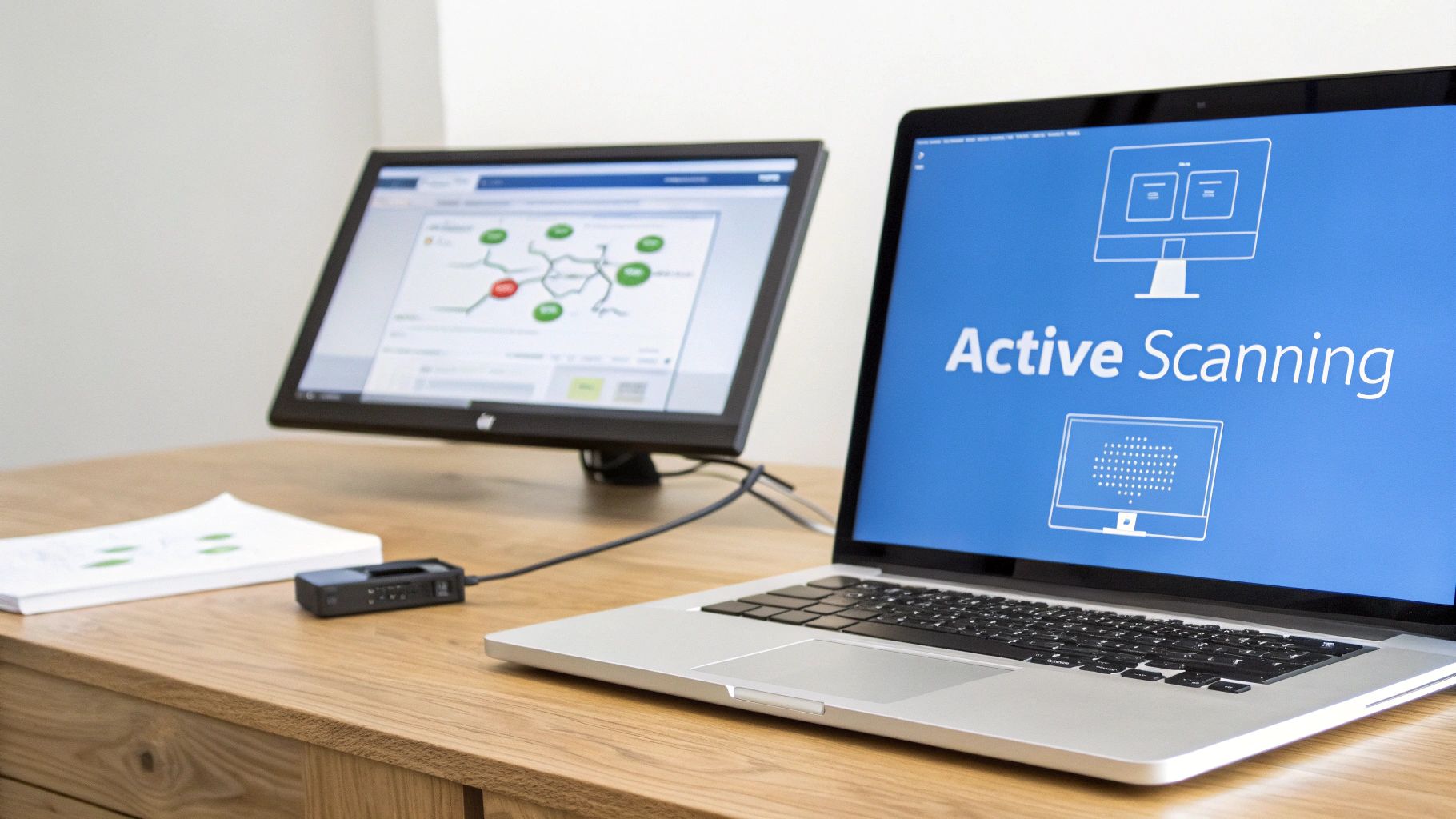
After reconnaissance, we move into the scanning and enumeration phase. Here, our testers actively start probing your client's systems. This is where the detective work turns into direct interaction. We use special tools to scan for open doors (ports), running services, and other system details, creating a detailed map of what's actually live and reachable.
This is a huge step up from what's publicly visible. It reveals the inner workings of their network and applications. Our certified pentesters don't just find a service like "Apache"; they identify the exact version, which might have a known, exploitable weakness. This level of detail is what makes a professional risk assessment valuable for compliance.

This active probing is what separates a real penetration testing engagement from a simple vulnerability scan. It confirms what we found earlier and uncovers issues that automated tools often miss. For clients needing to meet SOC 2 or PCI DSS rules, this phase provides concrete evidence of system weaknesses that need to be fixed to protect sensitive data. It gives you a clear, actionable list of security gaps.
Exploiting Vulnerabilities for Real-World Impact
Exploitation is the phase where we prove a vulnerability is a real threat. In this key step of the phases of a penetration test, our certified ethical hackers try to break in using the weaknesses found earlier. This is where we show that a vulnerability isn't just a warning in a report but a real doorway for an attacker.
For you as an MSP or vCISO, this is the proof you need to show clients why security investments are necessary. Our goal is to safely gain access, whether that's getting into a database, compromising a user account, or taking control of a server. This step shows the tangible impact of security gaps on business operations and compliance.

This phase answers your client's biggest question: "So what's the worst that could happen?" Showing that a simple misconfiguration could lead to their entire customer database being stolen is a powerful argument. For clients needing to meet SOC 2 or PCI DSS, this phase validates their security controls and shows exactly where they fail. A successful exploit is the best way to drive immediate action.
Post-Exploitation and Maintaining System Access
Once we've successfully exploited a vulnerability, we enter the post-exploitation phase. This is where our certified pentesters show the true business impact of a breach. The goal is to see how far an attacker could go, what sensitive data they could steal, and how long they could stay hidden inside the network.
For an MSP or vCISO, this phase provides the most powerful story for security improvements. It's no longer a "what-if" scenario; it's a real demonstration of a compromise. Our testers will try to move to other systems, gain higher-level permissions, and find sensitive data, all while trying to avoid being detected. This shows the potential "blast radius" of a real cyberattack.
This stage shows what happens after the initial break-in. An attacker on one computer is a problem, but showing how that leads to control over the entire company network is a catastrophe. This evidence is critical for justifying security budgets and meeting compliance rules like PCI DSS and HIPAA. It highlights the full chain of events that could lead to a major data breach.
Reporting, Analysis, and Effective Remediation
The reporting and analysis phase is where all our technical findings are translated into a clear business plan. This is one of the most important phases of a penetration test. Our team documents every vulnerability, explains the potential business impact, and provides simple, step-by-step instructions for fixing everything.
For you, the final report is the main deliverable and the proof of our value. A great report helps your clients make smart decisions about risk and security. It must explain complex issues in a way that both executives and IT teams can understand, making it easy to see why security improvements are needed.
A pentest is only as good as its report. For your clients, this document is the key to achieving compliance with frameworks like SOC 2 or ISO 27001. A detailed report that connects findings to specific compliance rules is a must-have. We deliver reports quickly, so your clients can start fixing issues right away. This clear documentation is the foundation for a strong security program and proves due diligence to auditors.
Finalizing with Remediation and Pentest Retesting
Remediation and retesting is the final phase that closes the loop. Your client fixes the vulnerabilities we found, and then our team comes back to verify that the fixes actually work. This step turns the pentest from a one-time report into a real security improvement process. It's where the risks we found are officially neutralized.
For an MSP or vCISO, this is where you show the most value. It’s not enough to just find problems; you have to solve them. This phase confirms that patches were applied correctly and that security gaps are closed. It provides concrete proof of a stronger security posture, which is vital for ongoing risk assessment and meeting compliance requirements.
This phase gives stakeholders the proof of improvement they need. A pentest without a retest is incomplete, leaving clients wondering if their fixes were effective. For example, after we find a critical flaw, the retest confirms the client's team fixed it properly without creating new issues. This validation is essential for frameworks like SOC 2 and PCI DSS, building trust and positioning you as a long-term security partner.
Partner with Us for Smarter Pentesting
Navigating the intricate phases of a penetration test, from initial planning and reconnaissance to exploitation and final reporting, is more than just a technical exercise. It’s a critical business function that protects your clients, satisfies compliance auditors, and builds trust. As we've detailed, each phase requires a unique blend of technical skill, strategic thinking, and meticulous documentation. For an MSP or vCISO, mastering this process is the key to delivering high-value security services that stand out in a crowded market.
Understanding these stages is the first step, but successful execution is what truly matters. You've seen how a poorly scoped test can miss critical vulnerabilities, how automated-only scanning can provide a false sense of security, and how a weak report can leave a client confused and unable to act. The difference between a check-the-box pentest and a truly effective one lies in the expertise, methodology, and commitment of the team performing the assessment. This is where the right partnership becomes a force multiplier for your business.
Key Takeaways for MSPs and vCISOs:
- Methodology Matters: A successful penetration test is not a random series of attacks. It is a structured, methodical process where each phase builds upon the last. Insist on a partner who can clearly articulate their methodology and how it aligns with frameworks like NIST or PTES.
- Manual Testing is Non-Negotiable: While automated tools are essential for the initial discovery and scanning phases, they cannot replace the creative, problem-solving skills of a certified human tester. True exploitation and post-exploitation often require a manual approach to uncover complex, business-logic flaws that tools will always miss.
- The Report is the Product: The ultimate deliverable is a clear, actionable report that empowers your client to remediate vulnerabilities. This document should include an executive summary for leadership, detailed technical findings for IT teams, and concrete, prioritized steps for remediation. It’s your tool for demonstrating value.
- Compliance is a Key Driver: Your clients often need a penetration test to satisfy requirements for SOC 2, HIPAA, PCI DSS, or ISO 27001. A quality pentest provides the necessary evidence and artifacts to streamline their audit and compliance efforts, making you an indispensable part of their GRC strategy.
For many service providers, building an in-house team of certified pentesters with OSCP, CEH, or CREST certifications is simply not feasible due to high costs and the scarcity of talent. This is where a channel-only partnership model provides a powerful solution. By partnering with a dedicated, white-label pentesting firm, you can instantly add a mature, high-demand security service to your portfolio without the overhead. You control the client relationship and the pricing, while your partner executes the technical work behind the scenes, delivering fast, affordable, and expert-driven results under your brand.
This model allows you to focus on what you do best: managing client relationships and delivering holistic IT and security strategy. It transforms penetration testing from a complex operational burden into a profitable, scalable revenue stream. For comprehensive assessments and expert guidance on your security posture, you might explore specialized cybersecurity consulting services to complement your core offerings. Ultimately, a strategic partnership empowers you to meet your clients' evolving security and compliance needs effectively, solidifying your position as their trusted advisor.
Ready to offer expert, manual penetration testing without the overhead? At MSP Pentesting, we are a 100% channel-only partner dedicated to empowering MSPs and vCISOs. Our affordable, white-label solutions and fast report delivery give you the competitive edge to win more business and meet any compliance demand. See the pentest report template you would deliver under your own brand.

.avif)
.png)
.png)
.png)

