
Are your clients routing traffic through critical infrastructure you've never tested?
That blind spot is common. Most MSPs, vCISOs, GRC firms, CPAs, and resellers talk about firewalls, endpoints, cloud apps, and compliance scopes. Far fewer look closely at points of presence and ask whether those network handoff points are secure, segmented, hardened, and even included in a real risk assessment.
That's a mistake. A Point of Presence is a strategically located physical infrastructure hub with routers, switches, and servers that connects local users to global internet backbones. It reduces latency by shortening the physical distance data travels, and AWS operates hundreds of Points of Presence worldwide alongside its Regions and Availability Zones, as described in its global infrastructure overview. If infrastructure operates at that scale, it belongs in your security conversations, your penetration testing scope, and your compliance planning.
Why MSPs Must Understand Points of Presence
Most MSPs still treat points of presence as a networking detail. That view is outdated.
A PoP sits in the path of business-critical traffic. If your client depends on cloud apps, video meetings, remote users, distributed offices, DNS performance, CDN delivery, or edge services, then a PoP is part of the environment users touch every day. If it affects availability and routing, it affects security too.
Why this matters to your clients
When a client asks for a SOC 2, HIPAA, PCI DSS, or ISO 27001 readiness review, they're not asking for a pretty diagram. They're asking whether the environment holds up under pressure. If traffic is moving through third-party edge locations, carrier facilities, or cloud-connected network hubs, and nobody has validated the controls around them, then the review is incomplete.
That gap gets bigger with remote work and cloud adoption. Traffic no longer flows neatly through one central office and one data center. It moves across providers, cached services, DNS layers, access routers, and regional handoff points that many teams never inventory properly.
Practical rule: If a PoP can affect access, latency, routing, or cached content delivery, it belongs in scope for a serious pen test or penetration test scoping discussion.
What MSPs should do differently
Start treating points of presence as part of the attack surface, not just part of the network map.
Use this lens when reviewing client environments:
- Map dependencies first: Identify where users connect, where traffic is handed off, and which providers run nearby edge or regional infrastructure.
- Tie infrastructure to business risk: If a PoP supports client portals, VoIP, cloud desktops, or regulated data flows, it has compliance impact.
- Sell the review, not just the scan: Automated checks won't explain trust boundaries, caching behavior, or weak access assumptions.
This is also a business opportunity. Clients already buy security reviews. What they usually don't get is a service provider who can explain points of presence in plain English and then turn that explanation into a scoped, white label pentesting engagement.
What Points of Presence Mean for Network Speed
Think of a PoP like a local distribution center. If every package had to ship from one faraway warehouse, delivery would be slow. A PoP fixes the same problem for data.
A Point of Presence works as a regional hub that brings data closer to end users, which reduces latency and improves speed for real-time services like video streaming and cloud apps, as described in OVHcloud's explanation of what a Point of Presence does. That's why users notice the difference in video calls, SaaS dashboards, file access, and web application responsiveness.
Why users feel the difference
When a request goes to a nearby PoP instead of a faraway central location, the path is shorter. Fewer miles usually means less delay. For business users, that turns into smoother meetings, faster logins, and fewer complaints that “the app is slow today.”
That performance gain matters because users often confuse speed problems with software problems. In reality, the issue may be the network path, the handoff point, or the way requests are routed through edge infrastructure.
What MSPs should explain to non-technical buyers
A simple explanation works best:
- Closer infrastructure means faster delivery: Data doesn't have to travel as far.
- Regional routing improves user experience: Nearby access points reduce delay for common tasks.
- Distributed design improves resilience: Traffic can be handled closer to where users are.
Faster access changes user behavior. When systems feel responsive, users trust them. When they lag, users bypass them, and that creates security problems of its own.
For an MSP, this isn't just a networking lesson. It's the foundation for better client conversations. If you can explain why points of presence affect speed, you can also explain why they deserve penetration testing, configuration review, and a place in ongoing compliance planning.
Understanding Different Types of PoP Infrastructure
Not all points of presence carry the same risk. If you treat every PoP like the same thing, your pen testing scope will be sloppy and your findings will miss actual problems.
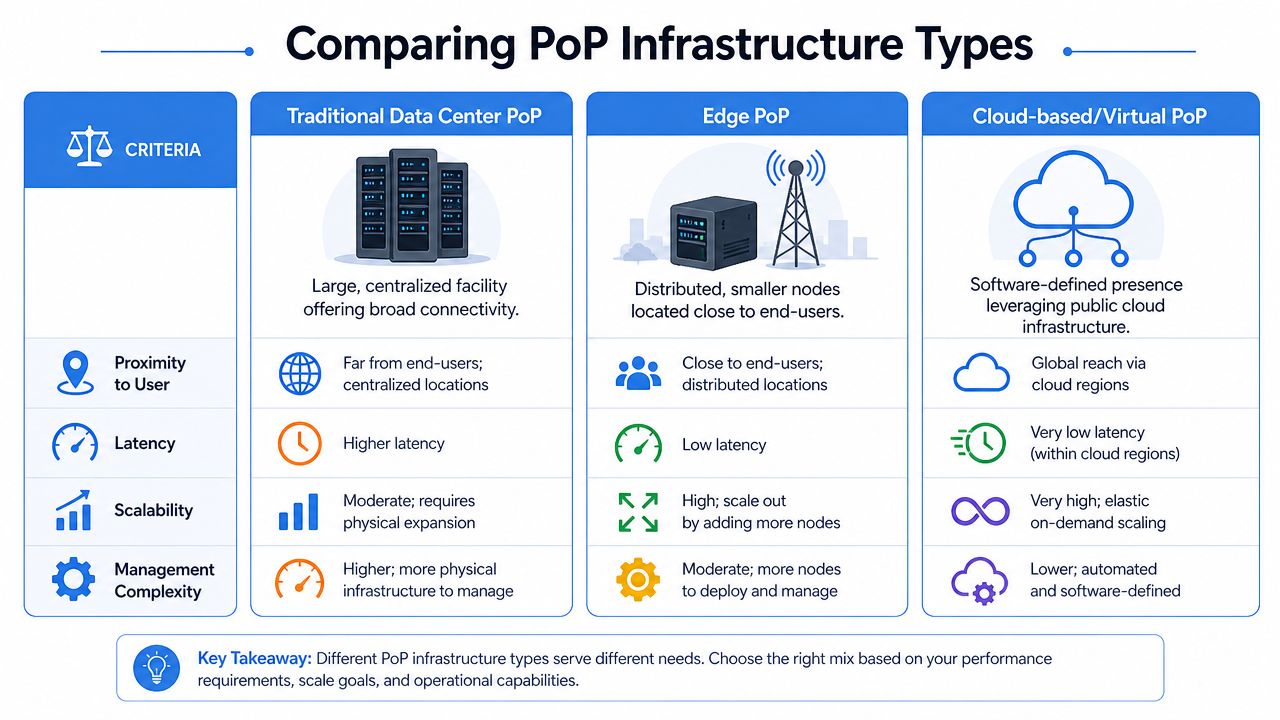
PoPs are foundational network access points where ISPs, CDNs, and enterprise networks physically connect and exchange traffic. They also improve DNS reliability through redundancy and lower latency, as Check Point explains in its overview of PoP infrastructure and DNS routing.
Four PoP categories MSPs should separate
Here's the practical breakdown that matters during a risk assessment.
| PoP type | What it does | Main security concern |
|---|---|---|
| Telco PoP | Connects carrier infrastructure and customer traffic | Weak access controls, device exposure, trust assumptions between providers |
| CDN PoP | Delivers cached content closer to users | Cache misconfiguration, stale content exposure, bad origin rules |
| Cloud edge location | Supports edge compute, routing, or service acceleration | API exposure, identity mistakes, poor segmentation |
| IXP-linked PoP | Exchanges traffic between networks efficiently | Routing trust, interconnection visibility, shared-facility exposure |
The categories overlap in real life. That's fine. What matters is knowing which role the infrastructure plays before you test it.
Why this changes your assessment work
A CDN edge location isn't tested the same way as a carrier handoff site. A cloud edge service doesn't create the same attack paths as an enterprise-owned regional router stack. If you blur them together, you'll miss both technical flaws and compliance impact.
That's one reason many MSP teams benefit from understanding adjacent infrastructure design, especially when clients also rely on colocation or hybrid architectures. This guide to building a data center helps frame how physical and logical network decisions shape downstream security testing.
A good penetration test starts with classification. If you don't know what kind of PoP you're looking at, you won't know what “secure” is supposed to look like.
For a vCISO or reseller, this classification step makes your recommendations look sharper. It also makes your white label pentesting offer easier to package, because you can scope by infrastructure type instead of selling a vague “edge review.”
Turning Edge Security Risks into MSP Revenue
Here, MSPs either stay stuck in commodity services or build a high-value offering.
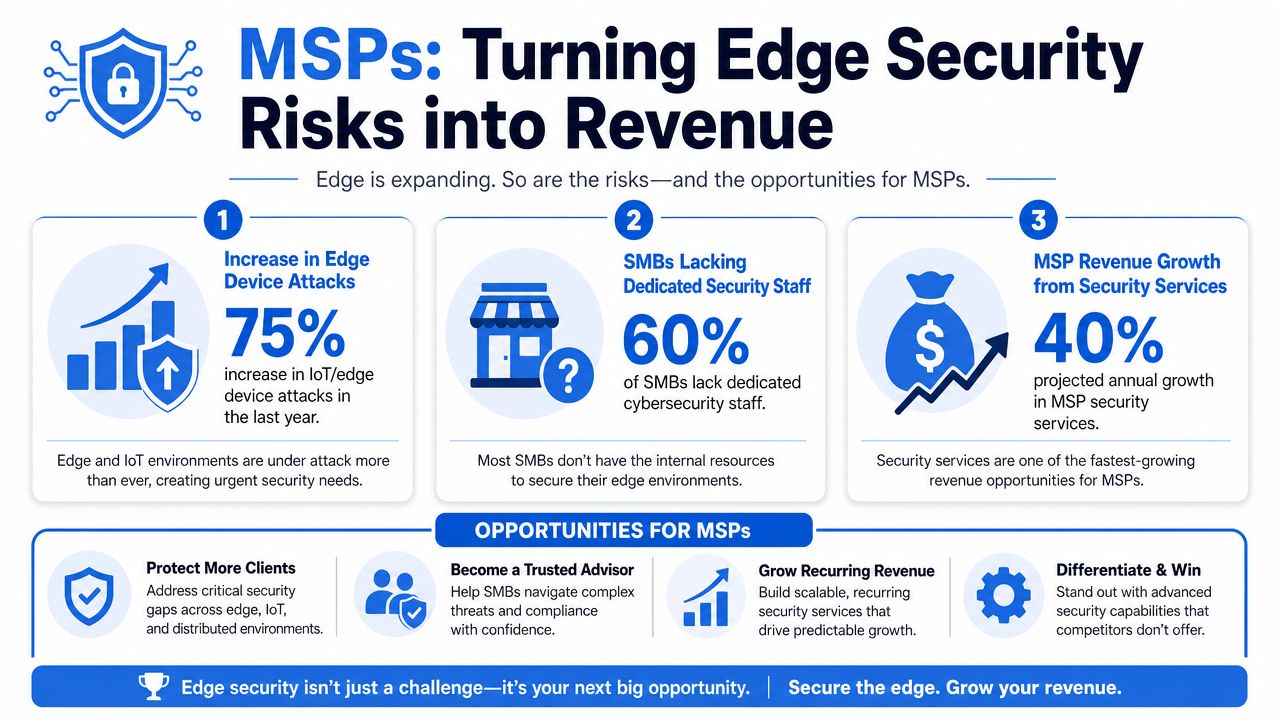
Edge infrastructure creates real exposure. Points of presence and edge locations can involve cached content, routers, switches, APIs, DNS handling, provider interconnection, and sometimes physical access in shared facilities. Those aren't clean, one-click scan targets. They require real pentesting, not just another automated report with low-value findings.
Penetration testing is a meaningful revenue opportunity for Managed Service Providers, as covered in MSP360's write-up on penetration testing for MSPs. Pricing depends on scope. Request a quote for exact figures. That should get your attention if you're trying to grow security revenue without becoming yet another low-margin monitoring shop.
Why clients will pay for this
Clients already know they need compliance. What they often don't know is that their existing testing provider may be skipping the infrastructure that affects access, routing, and resilience.
This matters in environments tied to:
- SOC 2: Reviewers care whether controls match the actual environment, not the one on the sales diagram.
- HIPAA: Distributed access paths and third-party handoffs raise questions about data flow and exposure.
- PCI DSS: Payment-related traffic paths need stronger scoping discipline than “we scanned the subnet.”
- ISO 27001: Asset identification and treatment plans fall apart when edge dependencies are ignored.
How to package the service
Don't sell “PoP testing” as a niche technical extra. Sell it as part of a smarter penetration test and risk assessment process for distributed environments.
A practical offer can include:
- Scoped edge review: Identify CDN, cloud edge, telco, and IXP-related dependencies.
- Manual validation: Confirm whether findings are exploitable, not just detectable.
- Compliance mapping: Translate technical issues into client-friendly remediation priorities.
- Reseller-ready delivery: Keep it white labeled so the client relationship stays yours.
If your clients use connected facilities, remote access hardware, or managed physical entry points near network infrastructure, technical teams may also benefit from reviewing cellular access control API documentation to understand how edge-connected access systems can expand attack surface in real deployments.
The market opening is simple. Most providers either overcharge, underdeliver, or rely too heavily on canned scans. An MSP that offers affordable, manual pentesting with clear reporting can win fast.
A Pentesting Checklist for Edge and PoP Security
Most PoP assessments fail before testing starts. The team scopes the wrong asset, confuses a PoP with an edge location, or assumes provider-managed means low-risk. That's lazy work.
Meter points out a critical gap. PoPs route traffic, while edge locations are designed for caching and edge computing, yet vendors often blur the distinction, which leads to bad vulnerability assessments in its explanation of PoP versus edge locations. If your penetration testing scope doesn't separate them, the output won't help the client.
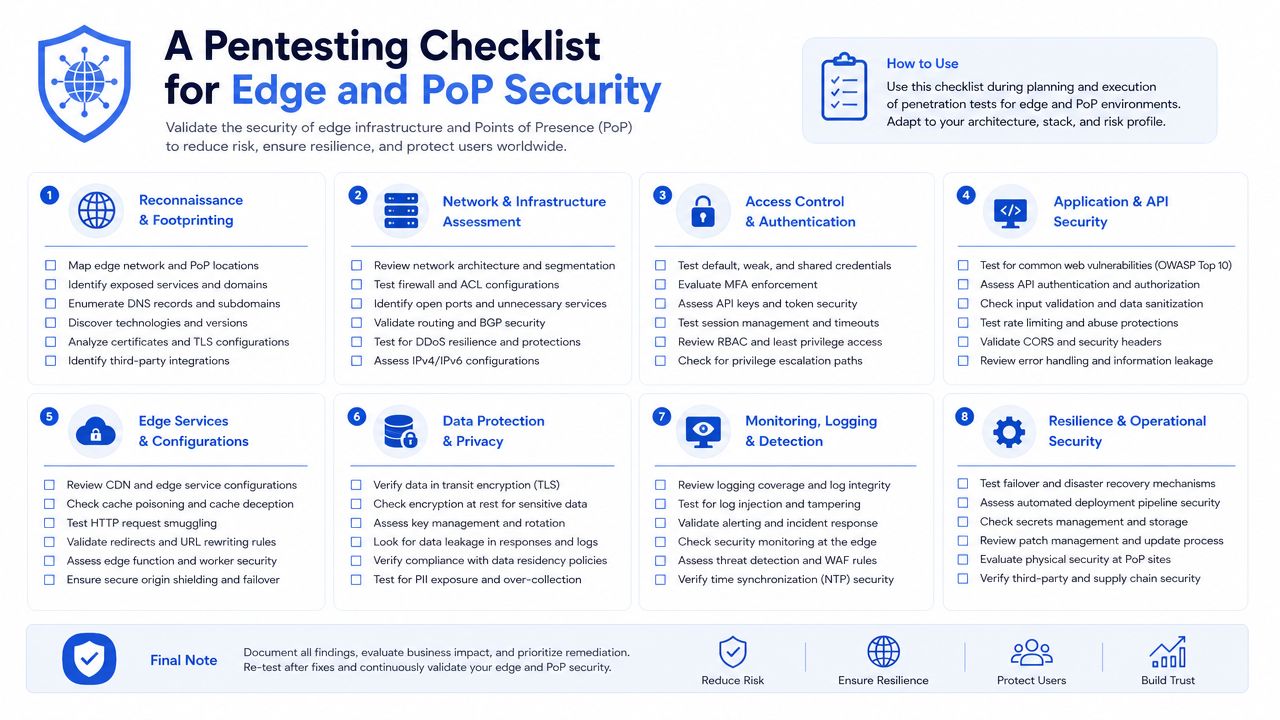
Start with the right questions
Before the pen test begins, ask:
- Who owns the infrastructure: The client, the carrier, the cloud provider, or a mix?
- What function does it serve: Routing, caching, DNS, edge compute, access brokerage, or all of the above?
- What data crosses it: Regulated, internal-only, public content, or identity-related traffic?
- What trust assumptions exist: Is the team relying on location, provider branding, or inherited settings?
These questions shape the test plan more than any scanner does.
What a solid manual pentest should check
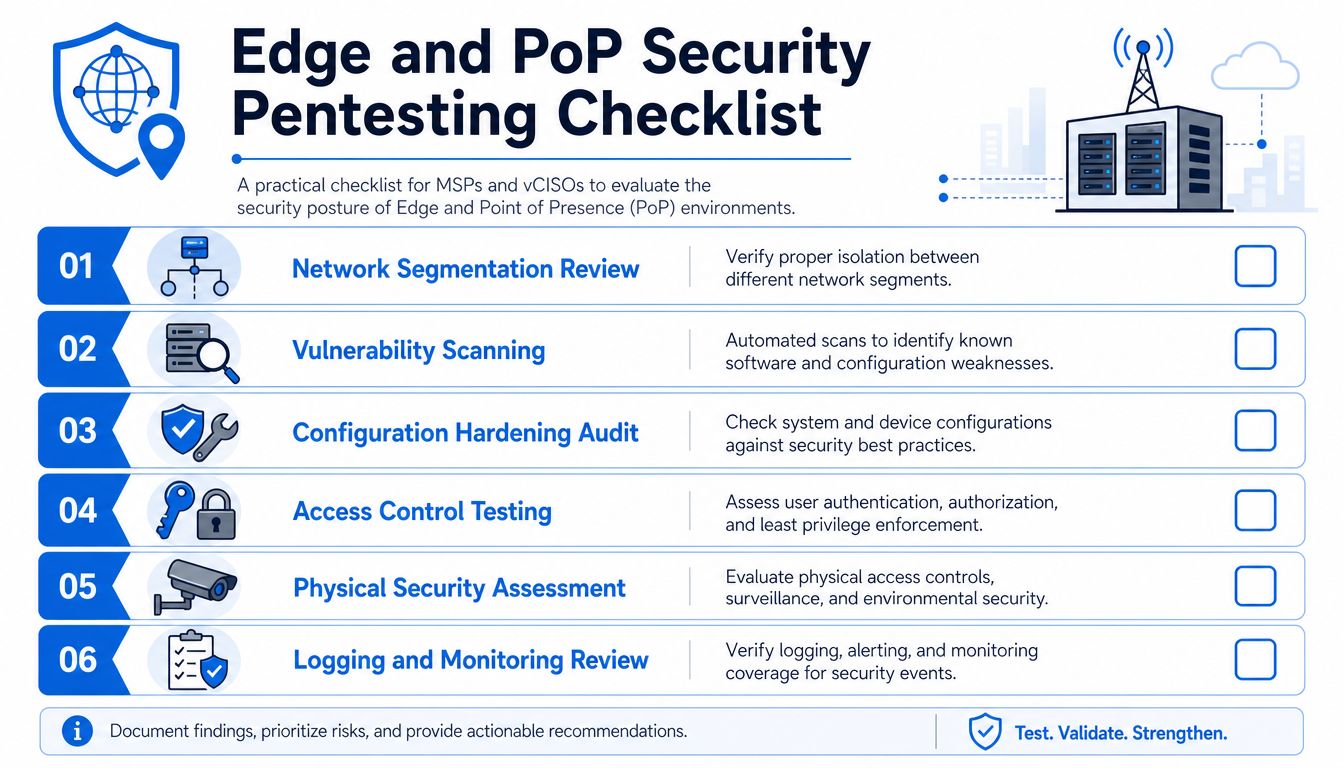
A real manual penetration test of edge and PoP security should include multiple review angles.
Configuration review
Check routers, switches, caching layers, access policies, and service exposure. Misconfigurations create easy wins for attackers and ugly surprises during audits.Access control testing
Review admin paths, remote management exposure, MFA enforcement, segmentation, and least-privilege controls. Shared infrastructure tends to accumulate exceptions.API and service validation
Many edge-connected services expose management or integration points. If the environment relies on physical entry systems, remote service orchestration, or cloud edge workflows, that's worth testing manually.Facility and physical exposure review
Co-located and metro-level infrastructure creates a physical dimension many IT teams ignore. Badge access, cabinet controls, cameras, visitor handling, and vendor procedures all matter.DNS, caching, and routing behavior
Review whether content is cached appropriately, whether requests route where expected, and whether failover behavior creates unintended exposure.
Field advice: Automated tools are useful for coverage. They are not enough for PoP security. You need human review to catch business logic flaws, trust issues, and access mistakes.
For teams that need broader background material when building client education around these topics, this guide on how to secure your business from cyber risks offers plain-language context you can use alongside technical reporting.
Why certifications still matter
This is one place where credentials are not just marketing. OSCP, CEH, and CREST certified pentesters are trained to think through exploitation paths, not just generate output. That matters when you're dealing with edge routing, provider assumptions, and mixed ownership boundaries.
If you're refining your service design, this resource on network security testing is a useful reference for turning broad testing concepts into a tighter engagement model for MSP and vCISO client work.
Offer Fast Affordable White Label Penetration Testing
The managed services and compliance market has a pricing problem. Too many firms charge inflated fees, hand over shallow reports, and take too long to deliver anything useful.
MSPs, vCISOs, GRC providers, CPAs, and resellers need a better option. The strongest model is channel-only, with white label pentesting that never competes with the partner. That keeps the client relationship clean and gives you a new security revenue stream without adding delivery overhead.
The service itself should be simple. Affordable, manual pentesting. Fast turnaround. Clear remediation guidance. Certified pentesters with OSCP, CEH, and CREST backgrounds. That's what clients want when they're facing SOC 2, HIPAA, PCI DSS, or ISO 27001 deadlines and can't wait through bloated consulting cycles.
If you're building that service line now, white label penetration testing lets you structure it in a way that supports your brand, your margins, and your client retention.
The bottom line is simple. Points of presence are no longer just a networking concept. They're part of the attack surface, part of the compliance conversation, and part of the MSP revenue opportunity. Build the offer now, and make it practical, fast, and manual.
If you want a channel-only pentest partner, MSP Pentesting delivers manual pentests, pen tests, penetration tests, and penetration testing under your brand without competing for your clients. Our external network pentesting helps MSPs, vCISOs, GRC firms, CPAs, and IT resellers offer affordable, fast, white-labeled security testing with OSCP, CEH, and CREST certified pentesters. Contact us today to learn more.

.avif)
.png)
.png)
.png)

