
A client calls and says they want help building a data center. Most providers hear racks, power, cooling, and cabling. Smart MSPs hear something else first. Security scope, audit exposure, compliance risk, and reputation on the line.
That shift matters. If you treat this like a facilities project, you can still deliver a building and fail the client. If you treat it like a security and compliance mission from day one, you protect the client's business and create a stronger long-term advisory role for your own firm.
Your Guide to a High Stakes Opportunity
A private data center can be the right move for clients that need tighter control, stronger audit readiness, or specific operational requirements. It can also turn into a mess fast when the project team waits too long to define security controls, network boundaries, physical access rules, and validation requirements.

The market is forcing the issue. Building data centers to meet the exponential rise in AI compute power requires a staggering $6.7 trillion investment globally by 2030, according to Avid Solutions' data center growth projections. When that much money is moving into infrastructure, bad actors pay attention too.
Why MSPs and vCISOs get pulled in
Your client doesn't just need a room full of hardware. They need a facility that can stand up to customer due diligence, internal risk assessment, and outside auditors looking at SOC 2, HIPAA, PCI DSS, or ISO 27001 controls.
That means your role changes from installer to advisor.
- Control design matters: Access control, camera coverage, logging, segmentation, and environmental monitoring need to be intentional.
- Audit evidence matters: If the client can't prove controls exist and work, the build is incomplete.
- Validation matters: A clean diagram is not proof. A passing config review is not proof either.
Practical rule: If security validation is scheduled at the end as an afterthought, the project is already behind.
A lot of firms still treat compliance as paperwork and security as tooling. That's backwards. In a new facility, compliance follows design choices, and real security comes from testing whether those choices hold up under pressure.
Making Key Strategic and Planning Decisions
The first major decision isn't what brand of rack or UPS to buy. It's whether the client should own the environment at all, lease space in a colocation facility, or stay in the public cloud and avoid the build.
Compare the three main paths
FactorOn-Premise Data CenterColocation FacilityPublic CloudControlHighest physical and technical controlStrong infrastructure control, less site ownershipLowest physical controlCompliance postureEasier to tailor for strict internal requirementsOften strong for regulated workloadsDepends on architecture and shared responsibilityUpfront costHighestModerateLower to startSpeed to deploySlowestFaster than building newFastestScalabilityLimited by site designBetter than on-prem for expansionMost flexibleOperational burdenHighestShared with facility providerShifted toward cloud operationsBest fitCustom security, fixed workloads, strict locality needsPrivate infrastructure without full build burdenFast-moving workloads and variable demand
There's no universal winner. For some clients, building a data center is justified. For others, it's expensive pride.
Start with feasibility, not hardware quotes
The planning and feasibility phase typically takes 2 to 6 months, and site selection or permitting mistakes can add 3 to 12 months to the total timeline, based on this data center planning analysis. Ignore that and you'll burn time before a single cabinet lands on site.
Ask these questions early:
- What workloads are staying private: Legacy applications, regulated records, GPU-heavy AI jobs, or mixed use.
- What audit scope will apply: SOC 2, HIPAA, PCI DSS, ISO 27001, and customer security questionnaires all shape the design.
- What has to be validated before go-live: Network segmentation, physical controls, logging, backup integrity, and a formal penetration test.
Build the project plan around bottlenecks
A weak plan usually fails in predictable ways.
- Permitting gets ignored: Real estate teams chase property before compliance and utility realities are clear.
- Power assumptions are sloppy: The client assumes utility access equals usable capacity.
- Security is delayed: Teams wait until installation is done, then scramble to add controls that should have shaped the layout.
The cheapest mistake to fix is the one you catch on paper before concrete gets poured.
For MSPs, resellers, and GRC advisors, this is where trust gets earned. You don't need to pretend to be a general contractor. You need to force the hard decisions early and tie each one to risk, cost, and compliance.
Designing for Maximum Power and Cooling Uptime
Power and cooling failures don't look dramatic on a project plan. They look dramatic in production. Overheated equipment, unstable uptime, and ugly audit findings all start with poor engineering decisions that someone waved through because they seemed “facilities related.”
Cooling choices that affect reliability
The basics still matter because teams skip them. To prevent air recirculation and overheating, best practices call for supply air temperature between 77°F and 79°F, 2-way chilled water valves, and Variable Frequency Drives on all pumps, according to the Department of Energy best practice guide for data center design.
That isn't trivia. Those settings shape performance, operating cost, and failure risk.
Use practical design rules:
- Keep airflow disciplined: Put racks back-to-back and seal empty equipment slots so hot and cold air don't mix.
- Avoid lazy valve selection: 3-way valves create problems that disciplined chilled water design avoids.
- Use VFDs everywhere they belong: Pumps without them waste energy and reduce operational flexibility.
Power planning cannot be casual
Power density is where many builds get humbled. AI-heavy workloads can turn a straightforward design into a much more demanding one, and the electrical plan has to reflect that reality from the start.
If your team needs a plain-English refresher on how commercial cooling design choices affect uptime and install quality, this overview of Tucson commercial HVAC solutions is a useful reference before you sit down with facilities vendors.
A data center doesn't fail only when power goes out. It fails when heat, airflow, and mechanical choices quietly erode your safety margin.
Your client doesn't need you to size every pump yourself. They need you to ask the questions that expose weak assumptions before those assumptions become outages.
Building a Secure Network and Physical Perimeter
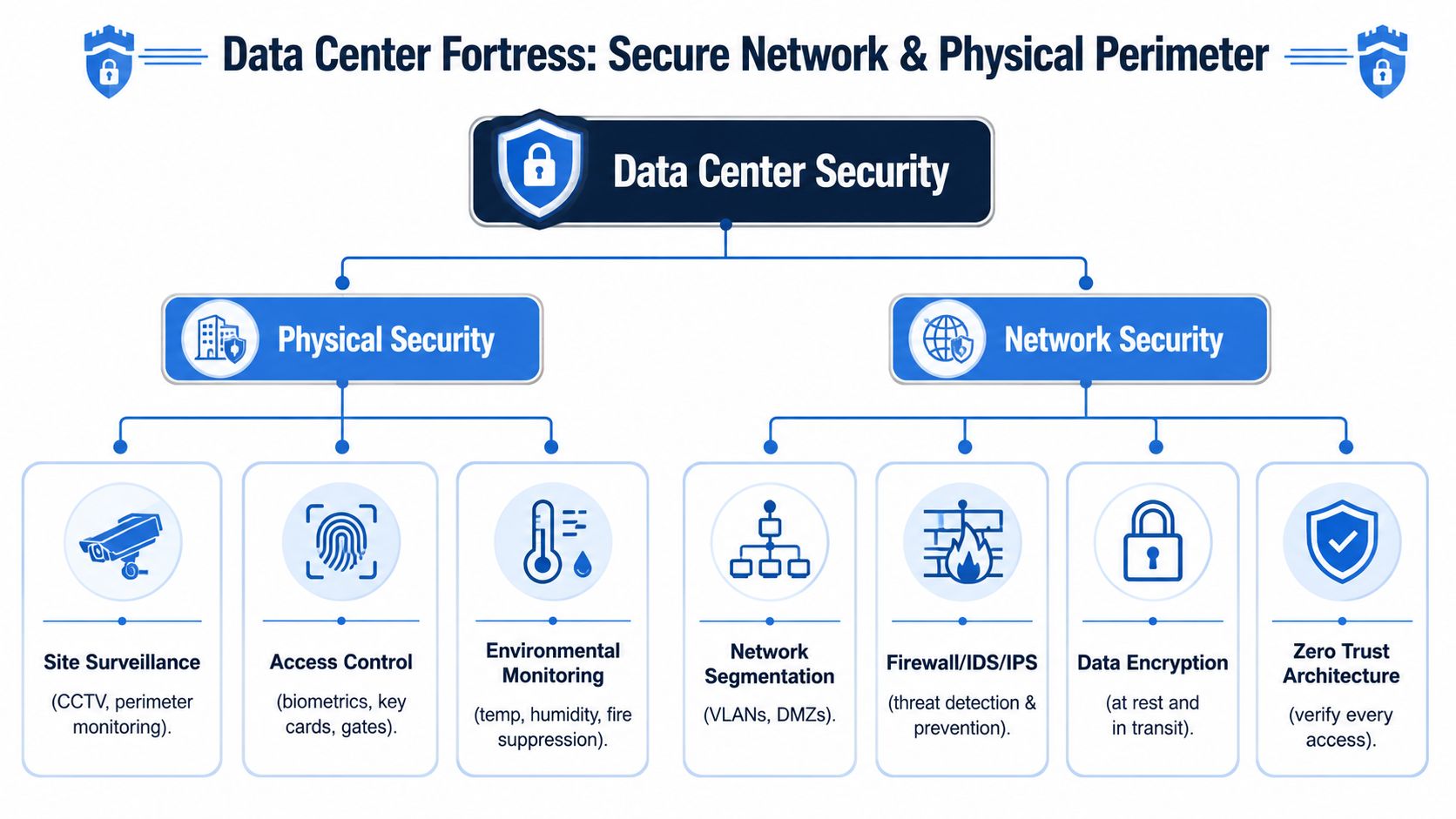
A new facility isn't secure because the doors look solid and the firewall is expensive. It's secure when physical controls and network controls work together, and when each one supports the compliance story the client will need to tell later.
Physical controls that auditors care about
Start with the obvious and do it well. You need controlled entry, visitor procedures, camera coverage, environmental monitoring, and documented access review. If the client handles regulated data, weak physical process can wreck an otherwise decent technical environment.
A practical outside reference is Overton Security's guide to data center protection. It's a good reminder that fences and badges aren't enough without layered procedures behind them.
Physical controls should include:
- Multi-factor entry: Badges alone are too easy to abuse.
- Recorded surveillance: Not just cameras, but retention and review procedures.
- Environmental safeguards: Temperature, humidity, and fire response need to be monitored and logged.
Network controls that must be intentional
Flat networks still show up in new builds. That's unacceptable. New facilities should launch with segmentation, role-based access, hardened management paths, and clear separation between user traffic, admin traffic, backup traffic, and any public-facing services.
If your client is still sketching this out, a focused network architecture review should happen before the environment is considered ready.
Use this checklist:
- Segment critical systems: Separate production, management, backup, and external services.
- Inspect east-west traffic: Attackers move sideways after entry. Your design should expect that.
- Encrypt where it matters: Data at rest and in transit both need clear policy and implementation.
Compliance is not proof of security
Here's where many teams get lazy. They map controls to SOC 2, HIPAA, or CMMC and assume the job is done. It isn't.
Most compliance frameworks, including SOC 2, HIPAA, and CMMC, require or strongly recommend annual penetration testing to catch drift from new systems, changed configurations, or uncleared access controls, as noted in Todyl's guidance on penetration testing for MSPs. That matters even more after a fresh build, because new environments are full of assumptions that no one has challenged yet.
Building controls is one job. Proving those controls work against an attacker is a different job.
Validating Security with Penetration Testing
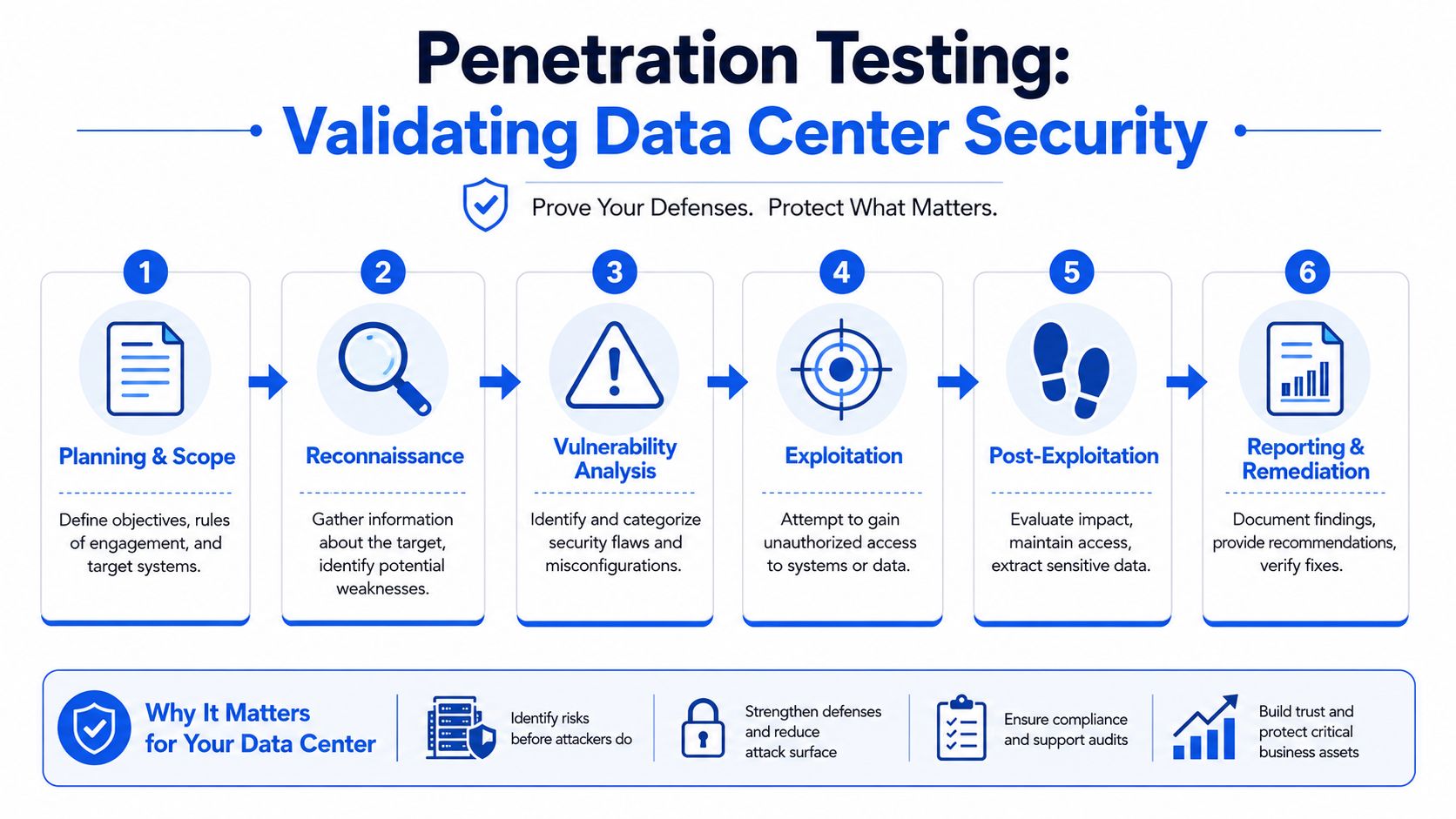
This is the step clients skip when budgets tighten, and it's the step that exposes whether the rest of the project was real or cosmetic. A vulnerability scan won't do it. A checklist review won't do it either. You need a manual pentest, a real pen test, performed by people who know how to chain weaknesses the way an attacker would.
What a proper pentest should cover
A strong penetration test after a data center build should validate more than exposed ports. It should challenge segmentation, access paths, management interfaces, physical assumptions, and the controls the client plans to show auditors and customers.
That usually means testing a mix of:
- External exposure: What an outside attacker can see and exploit
- Internal movement: What happens after initial access
- Physical assumptions: Whether site controls stop unauthorized activity
- Cloud and hybrid edges: Especially if the “private” facility still connects to cloud identity, backup, or management tools
For teams planning site-level validation, this guide to physical pentesting is worth reviewing alongside the technical scope.
Why manual penetration testing beats cheap automation
Automated scanners are fine for hygiene. They are not enough for assurance. A scanner can flag missing patches and known signatures. A certified human tester can spot bad trust relationships, privilege escalation paths, weak process controls, and dangerous combinations of “minor” issues.
That's why manual pentesting, penetration testing, and a properly scoped pen test should be part of the handoff, not a nice-to-have later. For MSPs, vCISOs, and reseller partners, this also creates a clean service line tied to recurring compliance needs.
The difference comes down to execution:
- Manual testing finds logic flaws: Not just technical signatures.
- Certified testers add credibility: OSCP, CEH, and CREST matter when clients ask who performed the work.
- Fast delivery matters: Long lead times kill project momentum and delay audit readiness.
If your client is relying on a scan report to prove a brand-new data center is secure, they're relying on the wrong evidence.
Affordable testing doesn't have to mean shallow testing. The problem in this market is the opposite. Many firms charge inflated prices, stretch timelines, and deliver weak methodology. A disciplined, white-labeled, affordable white label pentesting partner gives MSPs and vCISOs a better option.
Your Partnership for Secure and Compliant Growth
Building a data center puts your name on far more than a hardware project. It ties your firm to uptime, security posture, audit readiness, and the client's long-term trust. That's why the smartest providers treat planning, physical security, network design, and post-build validation as one connected job.
For MSPs, vCISO firms, GRC advisors, CPAs, and IT reseller partners, the opportunity is bigger than the initial project. Clients need ongoing risk assessment, recurring penetration testing, and documented evidence that their controls still hold up as the environment changes.
You also need the right delivery model. A channel-only partner matters because client ownership matters. If you want a partner that supports your brand instead of competing with it, review the pentest partner program and build security validation into your service stack the right way.
Do the build right. Then prove it.
If you need a channel-only team for affordable, fast, manual pentesting and white label pentesting, our white-label pentest delivery helps MSPs, vCISOs, GRC firms, and resellers deliver branded pentest, pen testing, penetration test, and penetration testing services without competing for client relationships. Our certified pentesters include OSCP, CEH, and CREST professionals. Contact us today to learn more.
%20(1).png)
.avif)
.png)
.png)
.png)

