
Your phone rings. A client just got an auditor question they can't answer cleanly: “Show me evidence that your GDPR controls are tested, not just written down.” They don't call their attorney first. They call their MSP, their vCISO, or the reseller they already trust.
That's where GDPR compliance testing stops being a paperwork problem and starts becoming a service line.
For MSPs, GRC firms, CPAs, and other IT resellers, this work fits right next to SOC 2, HIPAA, PCI DSS, and ISO 27001 support. The difference is that GDPR often exposes weak spots that clients didn't know they had. Weak logging practices, stale test data, missing DSAR workflows, bad vendor contracts, and security controls that were “configured” but never verified. A proper pentest, pen test, and process review turns those gaps into billable projects, recurring reviews, and stronger client retention.
Why GDPR Testing Is a Goldmine for MSPs
Most MSP owners already know the pattern. Clients don't buy compliance because they love compliance. They buy it when a regulator, customer, insurer, or board member forces the issue.
That's why GDPR work sells well when you frame it the right way. It's not “more paperwork.” It's proof that their controls are effective. As of March 2026, cumulative GDPR fines reached approximately €6.11 billion across 2,685 violations, according to the CMS GDPR Enforcement Tracker figures. If you're advising clients that handle personal data, that number changes the conversation fast.
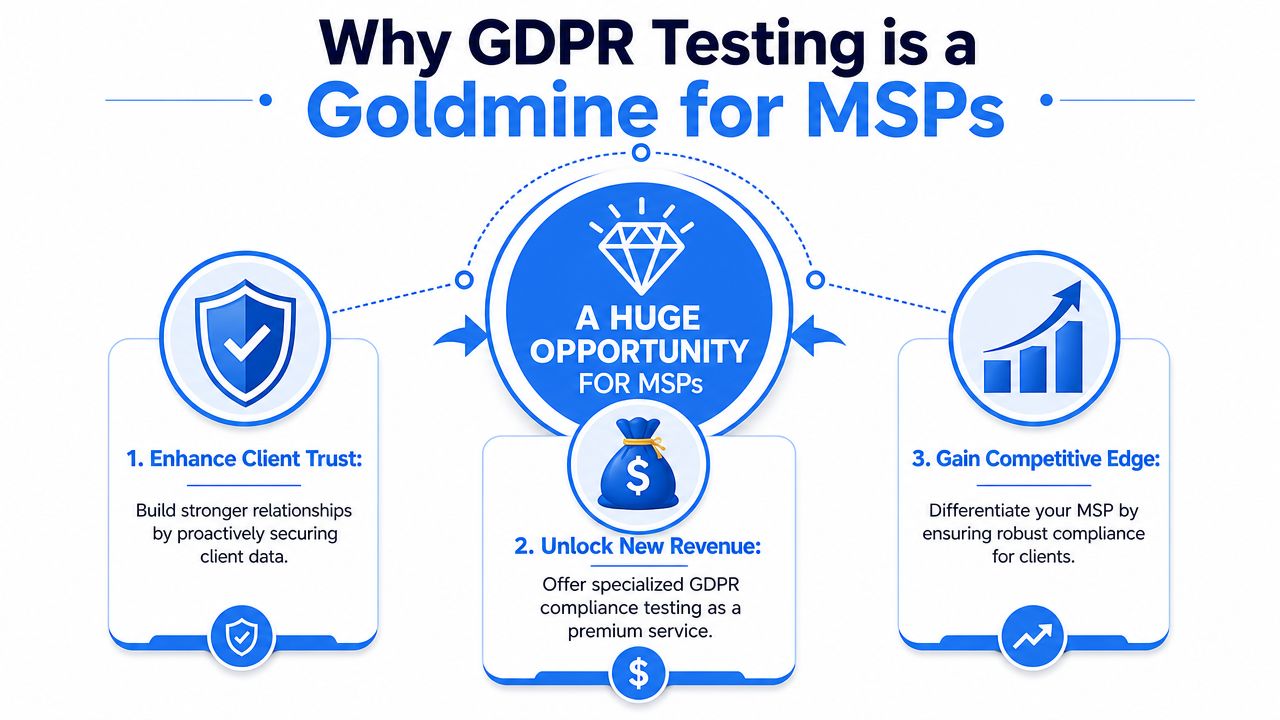
What clients actually pay for
Clients rarely ask for “GDPR compliance testing” in perfect language. They ask for help with things like:
- Audit pressure: They need evidence for an assessor, customer questionnaire, or internal review.
- Security validation: They want a risk assessment, a penetration test, or a check on whether sensitive data is exposed.
- Commercial trust: Their buyers want to know they can handle personal data responsibly.
A useful companion to that business conversation is this piece on important data privacy information for businesses. It helps explain why privacy isn't just legal overhead. It affects trust and retention.
Practical rule: If a client already buys managed security, compliance support, or virtual CISO services, they're already a fit for GDPR testing.
Why this is good business for channel partners
The managed service and compliance market has a pricing problem. Too many providers charge enterprise rates, use thin testing methodology, and deliver reports weeks after the client needed them. That leaves room for a better model.
A channel-only, white label pentesting approach fixes a lot of that. You keep the account. You stay in front of the client. You add affordable manual pentesting without hiring a full internal team or competing against your own partner.
A major positive outcome is this: GDPR projects often lead to more work around SOC 2, HIPAA, PCI DSS, internal controls, vendor reviews, secure SDLC checks, and recurring penetration testing. The first engagement isn't the whole sale. It's the wedge.
Mapping the Battlefield Before the Test
Bad scoping kills good testing. If you don't know where personal data lives, your pen test turns into a noisy checklist and your client pays for hours that don't move risk.
The first move is always data discovery and flow mapping. A rigorous GDPR testing method uses a 12-week phased approach that starts in weeks 1-2 with automated PII discovery and data flow mapping, as outlined in this GDPR-compliant test data guide. That's the foundation for everything else.
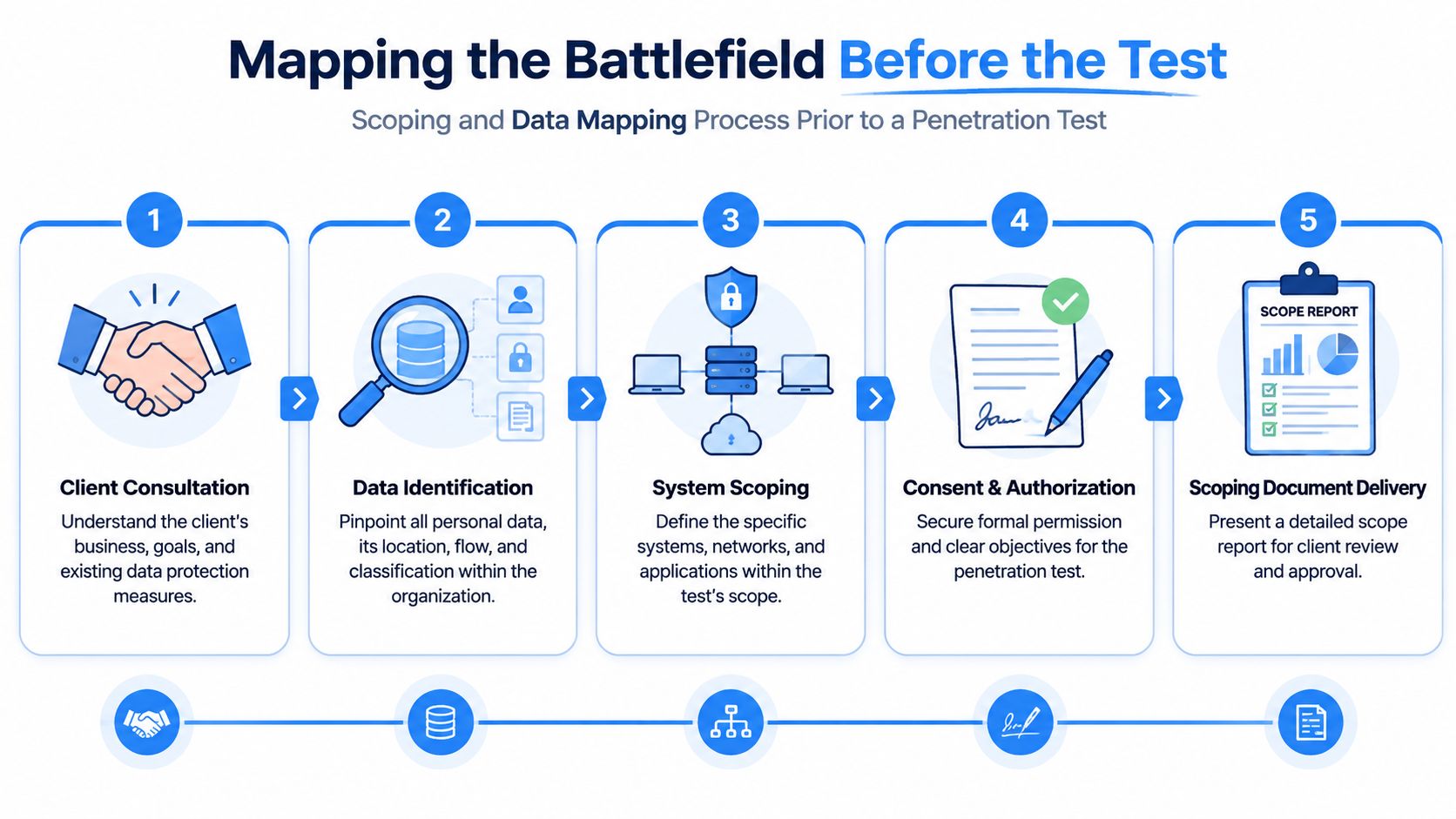
Start with data, not tools
Before anyone runs a scanner or starts manual enumeration, answer four simple questions:
- Where does personal data enter?
- Where is it stored?
- Where does it move?
- Where does it leak when systems fail?
That last one matters more than is often realized. Personal data doesn't only sit in the primary database. It shows up in API logs, debug output, stack traces, CI/CD artifacts, exports, screenshots, and support tickets.
A lot of GDPR failures hide in “secondary” systems that nobody put in scope because they weren't labeled production.
Build a scope that stays affordable
A broad scope sounds thorough. It also gets expensive fast. Smart gdpr compliance testing focuses first on systems with the highest consequence if exposed.
Use simple priority rules:
- Highest priority: Systems with Article 9 special category data, large volumes of personal data, or third-party access
- Next priority: Internet-facing apps, client portals, APIs, identity systems, and shared storage
- Then: Internal admin tools, backups, test environments, and log pipelines
A short scoping table helps keep clients aligned:
| Area | What to verify | Why it matters |
|---|---|---|
| Web apps | Forms, auth, session handling, exports | Personal data usually enters here |
| APIs | Response bodies, auth tokens, error handling | Data often leaks through integrations |
| Storage | Databases, file shares, object storage | Main data concentration point |
| Logging | App logs, SIEM forwarding, debug traces | Non-primary leakage is common |
| Test systems | Masking, stale snapshots, access limits | “Temporary” data often becomes permanent |
Get the paperwork right early
Scoping for GDPR isn't just technical. It's contractual and procedural too. If live personal data may be touched, you need documented authorization, scope boundaries, and clear handling rules before the engagement starts.
That step protects both you and the client. It also makes the final report much easier to defend during a review tied to ISO 27001, PCI DSS, or broader compliance programs.
Running a Manual Penetration Test for GDPR
A vulnerability scan is useful. It is not the same thing as a manual pentest.
For GDPR, that difference matters. GDPR Article 32(1)(d) requires a process for regularly testing security measures, and regulators interpret that to mean realistic, manual penetration testing is an expected compliance component, especially for organizations processing sensitive personal data, as explained in this GDPR cybersecurity and penetration testing analysis.

What automated scans miss
Scanners are good at known patterns. They're not good at thinking like an attacker.
A manual penetration test can verify things scanners usually miss:
- Broken access controls: One user can pull another user's records through a changed request
- Workflow abuse: A harmless export feature becomes a bulk data exfiltration path
- Error-based leakage: Personal data appears in verbose exceptions or debug panels
- Privilege chaining: Several low-severity issues combine into a serious breach path
This is why certifications matter. A team with OSCP, CEH, and CREST certified pentesters brings the human judgment that compliance-driven clients need. Not because the certs are magic, but because clients need a defensible test method and a tester who can explain business impact in plain English.
Which pen tests fit GDPR work
Different clients need different test types. For most MSP and reseller engagements, these are the ones that show value quickly:
- External penetration testing for internet-facing assets
- Internal penetration testing for lateral movement and access control
- Web application pentesting for portals, APIs, and admin panels
- Cloud-focused reviews where personal data sits in shared infrastructure
- Social engineering checks when the client's process risk is high
If the report only lists CVEs from a scanner, you bought a scan. You didn't buy a pen test.
Manual testing also helps you connect GDPR work to adjacent frameworks. The same client who needs proof for GDPR often needs support for SOC 2, HIPAA, or a broader risk assessment. Good testing creates evidence that travels well across all of them.
One practical option in the channel is MSP Pentesting, which offers white-labeled pentests and maps findings to compliance frameworks including GDPR. That makes the output easier to use in partner-led audit and certification conversations.
Testing Your Client's Human Firewall
A client can have solid firewalls, hardened endpoints, and clean configs and still fail GDPR because people follow bad process. That's why gdpr compliance testing has to include workflow testing, not just technical testing.
One weak point stands out. 58% of businesses fail to address GDPR data subject requests within the required one-month time limit, based on Talend research on GDPR compliance rates. If you never test the process, you won't know it's broken until a real request lands.
Pressure test the DSAR workflow
Ask the client to walk through a mock request from start to finish. Don't accept “we have a policy” as the answer.
Check whether the team can:
- Identify the request: Staff need to recognize a DSAR when it arrives through support, email, chat, or a web form.
- Locate the data: They should know which systems to search and who owns them.
- Review exceptions: Legal, HR, and compliance teams often need to confirm what can be disclosed.
- Deliver and document: The final response has to be consistent, complete, and traceable.
A lot of teams fail on handoffs. Support sees the request. Compliance assumes legal owns it. IT waits for a ticket. Nobody owns the clock.
Run a breach response tabletop
GDPR also puts pressure on breach reporting. Your client needs a process that works under stress, not just a PDF in SharePoint.
Use a tabletop exercise with a realistic scenario: exposed records in a storage bucket, leaked data in an application log, or credentials stolen through phishing. Include technical staff, legal, operations, and leadership.
For teams expanding into phishing simulations and user testing, this explainer on social engineering in cyber security is a useful add-on resource.
The human test is simple. If the team can't tell you who makes the call, who gathers evidence, and who contacts legal, the process isn't ready.
A good tabletop also tells you where to upsell next. Maybe the issue is user training. Maybe it's logging. Maybe it's incident ownership. That's where an MSP or vCISO moves from order-taker to trusted advisor.
Auditing the Supply Chain and Third Parties
Your client can do everything right internally and still get burned by a vendor. GDPR doesn't care whose logo was on the weak control. If a third party handles personal data, that relationship needs scrutiny.
That's good news for an MSP, reseller, or GRC advisor because vendor reviews are sticky work. They create recurring touchpoints and they tie directly into broader governance conversations around SOC 2, ISO 27001, and procurement.
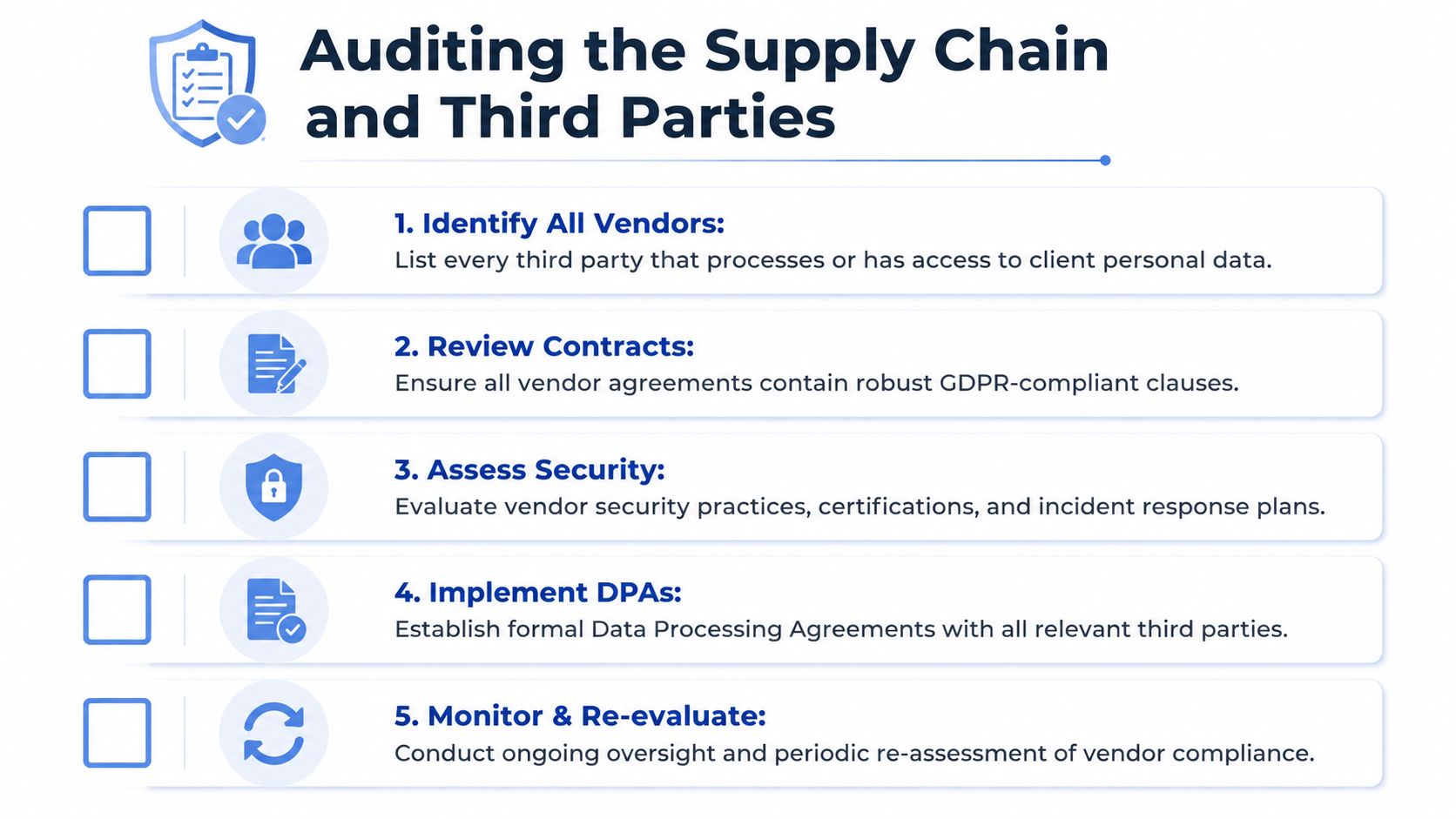
A simple vendor review checklist
Use a short checklist your client can repeat:
- Map the vendors: List every processor, subprocessor, SaaS platform, support firm, and contractor with data access.
- Read the contract: Check whether the agreement clearly defines processing roles, security obligations, and breach notification duties.
- Review assurance evidence: Ask for current SOC 2 or ISO 27001 documentation where relevant.
- Look at incident handling: Confirm they can support your client during a breach, deletion request, or access investigation.
- Reassess regularly: Vendors change tools, hosting models, and subprocessors all the time.
If you want a stronger process for this service line, this vendor risk assessment guide is a useful operational reference.
Watch for non-obvious third-party risk
Physical safety and operational context can affect privacy risk too. For organizations with distributed staff or mobile workers, tools related to protecting lone workers in Perth are a reminder that third-party systems often collect location, contact, and incident data that still need proper contractual and security review.
Vendor reviews don't need to be bloated to be useful. The best ones are fast, repeatable, and tied to a clear risk register. That makes them affordable to deliver and easy to sell as part of managed compliance.
Delivering Your White Labeled Pentest Report
The report is where a technical exercise becomes a business asset. If the document is messy, vague, or overloaded with scanner output, the client won't use it. The auditor won't trust it. Your team won't be able to build recurring revenue from it.
For GDPR, the documentation bar is higher than “send the PDF.” Required documentation includes the final report, test authorization letters, risk assessments, detailed methodologies, and Data Processing Agreements with third-party testers, according to this GDPR compliance guide for pentesting documentation.
What a report needs to do
A usable report serves three audiences at once:
| Audience | What they need | What to include |
|---|---|---|
| Leadership | Business risk and decisions | Executive summary, affected processes, remediation priorities |
| IT and security | Technical detail | Reproduction steps, evidence, affected assets, validation notes |
| Audit and compliance | Defensible records | Scope, authorization, methodology, data handling, tester details |
White label pentesting becomes valuable for channel partners. You can deliver a professional package under your own brand, keep ownership of the relationship, and avoid building an in-house reporting operation from scratch.
Don't send a report that dies in a folder
Clients act on reports when the remediation path is clear. Keep the findings practical:
- State the exposure plainly: Say what data or process is at risk.
- Show how it was verified: Briefly explain the manual test path.
- Recommend the fix in order: Start with the quickest control that reduces the most risk.
- Note retest needs: Make it easy to schedule validation after remediation.
A good model for presentation is borrowed from other reporting-heavy services. This guide on How to white label marketing reports is useful because the same rule applies here: the report has to be clear enough for the client to share internally without rewriting it.
For partners that want a cleaner deliverable format, this pen test report template is a practical reference.
Strong reports create follow-on work. Weak reports create clarifying calls, delayed fixes, and lost trust.
The best GDPR reporting isn't longer. It's tighter. It gives the auditor what they need, gives IT a fix path they can execute, and gives the MSP or vCISO a reason to come back for remediation validation, recurring penetration testing, and broader compliance support.
If you want to offer affordable, fast, manual pentesting under your own brand without competing with your client relationships, our white-label pentesting service is built for that channel model. Contact us today to learn more.

.avif)
.png)
.png)
.png)

