
Your phone rings. A client's controller just wired money to the wrong account after replying to what looked like a normal vendor email. Ten minutes later, your help desk finds a mailbox rule, a suspicious login, and a panicked office manager asking if cyber insurance will cover it.
That's the problem with social engineering. It doesn't start with a firewall failure. It starts with a person making a decision under pressure.
If you run an MSP, advise clients as a vCISO, or sell compliance services as a reseller or GRC partner, you can't treat this as a user training issue alone. It's a business risk, a compliance risk, and a service gap. If you don't have a practical way to test and reduce it, your clients are exposed and your stack won't save them.
The Human Element in Modern Cyber Attacks

Most clients still think cyberattacks begin with some genius hacker breaking encryption in a dark room. That's not what usually happens. The attacker sends a message that looks normal, sounds urgent, and lands at the right moment.
In real client environments, that message might be a fake Microsoft 365 password reset, a vendor bank change request, or a caller claiming to be from the IT team. It works because people trust routine business communication. That's why local business guides on Atlanta cybersecurity threats keep focusing on phishing, impersonation, and business email fraud instead of just malware.
Why MSP clients keep getting hit
Your clients are busy. Their staff approve invoices, reset passwords, share documents, and answer phones all day. Attackers hide inside those normal workflows.
That's also why generic annual awareness slides don't solve the problem. You need recurring testing, tighter identity controls, and service desk procedures that assume someone will try to manipulate your users. If you want a baseline before you run a campaign, this guide to security awareness training is a useful starting point.
Practical rule: If a client can be talked into bypassing a control, they don't really have that control.
Defining Social Engineering Beyond Technical Hacks
So, what is social engineering in cyber security?
It's human hacking. Instead of breaking into a system through code, the attacker tricks a person into opening the door. The tool isn't a software exploit first. The tool is psychological manipulation.
A technical attack targets software flaws. Social engineering targets trust, urgency, fear, routine, and authority. That's why even clients with solid endpoint protection, decent email filtering, and patched systems still get burned.
What attackers are really exploiting
Attackers don't need your client's users to be careless. They need them to be busy and convinced.
Common pressure points include:
- Urgency: “Approve this now or payroll will fail.”
- Authority: “I'm calling from Microsoft support.”
- Familiarity: “Replying” in an existing email thread.
- Fear: “Your account will be disabled.”
- Helpfulness: “Can you reset this access for me fast?”
The scale of the problem is hard to ignore. Over 90% of data breach incidents involve targeting the human element, and around 98% of cyberattacks incorporate social engineering in some form, according to Secureframe's summary of social engineering statistics.
That should change how you talk to clients. Social engineering is not a side topic. It is often the front door.
Why this matters for service providers
If you sell managed security, compliance support, or a risk assessment, clients expect you to think beyond antivirus and patching. They want guidance on how attackers get in.
Firewalls stop some traffic. They don't stop an accounts payable clerk from trusting the wrong email.
Common Attack Methods Your Clients Will Face
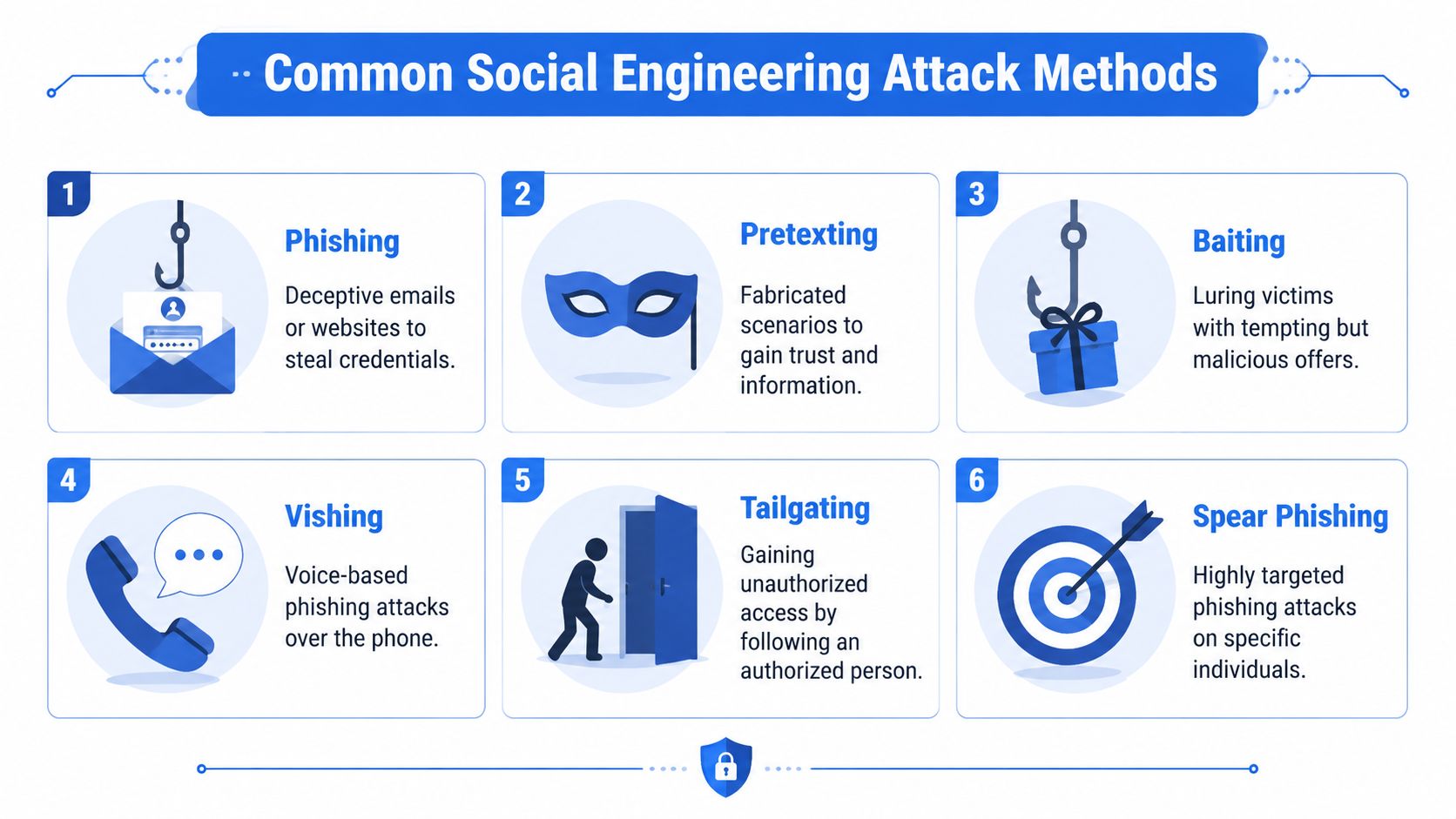
Your clients don't need a theory lecture. They need plain-English examples they'll recognize immediately.
The attacks showing up in business workflows
- Phishing
Email-based deception. A fake invoice, password reset, or shared document link steals credentials or delivers malware. - Vishing
Voice phishing over the phone. The caller pretends to be IT, a bank, or an executive and pressures someone to reveal information or approve access. - Smishing
Text-message scams. These often mimic MFA alerts, package notifications, or urgent account warnings. - Pretexting
A made-up story designed to gain trust. An attacker may pretend to be a new employee, auditor, or vendor to get data or a password reset. - Baiting
A tempting offer used as bait. That might be a “free” download, a fake gift card, or a USB device left in a shared area. - Spear phishing
A customized phishing attack aimed at a specific person. These messages look more convincing because they include names, projects, vendors, or internal language.
What MSP owners should watch for
The dangerous part isn't just the message. It's the context. Attackers study org charts, support processes, and software names. They know who handles tickets, approvals, and onboarding.
That's why AI-assisted impersonation matters. If you're trying to educate clients on new synthetic media risks, this article on preventing deepfake fraud gives useful context for how fake voice and video can strengthen a social engineering attempt.
For phishing-specific examples, this breakdown of types of phishing is a practical reference you can share with staff and clients.
Attack typeWhat it looks likeTypical outcomePhishingFake login or invoice emailStolen credentialsVishing“IT support” phone callMFA approval or resetSmishingUrgent security textLink click or code theftPretextingConvincing fake identityInformation disclosureBaitingEnticing file or offerMalware executionSpear phishingHighly tailored messageAccount compromise
Understanding the Social Engineering Attack Lifecycle
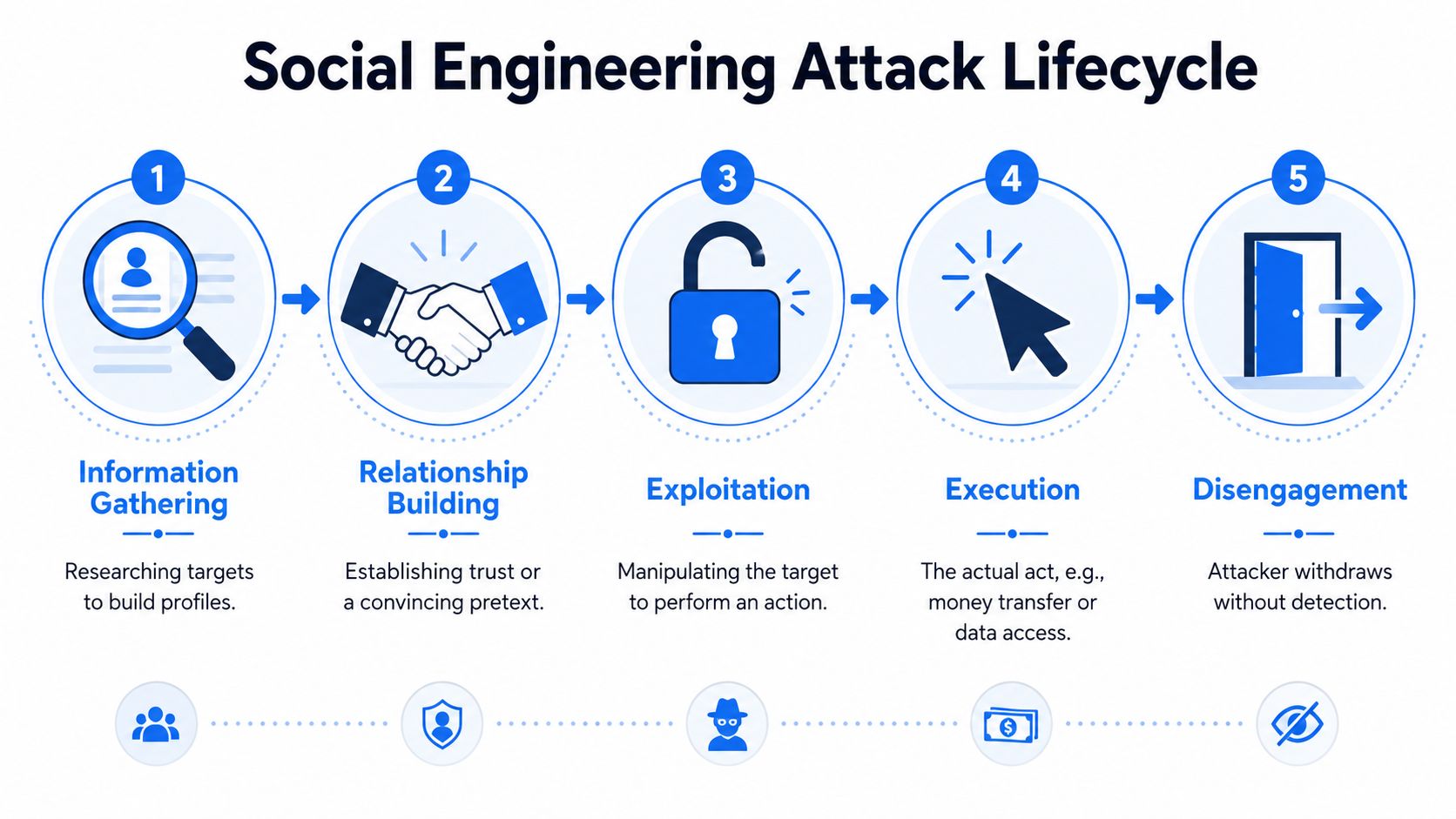
Social engineering is not random. Good attackers follow a repeatable process that looks a lot like a real penetration test.
How the attack unfolds
First comes investigation. The attacker reviews LinkedIn, company websites, social posts, vendor names, and support contacts. They're building a believable story.
Then comes planning. They choose the right pretext, the right target, and the right channel. Email for finance. Phone for the help desk. Text for a rushed executive.
Next is engagement. That's the moment the message lands or the call comes in. If the target responds, the attacker moves to exploitation, where the victim approves a login, opens a file, resets a password, or sends money.
Last is exit. The attacker covers tracks, forwards mail, sets persistence, or simply stops talking once access is gained.
According to Splunk's overview of social engineering attacks, phishing and social engineering serve as the initial attack vector in approximately 40% of incident response cases worldwide, more than double the next most common method.
Why lifecycle thinking matters
When you understand the lifecycle, your defense gets sharper:
- During investigation: reduce public exposure and tighten staff profile sharing
- During planning: harden processes attackers rely on, like password resets
- During engagement: train users to slow down and verify requests
- During exploitation: enforce MFA and conditional access
- During exit: log identity changes and mailbox rules
A strong pen test doesn't just ask, “Can we get in?” It asks, “Where in the human process does the business break?”
Social Engineering Risks For MSPs and Compliance

Many providers fail to grasp that social engineering is not just your client's problem. It is your problem.
MSPs sit in the middle of identity, remote access, admin tooling, ticketing, and trust. If an attacker tricks your technician, compromises your service desk workflow, or gets into a shared admin portal, they may not get one client. They may get many.
Why MSPs are prime targets
Threat reporting highlighted by MSP social engineering and white-labeled penetration testing guidance shows that attackers increasingly target MSPs first to pivot into client environments. MSPs sit at a trust juncture where a single compromised admin session can expose dozens of clients.
That should change your internal priorities fast. Password reset procedures, help desk verification, privileged access reviews, and technician MFA are not admin chores. They are revenue protection controls.
Where compliance breaks down
A successful social engineering attack can wreck a client's SOC 2 narrative in a hurry. If a user is manipulated into granting access, changing permissions, or bypassing MFA, you now have a problem with access control, monitoring, incident response, and evidence quality.
The same logic applies to HIPAA, PCI DSS, and ISO 27001. These frameworks all care about controlled access, staff awareness, documented procedures, and proof that controls are effective. A policy document isn't enough if a caller can talk your help desk into making exceptions.
For vCISO and GRC teams, this creates a service opportunity. You can map social engineering tests directly to control validation. For CPAs and compliance advisors, it gives you a clearer story around why user-focused testing belongs in audit readiness.
If your client can pass a checklist but fail a fake password reset call, their compliance posture is weaker than it looks.
How Manual Penetration Testing Stops Social Engineers
Automated tools won't solve a human trust problem by themselves. They can flag configurations and scan attack surfaces, but they can't think like a manipulator. That's why manual pentesting matters.
A good social engineering pen test simulates how a real attacker researches staff, builds a believable pretext, chooses a target, and tries to trigger action. That might include phishing, vishing, or process abuse around support escalation. The point is to test the real-world gap between your written controls and user behavior.
What a manual test should include
- Scoped scenarios based on business reality. Finance approvals, executive impersonation, service desk resets, shared portals.
- Human-led execution by certified testers. In this domain, OSCP, CEH, and CREST credentials matter because you want disciplined methodology, not spray-and-pray gimmicks.
- Evidence your clients can use for compliance discussions, remediation planning, and board reporting.
- Fast turnaround so the findings reach the client while the issue is still actionable.
According to Sprinto's social engineering statistics roundup, social engineering attacks were the leading initial access vector in modern cyber incidents, accounting for 36% of all reported breaches in 2025. That's exactly why social engineering-focused penetration testing belongs in continuous compliance work, not just annual security theater.
Why this is profitable for the channel
If you're an MSP, reseller, or advisory firm, white label delivery fixes a common problem. You can add a real penetration testing service without building an internal team, extending project timelines, or sending clients to a competitor.
For teams planning broader app and infrastructure assessments alongside social engineering work, this guide on how to plan your pentest for Supabase apps is a helpful example of why scoping matters before testing starts.
One channel-only option is attested third-party manual pentesting, which supports white label delivery for partners that need affordable, manual pentesting with quick reporting. That model fits MSP and vCISO firms that want to keep client ownership while adding social engineering, web, cloud, and internal pen testing services under their own brand.
The business case is straightforward:
- Sell a needed service your clients already should have
- Strengthen retention because you solve a real exposure
- Support SOC 2, HIPAA, PCI DSS, and ISO 27001 conversations with test evidence
- Avoid channel conflict by using a partner that doesn't compete for managed services work
If you need a channel-only partner for white label pentesting, social engineering assessments, or manual penetration testing that fits MSP, vCISO, and reseller workflows, see how we deliver pentests that carry your logo. Learn more about affordable testing, fast turnaround, and certified pentesters who help you protect clients without competing for them.

.avif)
.png)
.png)
.png)

