
API penetration testing is a manual test of the APIs behind your clients' apps, and it catches the access and logic flaws a scanner will always miss. For MSPs, it's turning into one of the easiest, highest-value security lines you can add. Every integration, every mobile app, every payment flow your clients run sits on an API, and that's where attackers aim now. The website out front isn't the prize anymore. The API behind it is.
Here's the problem, and the opportunity. The scanner you trust for web apps barely touches an API, so the flaws that actually breach a client stay hidden until someone finds them the hard way. That's the gap MSP Pentesting closes under your brand: manual, channel-only API penetration testing that comes back as a report with your logo on it, not ours. Below is what an API pentest really is, what it finds that tools miss, and how you sell and deliver it without hiring an application security engineer.
What API penetration testing actually is
It's a manual assessment of the endpoints your client's app exposes, the authentication sitting behind them, and the business logic they run. A tester works the API the way an attacker would. Map the endpoints. Bend the requests. Chain three small mistakes into one real breach.
A scanner doesn't work that way. It matches known signatures, which is fine for a missing header or an outdated library. It's close to useless against the flaws that matter, because those need context the tool doesn't have. A scanner has no idea that user A should never see user B's invoice. A tester does. That gap is where breaches happen.
Why APIs are the soft spot
The most common serious API flaw has a dull name and a brutal impact: Broken Object Level Authorization, or BOLA. An endpoint hands back a record based on an ID in the request and never checks whether you're allowed to see it. Change 1001 to 1002 and you're reading someone else's data. No malware, no exploit kit, just a number you edited.
A scanner can't reliably catch that, because catching it means knowing who owns what. The tool watches a valid request get a valid response and moves on. Only a person who understands the app knows that response never should have come back. That's why APIs get tested by hand, and it's why OWASP keeps a Top 10 built just for them.
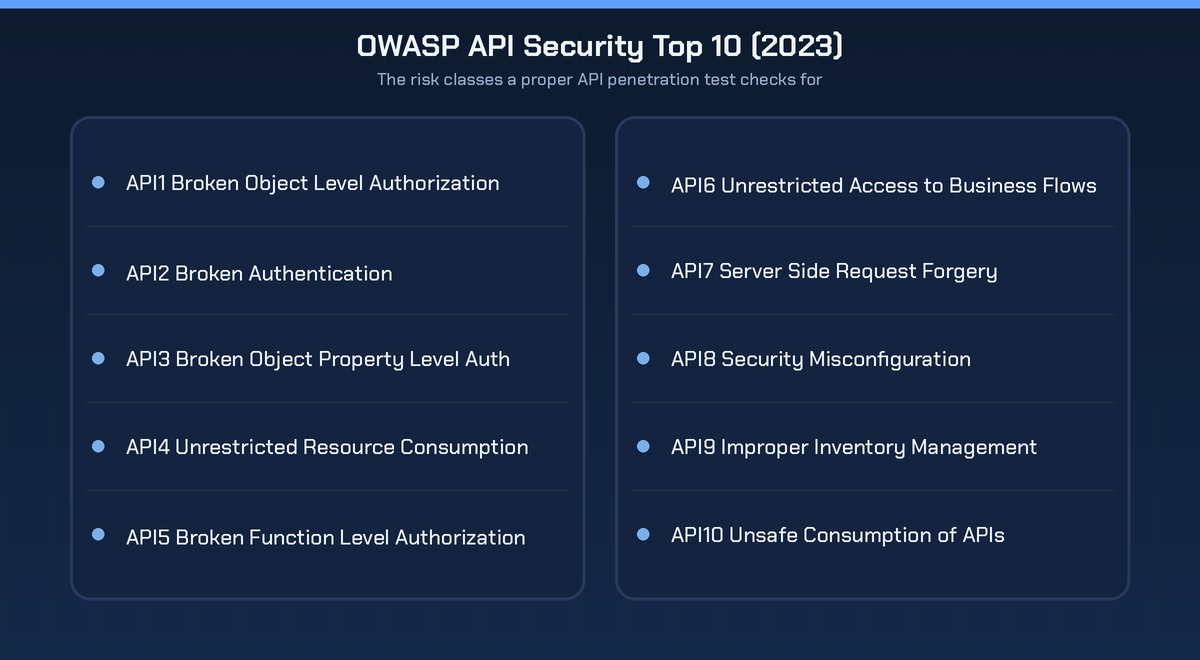
The OWASP API Security Top 10, in plain English
You don't need it memorized. You do need to hold your own in a client conversation about it. The ones that bite:
- Broken Object Level Authorization (API1): the ID-swap above. The single most common serious API flaw.
- Broken Authentication (API2): weak tokens, guessable keys, and login flows that let one user become another.
- Broken Function Level Authorization (API5): a normal user hitting an admin-only endpoint because the app hid the button, not the function.
- Unrestricted Resource Consumption (API4): no rate limiting, so an attacker runs up the cloud bill or knocks the service over.
- Security Misconfiguration (API8): chatty error messages, open debug endpoints, and defaults nobody changed.
Notice the pattern. Most of these are access and logic problems, not software bugs. That's the exact reason a scanner strolls past them and a human doesn't.
What a real API test covers
Scoped to your client's API, a proper test works through several layers, and every one of them needs a person:
- Authentication: can tokens be forged, replayed, or brute forced, and do sessions actually expire.
- Authorization: the BOLA and function-level checks, run object by object and role by role.
- Business logic: can the workflow be abused, like skipping a payment step or replaying a one-time action.
- Input handling: injection, mass assignment, and unsafe parsing.
- Rate limiting: can the API be overwhelmed or made expensive to run.
- Exposure: leaked keys, forgotten endpoints, and data the API hands back that it never should.
How an API pentest works
The engagement runs a clear path, and the manual work is the whole point.
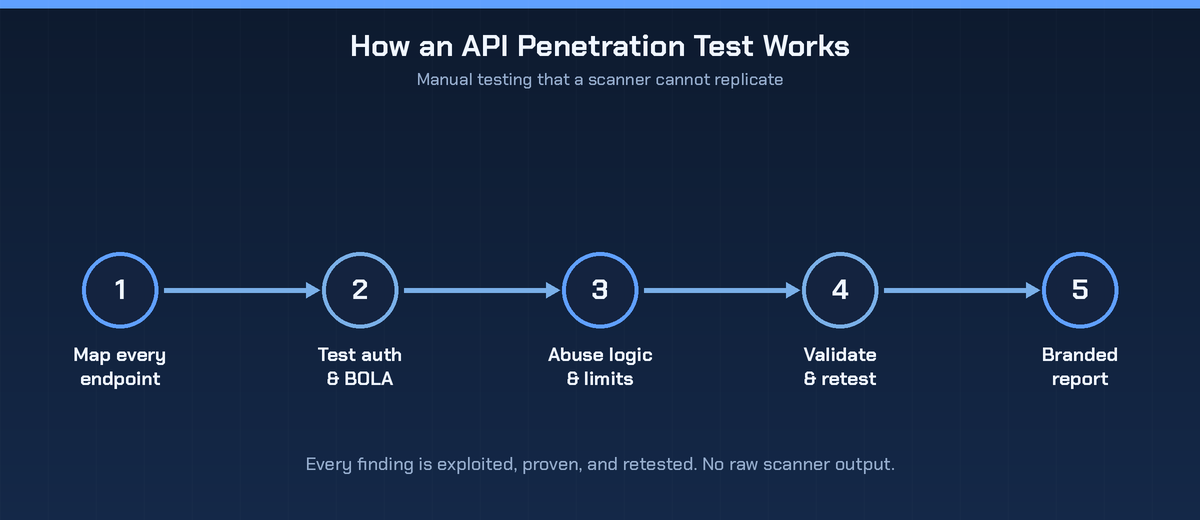
It starts by mapping every endpoint, including the ones nobody documented, because you can't test what you haven't found. From there the tester works authentication and authorization, abuses the business logic and the rate limits, then proves each finding by actually exploiting it so nothing on the report is a false positive. After your client fixes what turned up, the tester retests. That last step is what turns a list of problems into proof they're gone.
API penetration testing vs a vulnerability scan
Someone will ask why they can't just run a scan. Different tools, different jobs. A scan is broad, shallow, and automated, and it's genuinely good at catching known issues fast and cheap. An API pentest is narrow, deep, and manual, and it's the one that finds the flaw that would have ended up in a breach notice. Run scans all year. Run a pentest when it actually counts. Just don't let a client mistake one for the other.
When a client actually needs one
An API pentest goes from optional to overdue in a few obvious moments. A client shipping or reworking a product with a public or partner API. A client heading into SOC 2 or PCI DSS, where the in-scope app is expected to be tested. A client staring down a customer security questionnaire that wants proof. A client who just wired up an integration that moves sensitive data. Any of those on the table, and the test should be too.
How MSPs deliver API pentests without an app-sec team
API testing takes real skill, and hiring for it is slow and expensive. You don't have to. Scope the engagement with your client, hand the testing to a channel-only partner, and the report comes back with your logo on it. Your client sees your expertise, not ours. That's what white-label pentesting is for, and it lets you put application security on your menu without putting anyone new on payroll.
If web app testing is already something you offer, API penetration testing is the obvious next line item, and usually the more valuable one. Our guide to web application security testing covers the front-end half.
What a good API pentest report gives you
The report is what your client actually sees, so it has to earn its keep. A strong one lays out the scope and method, shows each finding with a proof-of-concept request so nobody can argue it's real, scores severity with CVSS, and hands developers remediation they can act on. Then it shows the retest that confirms the fix held. Clean, branded, and free of scanner noise. That's the difference between a report a client tolerates and one that wins you the next job.
Frequently asked questions
Is an API pentest different from a web app pentest?
Yes. A web app test goes after the browser-facing side. An API test goes after the endpoints and logic behind it, where the authorization and business-logic flaws live. Plenty of clients need both, and the API side is often where the real risk is hiding.
Can automated tools test an API?
Up to a point. They'll catch known issues and misconfigurations. They miss the access-control and logic flaws, like BOLA, that cause most API breaches. Those need a human who understands the app.
How often should an API be tested?
Once a year at minimum, and again after any real change, new endpoints, new auth, a major feature. Compliance usually sets the annual floor, but a big release is its own reason.
Do SOC 2 or PCI require API penetration testing?
Neither one names APIs outright, but both expect the in-scope app to be tested, and for most modern products the API is the app. If it handles in-scope data, it belongs in the test.
The bottom line
APIs are where your clients' data lives and where the attackers are already looking, and they're the one surface a scanner is worst at protecting. That makes API penetration testing one of the easiest services to add and one of the easiest to deliver through the channel. Scope it to the API, test it by hand, prove what you find, retest the fix, and put your brand on the report.
.png)
.avif)
.png)
.png)
.png)

