
A client pings you on a Tuesday afternoon. They need SOC 2 help, their auditor is already booked, and somehow this became your emergency.
That's the usual mess. The client waited too long, the scope is fuzzy, evidence lives in five different places, and everyone suddenly wants answers by Friday. If you're an MSP, vCISO, GRC consultant, CPA, or IT reseller, you've probably lived this more than once.
The fix isn't another panic-driven checklist. It's an audit readiness assessment that gives you a clean view of what exists, what's missing, and what will break during the audit if nobody deals with it now.
Stop the Scramble Before the Audit
An audit readiness assessment is the move you make before the pressure gets stupid. It's a structured pre-audit review, often described as a dry run, done months before the official audit to evaluate readiness for frameworks like SOC 2, ISO 27001, NIST CSF, or PCI DSS (Sprinto).

Many organizations treat compliance like a seasonal event. That's backwards. If your client only starts gathering policies, screenshots, approvals, and logs when the auditor shows up, they're already late.
Why the dry run matters
A solid readiness review checks the boring stuff that causes real pain later. Policies need to exist. Controls need to line up with the framework. Evidence needs to be available. Access controls need to make sense. That work is what keeps an audit from turning into a month of Slack archaeology.
Practical rule: If a control can't be explained, shown, and supported with evidence, it isn't ready.
This is also where smart partners separate themselves from commodity IT shops. When you lead with a readiness assessment, you stop being “the team that manages systems” and become the group that helps clients pass audits without chaos.
What clients usually miss
Clients often think readiness is just documentation. It isn't. Documentation matters, but so do timestamps, approvals, ownership, and traceability. If you want a simple example of how records support defensibility, the importance of contract audit trails is worth reviewing because the same principle applies across compliance work. Auditors trust what teams can prove.
If you support clients across HIPAA, PCI DSS, or ISO 27001, the business case is simple. Run the dry run early, tighten the weak spots, and walk into the formal review with control instead of guesswork.
Planning and Scoping Your Assessment
Bad scoping burns time fast. The client says “we need compliance,” but they usually mean one framework, a subset of systems, a specific business unit, and a deadline that nobody clarified.
Start there. Don't boil the ocean.
Ask these scoping questions first
Before you review a single policy, get clean answers to these:
- Which framework matters now: Is this for SOC 2, HIPAA, PCI DSS, or ISO 27001?
- What environment is in scope: Production only, or dev and staging too?
- Which data matters: Customer data, cardholder data, protected health information, or internal financial records?
- Who owns the controls: Security, IT, HR, legal, finance, or some mix of all of them?
- What changed recently: New cloud workloads, M&A activity, remote workforce expansion, vendor changes, or identity platform changes?
Those answers stop scope creep before it starts. They also keep your client from paying for work they don't need.
Build the project around risk
A readiness review should follow the systems and processes most likely to create audit pain. If your client has weak onboarding and offboarding, shared admin access, messy change approvals, or thin incident response records, those deserve attention early. A practical risk assessment methodology helps you prioritize what actually matters instead of creating more paperwork.
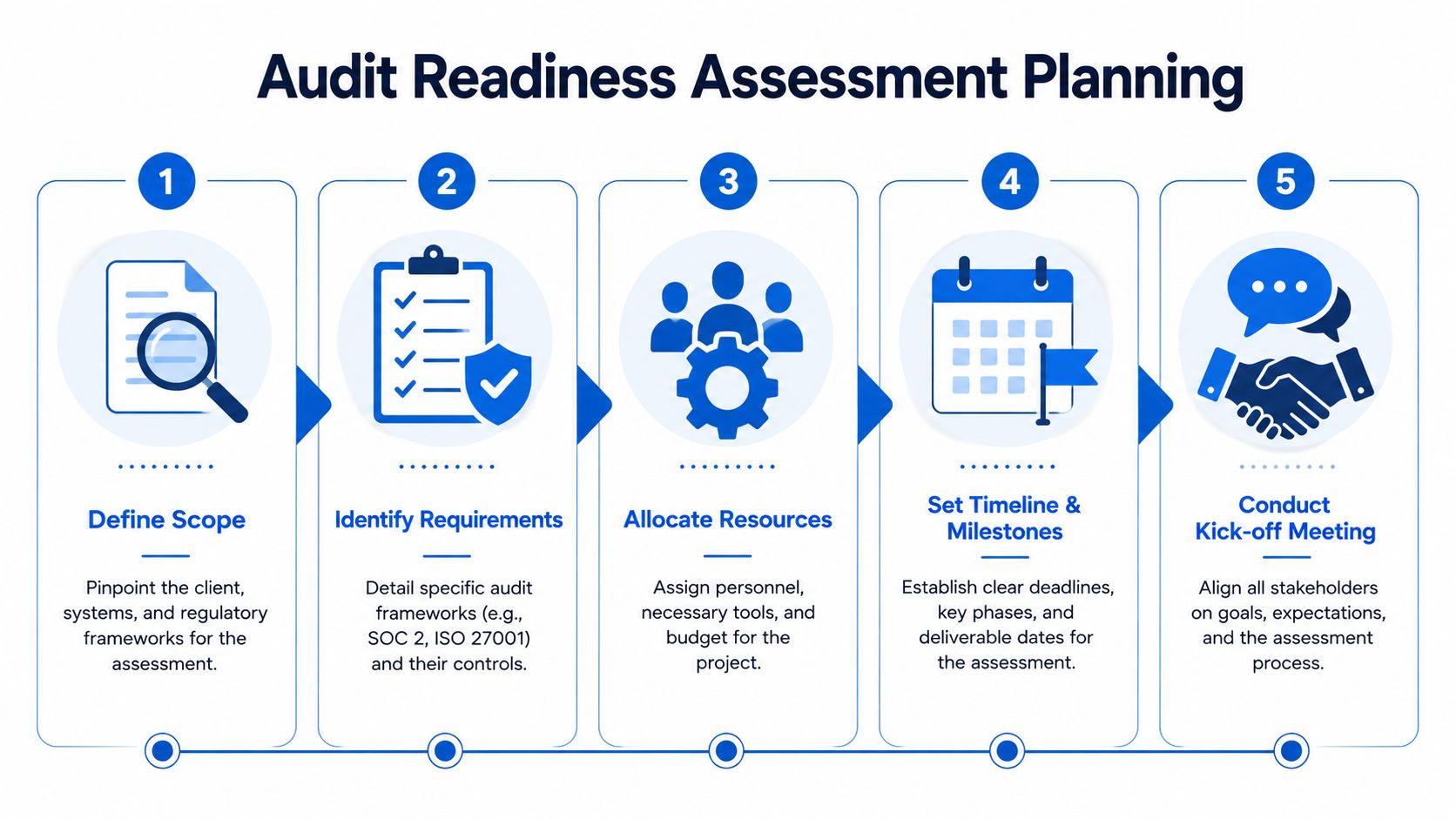
Use a simple planning model:
- Lock the framework and identify the audit objective.
- List in-scope assets such as SaaS apps, cloud platforms, endpoints, and supporting vendors.
- Map control owners so each request goes to a person, not a vague department.
- Set milestones for policy review, evidence gathering, control validation, and remediation.
- Agree on reporting so the client knows what “ready” looks like.
Don't accept “everything is in scope” unless the client wants to overpay and overwork their team.
What good planning looks like
Good scoping feels almost boring. That's the point. You know which systems matter, which controls will be tested, what evidence is required, and who has to deliver it.
Once that's defined, the rest of the audit readiness assessment gets easier. You're not reacting. You're running a project.
Conducting a Practical Controls Gap Analysis
An audit readiness assessment reveals whether the client has real compliance or just nice-looking files in a shared folder.
A useful audit readiness assessment checks each control in four dimensions: Documentation, Implementation, Evidence, and Operating Effectiveness, then scores it as Ready, Partially Ready, or Not Ready (Security Docs). That framework works because it kills paper compliance fast.
Use the four-part control test
Here's the blunt version.
Documentation asks whether the policy or procedure exists, is current within 12 months, and has management approval. If the document is old, unsigned, or vague, it's weak from the start.
Implementation asks whether the actual process matches the written policy. If the policy says MFA is required for admins but several privileged accounts don't use it, the control is not working the way the client claims.
Evidence means timestamped proof. Think logs, screenshots, tickets, approval records, or exported reports that cover the audit period. Evidence has to show that the control happened, not that someone intended it to happen.
Operating Effectiveness asks whether the control worked consistently over the observation window. For SOC 2 Type II, that window is typically 6 months in the methodology described by Security Docs.
A fast way to review controls
Don't overcomplicate it. For each control, ask four questions:
- Is it written down
- Is the team following the process
- Can they prove it
- Has it worked consistently
If any answer is weak, mark it and move on. You're building a remediation queue, not writing a novel.
A policy without evidence is a wish. Auditors don't certify wishes.
Common gaps MSPs keep finding
Some gaps show up constantly across GRC, IT, and compliance engagements:
- Access reviews drift: The process exists, but nobody can show recent approvals.
- Change management is informal: Work got done through chat or verbal approval.
- Incident response looks polished on paper: There's a plan, but no proof the team tested it or followed it.
- Vendor records are thin: The client relies on key vendors but can't show consistent oversight.
The smartest move is to rate controls quickly, attach one owner to each weak area, and avoid giant narrative reports. A short, clear gap log beats a beautiful PDF nobody updates.
Integrating Manual Pentesting to Validate Controls
Policies don't stop attackers. Working controls do.
That's the biggest blind spot in a lot of audit readiness work. Teams review documentation, confirm settings, collect screenshots, and call it done. Then a real penetration test shows the control can be bypassed in minutes.

Why technical validation belongs in readiness work
Documentation alone does not prove a control works, and that should change how every MSP and vCISO thinks about audit readiness assessment.
If the client says access control is strong, prove it with a pen test. If they say segmentation works, test it. If they say incident response is ready, pressure the technical controls that support detection, access, and containment.
Where penetration testing fits
You don't need to bolt on a giant red team engagement every time. Start with the controls most likely to fail under stress:
- Identity and access controls
- External attack surface
- Internal privilege paths
- Web applications tied to customer data
- Cloud configurations supporting in-scope systems
For clients heading into SOC 2, a focused review tied to SOC 2 penetration testing makes the readiness process far more credible.
Why manual pentesting matters
Automated scanners have their place. They're useful for coverage and repeatability. They are not the same as manual pentesting.
A manual penetration test digs into logic flaws, chained weaknesses, weak privilege boundaries, and bad assumptions that automation misses. For compliance-driven clients, that difference matters because auditors and buyers care whether the control works, not whether a scan ran successfully.
This is also where channel partners can add real value without bloating delivery. If you can bring in affordable, fast, white label pentesting from certified testers with OSCP, CEH, and CREST backgrounds, you create a better client outcome without building a testing bench from scratch.
Documentation tells the story the client wants to tell. Pentesting shows whether the environment agrees.
The result is stronger evidence, cleaner remediation, and fewer ugly surprises when the formal audit starts.
Tracking Remediation with Simple Checklists
A gap analysis without follow-through is just an expensive opinion.
Once you've identified weak controls, move straight into remediation tracking. Keep it simple. Many groups don't need a giant platform to start. A shared spreadsheet, clear owners, due dates, and evidence links will carry a lot of weight if people maintain it.
What to collect as evidence
Auditors want proof they can review quickly. That usually means:
- Timestamped screenshots: Use them for settings, approvals, and configuration states.
- Exported logs: Pull records that show control activity over time.
- Policy approvals: Keep the current version and proof of management signoff together.
- Ticket records: Tie operational work back to the control it supports.
If the client's environment changed significantly in the last 12 months, or they've never had a manual test, they're overdue because most frameworks including SOC 2, HIPAA, and CMMC require or strongly recommend annual penetration testing (Todyl).
Use a living checklist
A simple checklist works because everyone understands it. You can also pair it with a practical cyber security audit checklist to keep control reviews and evidence requests organized.
Here's a basic format you can steal and adapt:
| Control Area | Control Example | Status (Ready / Partially Ready / Not Ready) | Remediation Notes |
|---|---|---|---|
| Access Control | Admin access reviewed and approved | Partially Ready | Collect approval evidence and remove stale accounts |
| Change Management | Production changes documented in tickets | Not Ready | Require ticket linkage and approval before deployment |
| Incident Response | Incident handling process documented and evidenced | Partially Ready | Store incident records and response timelines centrally |
| Logging and Monitoring | Security logs retained and reviewable | Ready | Validate evidence retention and reviewer signoff |
| Vendor Management | Critical vendors assessed and documented | Not Ready | Assign owner and collect current vendor review records |
Keep the status language brutally clear
Use only three statuses: Ready, Partially Ready, and Not Ready. Anything more creates wiggle room and confusion.
Then add one owner, one next action, and one evidence target for each item. That keeps the audit readiness assessment practical instead of theoretical.
Field note: The best remediation tracker is the one your client will still update next week.
Become Your Client's Trusted Compliance Partner
Most clients don't need another vendor. They need a partner who can make compliance understandable, manageable, and commercially useful.
That's why audit readiness assessment work matters. When you combine smart scoping, real control testing, and manual pentesting, you stop selling tasks and start solving business risk. You become the person they call before the panic starts.
There's also a clean delivery model for this. White label penetration testing enables MSP or vCISO practices to offer critical manual pentesting services for SOC 2 or HIPAA compliance without bearing the huge operational cost of building their own testing team (MSP Pentesting white label penetration testing). That matters if you want to expand security and compliance services without hiring a full testing crew.
If your clients are also asking hard questions about AI usage, governance, and policy control, a useful companion read is AgentStack AI governance. It helps frame how compliance expectations are widening beyond classic infrastructure and endpoint concerns.
Stay channel-first. Protect the client relationship. Add the right expertise where it counts. That's how an MSP, vCISO, GRC firm, or reseller grows without creating operational drag.
If you want a channel-only partner for affordable, fast, white-labeled pentest, pen test, penetration test, and penetration testing services, start with channel-delivered risk assessments. Our certified team includes OSCP, CEH, and CREST pentesters, and we work behind the scenes so you keep the client relationship. Contact us today to add manual pentesting to your audit readiness process without adding in-house overhead.

.avif)
.png)
.png)
.png)

