
That email keeps showing up at the worst time.
A client is chasing SOC 2, renewing cyber insurance, answering a big customer security questionnaire, or trying to close a contract with an enterprise buyer. Suddenly they need a formal risk assessment. Not next quarter. This week.
If your current process is a spreadsheet, a vague heat map, and a few copied controls from a GRC template, you're already behind. Worse, your client can feel it. They don't just need a document. They need a decision-making tool they can hand to leadership, auditors, and buyers without looking unprepared.
Most MSPs lose momentum here because their process is too slow, too expensive, or too shallow. The old model pushes clients into checkbox compliance. That might satisfy a form. It doesn't help them decide what to fix first, what to fund next, or how to explain security spending in plain business terms.
Why Your Clients Now Demand Risk Assessments
Clients aren't asking for risk assessments because they suddenly love governance. They're asking because buyers, auditors, and regulators keep forcing the issue.
A company going through SOC 2, HIPAA, PCI DSS, or ISO 27001 review needs a defensible way to identify and prioritize risk. If you can't provide that, somebody else will. That's how MSPs lose deals they should've kept.
The urgency is real. Breaches now take an average of 277 days to detect and cost businesses $4.88 million on average, according to Wolters Kluwer's overview of common GRC risk methodologies. When detection takes that long, weak risk assessment isn't an admin problem. It's a business exposure problem.
Compliance started this problem
For many MSPs, the trigger is simple. A client says:
- We need SOC 2: Their auditor wants a documented risk process.
- We handle regulated data: Their legal or compliance team wants proof of review.
- We got a big customer questionnaire: Procurement wants evidence, not opinions.
That's why risk assessment has become a gatekeeper service. If your offering stops at patching, backups, and endpoint management, you're leaving a gap right where clients make buying decisions.
Practical rule: If a client is pursuing compliance, signing larger customers, or renewing security reviews, risk assessment should already be in your stack.
Static reports don't close business
The bigger problem is that most MSP risk assessments are still static. They produce red, yellow, and green boxes, then stop. That helps nobody in the boardroom.
Your client wants to know what matters now, what can wait, and what will cost real money if ignored. If third-party exposure is part of the picture, vendor risk assessment guidance for MSPs should be part of your operating model too, not an afterthought.
A good risk assessment methodology doesn't just help with compliance. It helps your client buy with confidence and helps you keep the account.
What Is a Risk Assessment Methodology
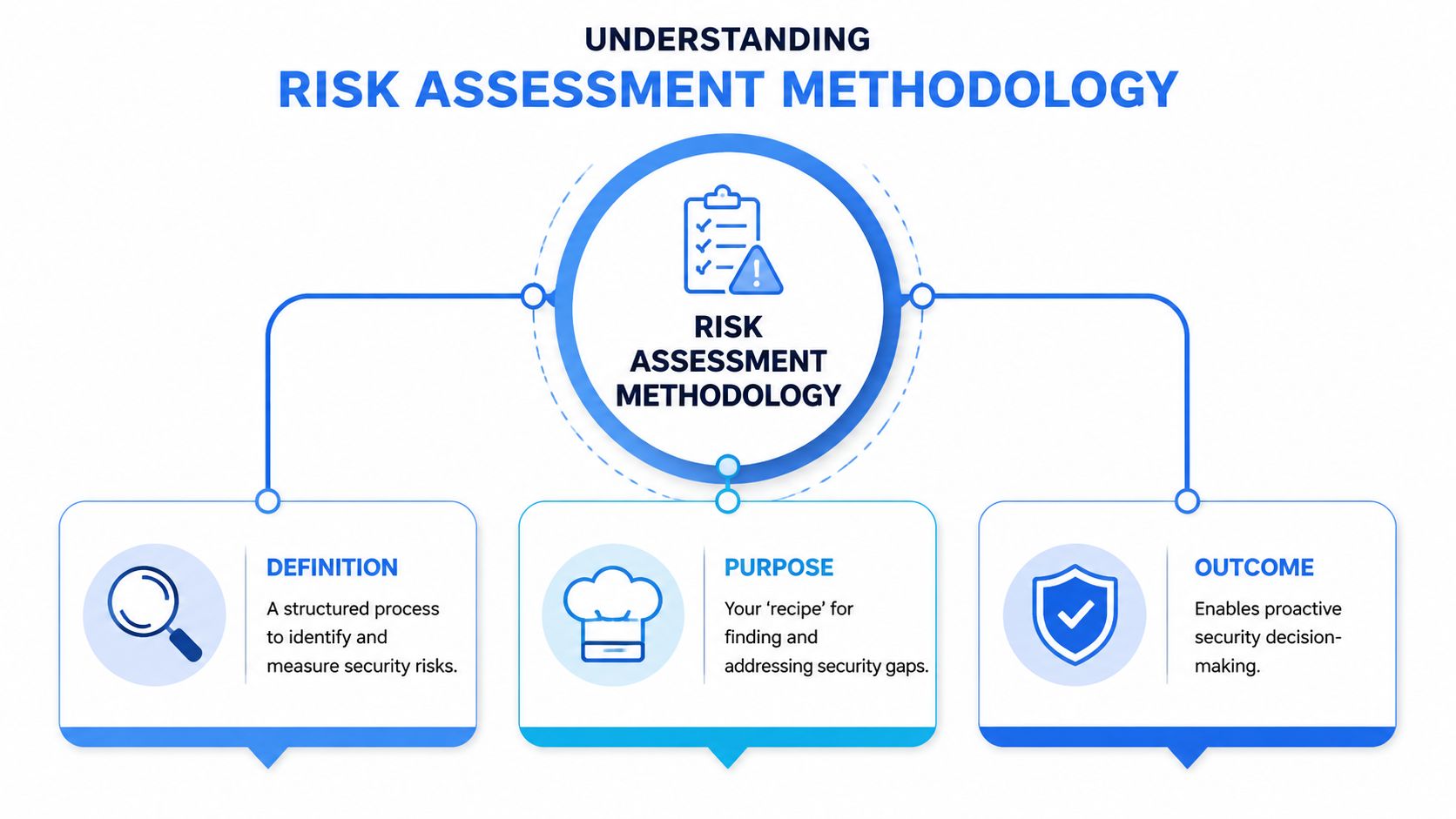
A risk assessment methodology is just a repeatable way to find security problems, judge how serious they are, and decide what to do next.
Imagine securing a house. You check the doors and windows, figure out which ones are easiest to break through, then decide whether to install better locks, cameras, or alarms first. The same logic applies to servers, cloud apps, endpoints, vendors, and user access.
According to Optro's explanation of risk assessment methodology, it has three core components: Risk Identification, Risk Analysis, and Risk Evaluation, with evaluation deciding how each risk should be handled relative to business goals.
The three parts that matter
Risk Identification means finding what could go wrong. That includes exposed systems, missing controls, weak processes, bad vendor dependencies, or sensitive data sitting where it shouldn't.
Risk Analysis means deciding how likely the issue is and how much damage it could cause. At this juncture, you stop listing findings and start ranking them.
Risk Evaluation means choosing the response. Fix it now, plan it, accept it, or transfer it.
Keep the terms simple
A lot of teams get tangled in security language. Don't.
- Threat means what could cause harm, like ransomware or unauthorized access.
- Vulnerability means the weakness that makes harm possible, like an exposed admin portal or poor MFA coverage.
- Risk means the business damage that could happen when the threat uses the vulnerability.
A good methodology turns security from a pile of technical findings into a business conversation.
For healthcare clients, practical checklists can help ground the process. Technovation LLC's checklist is a useful example of how a structured review can support HIPAA work without drowning the client in jargon.
Why methodology beats improvisation
If your team handles every client assessment differently, results become subjective fast. One engineer marks a risk "high." Another says "medium." The client gets inconsistency, not guidance.
A clear methodology gives you:
- Repeatability: Every client gets the same baseline process.
- Defensibility: Auditors and customers can see how you reached your conclusions.
- Clarity: Your vCISO, GRC, and technical teams can work from the same playbook.
That consistency is what makes compliance smoother and keeps your recommendations from sounding arbitrary.
Choosing Your Risk Assessment Framework
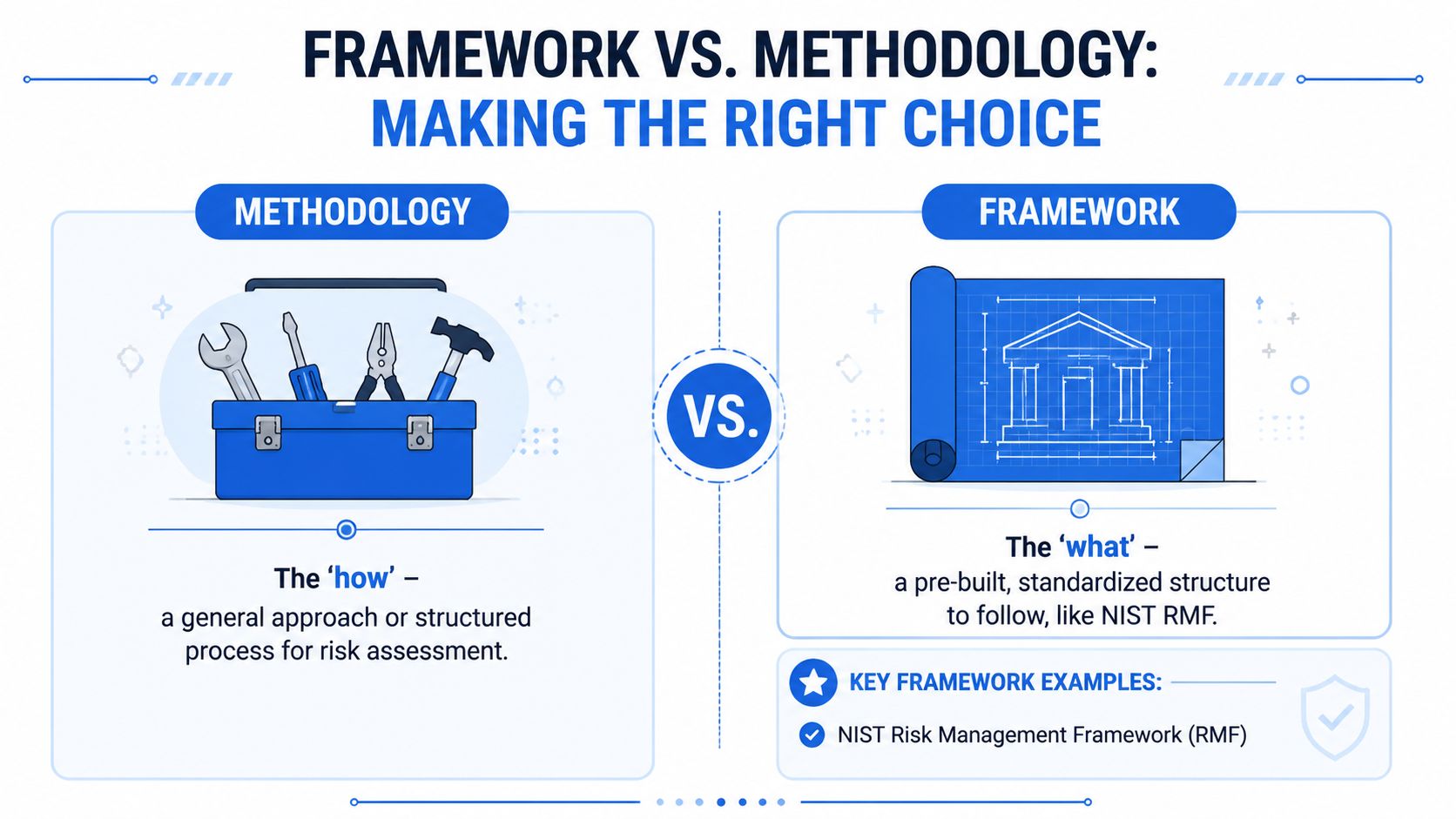
A methodology is the process. A framework is the structure you borrow from.
That's where MSPs often overcomplicate things. They think they need to master every standard on earth. You don't. You need a framework that matches the client's business reality and a methodology your team can run without turning every engagement into a consulting marathon.
The common framework choices
NIST RMF works well for U.S.-based organizations, regulated environments, and clients that expect formal control mapping. It's strong, but it can get heavy if you apply it in full.
ISO 27005 fits naturally with ISO 27001 programs. If your client has international partners, formal ISMS goals, or a mature compliance team, this is often the cleaner fit.
FAIR is different. It pushes you to express risk in financial terms instead of only scoring severity levels. That's useful when leadership wants to know why a control matters in dollars, not just colors.
What most MSPs should actually do
For most MSP, reseller, and vCISO engagements, a simplified model based on NIST or ISO principles is enough. The client usually doesn't need a textbook implementation. They need a practical assessment they can defend.
Use this decision lens:
Client situationBest fitU.S. compliance-heavy environmentNIST-aligned approachInternational or ISO-driven programISO 27005-aligned approachLeadership demands financial justificationFAIR-style quantitative layerEarly-stage compliance for SOC 2 or HIPAASimplified NIST or ISO process
If you want a useful outside perspective on structuring that foundation, Lighthouse Consultants has a solid overview of framework-building decisions.
Stop confusing completeness with usefulness
Many GRC projects falter here. Teams build huge control libraries and beautiful policy maps, then fail to help the client make a single spending decision.
The underserved problem is quantitative translation. Some MSPs still rely entirely on heat maps and high-medium-low labels, while struggling to connect those scores to financial impact, budget requests, or ROI. That's why the framework alone won't save you. You need a methodology that can move from compliance language into business language.
Advisor view: If your framework can't help a client explain why one control gets funded before another, your process is incomplete.
A practical starting point is a framework that supports your client's audit needs and an execution model your team can repeat. If you need a stronger baseline for that process, this guide to a cybersecurity risk assessment framework is a useful reference point.
Building Your Practical Risk Assessment Matrix
The work then becomes usable.
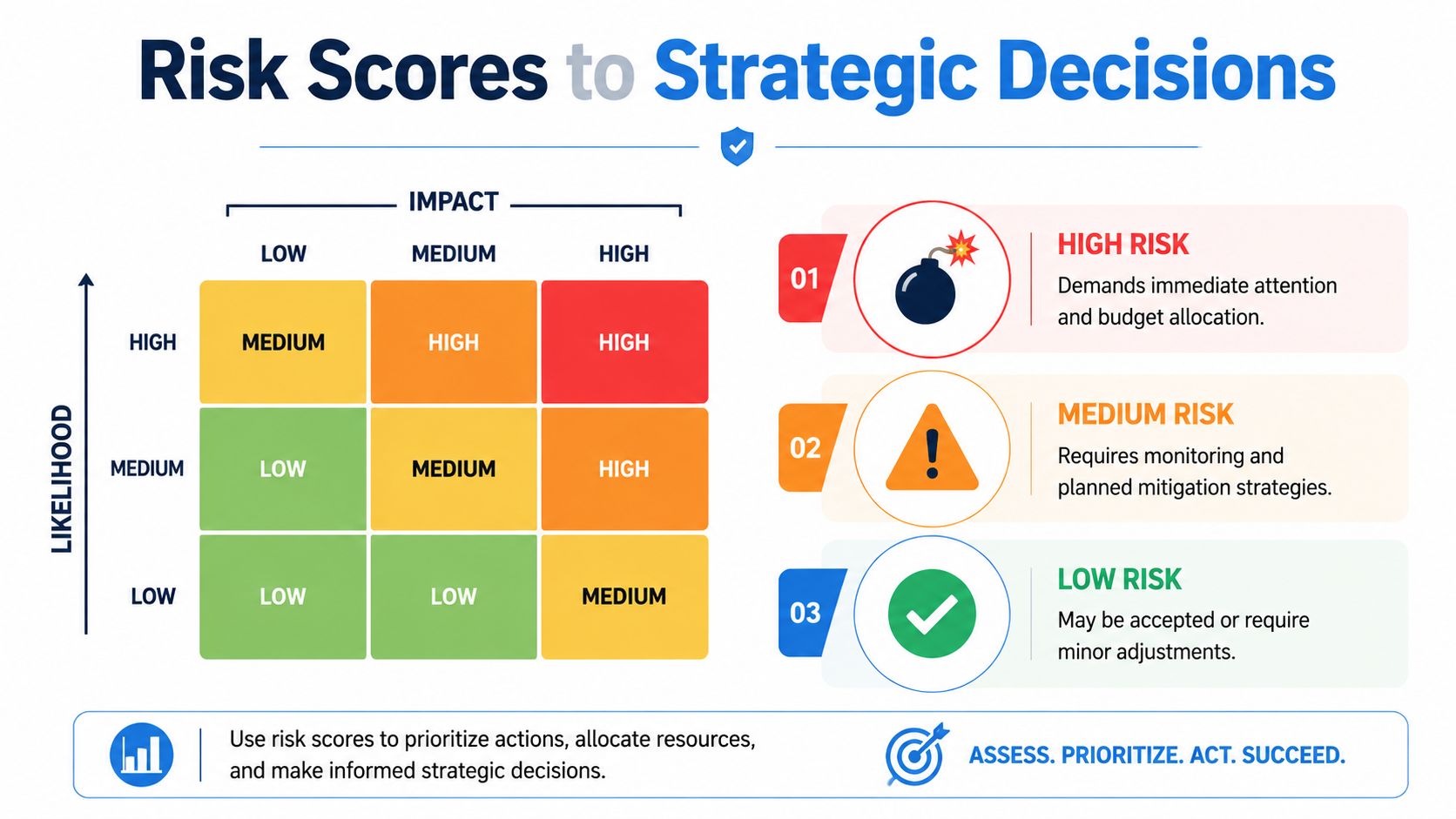
A risk matrix gives you a simple way to prioritize findings without pretending every client has perfect data. The common model is a 5x5 matrix. One side is likelihood. The other is impact.
According to Base Operations' breakdown of security risk assessment methodology, a robust process includes Risk Identification, Risk Analysis, and Risk Evaluation, and the analysis piece often uses 5x5 scoring matrices with anchor definitions.
Use plain scoring anchors
Don't just score from one to five and hope everyone interprets it the same way. Define the anchors.
For likelihood, use terms like Rare, Unlikely, Possible, Likely, and Almost Certain. For impact, use a matching range from minor business disruption to severe operational, compliance, or customer damage.
Here's a simple model.
Sample 5x5 Risk Matrix1 (Rare)2 (Unlikely)3 (Possible)4 (Likely)5 (Almost Certain)1 Low ImpactLowLowLowLowMedium2 Moderate ImpactLowLowMediumMediumMedium3 Significant ImpactLowMediumMediumHighHigh4 Major ImpactLowMediumHighHighHigh5 Severe ImpactMediumMediumHighHighCritical
How to score without guesswork
Start with the asset or process. Then ask two questions.
- How likely is this issue to be exploited or triggered?
- If it happens, how much business harm follows?
An exposed remote access service with weak authentication might score high on likelihood. A shared file repository with sensitive client records might score high on impact. When both land near the top, you've found a priority item.
Use evidence when you can:
- Technical exposure: Internet-facing systems, stale software, weak segmentation
- Business context: Regulated data, client contracts, operational dependency
- Control reality: MFA, logging, monitoring, backups, tested response plans
The matrix doesn't replace judgment. It organizes judgment so clients can act on it.
Why the matrix matters to sales and retention
A clean matrix helps you present risk without drowning the client in raw findings. Executives don't want twenty pages of scanner output. They want ranked issues tied to business outcomes.
That's why this step matters commercially. Your report becomes easier for a CFO, compliance lead, or operations head to understand. It also gives your GRC and technical teams a shared way to talk about urgency.
If you're still handing over a list of vulnerabilities with no clear priority, you're forcing the client to do your job for you.
Connecting Risk Scores to Business Decisions
A red box on a matrix gets attention. It doesn't get budget approval by itself.
To move from compliance theater to actual decision-making, you need to translate important risks into money. That's the gap most MSPs still leave wide open.
According to SecurityScorecard's explanation of quantitative risk assessment, a quantitative approach requires assigning a dollar value to each critical digital asset and calculating financial loss by multiplying that asset value by the estimated percentage of loss for a given risk event.
The simple formula MSPs should use
Start with the basic model:
Risk = Asset Value × Loss Percentage
That gives you a direct financial estimate for a scenario. It's not perfect. It is useful.
The same source gives a straightforward example: if a server is valued at $100,000 and the estimated loss impact is 40%, the quantified risk is $40,000. That number changes the conversation immediately.
Why this changes the client conversation
When you tell a client, "This is a high risk," you're giving them a label.
When you tell them, "This system supports revenue, regulated data, and critical operations, so the potential loss is substantial," you're getting closer.
When you show a quantified estimate tied to a control decision, leadership can finally compare cost versus exposure.
Use that in practical terms:
- Risk register entry: Critical cloud workload with weak access controls
- Business translation: Revenue interruption, recovery cost, compliance impact
- Decision point: Fund remediation now, accept the risk, or redesign the control stack
Where pentesting fits in
This is also where pentesting, penetration testing, and a real pen test become easier to justify. Instead of selling a technical service in isolation, you're validating a prioritized business risk.
That matters for SOC 2, PCI DSS, and broader compliance programs because clients don't just need a list of possible weaknesses. They need proof that the issues they funded were worth the money.
Board-friendly advice: Don't ask clients to buy security tools. Ask them to reduce a defined business exposure.
Most MSPs stay stuck in qualitative scoring because it's familiar. The firms that win trust are the ones that can say, "Here's the likely business impact, here's the control gap, and here's the smartest next move."
Validating Risk With Manual Penetration Testing
A risk assessment tells you where to look. A penetration test tells you whether the weakness is exploitable.
That's a huge difference. If your assessment says a system looks exposed, but nobody verifies the attack path, you're still making assumptions. For SOC 2, PCI DSS, and many client due diligence reviews, assumptions aren't enough.

Scan results are not the same as a pentest
This part gets abused constantly in the market.
According to DeepStrike's penetration testing cost breakdown, the cheapest engagements on the market are usually just automated vulnerability scans lacking manual validation. Pricing depends on scope. Request a quote for exact figures. That's the line MSP owners need to understand.
A scanner can flag issues. A manual pentest confirms exploitability, chains weaknesses together, and shows what an attacker could do.
What a real manual pen test includes
A strong engagement should include human validation, not just tool output. That means testers manually checking logic flaws, access paths, authentication weakness, privilege escalation opportunities, and real-world attack paths.
Look for teams with certifications like OSCP, CEH, and CREST. Certifications aren't magic, but they do signal that the people performing the work have been tested against recognized standards.
Here's the practical filter:
- Automated scan: Fast, cheap, broad, often noisy
- Manual penetration testing: Slower, focused, far more useful for proving risk
- White label pentesting: Best fit when an MSP or reseller wants to keep client ownership
Cheap scanning can support hygiene. It can't replace a real pentest when the client needs evidence.
Why channel partners need a better option
Most MSPs don't want to hire a full internal offensive security team. That's reasonable. The primary issue is finding a partner that delivers quickly, stays in their lane, and doesn't try to poach the client relationship.
If you need a model for that validation step, attested third-party manual pentesting is the kind of service structure channel firms should be looking for. Fast turnaround matters. So does staying white labeled.
When your risk assessment and your pen testing process work together, clients stop seeing security as paperwork. They start seeing proof.
Grow Your Security Services With Our Partnership
Your clients already need risk assessment, compliance support, and validation through real penetration testing. The only question is whether you'll own that work or send it somewhere else.
The market is full of slow firms, inflated pricing, and low-grade scanning sold as pentesting. That's bad for your margin and worse for your reputation. MSPs, vCISOs, GRC providers, CPAs, and other channel partners need a better model.
That's where a channel-only partner matters. You need affordable, fast, fully manual pentesting delivered under your brand, without competing for your accounts. You also need certified testers with OSCP, CEH, and CREST backgrounds who understand compliance-driven work across SOC 2, HIPAA, PCI DSS, and ISO 27001 environments.
Build the risk assessment methodology. Translate risk into business terms. Validate the findings with a real pen test. Then keep the client relationship where it belongs.
If you want a channel-only partner for affordable, fast, white label pentesting, our team also runs channel-delivered risk assessments and helps MSPs, vCISOs, and resellers deliver manual pentests without competing for the client. Contact us today to learn more.

.avif)
.png)
.png)
.png)

