

A ransomware readiness assessment is a hard look at whether a client would actually survive a ransomware hit. Not whether they bought the right tools, but whether the controls hold when someone is actively trying to encrypt everything. For MSPs, it's one of the easiest security services to sell, because every client is scared of ransomware and almost none of them have ever tested whether they'd recover.
Here's the gap it closes. Your client has backups, EDR, and MFA, and they assume that means they're covered. Assuming isn't testing. A ransomware readiness assessment pressure-tests those controls the way an attacker would, then hands back a prioritized list of what breaks first. MSP Pentesting runs it under your brand, channel-only, so the report comes back with your logo on it. Below is what it checks, how it runs, and how you add it without building a security team.
What a ransomware readiness assessment actually is
It's a focused test of the controls that decide a ransomware outcome: identity, endpoints, backups, segmentation, and the response plan. It isn't a generic audit. It asks one question over and over. When ransomware lands on this network, what stops it, what slows it, and what brings the business back.
That framing matters, because most clients grade themselves on what they own. Owning a backup tool isn't the same as restoring from it under pressure. The assessment cares about the second thing.
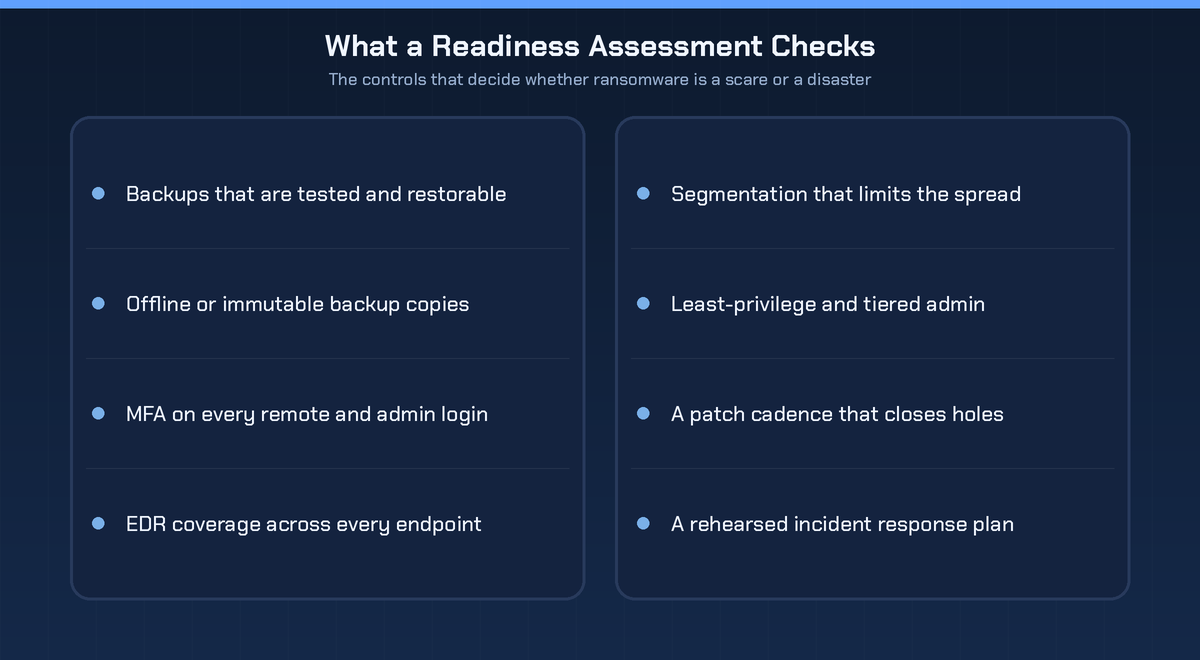
The controls that actually decide the outcome
A few of these carry most of the weight. Backups that get tested, not just scheduled, because plenty of teams find out their restores don't work on the worst possible day. Offline or immutable copies, so the ransomware can't encrypt the backups along with everything else. MFA on every remote and admin login, since stolen credentials are still the front door. EDR on every endpoint, not most of them. Segmentation that keeps one infected machine from becoming the whole network. Least privilege, so a single compromised account can't reach everything. A patch cadence that closes the holes attackers actually use. And a written incident response plan someone has actually rehearsed, because the middle of an attack is a terrible time to read one for the first time.
How a ransomware readiness assessment works
Clear path, run by a person, not a questionnaire the client fills out about themselves.
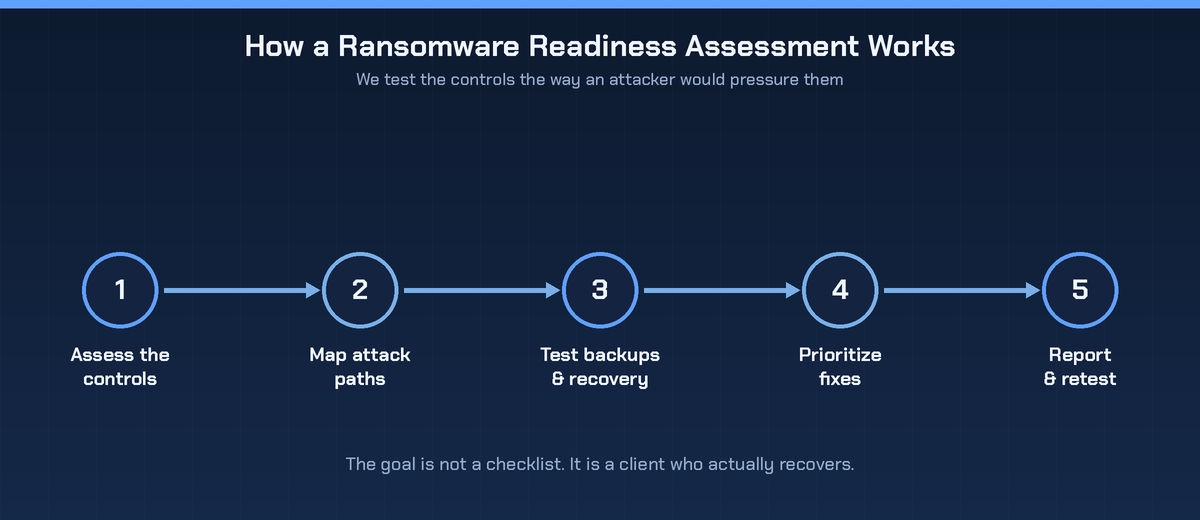
It starts by assessing the real state of the controls, then mapping the paths an attacker would take from a single foothold to full encryption. From there the tester puts the backups and recovery to an actual test instead of trusting the dashboard. Then everything gets prioritized by risk, so the client fixes what matters first instead of boiling the ocean. And after the fixes, a retest confirms the gaps are closed.
A readiness assessment isn't a pentest, and it isn't a scan
These get lumped together and they shouldn't be. A vulnerability scan lists known CVEs. A penetration test tries to break in and proves what an attacker could reach. A ransomware readiness assessment answers the question the other two skip: once they're in, does the business survive. They pair well. A pentest finds the way in, the readiness assessment tells you what happens next. Sell them together and the client gets the whole picture.
Why your clients need one now
Ransomware is still the threat that takes SMBs offline for days and drains the bank account doing it. And the pressure isn't only technical anymore. Cyber insurers now want proof that backups, MFA, and EDR are real before they'll write or renew a policy, and a readiness assessment is exactly the evidence that conversation needs. If a client is renewing insurance, chasing an audit, or just got spooked by a competitor's breach, the timing is now.
How MSPs deliver it without a security team
You don't need to hire incident responders to offer this. Scope the engagement with your client, hand the testing to a channel-only partner, and the report comes back under your brand. Your client sees your logo and your expertise, not ours. That's what white-label pentesting is built for, and readiness assessments are an easy add because so much of the value is in the analysis and the report. If you want the reseller pricing behind it, that's what the partner program is for.
What the report gives you
The report is what the client remembers, so it has to be more than a grade. A strong one opens with a plain-English executive summary the owner can act on, ranks every gap by how much it changes the ransomware outcome, gives concrete remediation steps, and shows the retest that proves the fixes held. Branded to you, clean, and free of scare tactics. That's a document that sells the next engagement on its own.
Frequently asked questions
How do you perform a ransomware readiness assessment?
You assess the controls that decide a ransomware outcome (identity, endpoints, backups, segmentation, response), map how an attacker would move from one machine to the whole network, actually test the backups and recovery, then hand back a prioritized roadmap and retest the fixes.
Is a readiness assessment the same as a pentest?
No. A pentest proves how an attacker gets in. A readiness assessment answers what happens after they're in and whether the business recovers. They complement each other, and many clients need both.
How often should a client have one?
At least once a year, and again after a major change, a new backup platform, an acquisition, a big shift in the environment, or an insurance renewal that asks for proof.
Do cyber insurers care about this?
Increasingly, yes. Insurers want evidence that core controls like MFA, EDR, and tested backups are actually in place, and a readiness assessment produces exactly that evidence.
The bottom line
Every client fears ransomware, and almost none of them have tested whether they'd survive it. That gap is the opportunity. A ransomware readiness assessment turns a vague fear into a prioritized plan, gives you a natural upsell next to pentesting, and delivers through the channel with your brand on the report. Assess the controls, test the recovery, prove the fixes, and hand the client something that actually protects them.

.avif)
.png)
.png)
.png)

