
You cannot be the independent third party for a network you administer. That single sentence is why third-party penetration testing exists as a category, and why MSP Pentesting only sells through the channel. It isn't a comment on your skill. It's a definitional problem: the frameworks your clients are being measured against define independence by who manages the system, and you manage the system.
So when a client forwards you a contract clause demanding an independent test, you've got two options. Refer the work out and lose the relationship, or bring in a tester who works under your brand and stays organizationally separate from your operations team.
Second option keeps the logo yours.
What the frameworks actually say
People throw "independent third party" around like it means one thing. It doesn't. Three of the documents your clients care about most use the phrase differently, and the differences matter when you're deciding who can sign what.
PCI DSS is the most specific
PCI DSS v4.0.1 requirement 11.4.3 says external penetration testing is performed "By a qualified internal resource or qualified external third party" and that "Organizational independence of the tester exists (not required to be a QSA or ASV)." Requirement 11.4.2 says the same thing for internal testing.
Read that carefully, because two things fall out of it.
First, the tester doesn't have to be an outside company. An internal team can do it if that team is organizationally separate from the people who build and run the cardholder data environment. Second, the tester doesn't have to be a QSA or an ASV. PCI says so in the requirement text, in parentheses, presumably because assessors got tired of being asked.
What PCI does hard-mandate a named vendor for is scanning, not testing. Requirement 11.3.2 puts external vulnerability scans in the hands of a PCI SSC Approved Scanning Vendor, at least once every three months. That's a list you're either on or you aren't. Penetration testing has no such list, which surprises a lot of MSPs who assume the two rules are the same rule.
Two more clauses worth knowing. Requirement 11.4.5 applies the same independence language to segmentation testing. Requirement 11.4.6 tells service providers to test segmentation controls at least once every six months, not twelve. If your client is a service provider, their cadence just doubled.
SOC 2 is quieter than you think
Here's the thing nobody tells you: SOC 2 doesn't require a penetration test. No numbered criterion says so.
CC4.1 maps to COSO Principle 16 and reads that the entity "selects, develops, and performs ongoing and/or separate evaluations to ascertain whether the components of internal control are present and functioning." The points of focus underneath it name penetration testing first, ahead of independent certifications and internal audit assessments. Points of focus aren't requirements. They're the AICPA telling you what it had in mind.
In practice, auditors have converged on it anyway. Ask a service auditor what evidence they'd accept for CC4.1 in a Type 2 report and most will describe a penetration test. So the requirement is real even though the words aren't.
The independence that's genuinely enforced in SOC 2 sits somewhere else entirely: on the CPA firm. Under the AICPA Code of Professional Conduct, nonattest services provided to an attest client are governed by ET section 1.295, and the firm has to evaluate whether those services create a self-review threat it can't reduce to an acceptable level. Translation: the same firm auditing your client's controls shouldn't also be the firm that built or tested them without a hard look at independence first.
That's a good thing to know when a client's auditor casually offers to bundle in the pentest.
Cyber insurance turns it into a warranty
Insurers don't publish a standard. They ask questions on an application, and the answers become part of the contract.
Plenty of carriers now ask whether an independent third party performs annual penetration testing, alongside the questions about multi-factor authentication, endpoint detection and immutable backups. Answer yes and you've made a representation the carrier relied on when it priced and issued the policy.
Get that wrong and the fight isn't about the claim, it's about the policy. Material misrepresentation on an application is grounds to rescind, and rescission means the coverage gets treated as if it never existed. Carriers have taken that route in court over a multi-factor answer. Your client's penetration testing answer sits on the same form, a few lines down.
If you fill out a client's cyber insurance questionnaire on their behalf, you're the one supplying answers that can void their coverage. Read that sentence again before your next renewal season.
| Where the clause lives | What it actually demands | Can the incumbent MSP do it? |
|---|---|---|
| PCI DSS 11.4.2 and 11.4.3 | Qualified tester, organizational independence, no QSA or ASV required | No, if the MSP manages the in-scope systems |
| PCI DSS 11.3.2 | External scans by a PCI SSC Approved Scanning Vendor, every three months | Only if the MSP is itself a listed ASV |
| SOC 2 CC4.1 | Ongoing or separate evaluations, with pentesting named as an example | Technically yes, but the auditor will discount it |
| Cyber insurance application | Whatever the question says, answered as a binding representation | Depends on the wording, and the wording is rarely kind |
Why you're structurally disqualified, and why that's fine
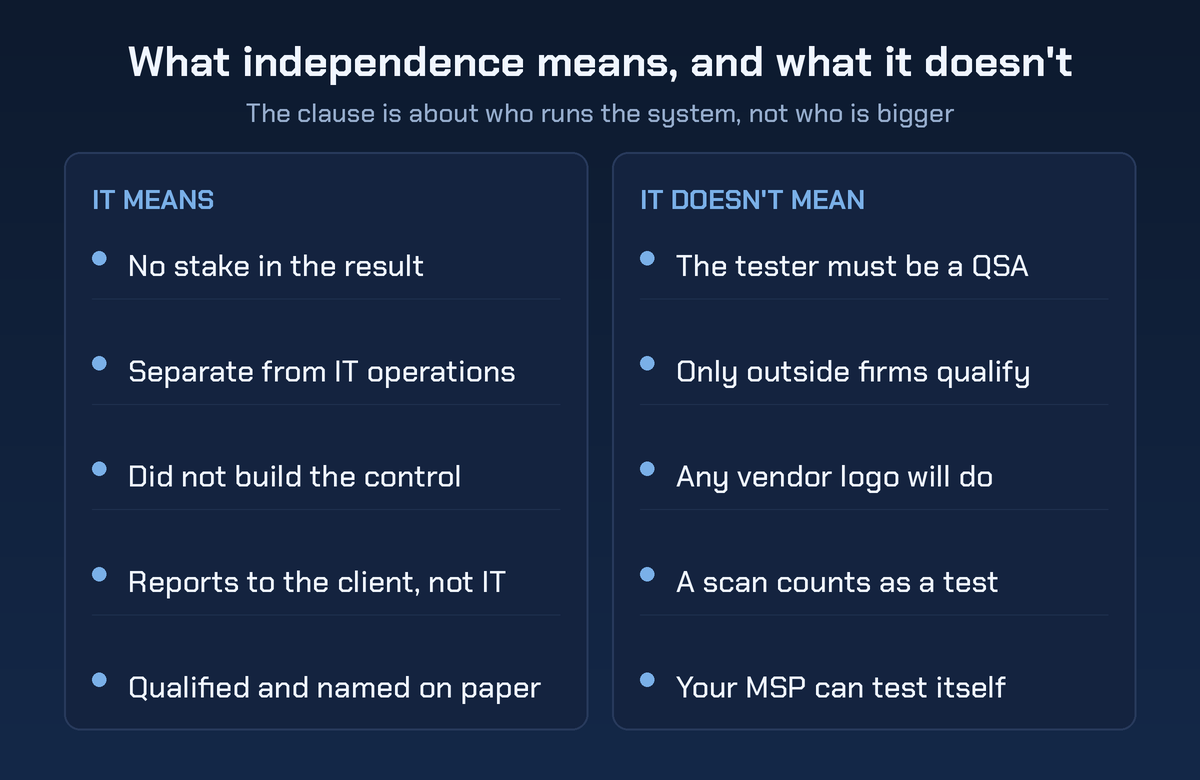
Independence in every one of these documents comes down to one question. Does the tester have a stake in the answer?
You built the firewall rules. You chose the EDR. You set the conditional access policies and you wrote the backup runbook. A finding against any of those is a finding against you, and no amount of professionalism changes how that looks to an assessor or an underwriter.
There's also the practical version of the problem. You can't find what you don't know to look for, and the blind spots in a network you've run for six years are precisely the ones you installed.
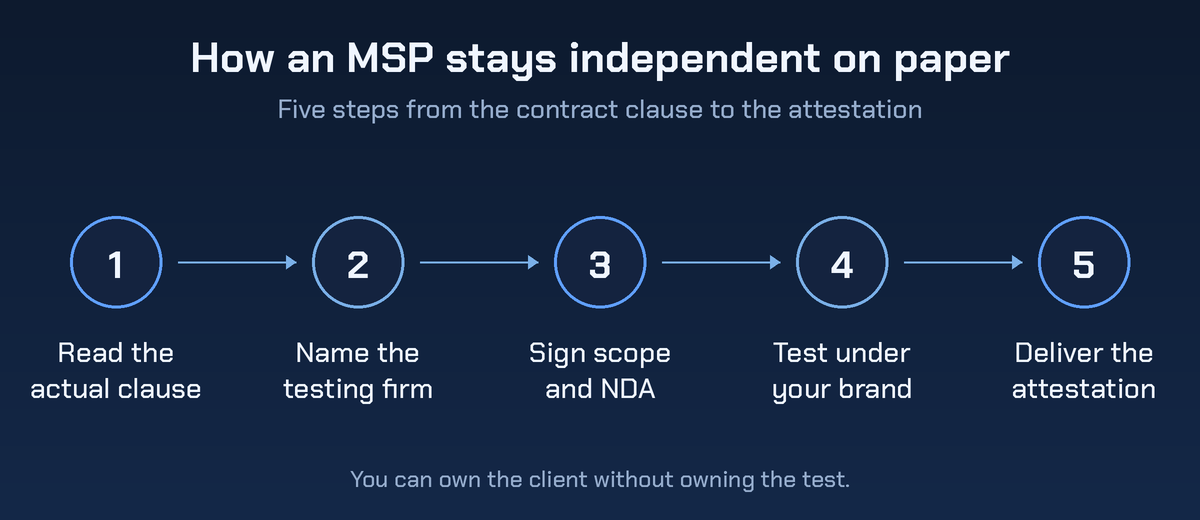
None of this means you lose the revenue. It means the tester and the operator have to be different entities. A white-labeled pentesting arrangement puts a separate firm on the engagement letter while the report, the remediation plan and the follow-up work stay with you. Your client's assessor sees an independent tester. Your client sees you.
3rd party penetration testing is not third-party risk management
These get confused constantly, and searches for 3rd party penetration testing land on vendor risk pages all the time. They're opposite jobs.
Third-party risk management is inbound. It's about the vendors your client depends on: the payroll processor, the EHR host, the MSP. You're assessing whether somebody else's security is good enough to trust. That's questionnaires, SOC 2 reports you read rather than produce, and contract language. Our risk assessment work sits on that side of the line.
Third-party penetration testing is outbound. It's about being the independent tester somebody else relies on. Different deliverable, different buyer, different clause in the contract.
A client who asks for "third party testing" usually means the second one. A client who sends you a 90 question spreadsheet means the first. Ask which before you quote.
What to check before you pick a testing partner
The clause says independent and qualified. Independent you can establish structurally. Qualified you have to verify, because PCI deliberately declines to define it and SOC 2 never tries.
- A stated methodology. PTES, NIST SP 800-115, the OWASP Testing Guide. Assessors ask which one, and "our internal process" is a weak answer.
- Manual testing, evidenced in the report. Business logic flaws and chained vulnerabilities don't come out of a scanner. If every finding maps to a CVE, you bought a scan.
- Named testers with named credentials. OSCP, GPEN, CREST, whatever the firm actually holds. You'll be asked.
- Retest included. PCI 11.4.4 expects exploitable findings to be corrected and testing repeated. If retesting is a separate line item, the engagement isn't finished when the report lands.
- Channel terms in writing. Non-solicitation, your logo on the deliverable, and no direct contact with your client unless you're in the room.
What clients ask about independence
Does the tester have to be an outside company?
Under PCI DSS, no. The requirement text allows a qualified internal resource as long as organizational independence exists. For the MSP that runs the environment, though, external is the only clean route, because the independence test is about who manages the systems and that's you.
Does my client's auditor have to approve the tester?
Usually not in advance. The assessor evaluates the evidence after the fact: the methodology, the scope, the tester's qualifications and whether the scope matched the environment being assessed. Getting scope agreed with the assessor before testing starts saves an argument later.
Can we white-label an independent test and still call it independent?
Yes, as long as the testing firm really is separate and the engagement documents show it. Independence is about organizational separation and who has a stake in the findings, not about whose logo sits on the cover. Where MSPs get into trouble is claiming to have performed testing they subcontracted while representing themselves as the tester of record.
Do we need a QSA to run a PCI penetration test?
No. Requirement 11.4.3 says it in the text, in parentheses: not required to be a QSA or ASV. External vulnerability scanning under 11.3.2 is the part that genuinely requires an ASV.
What does a client actually receive at the end?
A full technical report, an executive summary and, where the client needs something short to hand an auditor or a customer, a letter of attestation confirming the test happened, the dates, the scope and the tester. No test result guarantees an audit outcome, and any firm promising one is selling you a problem.
The clause is the pitch
Every SOC 2 readiness call, PCI scoping exercise and insurance renewal eventually produces the same sentence about an independent third party. Your client will read it, look at you, and ask whether you can do it.
The right answer is that you can arrange it, own the outcome and stay on the remediation. Just not perform the test yourself on systems you administer.
That's the whole channel model, and clients accept it easily once somebody explains why the rule exists. If you'd rather have the conversation with the clause in front of you, get a pentest quote and send us the language your client is working from.

.avif)
.png)
.png)
.png)

