
Most MSPs think they already know their clients' environments. They don't.
A client adds a SaaS tool without telling anyone. A dev spins up a cloud workload for a short project and forgets it. A remote office keeps an old firewall alive because nobody wants downtime. Those loose ends turn into exposed entry points, and your client still assumes you've got everything covered.
That's why attack surface mapping matters. It gives you a real picture of what's reachable, what's exposed, and what could hurt both your client and your reputation. If you manage multiple tenants, the stakes are even higher. One missed exposure can turn into a client retention problem, a compliance problem, and a sales problem all at once.
What Is Attack Surface Mapping for an MSP
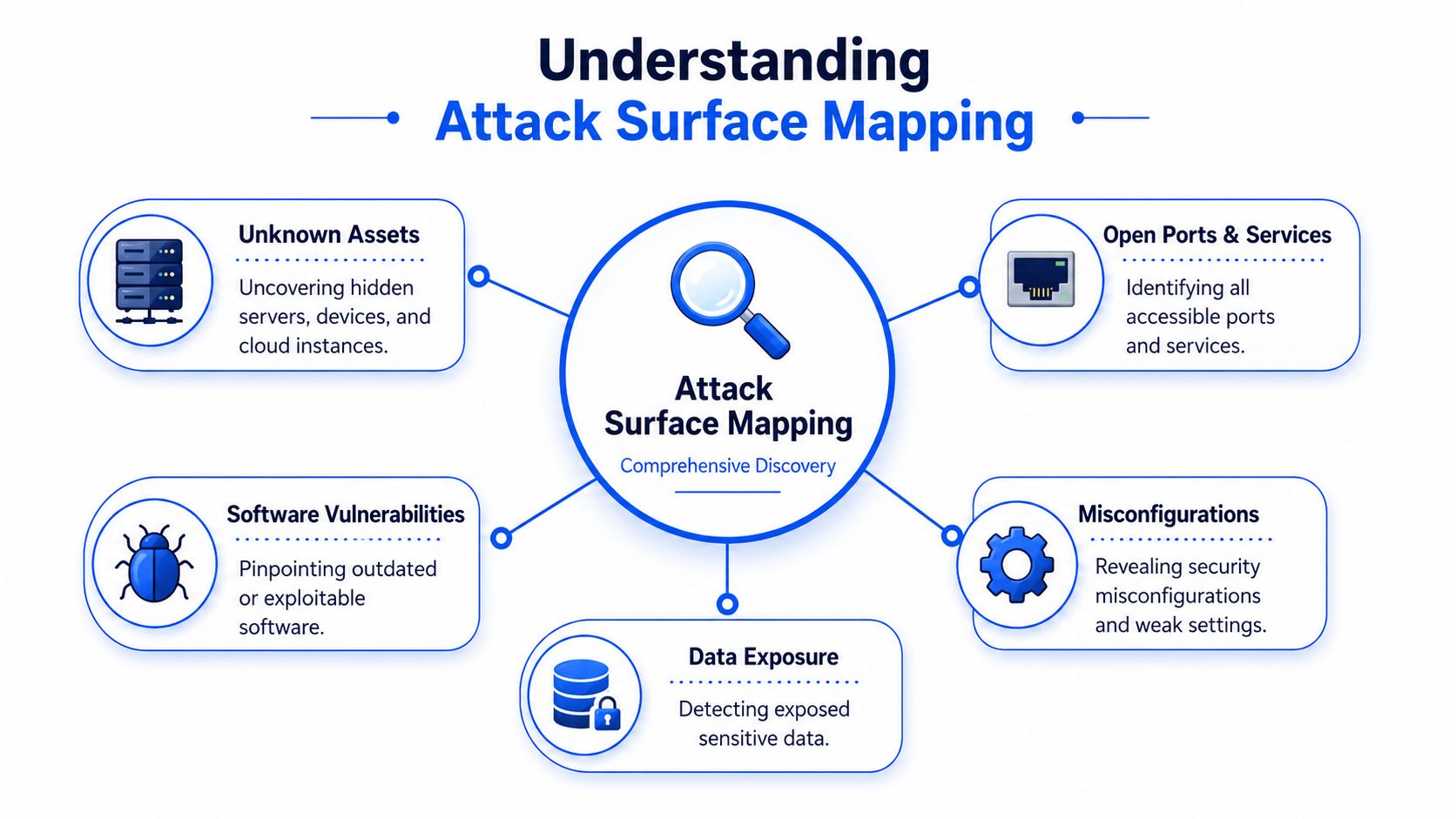
Attack surface mapping is the process of finding every digital door, window, and side entrance a client has. That includes internet-facing assets, cloud resources, exposed services, web apps, and the things nobody remembered to document.
For an MSP, this isn't just another scan. It's the groundwork for a real risk assessment. If you don't know what exists, you can't secure it, prioritize it, or explain the risk to a client's leadership team.
It's a lifecycle, not a one-time task
Attack surface work only fails when people treat it like a checkbox. Skyhawk's definition of attack surface management is the right one: “Effective attack surface management is defined as a continuous lifecycle encompassing discovery, mapping, inventory, risk analysis, classification, prioritization, monitoring, and threat mitigation across all assets processing sensitive data, rather than a one-time audit.”
That's the model MSPs should sell. Not a snapshot. A process.
If a client asks how this differs from a scanner, give them the simple version. A scanner checks known things for known issues. Attack surface mapping first answers the bigger question: what do you have exposed in the first place?
Practical rule: Don't offer a penetration test before you understand the client's exposed footprint. Scope without mapping is guesswork.
What this looks like in practice
A solid engagement usually includes:
- Asset discovery: Domains, subdomains, public systems, web apps, cloud services, and forgotten systems.
- Exposure review: Open services, weak configurations, unnecessary access, and obvious weak points.
- Prioritization: Which findings matter now, and which can wait.
- Ongoing review: New assets appear all the time, especially in cloud-heavy environments.
If you're still leading with simple scan reports, you're leaving value on the table. A security vulnerability scanning approach has a place, but it isn't the same thing as understanding the full attack surface.
Why Mapping Protects Your Clients and Revenue
The business case is simple. If you're not offering attack surface mapping and penetration testing, somebody else will.
Clients don't leave MSPs only because of poor support. They leave when they think their provider missed something important. Security blind spots create doubt fast, especially when a vCISO, CPA, or GRC advisor starts asking harder questions about SOC 2, HIPAA, or PCI DSS readiness.

Multi-tenant drift is your real problem
Single-company advice doesn't fit the MSP model.
That's exactly the issue. You're not managing one network. You're managing many environments with shared tooling, shared processes, and sometimes shared identity paths. Drift in one tenant can become an issue across your book of business.
If you manage multiple client environments, your exposure isn't additive. It's connected.
This service changes your client relationship
Attack surface mapping moves you out of the “help desk plus patching” box. It gives you a strategic security conversation that clients will pay for because it ties directly to compliance, board reporting, insurance questions, and vendor reviews.
It also helps you defend margin. Instead of racing competitors on commodity support pricing, you add a security service that is easier to justify and harder to replace.
Here's where MSPs usually win:
- Client retention: You become the team that finds risk before it becomes an incident.
- Higher-value projects: Mapping often leads to remediation work, segmentation projects, policy updates, and deeper pentesting.
- Compliance pull-through: Clients working toward SOC 2, HIPAA, ISO 27001, or PCI DSS need stronger evidence than “we ran a scan.”
Exploring Every Part of the Attack Surface
A complete attack surface isn't one thing. It's a collection of places an attacker might use to get in, move around, or steal data.
A good way to explain it to clients is to compare it to a building. The outside matters, but what happens after someone gets through the front entrance matters just as much.
The main areas you need to map
- External network: This is the public face of the building. Domains, remote access portals, internet-exposed services, and anything visible from outside.
- Internal network: This is what happens after someone gets in the lobby. If an attacker lands on one workstation, what can they reach next?
- Cloud infrastructure: Think of this as rented office space with lots of moving parts. Misconfigurations in AWS, Azure, or GCP can expose data and services fast.
- Web applications: Client portals, login pages, forms, dashboards, and APIs all create opportunities for abuse.
- Third-party connections: Vendors, integrations, and remote support tools often become trusted shortcuts into the environment.
MSP360's guidance on penetration testing gets this right: thorough pentesting must cover multiple attack vectors including internet-based network penetration, social engineering via human targets, web application vulnerabilities, and physical building access to fully map the complete attack surface.
Why scope matters
Most bad pen testing engagements fail before they start. The scope is too narrow. Someone only checks the firewall, or only tests the web app, then calls it complete.
That's not complete. That's partial visibility dressed up as assurance.
A vCISO or reseller should scope for how attackers behave. They don't care how your org chart is drawn. They care about the easiest path to valuable systems and data.
Manual Pentesting vs Automated Scanning for Mapping
A common pitfall for many MSPs occurs when a vendor runs an automated scan, exports a report, changes the label to “pen test,” and the client thinks they bought real assurance.
They didn't.
Scanners find possibilities
Automated tools are useful for coverage. Tools like OWASP ZAP, Arachni, and Skipfish can help crawl web applications and identify reachable components, which aligns with OWASP's attack surface analysis guidance. They're good at surfacing obvious issues and helping teams map broad exposure quickly.
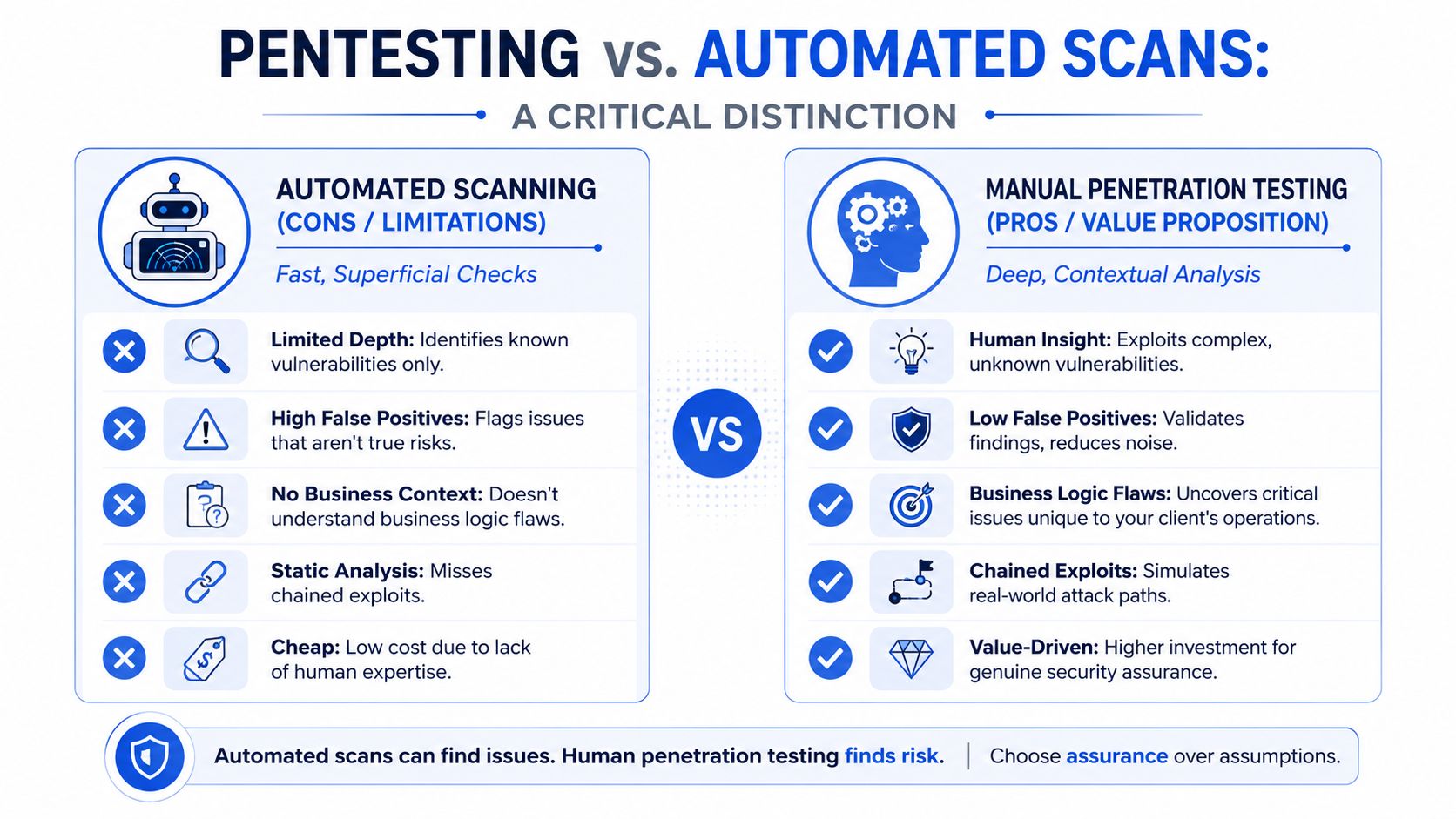
But they don't think. They don't chain findings. They don't understand business logic. They don't test how far a real attacker can go once access is gained.
Humans prove impact
Todyl makes the distinction clearly: a real pen test conducted by credentialed engineers reveals what an attacker can do once inside the network, whereas a scanner only identifies potential entry points, making manual adversary-simulated testing the only valid method for true attack surface mapping.
That's why manual pentesting matters. Certified pentesters with OSCP, CEH, and CREST credentials can validate whether a finding is real, exploitable, and meaningful. That cuts noise and gives clients something they can act on.
Bottom line: Automated scanning gives you breadth. Manual penetration testing gives you truth.
A practical model is to use automation to support discovery, then use human-led pen testing to verify risk and show impact. If you want a plain-English breakdown of where automation fits and where it falls short, this guide on automated and AI pentesting is worth reviewing.
What clients actually buy
Your clients aren't buying a list of CVEs. They're buying answers to questions like:
| Need | Automated scanning | Manual pentest |
|---|---|---|
| Broad visibility | Good | Good |
| Business context | Weak | Strong |
| Chained exploit testing | Weak | Strong |
| False positive reduction | Weak | Strong |
| Compliance credibility | Limited | Stronger |
That's why affordable manual pentesting is the sweet spot. It gives you a service that's credible enough for ISO 27001, PCI DSS, and broader compliance conversations without the bloated process and pricing that large firms often push.
Offer White Label Penetration Testing Services
You do not need to build an internal pentest team to sell this well.
That's the mistake a lot of MSPs make. They assume they need to hire specialists, buy tooling, create reporting templates, and somehow keep utilization high. Most never get there, so they keep referring work out and losing control of the account.
A cleaner reseller model
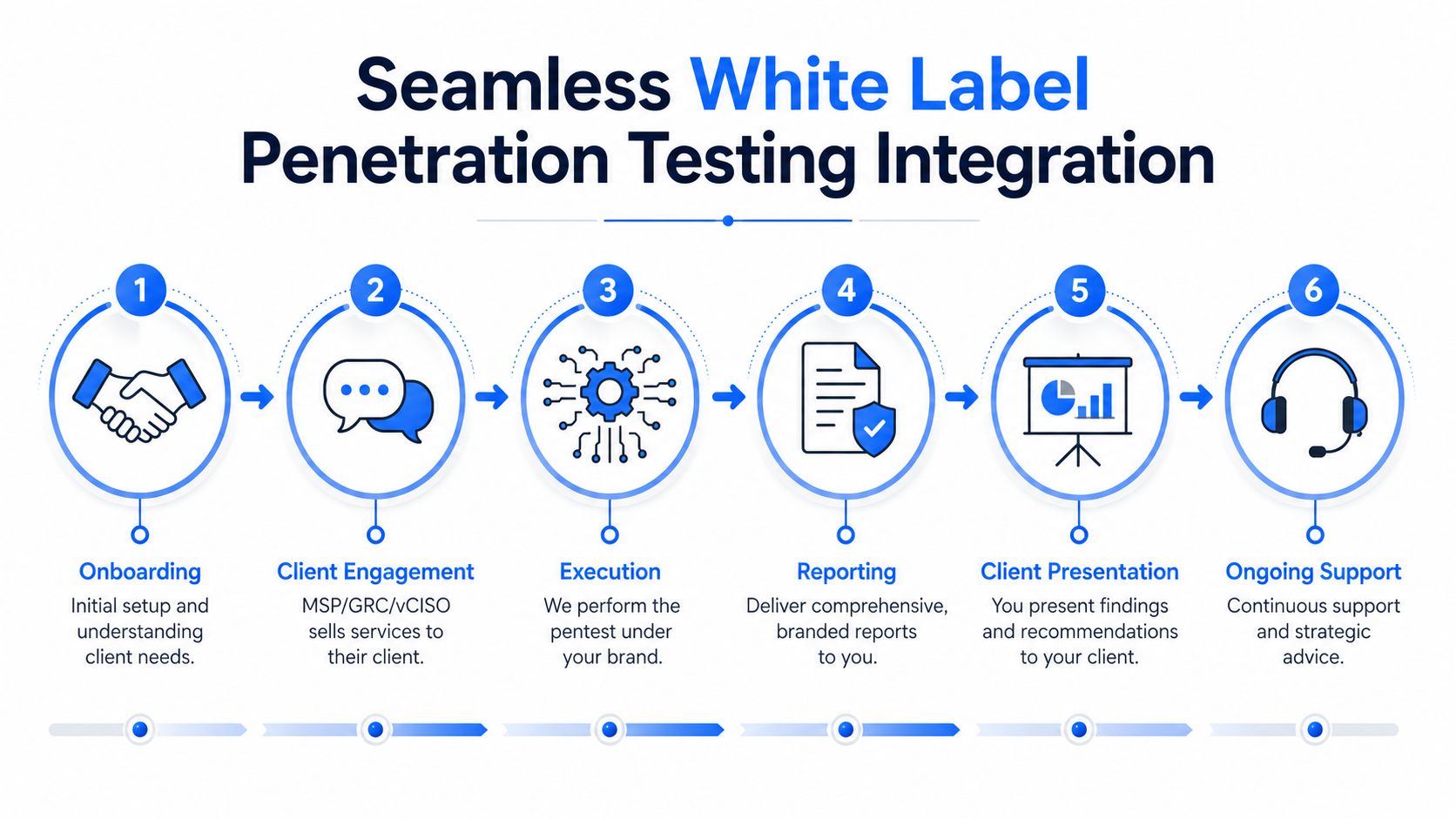
The better move is white label pentesting. You keep the client relationship. Your client sees you as the advisor. The delivery happens behind the scenes.
That model works especially well for MSPs, vCISOs, and GRC firms that need to attach security testing to roadmap work, audits, and recurring compliance programs.
A simple playbook looks like this:
Find the trigger
A client needs a risk assessment, a compliance review, a renewal package, or proof of security testing.Scope the exposure
Define whether the work includes external, internal, web application, cloud, mobile, social engineering, or physical attack paths.Deliver the test under your brand
A channel-only partner performs the work while you stay in front of the client.Present findings and remediation
You guide the conversation, tie findings to business risk, and create follow-on services.
Why this is easy to sell
Shadow IT keeps creating openings. Unit 42 reports that over 23% of organizations suffer from critical attack surface vulnerabilities due to unsanctioned services or “shadow IT” that remain undetected by standard security baselines. That gives MSPs a concrete reason to offer mapping plus penetration testing as an ongoing service, not a one-off event.
If you want a model built around the channel, white label penetration testing for MSP partners shows how that structure works. MSP Pentesting is one example of a provider focused on channel-only delivery across external, internal, web, mobile, cloud, physical, and social engineering assessments, with certified pentesters and white-labeled reporting.
Partner With Us for Affordable Pentesting
The compliance and managed services market has a pricing problem. Too many firms charge enterprise rates, stretch timelines, and deliver shallow testing dressed up as premium work.
That creates an opening for smart MSPs and resellers. If you can offer affordable, fast, manual penetration testing with a clean white-label model, you keep deals in-house, protect your accounts, and grow margin without building a huge internal security team.
You also need the right partner model. A channel-only provider matters because you should never worry that the company doing the work is trying to take your client. That line needs to stay clear.
If you want to stand out, stop treating pentesting as a referral. Sell attack surface mapping, pair it with real pen test services, and make it part of your ongoing compliance and security strategy. That's how you stay relevant to SOC 2, HIPAA, PCI DSS, and ISO 27001 buyers. That's also how you stop competing on commodity support alone.
Learn more and contact us today.
If you're an MSP, vCISO, GRC firm, CPA, or reseller that wants fast, affordable, manual, white-labeled pentesting without channel conflict, start with our external pentesting service.

.avif)
.png)
.png)
.png)

