
Your client didn't wake up one morning excited about cloud security frameworks. Their customer pushed them. An auditor pushed them. A prospect asked for proof of SOC 2, ISO 27001, HIPAA, or PCI DSS readiness, and now your phone rings.
That's a key issue for an MSP, vCISO, GRC firm, CPA, or reseller. This isn't just about technical hygiene. It's about keeping accounts, protecting recurring revenue, and making sure another provider doesn't walk in with a better compliance story and take your seat.
Most providers still handle this badly. They throw a checklist at the client, run a scanner, and call it security. Clients are getting smarter than that. They want evidence, not jargon. They want a partner who can explain the framework, map it to risk, and validate the controls with real pentesting, pen test, penetration test, and penetration testing work.
Why Your Clients Suddenly Care About Cloud Frameworks
One of your clients lands a bigger customer. Great news, until procurement asks for proof that their cloud environment follows a recognized security framework. Now the client needs answers fast, and if you can't guide them, somebody else will.

The pressure is justified. In 2025, 45% of all data breaches occurred in cloud environments, and cloud intrusions rose 37% year over year, according to Exabeam's 2025 cloud security statistics. Clients aren't asking for framework alignment because it sounds mature. They're asking because cloud risk is now a boardroom problem.
A lot of MSPs still treat cloud compliance as a side conversation. That's a mistake. Framework questions usually show up right before renewal, procurement review, cyber insurance review, or enterprise onboarding. If you don't have a clean answer, your client starts shopping.
For a quick look at the kinds of exposure driving these conversations, review these common cloud computing security risks. It helps frame the client discussion around business risk instead of generic fear.
What clients are really asking
They usually aren't asking, “Can you explain the CSA CCM in detail?”
They're asking things like:
- Can we pass the customer security review?
- Can we support our SOC 2 effort?
- Can we prove our cloud is locked down?
- Can we show someone tested this?
Practical rule: When a client asks about a framework, they're usually asking whether you can help them keep a deal, pass an audit, or avoid a nasty surprise.
Why this matters to your business
Framework guidance makes your services stickier. If you help a client choose the right standard, map controls, and validate them with a proper risk assessment and penetration testing plan, you move from vendor to trusted advisor.
That creates three obvious business wins. Better client retention. Higher-margin security services. A stronger competitive position against generic IT shops that still confuse compliance with a vulnerability scan.
Comparing Major Cloud Security Frameworks for Compliance
Most clients don't need a lecture on standards. They need the right one for their business, their buyers, and their data. Your job is to simplify the mess.
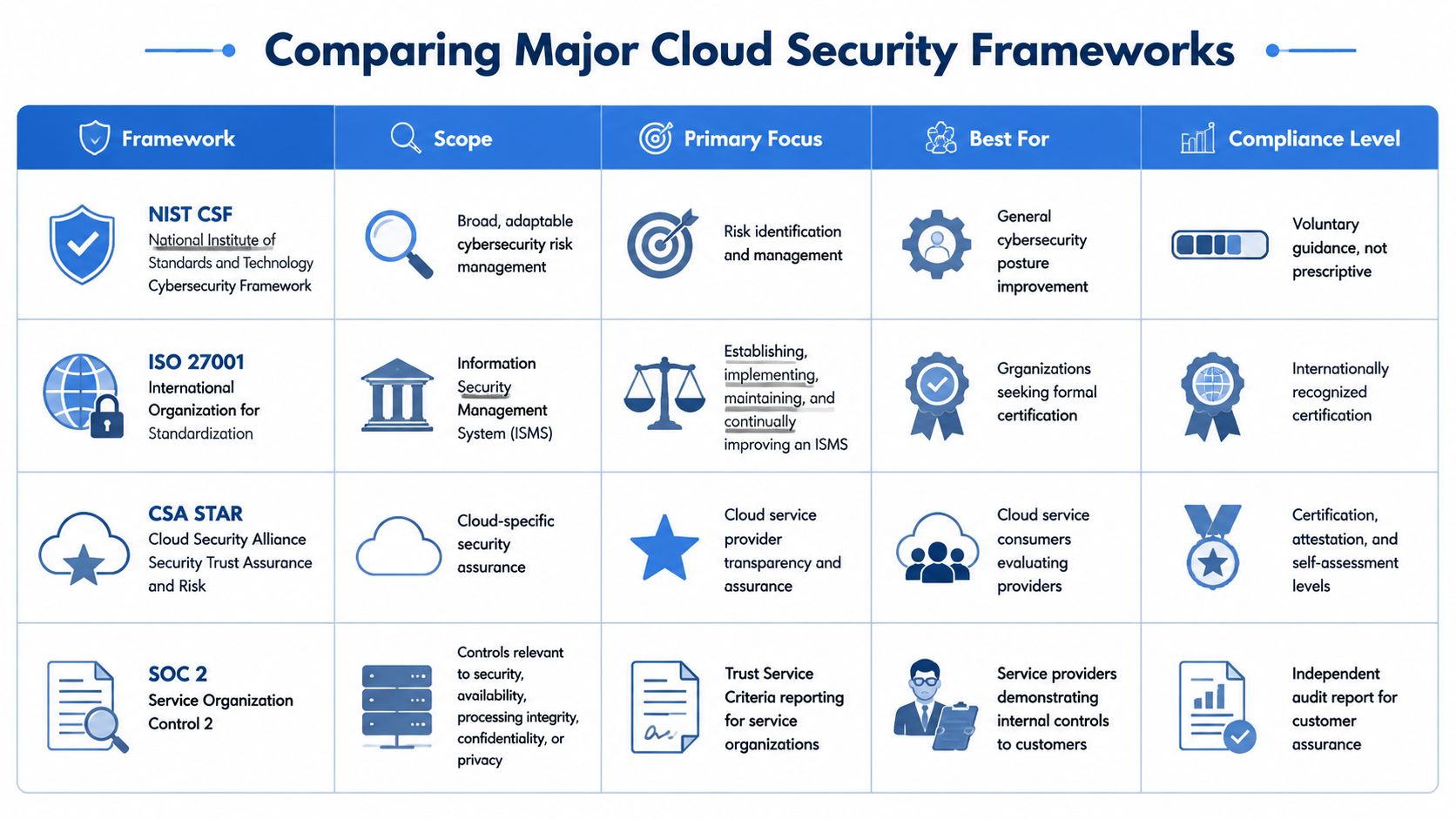
The frameworks that come up most
Here's the plain-English version.
FrameworkWho needs it mostWhy it mattersNIST CSFMid-market companies, regulated organizations, public sector adjacent clientsGives a practical structure for identifying, protecting, detecting, responding, and recoveringISO 27001Companies that want formal certification and global credibilityBuilds an information security management system clients and auditors recognizeISO 27017Organizations securing cloud workloads under ISO-style governanceAdds cloud-specific guidance to ISO 27001, especially around shared responsibilitySOC 2SaaS providers and service companies selling to larger customersHelps prove internal controls to prospects and customersPCI DSSAnyone storing, processing, or transmitting payment card dataNon-negotiable if payments are in scopeCSA CCMTeams that want cloud-specific control mappingStrong baseline for aligning cloud controls across multiple compliance demandsCIS Controls and BenchmarksMSPs that need technical hardening guidanceGood for operational baselines and day-to-day cloud hardening
The Cloud Controls Matrix is one of the best starting points because it's cloud specific and broad without being vague. The Cloud Controls Matrix overview from TuxCare notes that the CCM includes 197 control objectives across 17 domains and helps organizations align with major regulations like GDPR, HIPAA, and SOC 2.
How to explain each one to a client
Use simple language.
- NIST CSF fits clients that need a flexible risk model. Good for organizations that want a strong security program without chasing a certification first.
- ISO 27001 fits clients selling into mature procurement environments. If customers ask for formal certification, this usually enters the chat fast.
- ISO 27017 matters when cloud roles and shared responsibility get muddy. It helps define what the provider secures and what the customer still owns.
- SOC 2 matters for service businesses. If your client sells software, handles customer systems, or stores sensitive business data, their prospects will ask for it.
- PCI DSS is simple. If card data is involved, it's mandatory.
- CSA CCM helps when clients need cloud-specific control coverage that maps well to other requirements.
- CIS is practical when the immediate need is hardening AWS, Azure, or GCP configurations.
If your client is drowning in questionnaires, start with the buyer requirement. The framework usually reveals itself fast.
Use frameworks to shape service packaging
MSPs have an opportunity to be more strategic. Don't sell “security help.” Sell a path.
For example, a startup preparing for SOC 2 often also needs policy work, cloud control review, evidence collection, and validation. If they're budgeting for automation, resources like Drata startup credits can help lower the cost of the compliance stack.
If you support public sector or highly regulated environments, it also helps to understand NIST 800-53 cloud control expectations. That gives you a stronger way to map technical work to governance language your clients already hear from auditors and customers.
Helping Your Clients Choose The Right Framework
You don't need a giant decision tree. You need a few sharp questions.
Start with business triggers
Ask the client:
- What industry are you in?
- What data lives in the cloud?
- What are customers, auditors, or insurers asking for?
- Are you trying to win bigger accounts?
- Do you need certification, attestation, or just a stronger security baseline?
That conversation gets you most of the way there.
A healthcare client storing regulated data will naturally lean toward HIPAA-aligned controls. A SaaS vendor trying to close enterprise deals will usually care about SOC 2. A company with payment flows can't ignore PCI DSS. A globally minded organization may lean toward ISO 27001 and ISO 27017 because buyers recognize them.
Match the framework to the real outcome
Don't frame it as a technical project. Frame it as a business choice.
- Need to satisfy customers fast. Focus on the framework buyers already ask for.
- Need a broader security operating model. Start with NIST CSF.
- Need formal certification credibility. Push toward ISO 27001.
- Need cloud-specific control mapping. Bring in CSA CCM and cloud hardening guidance.
Turn this into advisory revenue
This is easy consulting work if you package it right. A short discovery session, a cloud risk assessment, and a framework recommendation can lead straight into remediation, policy mapping, and validation services.
For a stronger structure, use a cybersecurity risk assessment framework to guide the conversation. It helps you move from “Which framework do we need?” to “What gaps do we need to fix first?”
The MSP that can translate compliance language into plain business decisions usually keeps the client longer.
A simple recommendation model
Use this rough model in live calls:
- Customer asks for proof. Start with the requested framework.
- No formal requirement yet. Start with NIST CSF plus cloud-specific control baselines.
- Cloud complexity is high. Add ISO 27017 or CSA CCM thinking.
- Audit pressure is rising. Pair framework work with validation, not just documentation.
That last point matters most. Frameworks on paper don't protect anyone. Working controls do.
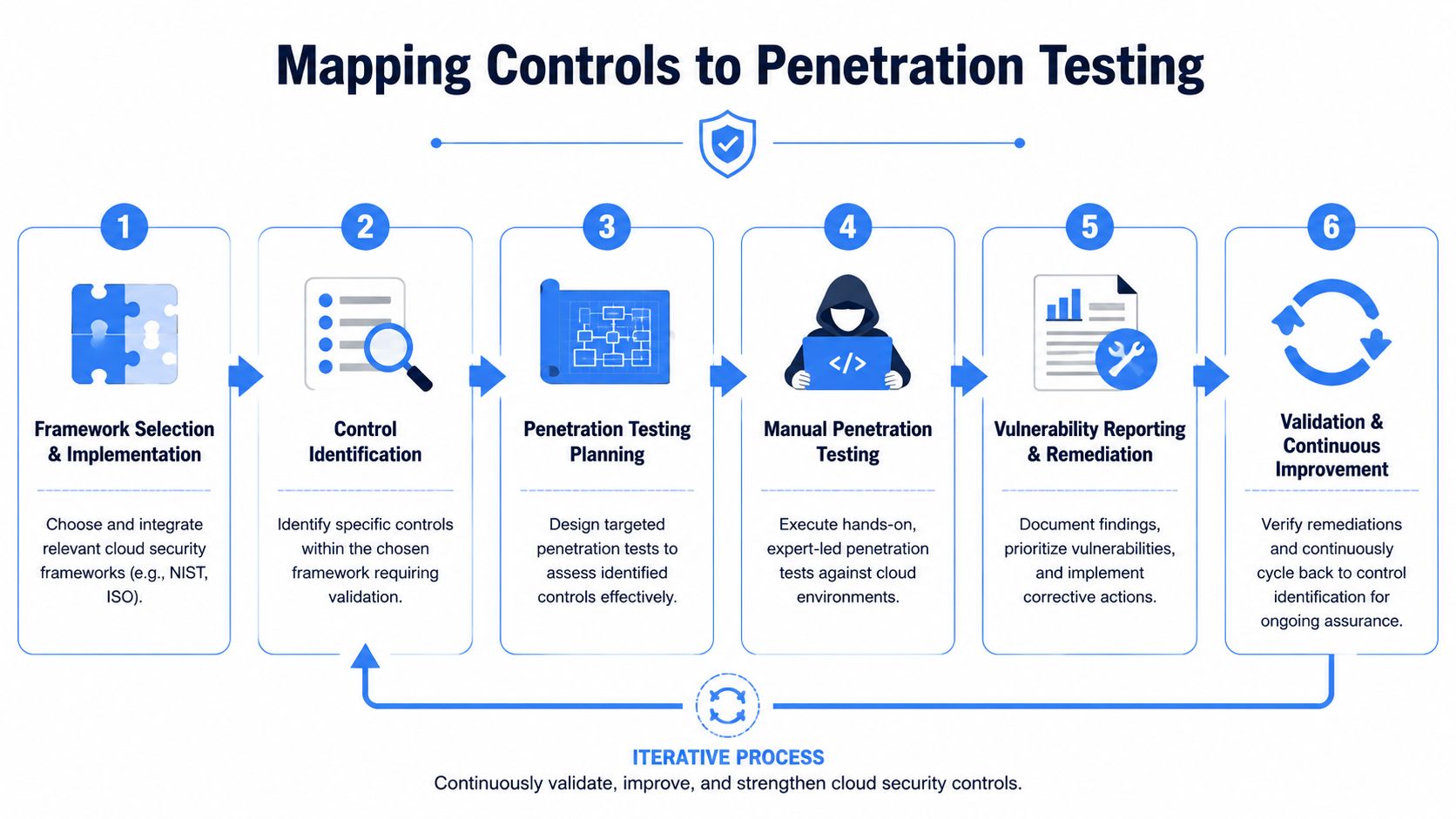
Mapping Framework Controls to Manual Penetration Testing
A framework without validation is paperwork. That's the part too many providers skip.
Why scanners don't solve this
You can run a CSPM tool all day and still miss the thing that matters. Misused permissions. Broken access paths. Chained weaknesses. Runtime issues that only show up when a human tester pushes the environment the way an attacker would.
That gap is bigger than most MSPs admit. Plenty of providers never integrate pentesting into their cloud compliance work at all, and lean on static scans that miss the runtime issues a human tester would surface. This overview of cloud security architecture is a useful primer on where those gaps form.
That's the core problem. Frameworks require controls. Clients assume those controls are effective. Static tooling often can't prove that.
What a manual penetration test validates
A proper manual pentesting engagement can test whether the framework controls hold up under pressure.
Here's how that maps in practice:
- IAM controls get tested through privilege escalation checks, access path reviews, and identity abuse scenarios.
- Data protection controls get tested by looking for exposed storage, weak secrets handling, and unsafe access routes.
- Configuration and workload security gets tested through hands-on review of cloud services, workloads, and attack paths.
- Network security gets tested by validating segmentation, exposed services, and lateral movement opportunities.
- Monitoring and response assumptions get challenged when testers generate realistic activity and examine whether the client catches it.
Certifications matter here
If you're selling penetration testing as part of a compliance or assurance package, quality matters. A lot.
Certified testers with OSCP, CEH, and CREST backgrounds bring stronger methodology, cleaner reporting, and better judgment than generic scan-and-send shops. They know when a cloud issue is exploitable, when it's noise, and how to write findings a client can act on.
Reality check: An auditor may accept a report. Your client still needs a report that helps them fix the environment.
Speed and affordability change the offer
Many MSPs get stuck. They know clients need a penetration test, but the old buying model is painful. Long waits, bloated pricing, and firms that don't understand channel relationships.
That's why a fast, affordable, white label model works so well for MSPs, vCISO teams, and resellers. You can scope the engagement, position it under your brand, and deliver something real instead of outsourcing trust to a third party that confuses your client.
How to package it
Bundle the work around the framework the client already cares about.
Client needGood service comboSOC 2 preparationGap review, control mapping, manual pen test, remediation validationHIPAA cloud reviewRisk assessment, access review, cloud penetration testing, report for leadershipPCI DSS supportScope review, segmentation validation, external and internal penetration testISO 27001 maturityControl mapping, evidence support, manual pentesting, retest
That's how frameworks become revenue. You're not selling a document. You're selling clarity, proof, and lower client friction when they face a buyer, auditor, or insurer.
Your MSP Checklist for Cloud Security Services
You don't need a huge practice buildout to start. You need a simple process you can repeat.
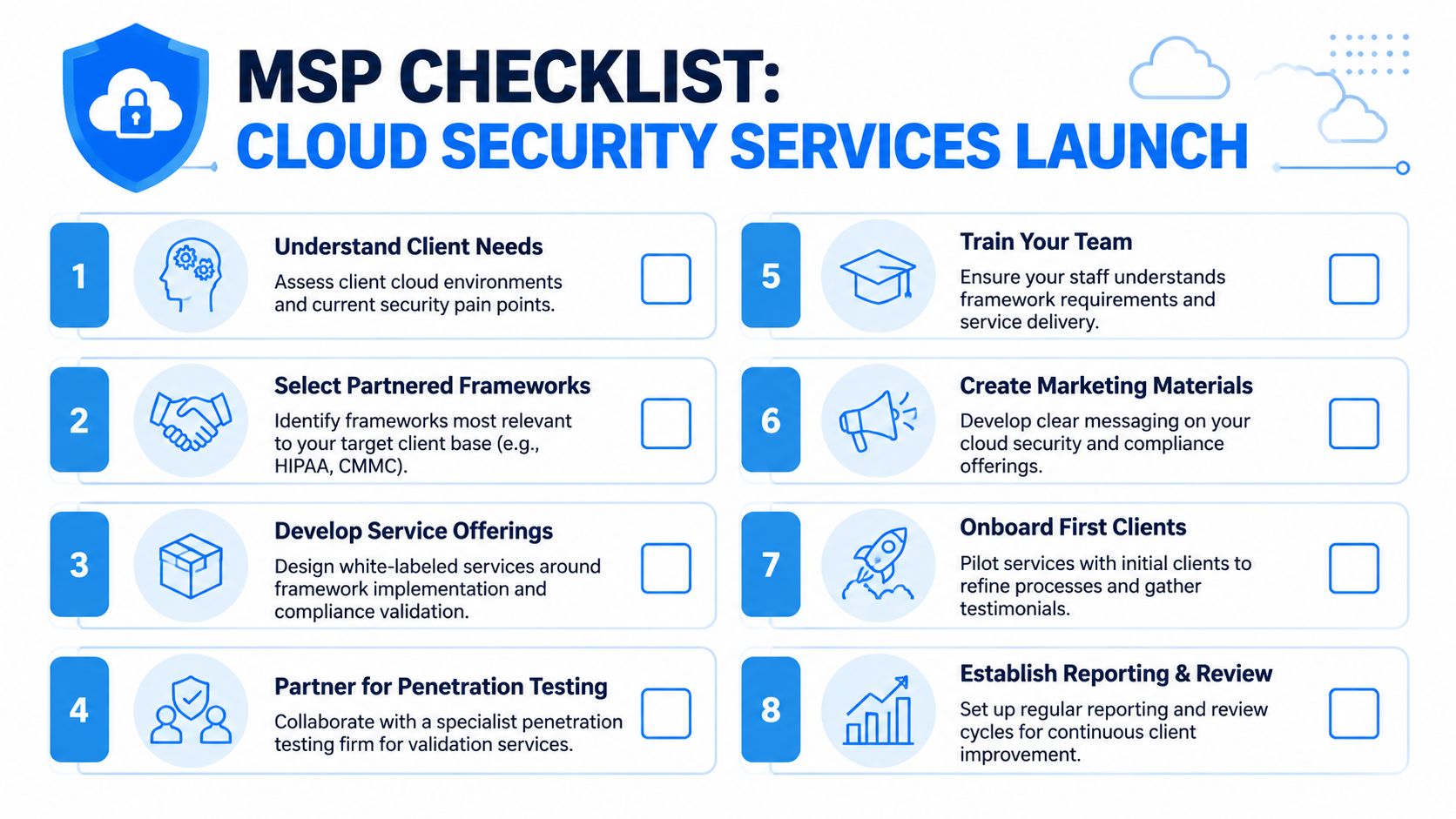
Build the offer in order
- Review your client base and flag who faces SOC 2, HIPAA, PCI DSS, or ISO 27001 pressure.
- Package a light advisory session so your account managers can identify which cloud security frameworks fit each client.
- Add a risk assessment layer that turns vague security concerns into named gaps and priorities.
- Line up a white label pentesting partner that can deliver affordable, manual pentesting without competing for the account.
Keep delivery simple
Don't overcomplicate the first few deals.
- Run discovery on the cloud environment and business requirement.
- Recommend the right framework path based on customer and regulatory pressure.
- Scope the pen test or penetration testing engagement around the relevant controls.
- Deliver findings under your brand with remediation guidance and a clear retest option.
Protect margin and trust
Many resellers fail. They either underprice the work or hand the client directly to a security vendor that starts building its own relationship.
Use a channel-only model. Keep ownership of the client conversation. Present the testing, reporting, and remediation follow-up as part of your broader compliance and advisory service.
The easiest security revenue to lose is the revenue you refer away.
Partner With Us for White Label Pentesting
Your clients already need stronger cloud security answers. They need framework guidance, a clear risk assessment, and proof that their controls work. If you don't offer that, another MSP, vCISO, or security reseller will.
The old model is still broken. Prices are inflated. Methodology is weak. Lead times are ridiculous. That's not acceptable when a client is trying to close a deal, satisfy SOC 2 demands, support HIPAA work, or respond to a PCI DSS requirement.
A better model is simple. Affordable, manual pentesting performed by certified testers with OSCP, CEH, and CREST credentials. Fast turnaround. White label delivery. Channel-only partnership. No competition with your firm.
And speed matters. Pentestly's MSP pen testing article notes that traditional penetration testing often carries a long lead time, while a channel-focused model turns work around far faster.
If you want to keep clients longer, increase margin, and offer real security validation instead of another checklist, this is the move.
Want to add affordable, fast, white label pentest, pen testing, penetration test, and penetration testing services without competing against your own partner? See how we test under your brand and keep the client relationship.

.avif)
.png)
.png)
.png)

