
Your client just asked for help getting ready for SOC 2. They didn't call a CPA first. They called you.
That's the opportunity.
Most MSPs treat SOC 2 work like a messy side project. It isn't. It's a sticky, high-value service line that can pull in recurring compliance work, annual pentest and pen testing engagements, policy updates, evidence reviews, and advisory support across SOC 2, HIPAA, PCI DSS, and ISO 27001.
The problem is that the market is packed with slow firms, bloated statements of work, and weak technical testing. Clients get jargon, long timelines, and inflated pricing. You need a cleaner model. Sell the strategy, own the client relationship, and use a white-label partner for the specialized work you don't want to build in-house.
Why MSPs Must Offer SOC 2 Compliance Services
A buyer asks your client for a SOC 2 report. Your client turns to you because you already run their environment, handle their stack, and answer the hard security questions. If you can't help, they'll find someone who can. Once that outside firm gets in, your account gets exposed.
SOC 2 is a voluntary framework from the AICPA for service organizations to report on how they manage customer data. It comes in two forms: Type 1 for a point-in-time review and Type 2 for a review over a period, typically months. It has become a foundational benchmark for buyers assessing vendors, MSPs, and cloud providers, according to University of Tulsa guidance on SOC 2 compliance.

That matters for your business because buyers don't see SOC 2 as optional trust theater. They use it to screen vendors. If your clients handle data, host applications, provide managed services, or support regulated workloads, SOC 2 conversations will keep landing on your desk.
Why this turns into recurring revenue
You don't need to become an audit firm. You need to package SOC 2 compliance services in a way that's simple for clients to buy.
That usually means combining a few services under one banner:
- Advisory support for scoping, readiness, and control mapping
- Technical validation such as pentest, penetration testing, and risk assessment work
- Operational support for evidence collection, remediation tracking, and annual reviews
Practical rule: If your client already trusts you with security operations, they'll expect you to guide compliance decisions too.
A lot of MSPs already offer pieces of this but never bundle it clearly. If that sounds familiar, tighten the offer and frame it as part of a broader IT compliance services strategy. Buyers respond better when they can see a path, not a pile of disconnected tasks.
Breaking Down SOC 2 Service Components
SOC 2 scares people because they think it's one giant audit event. It isn't. It's a chain of smaller jobs that need to happen in the right order.
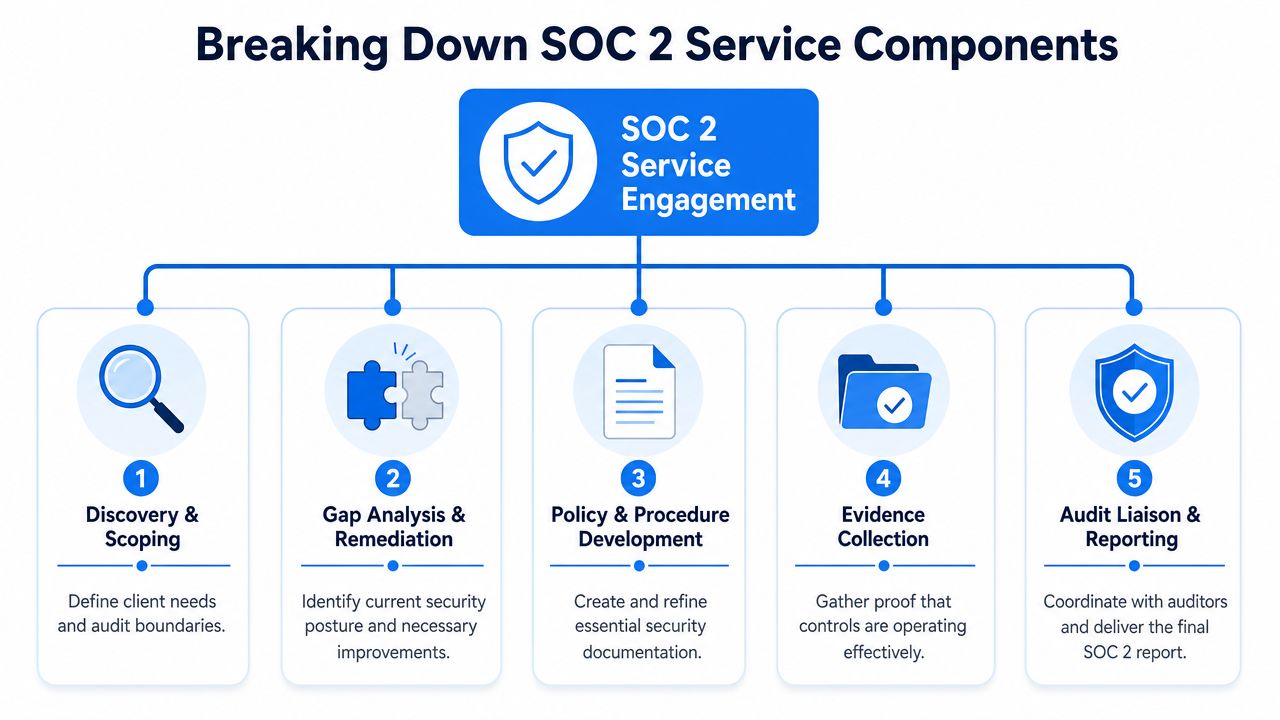
A useful way to sell it is to break the engagement into clear parts the client can understand and your team can manage.
Discovery and scope control
Start with scope. If you scope badly, everything after that gets slower and more expensive.
SOC 2 is built on the Trust Services Criteria, with security mandatory. A compliance program needs a control system with evidence for access control, intrusion detection, and vulnerability management, and auditors need proof those controls operate over time, meaning logs, tickets, and reviews matter as much as the controls themselves, as explained in Palo Alto Networks' overview of SOC 2.
That means your first job is deciding what systems, people, vendors, and workflows belong inside the engagement. Don't let the client dump their entire business into scope because they're nervous.
Gap analysis and remediation planning
A gap analysis is simple. You find the holes before the auditor does.
Some gaps are governance issues. Missing policies, weak onboarding and offboarding, no formal access review process. Others are technical. Poor logging, missing alert response records, weak vulnerability handling, or no documented change control.
Use the output to build a remediation plan with owners and dates. If there's no owner, it won't get fixed.
Policies and procedures that match reality
Bad policy work kills momentum. Plenty of firms hand clients generic documents that don't match the environment.
Your policy set needs to describe what the client does. If the stack runs in Microsoft 365, Azure, AWS, Google Workspace, or a line-of-business SaaS environment, the policy language should line up with those tools and workflows. Otherwise the evidence won't support the paperwork.
Policies don't pass audits by themselves. Auditors want to see that people followed them.
Evidence collection and audit support
At this stage, projects frequently bog down. Clients think they're done once controls exist. They're not.
You need proof that the controls ran consistently. That can include access review records, change tickets, incident records, training artifacts, logging output, vendor assurance documents, and remediation notes.
A solid white-label partner helps with:
- Evidence mapping so each artifact ties to a specific control
- Request management so clients don't drown in back-and-forth
- Auditor coordination so the project doesn't stall over unclear requests
That's the actual product. Not a binder. Not a template library. A managed process that keeps the client moving.
How Penetration Testing Supports SOC 2 Audits
A pentest is like hiring a trusted expert to check whether your doors and windows are locked in practice. Not whether you wrote a rule saying they should be locked. Whether they are.
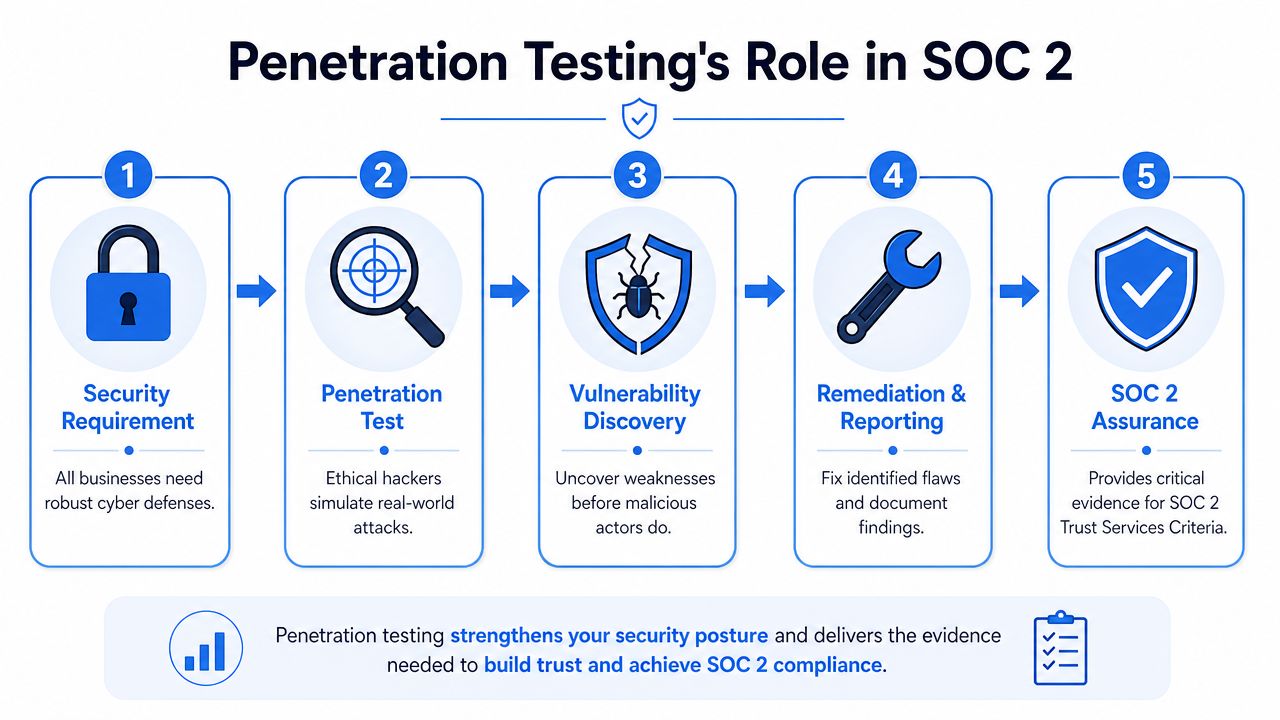
That's why pentesting, pen testing, penetration test, and penetration testing work matters in SOC 2. The security criterion is about real controls, not security theater. If a client says they manage vulnerabilities and protect systems, someone should verify that in a realistic way.
Why automated scans aren't enough
An automated scanner has a job. It flags common issues quickly. That's useful.
But a scanner is not the same as a manual penetration test. It doesn't think like an attacker, chain weaknesses together, or validate how far a flaw can really go. For a client facing an auditor, a board, or a serious customer security review, cheap scan-only reporting looks thin.
Manual pentesting gives you stronger evidence and better remediation guidance. It also gives your client something they can defend when a buyer asks tough follow-up questions.
What good penetration testing looks like
You want a partner whose testers hold real certifications and perform manual work. OSCP, CEH, and CREST matter because they signal that the people doing the work have been tested themselves.
A strong engagement should include:
- Defined scope for internal, external, web application, cloud, or tenant-specific environments
- Manual validation of findings so the report isn't padded with noise
- Remediation guidance your MSP team can act on fast
- White-labeled reporting that fits your brand and client delivery model
If you need a deeper look at how this connects to audit readiness, this guide on SOC 2 penetration testing for MSPs is worth reviewing.
Weak pen testing creates fake confidence. Good pentesting creates a fix list. Our walkthrough of SOC 2 pentesting services covers what belongs in that scope.
One option in the channel is MSP Pentesting, which provides white-labeled pentest services for partners and states that its team includes OSCP, CEH, and CREST-certified pentesters. For MSPs, vCISOs, and GRC firms, that model is useful because it separates client ownership from technical delivery.
Navigating SOC 2 Pricing and Project Timelines
At this stage, most deals wobble. The client asks two questions right away. What's this going to cost, and how long is this going to take?
Give a vague answer and you lose credibility.
What the market gets wrong
SOC 2 work is often overpriced because too many firms treat every project like custom legal drafting plus endless consulting hours. They drag out scoping, over-document obvious controls, and bury clients in meeting invites.
Industry guidance estimates SOC 2 audit costs at roughly $20,000 to $150,000 or more, depending on company size, system complexity, audit scope, and whether the organization pursues Type I or Type II, according to A-LIGN's guide to SOC 2. That number gets worse when the client starts unprepared and every remediation item becomes billable chaos.
You should be direct with clients about this. The audit itself is only part of the spend. Readiness work, technical testing, cleanup, and annual control tasks add real labor.
What timelines actually depend on
Timelines are driven by control maturity, not paperwork. Most organizations take 6 to 12 months for a Type 2 report, while a Type 1 audit typically finishes in 3 to 6 months, based on IT GOAT's SOC 2 timeline overview.
That's why weak operations create expensive delays. If the client can't show access reviews, alert handling, policy version control, or consistent change records, they aren't “almost ready.” They're early.
A realistic way to frame delivery is this:
- Type 1 readiness works for clients that need a faster trust signal and have decent controls in place already
- Type 2 readiness fits clients that need stronger buyer assurance and can support sustained evidence collection over time
- Annual work doesn't go away because activities like penetration testing, access reviews, and incident response testing are expected at least annually
How to price profitably as a reseller
Don't sell SOC 2 support as a vague consulting bucket. Package it.
Build tiers around outcome and effort. Example structure:
- Readiness package for scoping, gap review, and remediation roadmap
- Technical package for pentest, risk assessment, and validation work
- Managed compliance package for evidence support, policy upkeep, and recurring reviews
That gives clients a clean quote and gives you margin control. It also keeps your sales team from reinventing the deal every time.
How to Select Your White Label SOC 2 Partner
Picking the wrong partner can wreck the whole service line. The client sees delays, muddy reports, or confusing recommendations, and your brand takes the hit.
That's why partner selection needs to be ruthless.
Channel-only matters more than people admit
If your white-label partner also sells direct, you've created your own competitor.
A channel-only model removes that problem. The partner delivers the specialized work, you keep the account, and the client relationship stays clean. That's how this should work. Resellers should not have to wonder whether a subcontractor is about to become a “strategic advisor” to their client.
This isn't unique to security. Agencies deal with the same issue in other outsourced services. If you want a parallel example of how channel-safe delivery protects margins and client ownership, this breakdown of PPC management for agencies shows the same principle in another service category.
Scope experience is not optional
A major challenge for MSPs is SOC 2 scoping for multi-tenant environments. It's difficult to decide where one client's environment ends and another begins while still satisfying auditors, as noted in Venn's discussion of SOC 2 scoping.
Weak partners get exposed. They either over-scope everything and drive cost up, or under-scope shared systems and create audit risk.
Ask direct questions:
- How do you scope shared RMM, PSA, documentation, SIEM, and identity tools?
- How do you handle subcontractors and inherited controls?
- How do you document customer-specific environments without dragging every tenant into one giant control narrative?
If they answer with fluff, move on.
Buyer filter: If a partner can't explain multi-tenant scoping in plain English, they're not ready for MSP work.
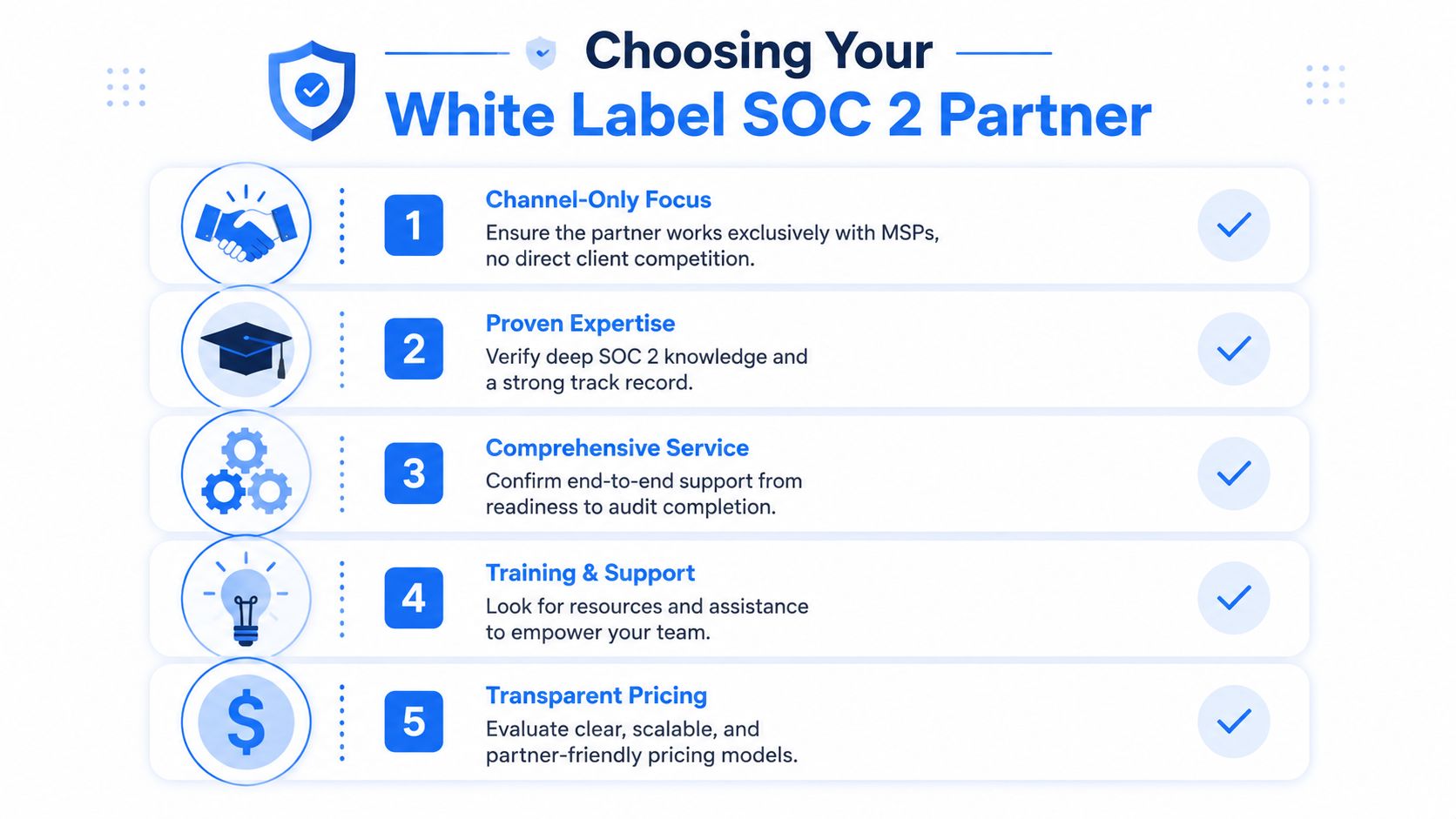
The checklist I'd use
Use this list before you sign anything or bring them into a client call.
- Channel-only commitment so they never compete for your client
- Certified talent including people with OSCP, CEH, and CREST for pentesting and penetration testing work
- Fast quoting because long presales cycles kill close rates
- White-label deliverables with your branding and your communication flow
- Real support for vCISO, GRC, and CPA-led engagements where technical and audit language both matter
You should also look at how they support adjacent frameworks. Clients asking for SOC 2 often ask about HIPAA, PCI DSS, ISO 27001, or a broader risk assessment next.
If you're actively evaluating a channel model, review a dedicated pentest partner program for MSPs and resellers and compare it against your checklist. Don't buy on personality. Buy on process, scope discipline, and channel safety.
Sample SOC 2 Service Contract Deliverables
If a partner says they “handle SOC 2,” ask what you receive. If they can't show deliverables, you're buying promises.
Use this checklist in your statement of work and reseller review.
Partner With Us for Your SOC 2 Needs
SOC 2 can be profitable for an MSP. It can also turn into a time sink if you rely on overpriced consultants, weak pen test vendors, or partners who don't understand reseller delivery.
The fix is simple. Keep the client. Package the work clearly. Use a white-label partner that can handle manual pentesting, compliance support, and fast turnaround without competing for the account.
If you support MSPs, vCISOs, GRC firms, CPAs, and other resellers, this model gives you a way to sell SOC 2 compliance services without building every specialty in-house. It's cleaner for your team, easier for your client to buy, and better for your margins.
Learn more and start the conversation today.
If you want a channel-only partner for white-labeled pentest, pen testing, and SOC 2 support, talk to us about how the partner program works.

.avif)
.png)
.png)
.png)

