
.png)
%202.png)
Achieving a SOC 2 audit is a huge milestone for any Managed Service Provider (MSP), vCISO, or GRC company. It's how you prove your commitment to security and build client trust. But getting there can feel like navigating a maze, with a long list of security controls that seem overly complex. You not only need to implement strong protections but also prove they work to an auditor, which often means dealing with slow, expensive consultants.
Many of our partners get frustrated with the long waits and high prices for essential services like penetration testing, which auditors commonly expect as evidence for SOC 2 monitoring criteria. You need a clear, direct path to understanding these controls and a reliable, affordable partner to help you test them. This guide cuts through the fluff. We'll break down the key items from the official SOC 2 security controls list, explain what auditors look for, and show how expert manual pentesting verifies your security.
This article is your roadmap to a smoother, faster audit. We focus on what you, as a reseller, need to know to guide your clients toward compliance without the usual headaches. We are a channel-only partner, so we never compete with our MSP or vCISO clients.
Mastering Access Control and User Authentication
Think of access control as the bouncer for your digital club. It’s a core part of any SOC 2 security controls list. The main rule is least privilege, which means users only get access to the data and systems they absolutely need for their jobs. This is how you protect sensitive client data, internal systems, and confidential penetration testing reports from wandering eyes.
Implementing this means using strong password policies, Role-Based Access Control (RBAC), and multi-factor authentication (MFA). By strictly defining who can access what, you build a strong defense against both outside attackers and internal threats. This control is fundamental for meeting SOC 2's Security, Confidentiality, and Privacy criteria. For businesses seeking to implement robust data security controls, the NIST SP 800-88 framework provides an authoritative guide to secure data sanitization practices, which is crucial for compliance.

To put this into action, MSPs should enforce MFA everywhere, especially for accounts with high-level privileges. Using Single Sign-On (SSO) centralizes control and makes it easier to manage user access. It's also smart to conduct regular access reviews, at least quarterly, to ensure permissions are up-to-date.
Implementing Continuous Security Monitoring Controls
Continuous security monitoring is like having a security guard who never sleeps. It's an essential defense on the SOC 2 security controls list. This involves constantly watching physical access, system activity, and network traffic to spot anything unusual. For MSPs and GRC firms, this is key to protecting client data and pentesting results from being stolen or accessed without permission.
This control requires a solid logging and alerting system that can flag suspicious behavior, like someone logging in at 3 AM or trying to access sensitive reports. By actively monitoring your whole environment, you can respond to threats fast, minimize damage, and keep things running smoothly. This control helps you meet the Security, Availability, and Confidentiality criteria for your SOC 2.
To make this work, set up specific alerts for high-risk activities, like accessing sensitive pentest reports outside of business hours. Make sure you keep audit logs for at least 90 days to help with any future investigations. It’s also important to know what "normal" activity looks like on your systems, so you can spot when something is off.
Encrypting Data In Transit and At Rest
Encrypting data is your last line of defense and a non-negotiable part of any SOC 2 security controls list. Imagine your data is a secret message. Encryption scrambles it so that only people with the right key can read it. This applies both when data is moving across a network (in transit) and when it's stored on a hard drive (at rest).
Strong encryption ensures that even if a hacker gets their hands on your files, the information inside remains useless to them. This is crucial for protecting things like client information, vulnerability findings from a risk assessment, and pentest reports. This control directly supports the Security, Confidentiality, and Privacy requirements of SOC 2, HIPAA, and PCI DSS.
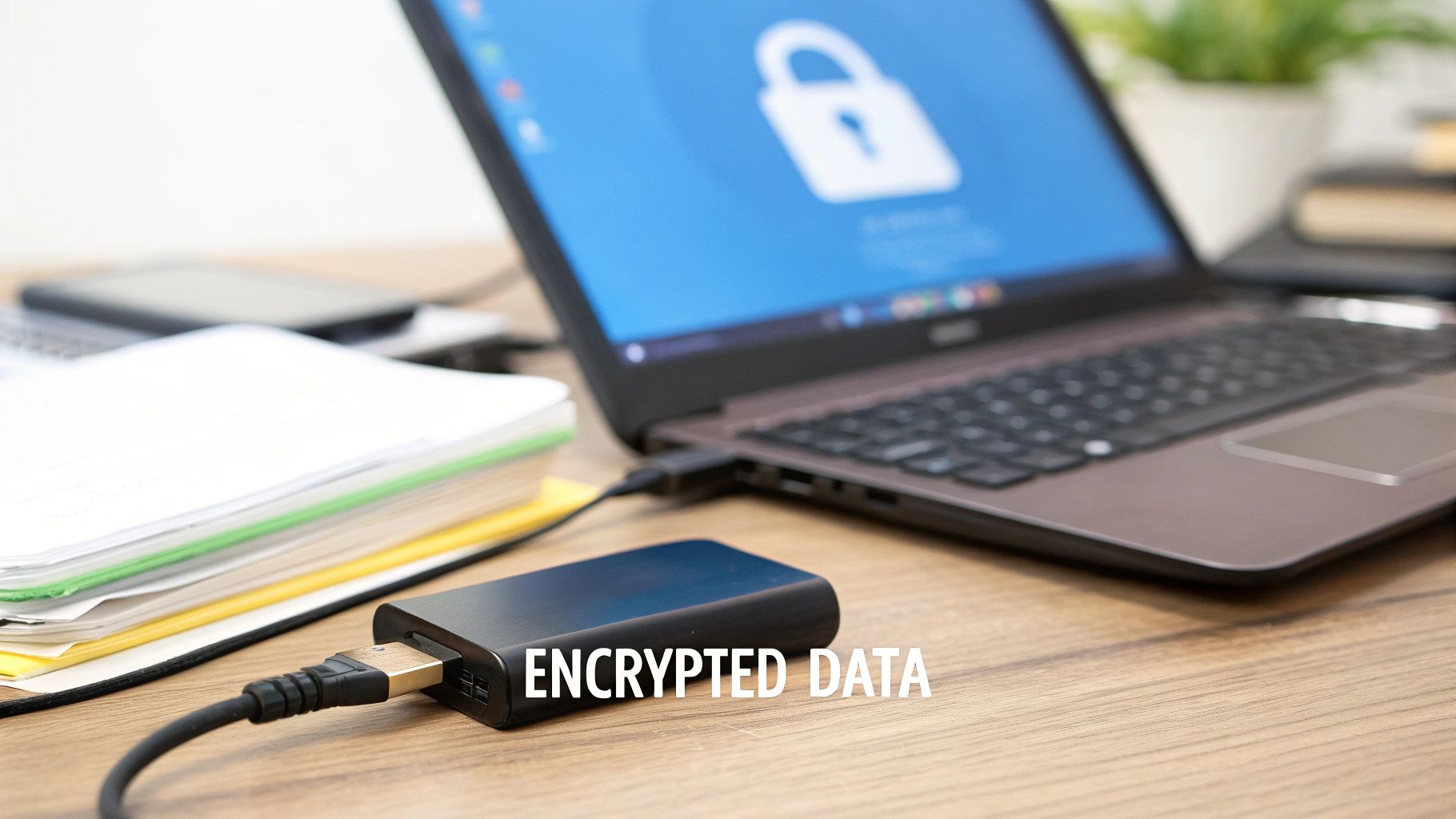
For practical steps, always use strong encryption like TLS 1.2 or higher for all websites and client portals. Mandate full-disk encryption (like BitLocker or FileVault) on all company laptops, especially for your pentesters who handle sensitive data. When sending findings, use secure, encrypted channels instead of regular email.
Managing Change and Configuration Control Effectively
A structured change management process is another key item on the SOC 2 security controls list. Think of it as a formal system for approving, testing, and documenting any changes to your systems or applications. This control is vital for preventing new vulnerabilities from being introduced when you update your software or change a setting.
This process ensures that every change is intentional, authorized, and reviewed. It dramatically reduces the risk of causing an outage or creating a security gap because of a poorly planned update. For an auditor, a clear and documented trail of all changes shows that you're committed to stability and security. This control supports the Security and Availability criteria for compliance.
For example, you should have a faster, separate process for deploying urgent security patches to respond to new threats quickly. It's also important to have a separation of duties, meaning the person who proposes a change shouldn't be the same one who approves and implements it. Using tools like Terraform or Ansible can also help by managing your infrastructure as code, making changes trackable and repeatable.
Developing Your Incident Response and Management Plan
Having a solid incident response plan is a must-have on any SOC 2 security controls list. This is your playbook for what to do when something goes wrong, like a data breach. The plan should detail every step, from detecting the incident to containing it, investigating it, and recovering from it. For any MSP or vCISO, this is critical for managing potential breaches that could affect client data.
This control moves you from being reactive to proactive. Instead of panicking when an incident happens, your team knows exactly what to do. A good incident response plan helps you minimize damage, restore services quickly, and maintain client trust. This directly supports the Security, Availability, and Confidentiality criteria of SOC 2 and ISO 27001.
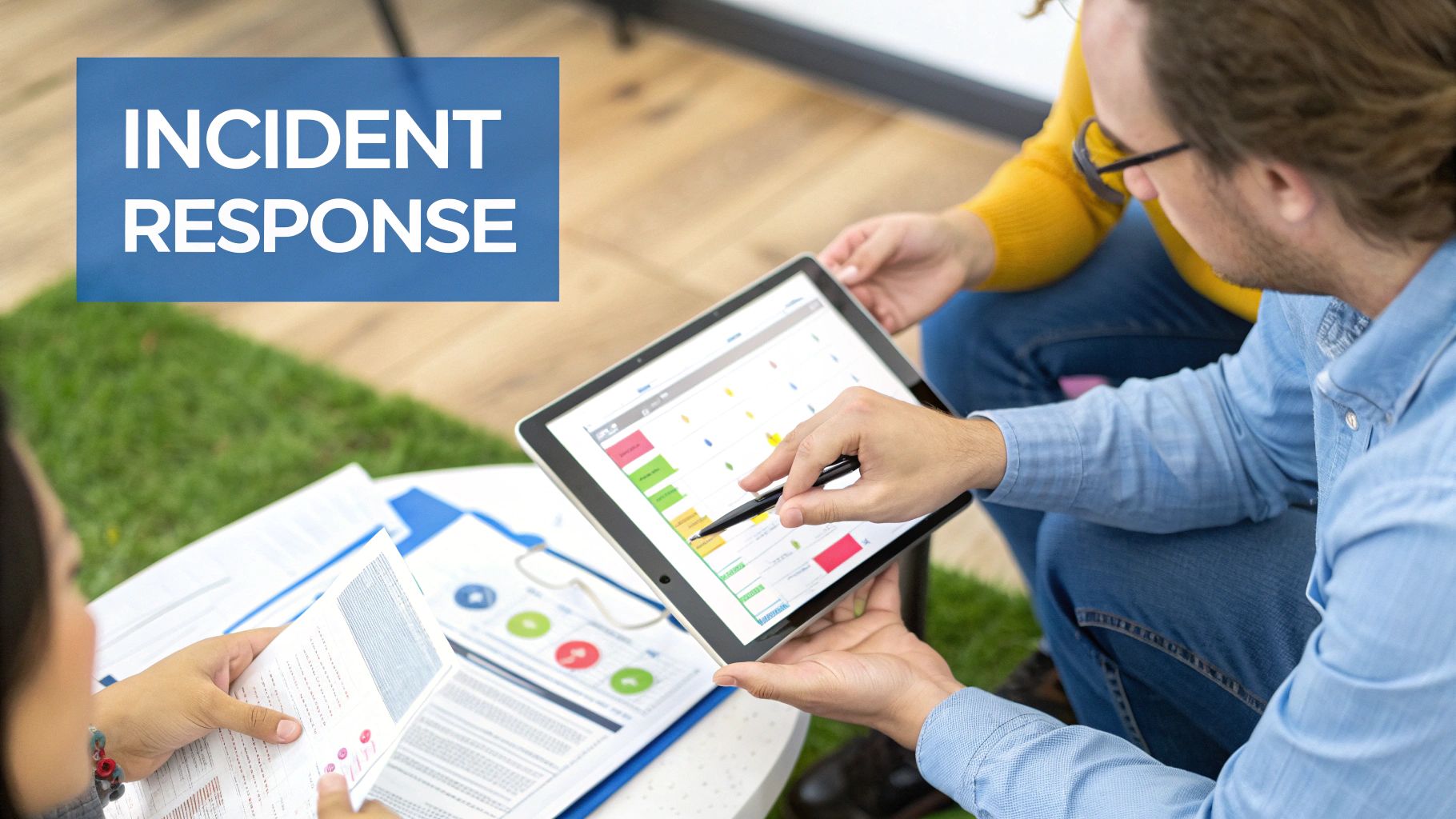
To implement this, create a specific playbook for different scenarios, such as a leaked pentest report or a ransomware attack. Document clear escalation paths so everyone knows who to notify and when. Run regular tabletop exercises to practice your response and find any weaknesses in your plan before a real incident occurs.
Prioritizing Vulnerability and Patch Management
A proactive vulnerability and patch management program is another core part of the SOC 2 security controls list. This involves constantly scanning your systems for weaknesses, assessing the risks, and fixing them. By finding and patching vulnerabilities quickly, you shrink the attack surface that hackers can target.
This isn't a one-and-done task; it's an ongoing cycle. It requires tools for scanning, clear policies for fixing issues, and tracking to make sure nothing falls through the cracks. This process is essential for maintaining system integrity and resilience against known threats, supporting both the Security and Availability criteria. Our pentesters are OSCP, CEH, and CREST certified, providing expert validation.
To make this happen, establish strict timelines for patching. For example, fix critical vulnerabilities within 48 hours and high-risk ones within 30 days. Automate patching where you can, but always test patches in a separate environment first. Don't forget to scan your own security tools, as they can have vulnerabilities too. For more insight, see how a proper SOC 2 penetration testing engagement validates these controls.
Understanding Segregation of Duties Controls
Segregation of Duties (SoD) is a classic control that prevents fraud and errors by making sure no single person has too much power. It's a key principle in a SOC 2 security controls list because it creates checks and balances. By separating conflicting tasks, you reduce the risk that one person could perform a sensitive action and cover it up.
For example, in a pentesting firm, this means one person shouldn't be able to find a vulnerability, mark it as fixed, and approve the final report all by themselves. This internal control is vital for safeguarding the integrity of client data and the testing process itself. It directly supports the Security and Confidentiality criteria.
To implement SoD, define roles clearly. The person who authorizes a pentest shouldn't be the one conducting it or approving the final report. Similarly, separate financial tasks from technical ones: the finance team should handle invoicing, while the technical team manages the scope of the engagement.
Implementing Cryptographic Key Management Policies
Effective cryptographic key management is a highly important part of a modern SOC 2 security controls list. This control covers the entire life of your encryption keys, from creation and storage to rotation and destruction. It ensures that the keys used to encrypt sensitive client data and protect confidential penetration testing reports remain secure.
Proper key management prevents someone from decrypting your data even if they manage to steal it. By having strict procedures for handling keys, you build a powerful defense against data breaches. This control is fundamental to upholding the Security, Confidentiality, and Privacy criteria. Our white label pentesting services help validate these controls for our reseller partners.
To do this right, use a dedicated key management system or a Hardware Security Module (HSM) to store your master keys. Automate key rotation, ideally every 90 days for active data. And enforce a strict policy that developers never commit keys or secrets directly into code repositories like Git.
Managing Third-Party and Vendor Risk
No business is an island, and your vendors are part of your security perimeter. Third-Party Risk Management is a critical SOC 2 security control that involves assessing and managing the risks from your vendors and service providers. This is especially important when third parties have access to your client's sensitive data or your internal systems.
This control requires a formal process to vet the security of every vendor before you start working with them and throughout the relationship. By checking that your partners meet your security standards, you reduce the risk of a breach coming from your supply chain. This is fundamental to meeting the Security, Confidentiality, and Availability criteria.
To put this into practice, require your critical vendors to provide their own SOC 2 report. Use a standardized security questionnaire to evaluate all potential vendors. Make sure your contracts include specific security requirements, like breach notification timelines. Learn more about developing a robust third-party risk management process to streamline these efforts.
Performing Risk Assessments and Threat Identification
A structured risk assessment program is the foundation of any good security strategy and a key part of the SOC 2 security controls list. This control requires you to formally identify, analyze, and evaluate potential threats to your systems and data. By understanding these risks, you can develop smart strategies to mitigate them and make informed decisions about where to invest in security.
This involves creating and maintaining a risk register, a living document that tracks all identified risks. This helps you prioritize what to fix first and ensures your security measures are aligned with the biggest threats to your business. This process is fundamental to meeting the Security, Confidentiality, and Availability criteria.
To implement this, conduct a formal risk assessment at least once a year. Use a recognized framework like NIST RMF or ISO 31000 to guide your process. Document all your findings in a risk register and review it quarterly with your leadership team. For a detailed guide, review this comprehensive SOC 2 compliance checklist.
Partner with a Pentesting Expert for SOC 2
You've just walked through the essential SOC 2 security controls list, from access controls and encryption to incident response and risk assessment. Understanding these controls is the first step toward building a secure and compliant environment for your clients. But knowing what to do is only half the battle.
SOC 2 compliance isn't just about having policies on paper. It's about proving that your security works in the real world. You can implement every control on this list, but your work isn't done until you can show an auditor that your defenses can stand up to an attack.
This is where penetration testing becomes essential. A pentest is the ultimate test of your security posture, simulating a real-world attack to find weaknesses. It turns your SOC 2 security controls list from a simple checklist into a validated framework. It’s the difference between saying you're secure and proving it.
However, many MSPs and vCISOs run into problems here. The pentesting industry often has inflated prices, slow report delivery, and worst of all, partners who compete for your clients. You need a partner who supports your business, not one who tries to steal it.
We built our company to solve this problem. As a channel-only partner, we only work with MSPs, vCISOs, and GRC firms. We are an extension of your team, never your competitor. We deliver affordable, fast, and high-quality manual pentesting from certified experts (OSCP, CEH, CREST). You get a detailed, white-labeled report to share with your clients, strengthening your relationship and reinforcing your value.
See our pentest report format and how fast, affordable, manual testing can become your competitive advantage.

.avif)
.png)
.png)
.png)

