
SOC 2 and ISO 27001 overlap by about 80%, but they solve different business problems. SOC 2 is a U.S.-centric attestation report on controls for service organizations, while ISO 27001 is a global certification for an organization-wide security management system, and that difference changes how you sell, scope, and support compliance work.
If you're an MSP, vCISO, GRC advisor, CPA, or reseller, you've probably had the same client email hit your inbox: “We need to be compliant. Should we get SOC 2 or ISO 27001?” If you answer too fast, you risk pushing them into the wrong audit path, the wrong budget cycle, and the wrong buyer expectations.
At this point, good advisors separate themselves from checkbox vendors. The client isn't just asking about compliance. They're asking about sales enablement, international growth, procurement friction, renewal burden, and how much internal pain they're about to buy.
Early on, keep the differences simple:
| Area | SOC 2 | ISO 27001 |
|---|---|---|
| What it is | Attestation report | Certification |
| Main audience | Customer assurance, especially in North America | Global markets and enterprise procurement |
| Scope style | Flexible Trust Services Criteria | Formal ISMS with structured scope and risk treatment |
| Core audit style | Evaluates control design and operating effectiveness | Certifies the security management process |
| Renewal rhythm | Annual audit cadence | Three-year certification cycle with annual surveillance audits |
| Best fit | SaaS, cloud, service providers needing customer trust evidence | Organizations needing global recognition and process maturity |
Choosing Between SOC 2 and ISO 27001
A client calls because a prospect asked for SOC 2. Another client asks for ISO 27001 because they're selling into Europe. A third says they need to satisfy HIPAA, support PCI DSS, pass vendor reviews, and still keep the budget sane. Same basic question. Very different answers.
For resellers and vCISOs, this is a service opportunity hiding inside a compliance question. If you guide the client well, you become the person who shapes their roadmap. If you don't, somebody else will step in with a louder opinion and probably a more expensive one.
Start with the buyer, not the framework
The right answer usually starts with three business questions:
- Who is asking for this. A U.S. SaaS buyer often wants a report they can review in diligence. A multinational enterprise may want a globally recognized certificate.
- What are they trying to prove. Some clients need to show controls worked. Others need to show they run a mature, repeatable security program.
- How much operational overhead can they handle. A founder-led software company and a mature enterprise do not absorb compliance work the same way.
A useful outside read on this is understanding SOC 2 and ISO 27001, especially if you need a plain-English primer to share with clients before a scoping call.
You should also tie the compliance conversation back to broader cloud risk decisions. If the client's environment is heavily cloud-driven, map their framework choice against cloud security frameworks before anyone locks in scope.
Practical rule: If the client starts with “our prospects keep asking for a report,” lean toward SOC 2. If they start with “we need a recognized security certification across the business,” lean toward ISO 27001.
Most firms don't need theory. They need a clean recommendation they can defend to a buyer, a board, or a procurement team. That's your job.
Understanding SOC 2 Attestation Reports
SOC 2 was established by the American Institute of Certified Public Accountants in 2011 to address rising demand for transparency in cloud computing. It is not a certification. It is an attestation report, and it typically requires annual audits to demonstrate continued compliance, with Type 2 reports covering a minimum of six months (Schellman).
That distinction matters because clients misuse the term “SOC 2 certified” all the time. You need to correct that gently but clearly. They don't get a certificate. They get a report that a customer, prospect, or diligence team can review.
What SOC 2 actually measures
SOC 2 is built around the Trust Services Criteria:
- Security
- Availability
- Processing Integrity
- Confidentiality
- Privacy
Only Security is mandatory. The others are optional based on the company's business model and commitments, which is why SOC 2 is often the more flexible fit for service providers that don't need a giant governance apparatus.
That flexibility is helpful, but it also creates sloppiness if nobody scopes it properly. Some advisors oversell SOC 2 as “faster and easier” without explaining that weak scoping now can create ugly remediation later.
Type 1 versus Type 2
Use simple language with clients.
- Type 1 asks whether the controls are designed appropriately at a point in time.
- Type 2 asks whether those controls operated effectively over a period.
According to Strike Graph's breakdown of ISO 27001 and SOC 2 timelines, SOC 2 Type 1 can be completed in as little as 45 days if the company is highly organized, while SOC 2 Type 2 requires a 6 to 12 month lookback period and typically takes 2 to 6 months to complete.
If the client wants to close enterprise deals, they usually care about Type 2. Type 1 may help early, but buyers often treat it as a stepping stone rather than the finish line.
For firms preparing documentation and control narratives, CEFCore's SOC 2 guidance is a decent reference to benchmark readiness tasks before the CPA gets involved.
SOC 2 is strongest when the client needs to prove operational control performance to customers. It's weaker when they expect it to serve as a global security badge.
That's the clean way to explain it.
Breaking Down ISO 27001 Certification
A reseller is about to lose a cross-border deal because the prospect does not care about a SOC 2 report. They want an ISO 27001 certificate from an accredited body, a defined security program, and evidence that leadership reviews risk like an operating discipline. That is the moment ISO 27001 stops being a compliance checkbox and becomes a market-access requirement.
ISO 27001 fits clients that need a formal, organization-wide security program buyers will recognize across regions and industries. For MSPs and vCISOs, that changes the service model. You are not just helping a client collect evidence for an auditor. You are helping them build and run an ISMS, then packaging the recurring work around policy governance, internal audits, risk reviews, corrective actions, vendor oversight, and technical validation.
ISO 27001 sells a management system, not just an audit outcome
The center of ISO 27001 is the Information Security Management System, or ISMS. The business implication is straightforward. Clients need a repeatable way to assess risk, assign ownership, review performance, and improve controls over time.
That requirement exposes weak operators fast.
A client can scrape through some compliance exercises with scattered policies and ad hoc decisions. ISO 27001 punishes that approach. The standard expects scope discipline, documented risk treatment, internal audit activity, management review, and a Statement of Applicability that explains how the organization handles Annex A controls and why any exclusions make sense. If you are advising a client, sell the operating model first and the certificate second.
That is also where service providers can increase account value. ISO 27001 creates recurring work that clients rarely want to manage alone. Quarterly risk reviews, annual internal audits, policy maintenance, asset and supplier reviews, and targeted validation work all become billable, defensible services. If the client also needs offensive testing to support risk treatment decisions, set expectations early around penetration testing pricing and scope so it is budgeted as part of the program instead of treated as a surprise add-on.
Certification follows a stricter operating cadence
ISO 27001 certification is more rigid than SOC 2 in practice. Clients should expect an internal audit, management review, a Stage 1 readiness review, a Stage 2 certification audit, then surveillance audits and eventual recertification. The point is not paperwork. The point is proving the security program is governed, reviewed, and maintained.
That cadence matters for MSPs and vCISOs because it supports a cleaner recurring revenue model. SOC 2 often centers on a reporting cycle. ISO 27001 supports an ongoing advisory relationship with clear checkpoints throughout the year. If you package those checkpoints well, you reduce fire drills, improve client retention, and make the certification body audit far less painful.
ISO 27001 also gets more explicit about operational discipline in areas many clients neglect. For example, the framework expects formal event reporting and handling processes, not just informal communication paths, as Mimecast notes in its comparison of ISO 27001 and SOC 2. That gives advisors a practical opening to tighten incident intake, escalation, and documentation before the auditor finds the gap.
If a client needs international credibility, stronger governance, and a security program you can manage as a long-term service line, ISO 27001 is usually the better play.
It is not the faster route. It is the stronger platform for clients that need broad buyer recognition and for partners that want recurring compliance revenue instead of one-time audit prep.
Key Differences in Audits Costs and Controls
A reseller closes a deal, the client asks for “SOC 2 or ISO 27001,” and the team treats it like a branding choice. That is how margins get squeezed. This critical decision affects audit cadence, evidence collection, buyer acceptance, and how much recurring service revenue you can attach to the account.
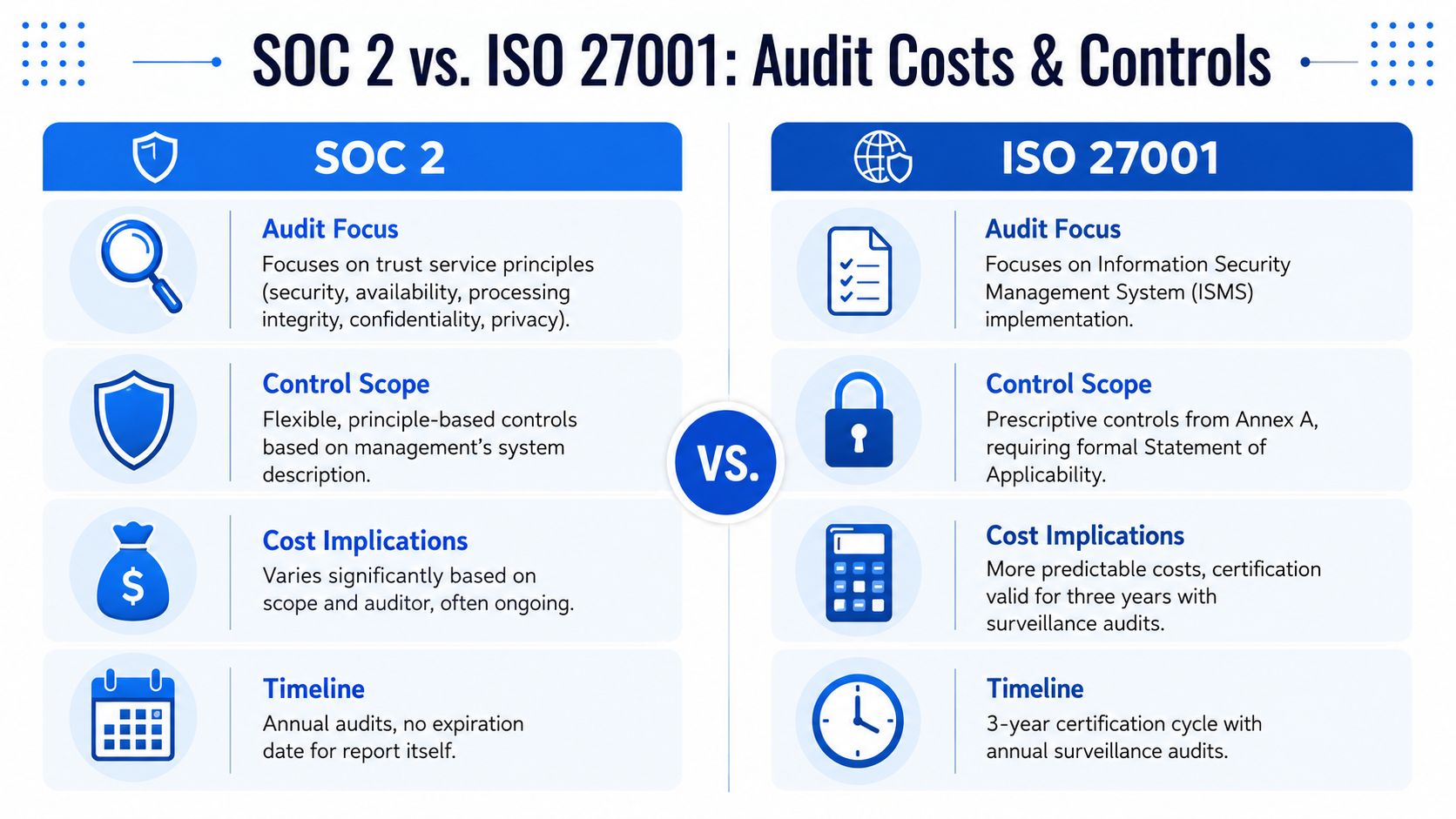
Audit rhythm and assurance depth
SOC 2 and ISO 27001 answer different buyer questions.
A SOC 2 Type 2 report shows whether controls operated effectively over a defined review period. That makes it easier for enterprise prospects, procurement teams, and customer security reviewers to inspect evidence tied to day-to-day operations. ISO 27001 certification shows that the client has a formal security management system that has been audited against the standard. That lands well with buyers who want a recognized certification, especially across international markets.
For MSPs and vCISOs, that difference matters because it changes the service model. SOC 2 usually drives annual evidence collection, control testing support, exception handling, and audit coordination. ISO 27001 creates more work around governance, internal accountability, and maintaining the management system between audit events. One is often a reporting engine. The other is often a program management engine.
Where the controls overlap and where they don't
There is plenty of shared ground. Access control, incident response, change management, vendor oversight, encryption, and vulnerability management show up in both frameworks. That is the good news.
The gap sits in the operating model. ISO 27001 pushes harder on formal governance, internal review, corrective action, and continual improvement. SOC 2 puts more practical pressure on proving that specific controls worked during the review period. If you build for one without planning for the other, you create rework. If you design a common control set early, you can sell one implementation effort and support two compliance outcomes.
That is where experienced partners make money. Build the shared controls once, then package audit-specific artifacts, testing support, and remediation tracking as separate service layers.
Cost pressure shows up in different places
Clients usually ask for a single price. That is the wrong way to budget this work.
SOC 2 often creates recurring annual audit and evidence preparation costs that clients underestimate. ISO 27001 usually creates more internal process overhead, more governance discipline, and more year-round involvement from leadership and control owners. The invoice is only part of the cost. Staff time, remediation effort, control ownership, and auditor coordination are what drag projects off schedule.
Technical validation belongs in that budget from the start. If the client needs a realistic estimate for testing work that commonly supports both frameworks, point them to how much a penetration test costs. It helps set expectations before the project turns into a procurement argument.
The practical recommendation
Use SOC 2 when the client needs a report their customers can read, especially in the U.S. SaaS market. Use ISO 27001 when the client needs a certifiable management system with broader international credibility.
If the client has budget, internal ownership, and long-term compliance plans, map both from the start. That gives you a cleaner service stack, less duplicated control work, and more room to attach recurring advisory, testing, and remediation revenue.
How Pentesting Supports Both Compliance Frameworks
A client starts a SOC 2 project to satisfy enterprise buyers. Midway through, leadership decides ISO 27001 is next because international prospects keep asking for it. If you scoped testing as a one-off audit checkbox, you just created duplicate work, budget friction, and a delivery problem. Scope pentesting correctly from the start and it becomes reusable evidence, a stronger risk story, and a service line you can package across both frameworks.
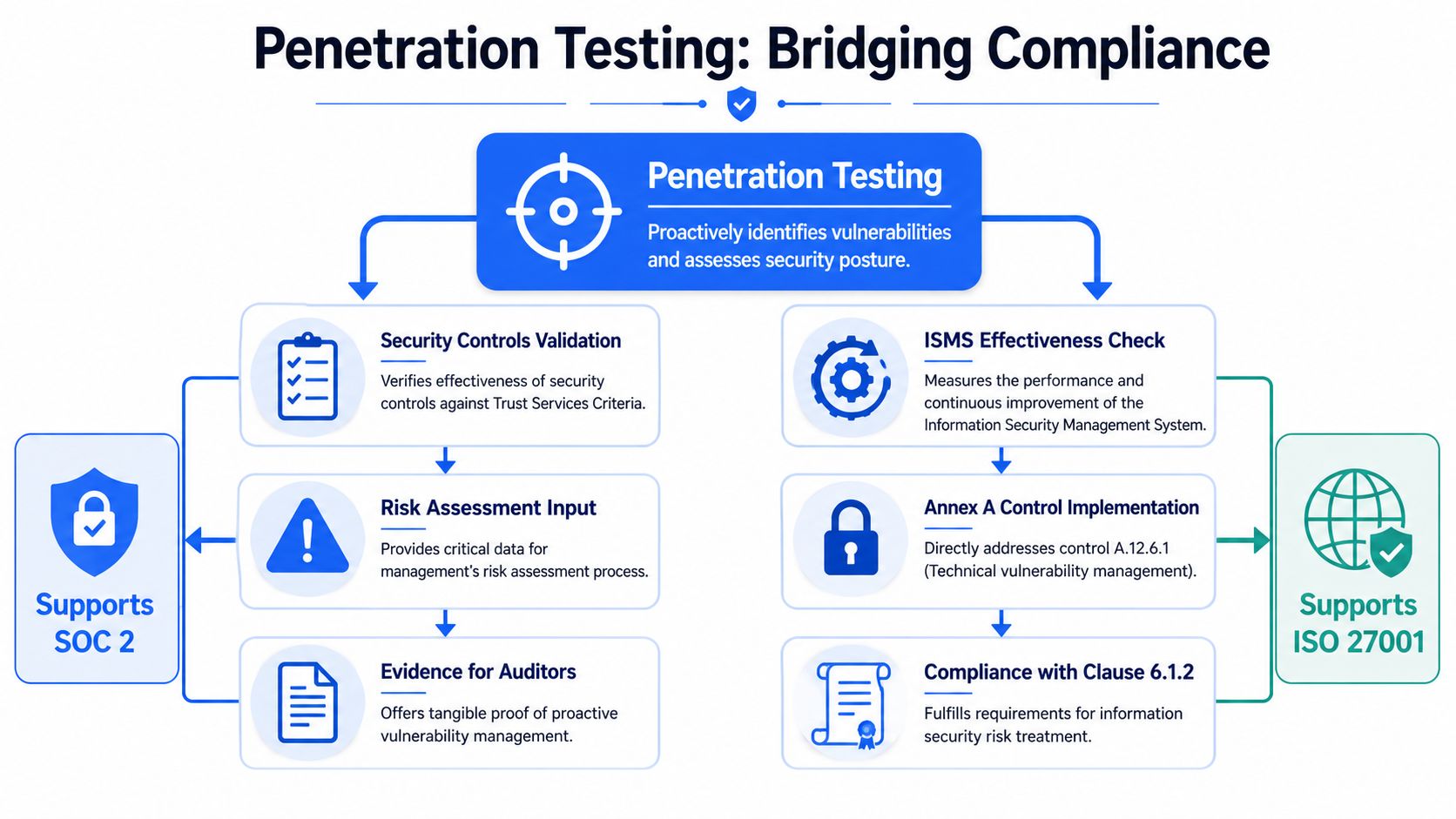
One penetration test can support both
SOC 2 and ISO 27001 overlap heavily in the areas that buyers and auditors scrutinize hardest. Access control, vulnerability management, incident response, cloud configuration, and evidence of control effectiveness all show up in different language across both frameworks. A well-scoped penetration test can support both paths if the environment, timing, and reporting match the client's audit plan.
That is good business for the client and for the reseller. You reduce duplicated testing, keep remediation focused, and give the client one technical workstream that can feed multiple compliance goals. Done right, pentesting stops being a last-minute purchase and becomes part of the compliance package.
Why manual pentesting matters
Automated scans find exposure. Manual pentesting shows how an attacker would use it.
That distinction matters in audit prep and in client advisory work. A scanner can list missing patches and exposed services. A real pentest tests attack paths, privilege escalation, weak segmentation, cloud misconfigurations, and chained findings that create business risk. That gives clients a report they can use for remediation, risk treatment, and buyer diligence, not just a spreadsheet of technical noise.
For teams packaging services, keep the line clear between penetration testing and vulnerability assessment. Clients confuse them all the time. They are related services with different outcomes, different evidence value, and different pricing logic.
- For SOC 2, penetration testing helps support the security narrative behind the Trust Services Criteria and gives auditors stronger evidence that technical controls are working in practice.
- For ISO 27001, penetration testing feeds the ISMS by identifying risks, validating treatment decisions, and showing whether technical safeguards hold up under realistic attack scenarios.
- For MSPs and vCISOs, the same engagement can be sold as part of readiness, annual validation, remediation verification, or a broader managed compliance retainer.
This is how margin is generated. If you treat pentesting as a standalone deliverable, you get one project. If you package it with scoping, evidence support, remediation tracking, and retesting, you get recurring revenue and a much better client outcome.
A Decision Matrix for MSPs and vCISOs
Most clients don't need a lecture. They need a decision path. Ask sharper questions and you'll get to the right answer faster.
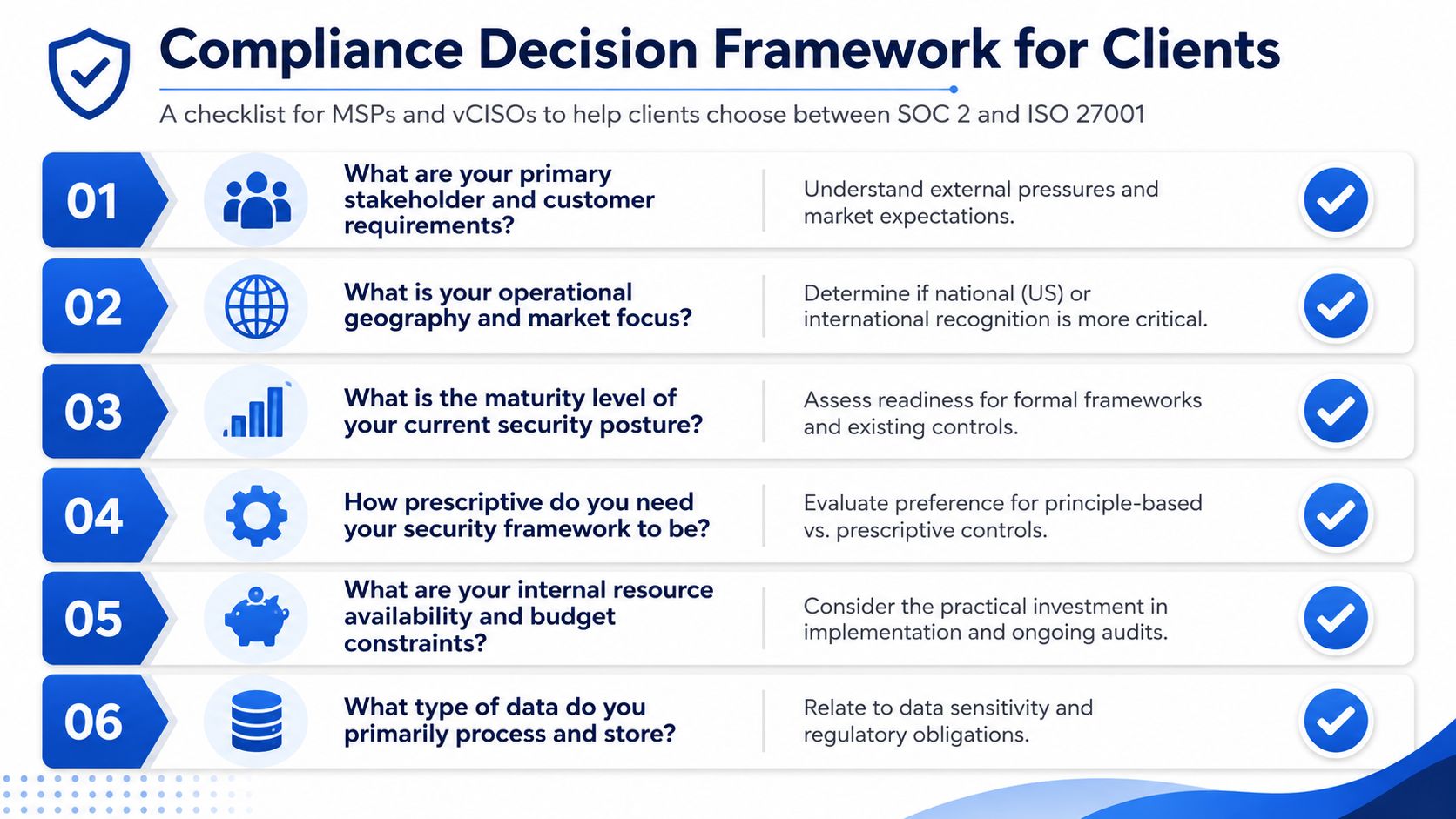
Ask these six questions first
Who is asking for proof
If U.S. customers, procurement teams, or investor diligence requests are driving the conversation, SOC 2 is usually the first practical move.
Where does the client sell
If they operate internationally or want broad recognition across markets, ISO 27001 usually carries more weight.
Do they need a report or a certificate
This sounds basic, but it cuts through confusion fast. Some buyers want a document they can read. Others want a recognized certification badge in procurement.
How mature is the current program
A company with scattered controls can sometimes still make a SOC 2 project work if the scoped controls are designed and evidenced properly during the audit period. A company pursuing ISO 27001 needs a formal ISMS, internal audits, and management reviews in place.
How much structure do they want
Some clients want flexibility. Others want a framework that forces governance discipline.
What recurring burden can they absorb
Compliance doesn't end at the first win. It becomes an operating cost and a management habit.
Watch for the bad program trap
A critical nuance that a lot of advisors miss is this: a company with a weak security program can still pass a SOC 2 audit if controls are sampled correctly during the audit window. By contrast, ISO 27001 requires a formal ISMS, internal audits, and management reviews, making it a more rigorous and self-sustaining framework that certifies the security management process itself (Fractional CISO).
That doesn't mean SOC 2 is weak. It means SOC 2 can be narrower than clients assume.
Some clients don't need a prettier audit artifact. They need a stronger operating model.
Here's the blunt recommendation set I'd use:
- Choose SOC 2 first if the client is a service provider selling into North America and needs customer-facing assurance fast.
- Choose ISO 27001 first if the client needs global market credibility, internal governance discipline, or enterprise-grade process maturity.
- Pursue both if the client sells internationally and still faces U.S. diligence demands.
- Delay both if the client's controls are chaotic and nobody owns remediation. In that case, build the security program first, then audit it.
That's the true advisor answer. Not “it depends.” It depends on identifiable business conditions.
Partner With Us for Compliance Pentesting
A client is three weeks from a board meeting, a customer renewal, or a procurement deadline. They need a pentest that will stand up to auditor scrutiny and arrive on time. If your testing partner misses the mark, you absorb the fallout.
That is the primary channel risk.
The compliance pentesting market still has serious quality problems. Some providers overscope the work to inflate fees. Others hand over scanner output dressed up as a penetration test. Many miss the client's reporting window, which turns a security project into a sales delay.
That failure lands on the advisor who made the introduction. Your client will remember who brought the tester in. They will not separate the vendor's mistake from your judgment.
A good pentesting partner helps you sell and retain compliance programs with less friction. You need clear scoping, fast turnaround, credible manual testing, and reports that map cleanly to the client's audit or certification effort. You also need a firm that understands the difference between testing for a checkbox and testing that improves the client's control environment.
For MSPs, vCISOs, and resellers, the business model matters as much as the technical quality. The right partner stays channel-first, protects your client relationship, and supports white-label delivery when needed. That gives you room to package recurring pentesting, risk assessment, remediation guidance, and audit prep into a service line with real margin instead of one-off project revenue.
If you plan to offer pentest, pen testing, or broader penetration test services, choose a partner that makes your practice easier to run and easier to scale.
If you want a channel-only partner for white label pentesting, manual pentesting, and compliance-driven penetration testing for SOC 2, ISO 27001, HIPAA, and PCI DSS, talk to us about pentests that carry your logo. Our OSCP, CEH, and CREST certified pentesters help MSPs, vCISOs, GRC firms, CPAs, and resellers deliver affordable security testing without competing for their clients. Contact us today to learn more.

.avif)
.png)
.png)
.png)

