
SOC as a Service is a subscription-based security operations center that gives your clients 24/7 monitoring, threat detection, incident response, and reporting without you building a full internal SOC. The market is projected to grow from USD 7.37 billion in 2024 to USD 14.66 billion by 2030 at a 12.2% CAGR, which tells you this model is no longer niche.
If you're an MSP, vCISO, or reseller, you're probably dealing with the same mess everyone else is. Clients want stronger security, cleaner audit evidence, and faster answers when something looks wrong. They also want it without paying for an internal security team, and they definitely don't want excuses when a SOC 2, HIPAA, PCI DSS, or ISO 27001 requirement gets missed.
That creates a real business opening. It also creates risk.
A lot of providers pitch SOC as a Service like it's a magic shield. It isn't. It's a delivery model. If you resell it without validating the provider, you can end up owning the fallout when alerts get missed, compliance breaks, or a vendor uses low-skill analysts behind a polished sales deck. The smart move is to treat SOCaaS as one part of a well-vetted security stack, then use manual pentesting, pen testing, penetration testing, and penetration test validation to prove the stack works.
What SOC as a Service Means for Resellers
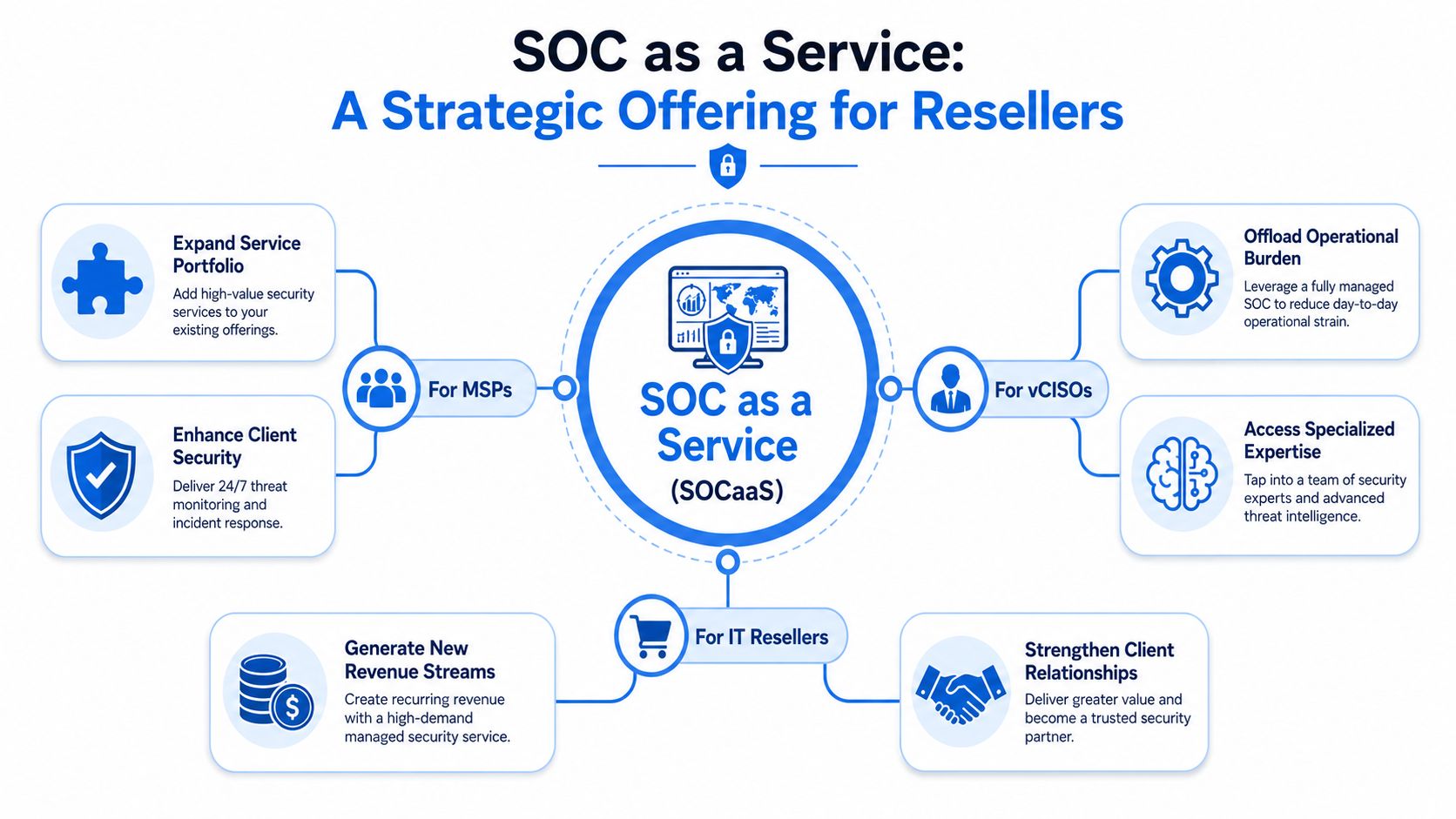
For a reseller, SOC as a Service isn't just another security tool. It's a way to sell a real security operations function without hiring your own around-the-clock team.
Your client has dozens of digital doors and windows: endpoints, Microsoft 365, cloud apps, firewalls, identity systems, and remote users. SOCaaS gives them a team watching those entry points all day and all night, then responding when something suspicious happens.
Why resellers should care now
This market is moving fast. The SOC-as-a-Service market is projected to grow from USD 7.37 billion in 2024 to USD 14.66 billion by 2030, with a 12.2% CAGR according to MarketsandMarkets research on the SOC-as-a-Service market. Buyers are adopting it because they want enterprise-style monitoring and response without carrying the fixed burden of building an in-house SOC.
That matters for your business in three ways:
- Recurring revenue: SOCaaS fits naturally into a managed services agreement.
- Client retention: Security operations are sticky. Once your reporting, escalations, and response processes are embedded, clients are less likely to shop around.
- Compliance support: Clients pursuing SOC 2, HIPAA, PCI DSS, or ISO 27001 often need better monitoring, cleaner incident handling, and defensible reporting.
Practical rule: If you're already advising on compliance or risk assessment, SOCaaS belongs in your offer set. If you don't provide it, someone else will.
What clients are really buying
They aren't buying dashboards. They're buying confidence that someone is watching for abuse, triaging alerts, and escalating incidents when their team is asleep or busy.
For MSPs and vCISOs, the strongest positioning is simple:
- You own the client relationship
- Your security stack handles operations
- Your documentation supports compliance
- Your penetration testing verifies that the stack is real
That last point matters more than most vendors admit. Plenty of clients hear "24/7 monitoring" and assume that means "problem solved." It doesn't. Good resellers know the difference between service coverage and actual detection quality.
How Modern SOC as a Service Platforms Work
A modern SOCaaS platform works like a cloud-delivered security layer. It collects signals from your client's environment, pushes that telemetry into centralized analysis, then routes suspicious activity to analysts who investigate and respond.
The core architecture is straightforward. Lightweight agents, API integrations, and secure log forwarding pull data from distributed environments into one place, reducing on-prem overhead while enabling centralized analysis and response across hybrid estates, as described in Deepwatch's SOCaaS overview.
What the workflow looks like
At a practical level, most deployments follow this sequence:
- Data collection
Endpoints, identity systems, cloud platforms, firewalls, email tools, and servers send logs and telemetry into the SOCaaS platform. - Normalization and correlation
The platform organizes that data so events from different systems can be compared and tied together. - Detection logic
Rules, behavioral analytics, and automation look for suspicious patterns. - Human triage
Analysts decide whether the alert is noise, a real issue, or something that needs escalation. - Response and reporting
The provider contains what they can, documents what happened, and gives the client a usable record.
Why architecture isn't enough
Buyers are often deceived. A provider can have decent tooling and still deliver weak outcomes if the analyst layer is thin, slow, or poorly trained.
That's why I tell MSPs to evaluate the system and the people. Ask how the provider integrates telemetry. Ask what the escalation path looks like. Ask what happens at 2 a.m. when a weird login sequence hits Microsoft 365 and endpoint alerts fire five minutes later.
If you're helping clients harden their network edge, it also helps to review how broader integrated network security systems fit into the detection pipeline. A SOC isn't isolated. It only works when it can see what's happening across the stack.
A SIEM can collect data. A SOC has to interpret it and act on it.
For MSPs building a monitored security offer, this is also why a managed SIEM service guide is worth reviewing alongside SOCaaS. The SIEM is often the data engine. The SOC is the operating layer that turns alerts into decisions.
What to verify with the provider
- Analyst depth: Who reviews alerts after automation flags them?
- Escalation clarity: When does the provider notify you versus taking action directly?
- Evidence quality: Are reports useful for compliance, or just screenshots and noise?
- Tool compatibility: Can they ingest from your client's current stack without forcing a rebuild?
If the provider can't explain those points cleanly, keep looking.
SOCaaS vs In-House SOC vs MSSP Comparison
Most buyers compare three models. Build an internal SOC, outsource to a traditional MSSP, or resell SOC as a Service. The wrong choice usually comes from chasing control without understanding the operational burden.
An in-house SOC gives maximum control. It also dumps hiring, tooling, process design, staffing, and after-hours coverage on your team. That's fine for some large organizations. It's a bad fit for most MSP client bases.
A traditional MSSP can help, but many MSSPs are broad by design. They may bundle many services, move slower, and operate in ways that feel more like a vendor-managed black box than a focused detection and response function.
Where each model breaks
An internal SOC breaks when leadership underestimates the staffing burden. Security operations don't stop at 5 p.m., and neither do attackers.
An MSSP relationship breaks when the provider treats your client like just another ticket queue. That hurts communication, audit readiness, and trust.
SOCaaS breaks when you assume the subscription alone guarantees quality. It doesn't. You still need to vet how detection works, who responds, and whether the provider plays well with your stack and your clients.
If your business depends on white-label trust, control over the client experience matters almost as much as detection itself.
My recommendation
For most MSPs and vCISOs, SOCaaS is the best middle path. It gives you a security operations capability you can sell now, not after building a security department from scratch. But it only works if you choose a provider that respects the channel, supports compliance reporting, and can prove it isn't just automating alerts into a pile.
If your clients need a broader security program, pair SOCaaS with risk assessment, policy support, and scheduled pentesting. That's how you move from "tool reseller" to "security advisor."
The Real Benefits and Hidden Risks of SOCaaS
The benefits are real. You can attach a recurring security service to your managed offer, deepen the client relationship, and support compliance conversations with more credibility. That's good business.
The problem is that many resellers stop there.
The upside for MSPs and vCISOs
SOCaaS helps you answer hard client questions without building a giant internal security practice. When a prospect asks how you handle alert triage, after-hours visibility, or incident documentation, you have an answer that sounds like a mature security program because it is one.
It also makes your stack more defensible during compliance reviews. Clients working through SOC 2, HIPAA, PCI DSS, or ISO 27001 don't just need controls on paper. They need evidence that someone is monitoring and responding.
The liability problem nobody likes to discuss
Here is the part vendors gloss over. If the SOCaaS provider misses an attack, your client usually doesn't care about the provider's marketing page. They care about who sold and stood behind the service.
The underserved reality is ugly. The 2025 Verizon DBIR found that third parties were involved in 30% of breaches. That should change how you review contracts, service language, and client promises.
Ask these questions before you resell anything:
- Negligence clauses: Does the provider accept responsibility for missed alerts, or is everything pushed back to you?
- Indemnity terms: Who pays if a monitoring failure leads to compliance fallout?
- Escalation obligations: What exactly must the provider do when they detect suspicious behavior?
- Evidence handling: Can they support an audit trail your client can use?
Don't confuse a feature list with a liability shield.
What smart partners do differently
They read the contract like a risk document, not a brochure. They test provider responsiveness before rolling the service out widely. They avoid vendors who want the monthly fee but won't put meaningful accountability in writing.
This is also where client poaching becomes part of the security conversation. If a provider talks directly to your accounts, controls the reporting relationship, or tries to expand into your advisory role, you've created both an operational and commercial threat.
A channel partner should strengthen your position, not sit one step away from replacing you.
Using Penetration Testing to Vet SOCaaS Partners
If you really want to know whether a SOCaaS provider is good, test them.
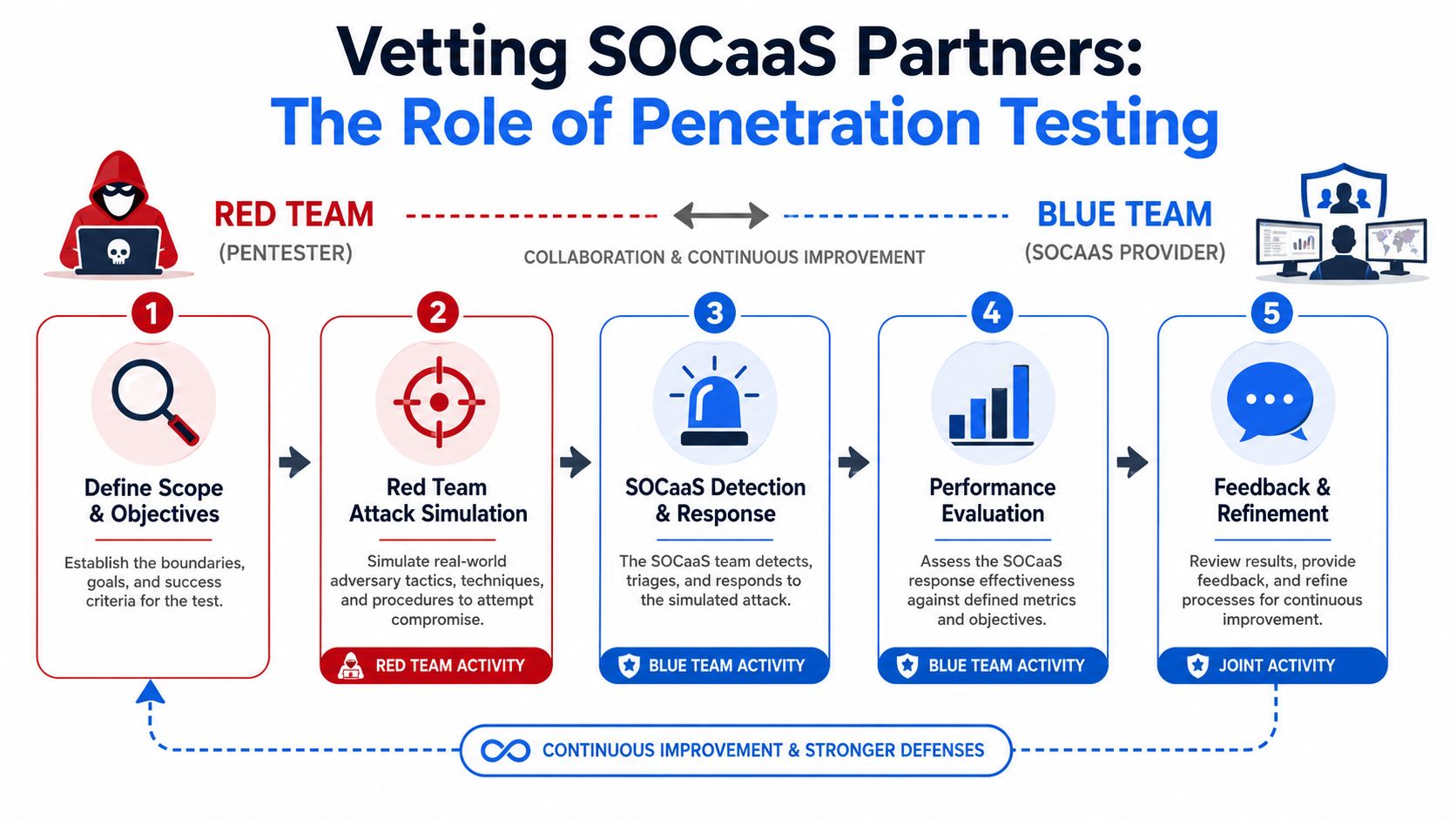
Not with a spreadsheet. Not with a polished demo. Test them with a real pentest, pen test, penetration test, and penetration testing exercise that simulates attacker behavior and measures whether the provider detects and handles it.
Why manual pentesting matters
A lot of SOCaaS sales language sounds strong because it focuses on platform features. However, a primary concern is human performance under pressure. A hidden gap in this market is that some providers route a large share of alerts to offshore, non-certified junior analysts, which creates a real chance that activity uncovered during a manual pentest gets missed.
That should bother any MSP serving regulated clients. If your red team finds behavior the blue team can't see, your client is paying for comfort, not protection.
One useful reference for understanding the actual expectations behind the cybersecurity penetration tester role is how offensive testing work is scoped and executed. The point isn't theory. The point is to simulate realistic attacker activity and judge whether the defense team notices.
What a validation exercise should include
A good vendor validation process should test detection, triage, and communication.
- Scoped attack simulation: Run controlled activity against agreed systems and identities.
- Detection review: Verify whether the SOC generated alerts on the right behaviors.
- Escalation timing: Check how the provider communicated with you or the client.
- Analyst quality: Review whether the write-up shows real investigation or generic alert forwarding.
A SOC that can't detect a controlled penetration test will struggle even more with a real attacker who isn't playing by rules.
What to look for in the results
You want signal, not theater. Did the provider identify the suspicious action? Did they connect events across tools? Did they escalate clearly? Did they document impact in a way that helps your GRC or vCISO workflow?
Manual pentesting has more value than checkbox scanning. Human testers don't behave like templates. They chain findings, pivot, and force the blue team to interpret context.
For partners that need a white-label validation option, pentest partner services can fit into a reseller workflow without putting your client relationship at risk. That matters if you're serious about selling security without inviting channel conflict.
I'll be direct here. A provider that won't cooperate with a penetration testing exercise, or gets defensive when you ask about analyst certifications like OSCP, CEH, and CREST, is giving you an answer already.
Choosing a Vendor and Understanding SOCaaS Pricing
Pricing matters, but pricing without validation is a trap.
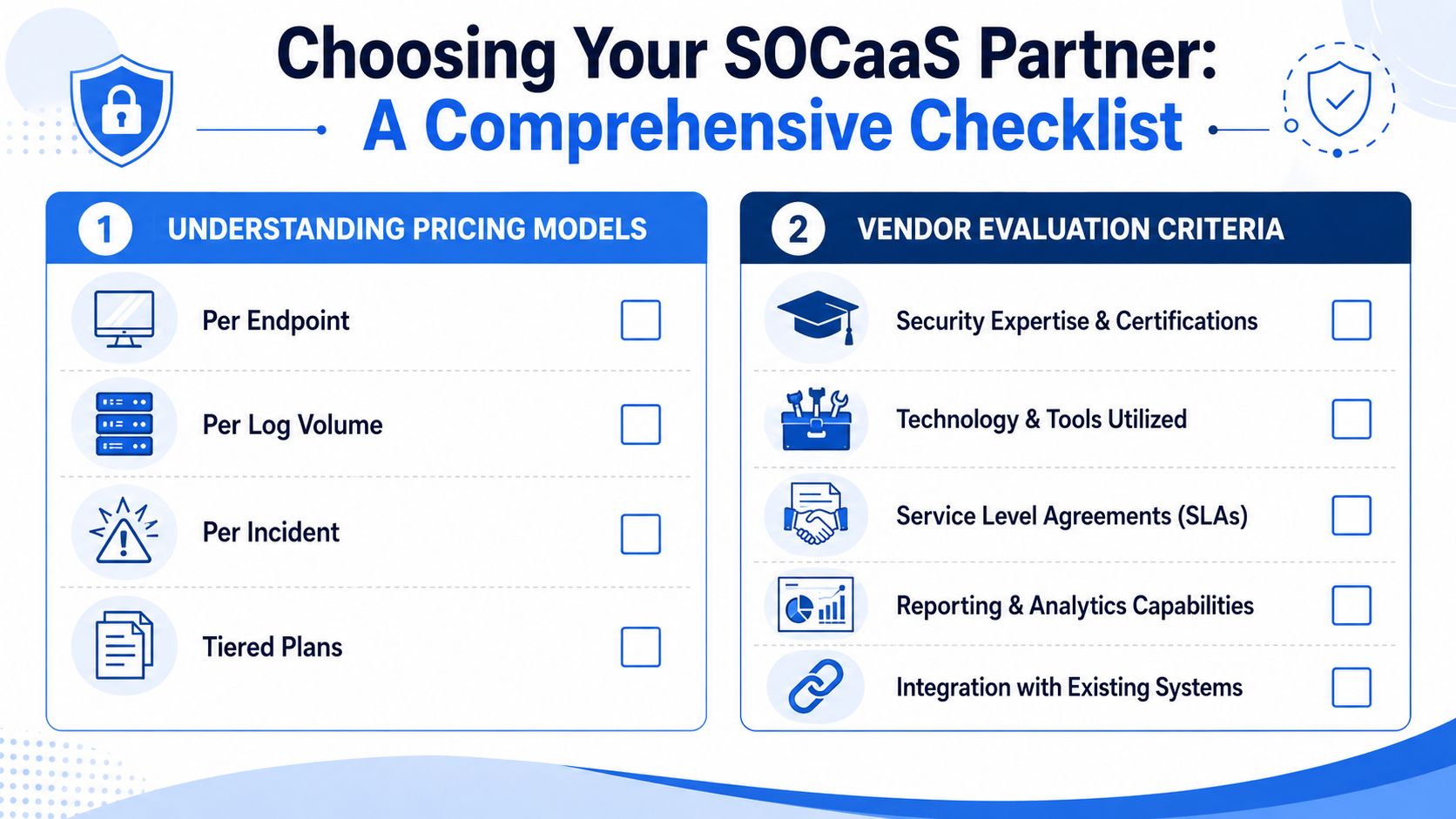
SOCaaS usually follows a subscription model ranging from USD 5,000 to USD 50,000 per month, with smaller organizations often in the USD 5,000 to USD 15,000 range and mid-size companies around USD 15,000 to USD 35,000, according to SentinelOne's SOC as a Service pricing overview. That pricing model is one reason resellers can package security operations as an operating expense instead of a large internal buildout.
What to ask before you sign
Use a checklist, not gut feel.
- Channel fit: Are they channel-only, or will they market directly to your clients?
- Analyst credentials: Can they explain the certification and experience level of the team handling alerts?
- Reporting quality: Will reports help with compliance and risk assessment, or just dump raw noise?
- Third-party testing support: Are they willing to be measured through manual pentesting and penetration testing validation?
- SLA clarity: What do they commit to for detection, response, and communication?
If you need a parallel benchmark for packaging security services, this managed security service pricing guide helps frame how recurring security offers are commonly structured.
My opinion on vendor selection
Pick the provider that's easiest to verify, easiest to work with, and least likely to compete with you. Fancy language doesn't matter. Clean escalation paths, strong analyst quality, usable compliance evidence, and respect for the reseller model do.
If a vendor can't answer basic questions about staffing, certifications, and how they perform during a penetration test, don't put your brand on their service. Your client will remember your name, not theirs, when something goes wrong.
If you want to validate a SOCaaS provider before you attach your brand to it, talk to us about white-labeled pentest delivery. We provide white-label manual pentests for MSPs, vCISOs, and resellers so you can pressure-test your security stack, support compliance work, and keep control of the client relationship.
.png)
.avif)
.png)
.png)
.png)

