
A lot of MSPs think they've covered the client perimeter because the firewall is tuned, the EDR is noisy in a good way, and the compliance checklist is mostly clean. Then you look closer and realize IPv6 is live, poorly understood, and barely inspected.
That matters because the ipv6 packet header looks simple in diagrams but behaves very differently in production. Attackers know that. Good pentesters know it too. If you're responsible for a client's risk assessment, SOC 2, HIPAA, PCI DSS, or ISO 27001 story, you can't afford to treat IPv6 like a side topic.
Your Firewall Is Ignoring Half the Internet
The common MSP scenario is straightforward. A client asks for a penetration test before an audit, the perimeter looks clean over IPv4, and everyone feels pretty good about the result. Then someone notices the environment is also speaking IPv6, but the rules, logs, and monitoring around it are thin or inconsistent.
That blind spot is dangerous because teams often understand packet flow at a high level but miss how IPv6 changes the inspection path. If you need a quick refresher on how traffic moves through networks in general, this overview of packet switching basics is useful before you dig into IPv6-specific behavior.
Why this gets missed
IPv6 often becomes operational by default. It can be enabled by default in operating systems, supported by cloud platforms, and partially handled by firewalls without anyone making a deliberate security decision about it.
The result is a split reality:
- IPv4 gets attention: Rules are tuned, alerts are reviewed, and scanners are aimed at it.
- IPv6 gets assumptions: Teams assume the same controls apply, even when they haven't validated that.
- Attackers get opportunity: If inspection is weaker on IPv6, they'll test that path first.
Practical rule: If a client can route IPv6, your security scope already includes it, whether the project plan said so or not.
For MSPs, vCISOs, and GRC partners, real value begins beyond superficial assessments. Clients don't just need a report that says ports are open or closed. They need someone to check whether security tools handle IPv6 traffic the way the dashboard suggests they do. That's exactly where manual pentest, pen testing, and penetration testing work beats a checkbox exercise.
Dissecting the IPv6 Base Packet Header
The IPv6 base header is simple by design. It stays a fixed 40 bytes, so routers can find the forwarding fields in the same place every time. That consistency helps performance, but it also gives teams a false sense of confidence. Clean header layout does not mean clean inspection once real traffic hits firewalls, IDS platforms, and cloud controls.
The fields that matter most
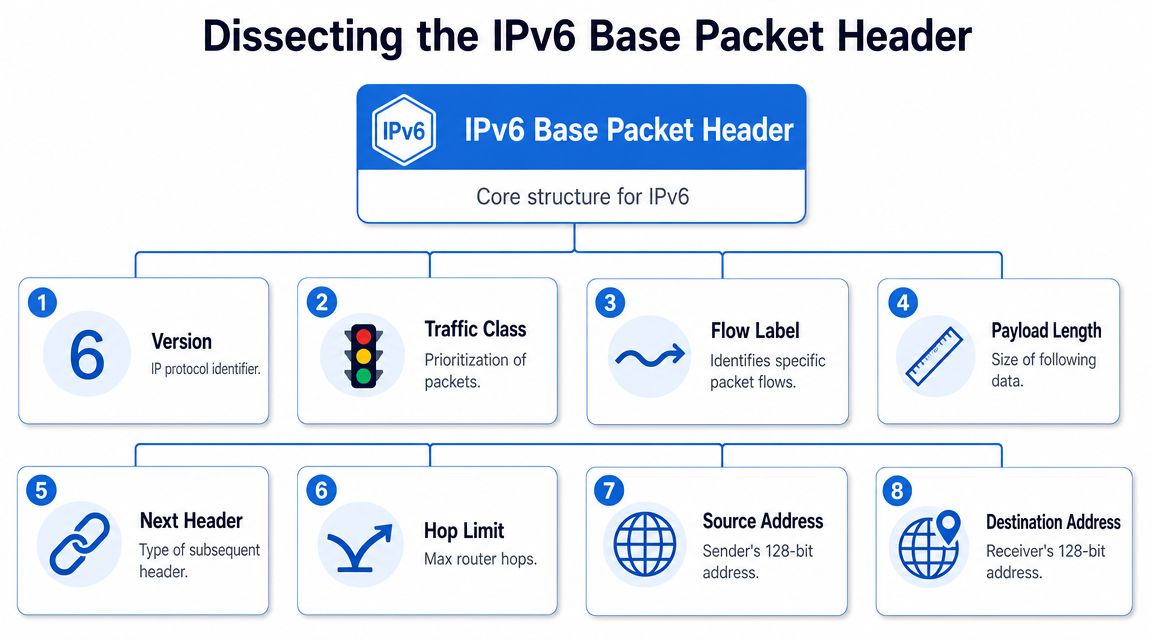
The base header carries eight fields. Each one affects either forwarding, visibility, or policy enforcement.
| Field | What it does | Why an MSP should care |
|---|---|---|
| Version | Marks the packet as IPv6 | Devices have to identify the packet correctly before any policy applies |
| Traffic Class | Carries priority and handling information | QoS and policy tools may treat traffic differently based on this value |
| Flow Label | Identifies packets that belong to the same flow | Useful during troubleshooting, but also worth validating because some tools barely log it |
| Payload Length | States the size of everything after the base header | Helps confirm whether devices parse packet size correctly under edge cases |
| Next Header | Identifies the next protocol or extension header | This field decides whether inspection stays straightforward or becomes error-prone |
| Hop Limit | Limits how many routers can forward the packet | Helpful for path testing and for spotting odd routing behavior |
| Source Address | The sender's IPv6 address | Matters for attribution, filtering, and log quality |
| Destination Address | The receiver's IPv6 address | Drives segmentation, exposure review, and ACL decisions |
A few field sizes matter during testing. Payload Length is 16 bits. Next Header and Hop Limit are 8 bits each. Source and destination addresses are 128 bits each.
That sounds academic until you test real controls. If a client's tooling logs only the addresses and ignores Next Header values, the SOC may see an IPv6 session but miss the parsing path that determined whether the packet was inspected.
What the fixed header actually buys you
IPv4 can include optional fields in its base header, so header length varies. IPv6 removed that variability from the base header. Routers no longer need to calculate where the transport header starts by reading an IPv4 header-length field first. They read a fixed-format base header, then follow the Next Header value.
For operations teams, that makes forwarding more predictable. For pentesters, it tells us exactly where to start checking for control gaps.
The base header itself is usually not the weak point. The weak point is how security products behave after they read it. Some platforms parse the first 40 bytes correctly, then fail open, log poorly, or apply inconsistent policy when the Next Header field points to anything other than a simple transport protocol. That gap matters to MSPs because clients often assume "IPv6 supported" means "IPv6 inspected."
Details that affect security testing
Payload Length covers data after the 40-byte base header. In normal traffic, that is straightforward. In larger payload cases, IPv6 can rely on a Jumbo Payload option carried outside the base header.
Next Header deserves the most attention during assessment work. It can point directly to TCP, UDP, or ICMPv6. It can also point somewhere less convenient for a firewall, which changes how much work the device has to do before it can enforce the right rule.
Hop Limit is operationally useful too. It replaced IPv4 TTL, and it still helps with path testing, traceroute-style analysis, and identifying routing anomalies. During an engagement, odd Hop Limit patterns can help confirm whether traffic is taking an unexpected path through a client environment or a provider edge.
A fixed header improves forwarding consistency. It does not guarantee that security controls interpret the rest of the packet correctly.
Where MSPs and pentesters get value
The business value is not memorizing field names. The value is knowing which fields influence visibility and which ones create inspection risk.
If an MSP understands the base header, they can ask better questions during onboarding and review. Does the client firewall inspect IPv6 beyond the base header. Do logs record Next Header values. Do alerting rules treat IPv6 transport traffic and IPv6 packets with chained headers the same way. Those are practical questions tied to client risk, audit readiness, and service quality.
This is also where partnering with us makes sense. We do not stop at "IPv6 is enabled." We test how the client's controls behave when packet structure stops being textbook-clean, and we do it at a price point MSPs can resell without turning every penetration test into a budget fight.
Navigating IPv6 Extension Headers
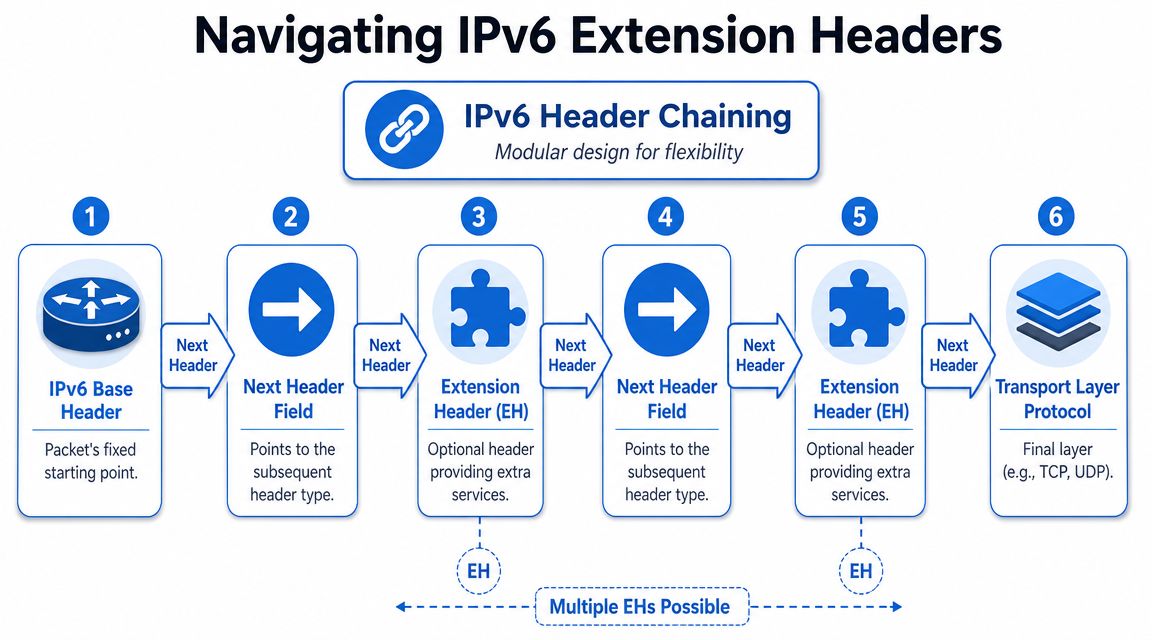
The trouble with IPv6 begins after the base header. The Next Header field can point to an extension header, which can point to another one, and then another. That chaining model is elegant on paper and messy in production.
Common extension headers include Hop-by-Hop Options, Routing, Fragment, and Destination Options. Each one exists for a reason, but each one also adds parsing work for devices that sit between sender and receiver.
What these headers are supposed to do
Not every extension header is malicious. Some support routing behavior, some support fragmentation, and some carry optional information meant for nodes along the path or for the destination.
The problem is operational consistency. A firewall, IDS, IPS, or cloud edge device has to parse the chain correctly before it can enforce policy with confidence.
- Hop-by-Hop Options: Intended for handling by nodes along the path
- Routing headers: Carry routing-related instructions
- Fragment headers: Support fragmentation behavior
- Destination Options: Carry optional data for the destination or selected nodes
What happens in the real world
The public internet doesn't handle these headers cleanly. APNIC reported a minimum 91% drop rate for small 8-byte Hop-by-Hop headers, rising to 100% as Hop-by-Hop size increased. The same study found Destination Options did better at smaller sizes but saw at least a 90% drop rate once options were 128 bytes or larger. It also reported a 2.5% global drop rate for atomic fragment packets, which APNIC described as unacceptably high in its analysis of IPv6 extension header behavior.
That's the gap MSPs need to understand. The protocol allows flexibility, but production networks often react by dropping the traffic, mishandling it, or creating inconsistent visibility.
A packet can be valid by specification and still fail across real networks.
There's another baseline rule worth remembering. IPv6 requires networks to pass packets up to 1,280 bytes as a minimum MTU. That sounds simple enough, but once extension headers enter the picture, reliability gets less predictable and security tools can misread what they're seeing.
Why this matters during testing
A scanner may say a target is unreachable when a normal packet would pass. Or the reverse can happen. A path may look healthy until an unusual header appears. That's why IPv6 troubleshooting and manual pentesting can't rely on default assumptions.
For MSPs and reseller partners, this is a useful differentiator. If your client only gets an automated scan, they may never learn that inspection and reachability change under extension-header conditions.
IPv6 Header Exploits in Penetration Testing
A client can pass an IPv4-focused perimeter review and still have IPv6 paths that behave very differently under pressure. Attackers test those paths because extension headers, fragments, and unusual header order can expose gaps between what the firewall thinks it inspected and what the endpoint accepts. For an MSP, that gap is not academic. It affects scoping, risk reporting, and whether a client is paying for controls that fail under real traffic.

Header chain evasion
A common test case is the long or unusual header chain. Some security devices stop parsing after a certain point. Others inspect the packet inconsistently across policy, logging, and alerting. The endpoint may still process the traffic normally.
That creates practical failure modes:
- Policy mismatch: The control applies a rule to an incomplete view of the packet.
- Visibility loss: Logs show enough to look normal, but not enough to explain what reached the host.
- False negatives: Automated testing reports a cleaner result than a manual review finds.
This matters in real assessments. A deny rule that works for plain IPv6 traffic may behave differently once extension headers are added in a way the product technically supports but operationally mishandles. That is exactly the kind of edge case an attacker will probe after they map the perimeter.
Fragmentation and inspection gaps
Fragment handling is another weak spot. Devices often have to make allow or block decisions before they have full context, especially if packet sequences are malformed, split in unexpected places, or combined with other IPv6 features. In a business network, fragmented IPv6 traffic may be rare. Attackers only need it to work once.
The base header also omits a checksum. That design reduces processing overhead for routers, but it leaves inspection logic relying on upper-layer validation and correct reassembly behavior. If a firewall, IDS, or cloud edge handles fragments and extension headers differently from the destination stack, inspection gaps appear. Pentesters look for those gaps because they can turn a nominally filtered service into reachable attack surface.
Why manual pentesting matters here
Automated scanners are useful for coverage. They do not make good judgment calls about malformed header chains, partial inspection, or conflicting behavior between routing, filtering, and logging. A tester does.
Manual pentesting earns its keep in these situations, especially when the goal is to answer a business question instead of just generating findings. Can the client trust its perimeter controls when IPv6 traffic stops looking clean and predictable? A focused external penetration testing engagement often surfaces this first because internet-facing firewalls, remote access paths, and cloud security groups are where IPv6 assumptions break.
For MSPs and white label partners, this is a strong consulting angle. If you can show a client that their tools inspect standard IPv6 traffic correctly but fail on specific header combinations, you move the conversation from checkbox security to measurable exposure. That creates room for better remediation planning, stronger vCISO guidance, and repeat testing that proves the fixes worked.
The same practical mindset applies outside pure perimeter testing.
If a pen test never challenged IPv6 parsing and inspection behavior, it likely left part of the perimeter untested.
Practical Guidance for MSP and vCISO Teams
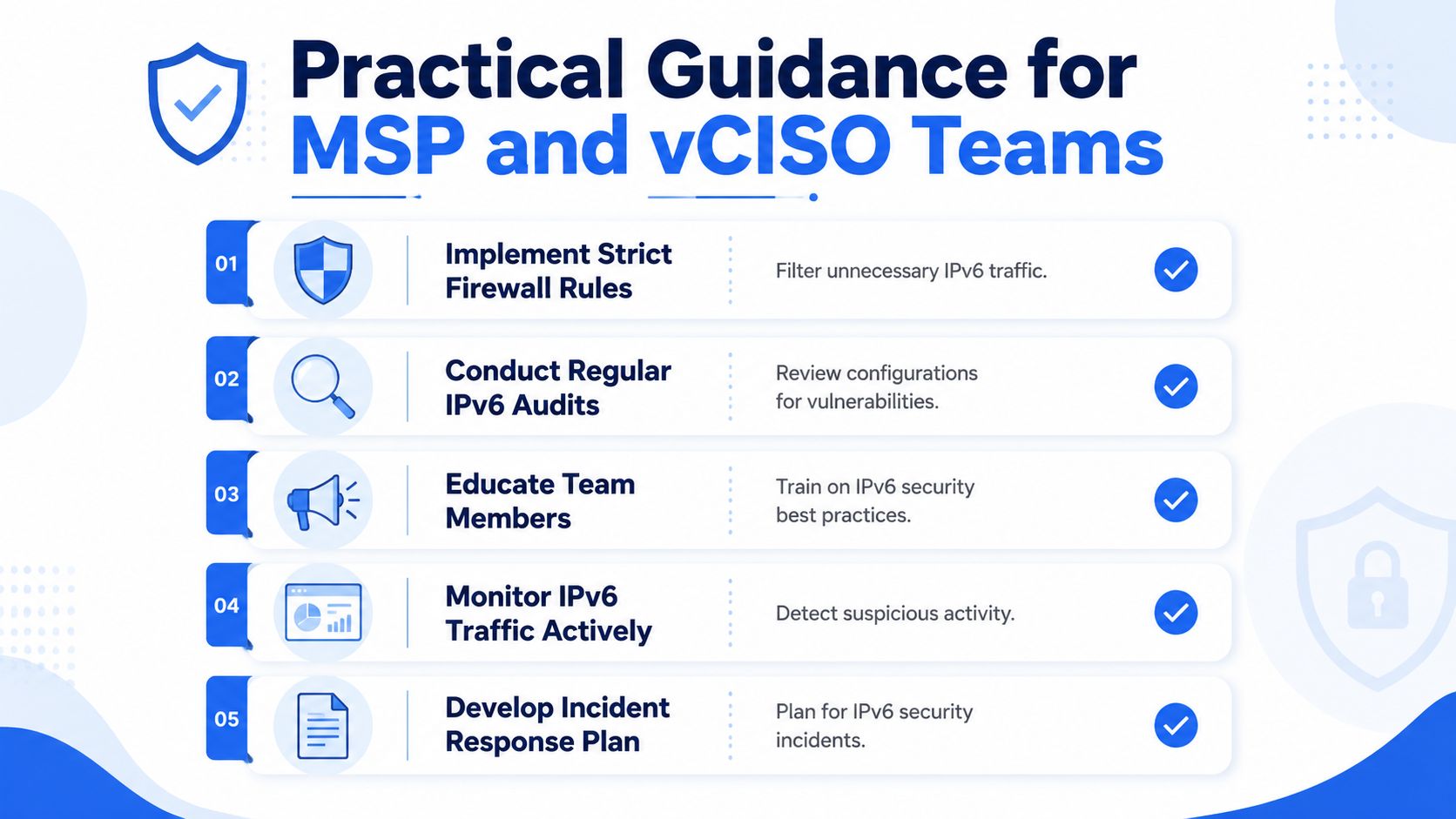
Most IPv6 mistakes are not caused by exotic attackers. They come from default settings, partial deployments, and overconfidence in tooling. If you're the MSP or vCISO on the account, the job is to reduce ambiguity.
Start with policy, not assumptions
RFC 9098 documents that IPv6 extension headers are widely dropped across the public internet, which means scans and security tools can misreport reachability or miss attack paths if teams assume IPv6 traffic is handled correctly, as noted in RFC 9098.
That leads to a simple operating principle. Don't trust the default behavior of the firewall just because the product brochure says it supports IPv6.
Use a practical review process:
- Decide what should exist: If a client doesn't need certain IPv6 functions exposed, deny them by policy instead of inheriting vendor defaults.
- Log what you permit: If you allow specific IPv6 traffic, make sure you can see it in logs and packet captures.
- Test from outside and inside: Some controls treat transit, inbound, and east-west IPv6 traffic differently.
What to look for in reviews
A good configuration review doesn't just ask whether IPv6 is enabled. It asks whether the environment can explain its own behavior.
Focus on these checks:
| Review area | Good sign | Bad sign |
|---|---|---|
| Firewall policy | Explicit IPv6 rules exist | IPv6 is enabled but mostly unmanaged |
| Monitoring | Logs show IPv6 events clearly | Dashboards are IPv4-heavy and vague on IPv6 |
| Testing | Pen test included IPv6 handling | Report only covered IPv4 paths |
| Documentation | Scope defines IPv6 expectations | Team assumes vendor defaults are enough |
Field note: When teams say "we don't really use IPv6," that usually means "we haven't measured it."
Build process around real operations
Train the help desk, network team, and security team to spot IPv6 indicators in logs, alerts, and captures. Make sure incident response playbooks mention IPv6 traffic, not just IPv4 observables. For clients with remote users and cross-border operations, even adjacent architecture decisions can affect visibility.
For compliance-focused accounts, pair the review with a risk assessment and a manual pen test. That gives the client something much more useful than a generic pass/fail statement. It gives them evidence about what works.
This is also where white label pentesting helps MSPs and GRC firms. You can stay in front of the client, keep the engagement under your brand, and still get the depth needed to find IPv6-specific gaps without bloated pricing or slow delivery.
How IPv6 Security Impacts Compliance Audits
Compliance teams don't care whether a control failed because of IPv4 or IPv6. They care whether the client identified the risk, tested the control, and documented the response. That's why IPv6 matters in SOC 2, HIPAA, PCI DSS, and ISO 27001 conversations.
An unreviewed IPv6 path can undermine the story you're trying to tell in a formal risk assessment. If traffic can traverse the environment over a protocol the team doesn't monitor well, the control set is incomplete even if the IPv4 side looks polished.
Why auditors ask harder questions now
Auditors and assessors increasingly expect security programs to reflect actual network behavior, not just stated policy. If a client allows IPv6 but can't explain how it's filtered, logged, and tested, that weakness can show up as a finding or as uncomfortable follow-up questions during evidence review.
A strong SOC 2 penetration testing approach should include enough technical depth to validate exposure across real attack paths, not just the easy ones.
The reporting advantage
A proper penetration test or penetration testing engagement gives compliance teams something they can use. It documents scope, testing method, observed behavior, and remediation guidance in a way that maps to governance conversations.
That matters for several reasons:
- SOC 2: Supports the claim that controls are tested and exceptions are tracked.
- HIPAA: Helps show reasonable technical safeguards and active risk management.
- PCI DSS: Strengthens evidence around segmentation and external exposure reviews.
- ISO 27001: Supports the cycle of risk identification, treatment, and verification.
For MSPs, CPAs, vCISOs, and reseller partners, this turns IPv6 from a hidden liability into a visible maturity marker. Clients don't just want security. They want defensible security.
Secure Your Clients with Expert Pentesting
A client passes its annual control review, then gets hit through an IPv6 path nobody tested because the firewall team assumed the IPv4 policy covered the same ground. We see versions of that mistake regularly. The packet header looks straightforward on paper, but real networks behave differently once extension headers, fragmented traffic, and inconsistent device parsing enter the picture.
That is where manual testing earns its keep. An automated scanner may confirm that IPv6 is enabled and identify exposed services, but it usually will not prove how a specific firewall, IDS, WAF, or cloud control handles chained headers under pressure. A human tester can check whether inspection stops early, whether fragments bypass logging, and whether monitoring tools normalize the traffic correctly. Those are the gaps attackers use.
For MSPs, vCISOs, GRC firms, and reseller partners, this creates a practical service opportunity. Clients need someone who can validate real exposure, explain the result in business terms, and give their network team fixes they can implement. Good penetration testing does that. It turns IPv6 from a vague concern into a scoped finding, a remediation plan, and a stronger client relationship.
Our team works with partners that want affordable, fully manual pentests without building a specialist IPv6 practice in house. We test the controls that commonly fail in production, document where packet handling differs from policy, and deliver reporting you can put in front of technical staff, executives, and auditors. That helps you sell with confidence and keeps the client from learning about IPv6 weaknesses during an incident.
If your clients rely on you for compliance, risk assessment, and security guidance, include IPv6 header behavior in the test plan. If they are already asking whether their tools inspect extension headers correctly, they are asking the right question.
If you need a fast, affordable, fully manual pentest delivered under your brand, our external perimeter testing service helps MSPs, vCISOs, GRC firms, and resellers close IPv6 and broader security gaps without channel conflict. We're channel-only, we never compete with our partners, and our OSCP, CEH, and CREST certified pentesters deliver white label penetration testing with quick turnaround for compliance-driven and security-focused clients.
%20(1).png)
.avif)
.png)
.png)
.png)

