
You've probably had this call already.
A client is closing a new deal, their buyer sends over a security questionnaire, and suddenly the questions get specific. How do you protect customer data? How do you validate controls? Do you perform penetration testing? Can you support SOC 2, HIPAA, PCI DSS, or ISO 27001 efforts?
If your team can handle backups, patching, MFA, and endpoint management but can't clearly answer the data security and data protection questions, you're exposed. Not just technically. Commercially. Clients don't wait while you figure it out. They call the MSP, vCISO, GRC firm, or reseller who already has a process.
Why MSPs Must Master Data Security
An MSP can lose a healthy account without ever suffering a breach. All it takes is one stalled audit, one failed vendor review, or one buyer who asks for proof you don't have.
That's why data security and data protection matter. They aren't abstract security terms. They're sales blockers, retention issues, and margin opportunities. If your client is under pressure from a customer, regulator, CPA, or board member, they need answers fast. If you can provide those answers, you stay in the account and expand it.
A lot of MSP owners still treat this as someone else's job. They assume the client's legal team, compliance consultant, or internal security lead will handle it. That's a mistake. The client expects you to connect the dots between tooling, policy, and evidence.
The business problem is simple
- Deals stall: Clients can't pass security reviews without documented controls.
- Margins shrink: You scramble to find outside help after the request lands.
- Competitors move in: A reseller or vCISO with a stronger security story takes the strategic seat.
- Trust erodes: Clients start seeing you as the patching vendor, not the advisor.
Practical rule: If your client stores sensitive data, sells to larger companies, or works in regulated industries, you need a service story for both protection and validation.
The pain gets worse as clients adopt more SaaS and AI-driven workflows. Data moves faster, staff use more tools, and governance gets messy. Even basic operational changes, like shared inbox automation or AI-assisted workflows, create new data-handling questions. If you're helping clients modernize communications, a resource like Explore programmatic mailboxes for agents is useful because it shows how quickly business processes can change underneath your existing controls.
MSPs that understand this don't just keep clients. They grow into vCISO, GRC, and compliance advisory work that commands better pricing.
Data Security Versus Data Protection Explained
These are often mixed up. Auditors don't. Buyers don't. Attackers definitely don't.
Data security is how you stop unauthorized people from getting to data. Data protection is how you govern the data itself, including what you collect, who can use it, why you keep it, and when you should delete it.
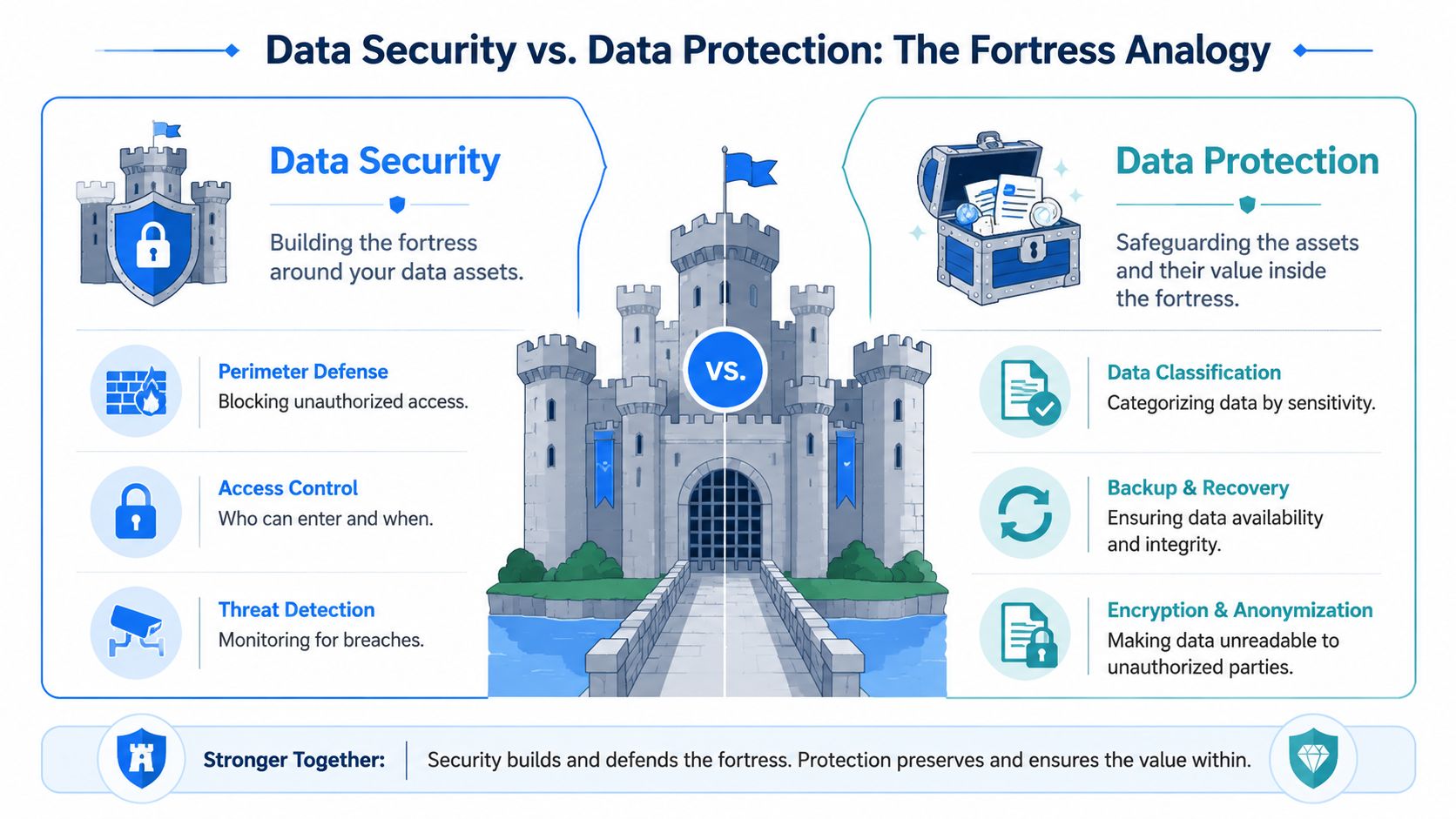
Think fortress and treasure
The easiest way to explain it to clients is this:
- Data security is the fortress. Walls, gates, guards, cameras, locks.
- Data protection is the treasure policy inside the fortress. What counts as valuable, who can touch it, where it can go, and how long it stays there.
You need both. A fortress with no rules still loses treasure. Rules with no fortress get ignored by the first attacker who gets in.
What belongs in each bucket
Here's the practical split MSPs should use when talking to clients:
AreaData security examplesData protection examplesAccessMFA, least privilege, network controlsrole-based access by data type, approval workflowsVisibilitylogging, monitoring, alertingdata inventory, classification, records of processingResiliencebackups, recovery testing, endpoint controlsretention schedules, deletion policies, legal hold handlingData handlingencryption in transit and at restanonymization, minimization, purpose limits
If you need a simple explainer for encryption concepts when discussing security controls with clients, this guide to public key and private key encryption is a useful reference.
Most MSPs over-focus on the fortress
They buy more tools, add more alerts, and still miss the actual exposure. A frequently missed angle is that security failures often come from over-collection and poor governance, not just outside attackers. Many breaches start with data sprawl and shadow IT, and better security often starts with deletion and tighter access scoping, not more tools, as noted by Acceldata's guidance on data sprawl and governance.
That point matters because plenty of clients store data they don't need. Old exports. Duplicated records. Shared drive dumps. CRM fields nobody uses. If they keep collecting without limits, your attack surface keeps growing.
Strong data protection starts with one blunt question. Do we need this data at all?
This also affects reputation. If your client suffers a security incident, the aftermath isn't only technical. It becomes a trust problem. That's why broader resources like PeopleFinder insights on online brand protection are worth reviewing alongside security controls.
If you only sell firewalls and EDR, you're covering part of the problem. If you help clients classify, minimize, retain, and validate, you're solving the whole one.
Turn Compliance Into a Service Opportunity
Most MSPs hear compliance and think paperwork. That's too small. Compliance is a service wrapper around recurring security work.
By the end of 2024, data protection laws covered 79% of the world's population, and 172 countries had enacted such legislation by 2025, according to Usercentrics' roundup of global privacy law coverage. That means your clients aren't dealing with a niche issue. If they operate across borders, sell online, or handle customer data at scale, privacy and protection requirements are already part of doing business.
What buyers actually need from you
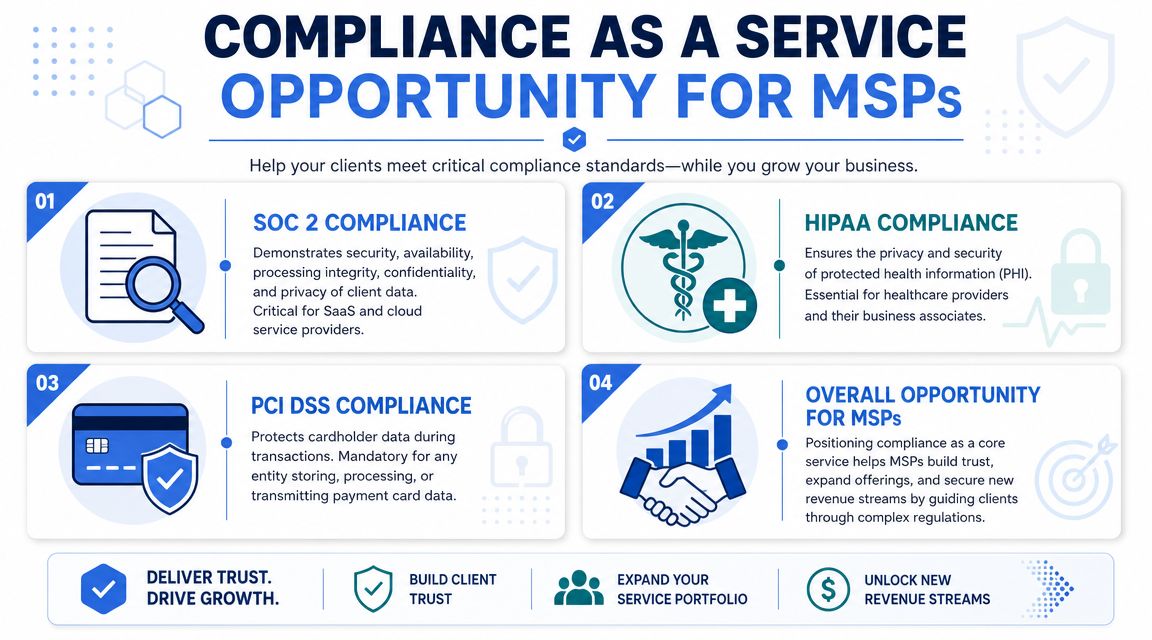
Clients usually don't ask for “data protection architecture.” They ask for help with a framework.
- SOC 2 usually turns into questions about access, logging, change control, risk assessment, and evidence.
- HIPAA pushes attention to protected health information, access restrictions, and handling discipline.
- PCI DSS centers on cardholder data and where it flows, lives, and can be exposed.
- ISO 27001 forces a broader management-system view, including policy, risk, and continuous improvement.
Each one creates billable work for an MSP, vCISO, or GRC partner. Readiness reviews. Gap assessments. control mapping. Policy cleanup. Vendor reviews. Evidence collection. Ongoing remediation tracking.
Stop treating compliance as a one-off
The wrong model is “help the client pass the audit and move on.” The better model is recurring advisory work.
You can package services like this:
- Readiness work: map existing controls, identify gaps, define responsibilities
- Operational support: manage tooling, access reviews, data handling processes
- Validation support: coordinate risk assessment, penetration testing, and retesting
- Audit support: gather evidence, organize artifacts, answer assessor questions
If you already offer security consulting, a deeper page on IT compliance services can help frame these engagements in client language.
Compliance work gets sticky when you tie it to business outcomes. Faster vendor approvals. Fewer blocked deals. Cleaner audit cycles.
Often, MSPs leave money on the table. They already manage the systems. They already know the environment. But they fail to package that knowledge into a formal compliance and GRC service line.
That's a miss. Clients will pay for clarity, structure, and evidence. Especially when they're under pressure.
A Practical Roadmap to Implementing Controls
Clients get overwhelmed when you dump a giant security checklist on them. Don't do that. Break the work into phases they can fund, understand, and execute.
Modern privacy and security programs are being pushed to prove ongoing control effectiveness, not just implement controls once, because cloud-first environments and changing regulations make continuous audit readiness a baseline expectation, as discussed in Amplitude's overview of privacy and security trends.

Phase one lock down the basics
Start with the controls that reduce obvious risk and support nearly every framework.
- MFA everywhere that matters: admin accounts, remote access, email, line-of-business apps
- Patch discipline: internet-facing systems and critical business apps first
- Access cleanup: remove stale accounts, reduce admin rights, separate duties where possible
- Backup confidence: confirm recoverability, not just backup job success
- Network segmentation: don't leave sensitive systems flat and exposed
This phase isn't glamorous. It is essential. A client with weak basics has no business talking about maturity.
Phase two improve detection and response
Once the fundamentals are in place, you build visibility and response capability.
That usually means stronger endpoint telemetry, log review processes, alert triage, and better cloud monitoring. It also means figuring out what normal looks like so abnormal behavior stands out faster.
A short checklist works better than a long manifesto here:
- Pick the crown jewels
Identify the systems and data stores that would hurt most if exposed or altered. - Centralize visibility
Pull logs and alerts into a workflow somebody reviews. - Test your response path
Know who gets called, who approves containment, and how evidence is preserved.
Don't confuse alert volume with control maturity. Mature teams know which events matter and who owns the next action.
Phase three govern the data itself
At this point, data protection gets real.
Clients need to know what data they have, where it lives, who can reach it, and whether they still need it. That means data discovery, classification, retention rules, access reviews, and deletion discipline.
A practical way to explain it:
QuestionControl actionWhat data do we haveinventory and classificationWhy do we keep itdocumented purpose and business ownerWho can access itleast privilege and periodic access reviewHow long should it stayretention schedule and deletion processWhat if it movesapproved transfer paths and monitoring
This is also where MSPs can add real advisory value. You're not just managing systems. You're helping the client reduce exposure by shrinking the amount of sensitive data they keep lying around.
Make the roadmap manageable
Don't try to fix everything in one quarter. Tie each phase to business triggers.
- A healthcare client may start with HIPAA-related access and retention controls.
- A SaaS client chasing enterprise deals may start with SOC 2 evidence and change control.
- A retailer may focus first on cardholder data handling for PCI DSS.
- A manufacturer may care more about operational continuity and restricted access to sensitive systems.
That's how you keep the engagement practical and affordable. You sequence the work based on risk and commercial pressure, not theory.
Validate Controls With Affordable Penetration Testing
This is the part too many MSPs skip. They implement controls, write policies, and assume everything works.
That assumption is expensive.
Modern data security is shifting away from static rules because AI and SaaS workflows spread sensitive data faster than legacy policies can react. Cyberhaven gives a useful example: a CFO exporting financials into an AI tool can bypass old gateways, which is exactly why context-aware controls and validation through testing matter, as described in Cyberhaven's outlook on data security trends.
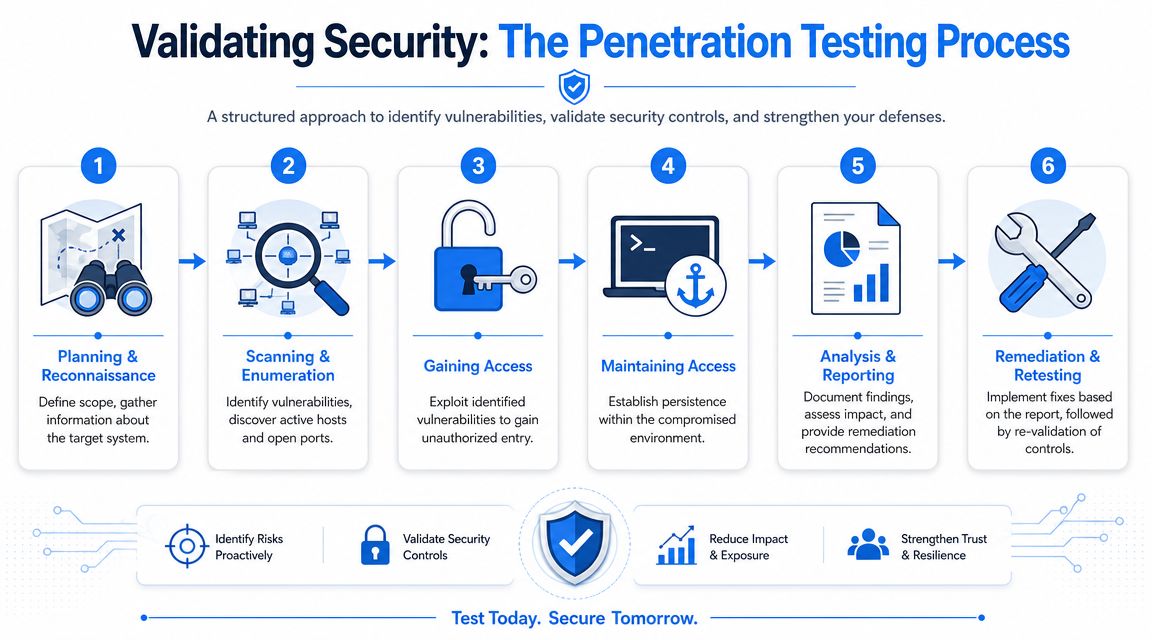
What pentesting actually does
A pentest, pen test, or penetration test is simple to explain. You hire qualified people to think and act like attackers, inside a defined scope, so they can find the weaknesses your tools and checklists missed.
That matters because controls often look solid on paper. Then a tester chains together a weak permission setting, an exposed service, and an overlooked cloud path, and suddenly the story changes.
If you want a more detailed breakdown of how a penetration testing engagement works, this overview of pen testing methodology is a good technical primer.
Why MSPs hate buying penetration testing
The traditional market gets this wrong in three ways.
First, pricing is often inflated. The quote lands, your client balks, and the project dies. Second, lead times are slow, which kills momentum when a deal or audit is already waiting. Third, a lot of security firms don't respect the channel. They see your client list as their future pipeline.
That's why the model matters as much as the test.
The right partnership model for channel firms
If you're an MSP, vCISO, GRC firm, CPA, or reseller, you need a partner that fits your business model.
Look for this:
- Channel-only delivery: they don't compete for your clients
- White label pentesting: reports can sit under your brand
- Manual pentesting: not just scanner output with a glossy PDF
- Certified pentesters: teams with OSCP, CEH, and CREST credentials
- Fast turnaround: because clients don't want to wait weeks to move forward
- Retesting support: because findings only matter if they get fixed and verified
One example is MSP Pentesting, which provides white labeled pentests for channel partners across web apps, internal networks, mobile apps, cloud, external environments, and social engineering engagements.
A penetration test is not just a compliance checkbox. It's proof that your client's controls hold up when somebody pushes on them.
Where pentests fit in your service stack
You don't need to sell a penetration test as a standalone event every time. Tie it to moments that clients already care about.
- Before an audit: validate the environment before an assessor asks hard questions
- After major changes: cloud migrations, new SaaS deployments, acquisitions, identity redesigns
- After remediation: confirm the fix worked
- During recurring security programs: support annual or periodic validation expectations
Affordable, manual pentesting shines. It lets you offer a real security outcome without building an internal testing team, adding headcount, or waiting forever for specialist availability.
For MSP owners, that's the key advantage. You keep the client relationship, expand your service line, and avoid the cost and politics of building a pentest practice from scratch.
Your Action Plan for Security Service Growth
Here's the no-nonsense version.
Buyers expect more now. The World Economic Forum reported that 77% of organizations have adopted AI for cybersecurity, primarily for phishing detection, intrusion response, and user-behavior analytics, which raises the bar for governance and control validation according to the WEF Global Cybersecurity Outlook 2026. Your clients are hearing more advanced security language from everyone around them. If your offer still stops at endpoint and patching, you'll lose strategic ground.
Use this checklist:
- Find the pressured accounts: look for clients dealing with SOC 2, HIPAA, PCI DSS, ISO 27001, vendor reviews, or cyber insurance scrutiny
- Explain the split clearly: teach clients the difference between data security and data protection
- Package the work: offer risk assessment, readiness support, policy cleanup, and control validation
- Add white label pentesting: give clients a real penetration testing option without building your own bench
- Stay channel-safe: work with partners who won't compete for the account
- Lead with affordability and speed: clients move when the scope is clear and the turnaround is practical
That's how you stop being the IT vendor who reacts to tickets and become the advisor who helps clients close deals, pass audits, and reduce risk.
If you want a channel-only partner for white label pentesting, manual pentesting, and fast-turnaround penetration testing that supports your MSP, vCISO, GRC, or reseller model, talk to us about testing delivered under your own brand.
%20(1).png)
.avif)
.png)
.png)
.png)

