

ITSM is the overall strategy for managing IT services, while ITIL is a specific framework for implementing that strategy. The difference got much clearer with ITIL 4 in 2019, which positioned ITIL as a flexible way to support service value, not the whole discipline itself.
If you're an MSP owner, vCISO, GRC advisor, or reseller, you've probably heard clients throw around both terms like they mean the same thing. They don't. That confusion matters because it affects how you package services, document controls, pass audits, and sell higher-value work like penetration testing, risk assessment, and compliance support for SOC 2, HIPAA, PCI DSS, and ISO 27001.
Most articles stop at textbook definitions. That's not useful when you're trying to standardize your help desk, tighten change control, or add white label pentesting without bloating payroll. What matters is how these concepts shape your service catalog, your margins, and your credibility with clients.
ITIL vs ITSM Unpacking the Confusion
The confusion usually starts when a client says they "want ITIL" but what they really need is a more disciplined service operation. They want fewer ticket escalations, cleaner approvals, better documentation, tighter vendor coordination, and security work that fits into their compliance program.
Here's the clean answer. ITSM is the broad discipline of managing IT services. ITIL is one structured framework inside that discipline. Think of ITSM as the operating model for your MSP. Think of ITIL as a playbook you can use to make that model more consistent.
A simple way to frame it:
TopicITSMITILWhat it isBroad service management disciplineSpecific framework of practicesRole in your MSPShapes how you deliver all servicesHelps standardize selected workflowsMain question answeredWhat services do we manage and whyHow should we run those servicesBest useStrategy, service design, lifecycle thinkingProcess guidance, terminology, governanceSecurity relevanceDefines where security fits in service deliveryHelps formalize tickets, changes, incidents, and improvements
Practical rule: If you're deciding how to run your business, you're talking about ITSM. If you're choosing a formal workflow for incidents, changes, or service requests, you're talking about ITIL.
This matters for security services too. A client doesn't buy a penetration test because they love security jargon. They buy it because they need risk reduced, controls validated, and evidence for compliance. That's ITSM thinking. How you schedule, scope, approve, remediate, and review that pentest work is where ITIL can help.
Understanding ITSM as Your Business Strategy
Most MSPs already practice ITSM. They just don't always call it that.
If you run onboarding, service desk, patching, vendor coordination, endpoint support, cloud administration, compliance support, and client reporting under one service model, you're doing IT service management. You're managing services, not just fixing devices.
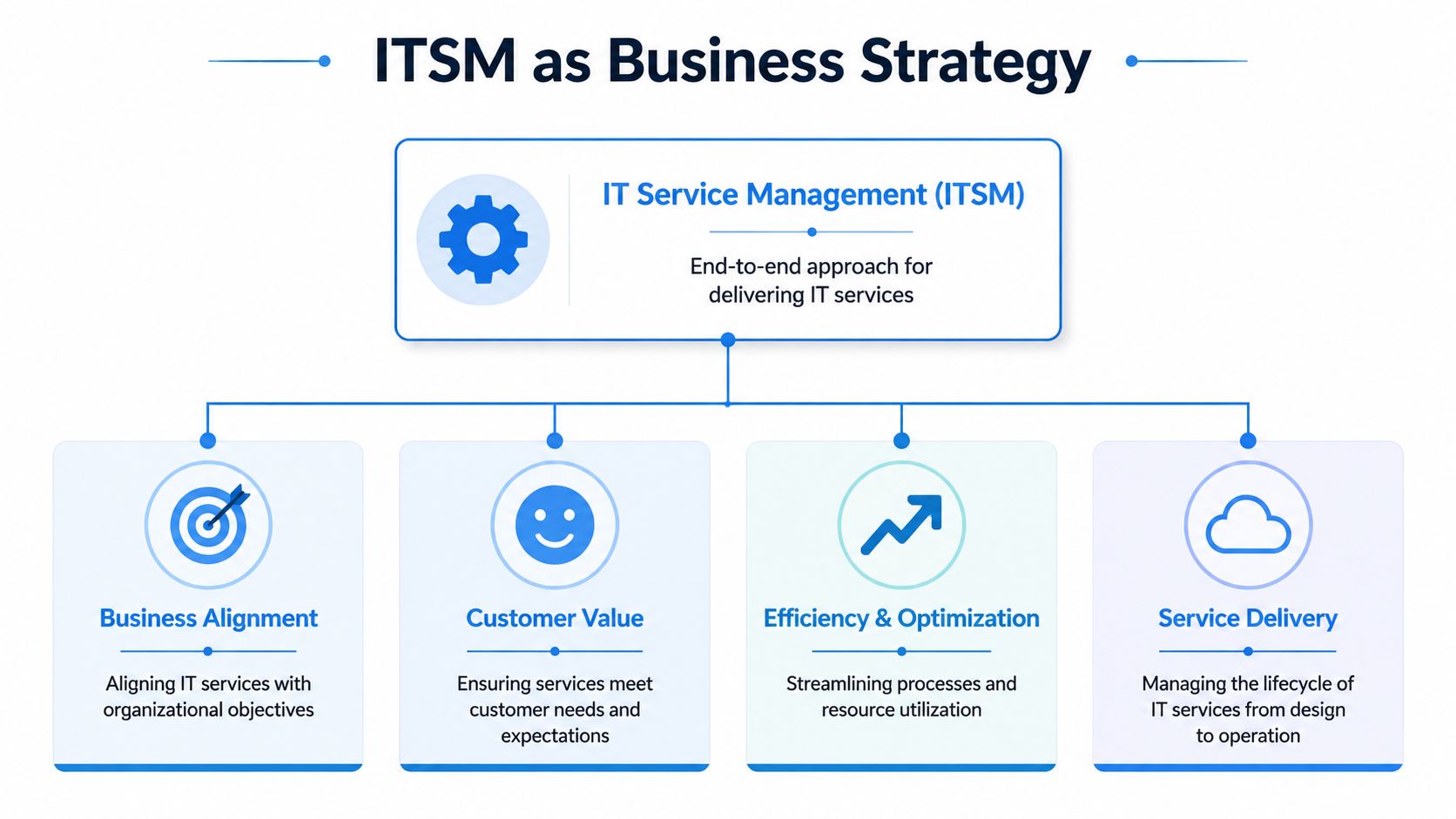
The key point is that ITSM is bigger than any framework. According to PeopleCert's explanation of ITSM and ITIL, ITSM is the broader discipline of managing IT services, while ITIL is a specific framework within that discipline. That distinction became especially clear with ITIL 4 in 2019, which reframed ITIL around the Service Value System, seven guiding principles, and four dimensions of service management.
What ITSM looks like inside an MSP
A healthy ITSM model usually shows up in very practical ways:
- Service catalog discipline means you know what's included, what's out of scope, and what should become project work.
- Ownership across the lifecycle means somebody is responsible from onboarding through support, reporting, renewal, and offboarding.
- Security built into delivery means backups, access reviews, logging, patching, and penetration testing aren't random add-ons.
If you're helping clients choose governance, risk, and compliance tools, that's ITSM in action. You're aligning service delivery with business risk and audit expectations, not just reacting to tickets.
Good ITSM makes your MSP easier to scale because it turns tribal knowledge into repeatable service delivery.
Why this matters for profitability
MSPs lose margin when every client gets a custom process. ITSM pushes you to define a standard way to deliver value. That helps with staffing, documentation, escalation, and client expectations.
It also helps you package security work correctly. A pen test, penetration test, or manual pentesting engagement shouldn't sit off to the side like a one-off favor. It should tie into your broader service model, your compliance motion, and your QBR conversations.
Defining ITIL as a Practical Playbook
ITIL is the playbook a lot of service providers reach for when they need structure. Not because it's magic. Because it's familiar, widely understood, and useful when your team needs a common language.

A strong historical reason for its staying power is that ITIL was developed by the UK government and later became the most widely adopted framework for implementing IT service management, as noted by Dion Training's overview of ITSM vs ITIL. That's why buyers, auditors, and service teams often use the terms interchangeably, even when they shouldn't.
Where ITIL helps in daily operations
ITIL is useful when your MSP needs more than "we usually handle it this way." It gives you a reference model for the stuff that causes friction every week:
- Incident management for ticket triage and restoration of service
- Change enablement for approvals, scheduling, and rollback thinking
- Problem management for root cause analysis
- Service request handling for repeatable user asks
- Continual improvement for turning lessons into process updates
If you're trying to improve your operational level agreement process, ITIL gives you a cleaner way to define internal responsibilities between your help desk, engineering, security, and compliance functions.
What MSPs get wrong about ITIL
Some providers treat ITIL like an all-or-nothing religion. That's a mistake.
You don't need to implement every concept to get value. Use the parts that solve a real problem. If your ticket queue is fine but your change approvals are sloppy, fix change control first. If your remediation follow-up after a penetration test is weak, formalize that workflow instead of rewriting your whole operation.
ITIL works best when you adopt it selectively and tie it to service outcomes clients actually care about.
Comparing Key Differences For Service Providers
For MSPs, the ITIL vs ITSM debate isn't academic. It changes how you package services, support compliance, and decide what should be standardized.
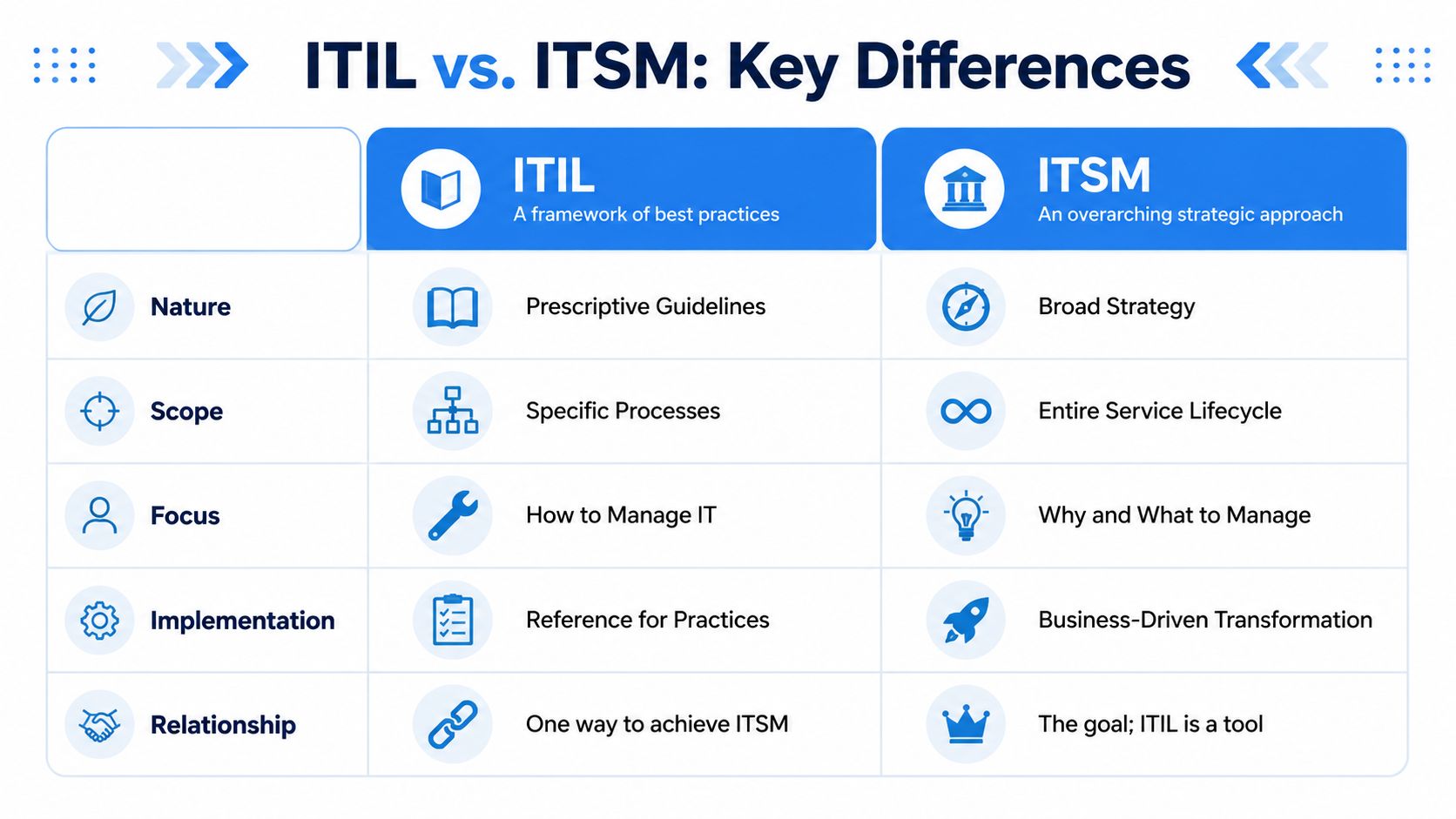
According to TeamDynamix on ITSM vs ITIL, ITSM is the broader operating discipline for managing IT services end to end, while ITIL is a prescriptive framework inside ITSM that supplies specific practices, terminology, and process guidance. That's the distinction service providers need to keep straight.
The business difference
ITSM is about your overall service machine. It covers client experience, service lifecycle, value, governance, staffing, and continuous improvement.
ITIL is about process discipline within that machine. It gives you names, control points, and workflow patterns that are easier to train, document, and audit.
Here's the practical split:
Decision areaUse ITSM thinking whenUse ITIL thinking whenService packagingDefining your managed services and compliance offersStandardizing how those services are deliveredClient alignmentMapping services to business goals and riskMapping workflows to internal process stepsSecurity operationsDeciding where pentesting and risk assessment fitDefining approvals, incidents, changes, and remediation trackingCompliance supportBuilding an audit-friendly service modelShowing repeatable operating proceduresScaling the teamDesigning roles and service ownershipTraining staff on consistent execution
The compliance difference
For SOC 2, HIPAA, PCI DSS, and ISO 27001, clients usually need evidence that services are controlled, documented, and reviewed. ITSM helps you define the operating model that supports those outcomes. ITIL helps you show that specific activities happen in an orderly way.
A good example is change control. If a client is rolling out a new web app, cloud environment, or identity workflow, your ITSM model says security validation belongs in the release cycle. ITIL-style process discipline says who approves the change, when the pen test happens, how findings are tracked, and when the change is closed.
The flexibility difference
ITSM is flexible by design. You can blend methods, tools, and vendors. ITIL is more opinionated, which is exactly why it helps when your operation feels messy.
If you're a smaller MSP, don't overbuild. Use ITSM to shape the business. Use ITIL where inconsistency is costing you time, trust, or margin.
How Pentesting Strengthens Your Service Model
Security services become much easier to sell when they fit inside a clear service model. That includes pentest work, penetration testing, recurring risk assessment, and remediation review.

Too many MSPs still treat a penetration test like a one-time compliance checkbox. That's the wrong model. A mature service provider treats manual pentesting as part of service quality, risk control, and change validation.
Where pentesting fits in ITSM
In an ITSM model, pentesting protects service value. It helps confirm whether the environment you're managing is defensible, not just "monitored."
That matters when clients ask for support tied to:
- SOC 2 readiness and control validation
- HIPAA security reviews
- PCI DSS scoping and testing conversations
- ISO 27001 risk treatment evidence
- board-level reporting from a vCISO
- ongoing GRC programs
A strong MSP doesn't just coordinate scanners and dump findings in a PDF. It makes security testing part of the client service lifecycle.
Where pentesting fits in ITIL practice
The model becomes practical.
A pen testing report can trigger problem management because it reveals root causes, not just symptoms. A remediation plan belongs in change enablement because fixes need approvals, timing, and rollback awareness. Follow-up validation belongs in continual improvement because the point isn't to produce a report. The point is to improve the environment.
According to the ITSM benchmarking discussion at ITSM.tools, ITIL 4 practice names are used by the AXELOS ITSM Benchmarking Report to measure adoption of core service-management capabilities, which makes ITIL a useful reference model for comparing maturity across organizations. For MSPs, that means security testing can be slotted into recognized service practices instead of floating around as an isolated add-on.
If you're building a channel offering, white label penetration testing for resellers and MSPs fits best when it's tied to onboarding, major changes, annual compliance cycles, and post-remediation validation.
The most profitable security service is the one that fits naturally into an existing client workflow.
Why this improves margins
Selling a standalone penetration test is harder than selling a security milestone inside a managed service or compliance roadmap. Clients understand "test before go-live," "validate controls for audit," and "retest after remediation." Those are service events with business meaning.
This also keeps your internal team lean. You don't need to build a full offensive security bench in-house to offer quality pentests. You need a clean process, a trusted delivery partner, and a model that keeps branding, reporting, and client ownership under your control.
Your Next Steps For Better Service Delivery
Stop treating ITIL vs ITSM like a fork in the road. It isn't. ITSM should shape how your MSP delivers value. ITIL should support the parts of that delivery that need tighter structure.
Do these next:
- Review your service catalog and decide which offerings are core managed services, which are project work, and which should become recurring security services.
- Pick one broken workflow and standardize it. Change approval, remediation follow-up, onboarding handoff, or ticket escalation are good places to start.
- Map security into delivery, not beside it. Add penetration testing, pen test validation, and risk assessment checkpoints to onboarding, major changes, and compliance engagements.
- Package by client outcome. Sell around readiness for SOC 2, HIPAA, PCI DSS, and ISO 27001, not just around technical tasks.
- Protect margin with specialization. Keep strategy and client ownership in-house. Use white-labeled technical depth where it makes sense.
If you're an MSP, vCISO, GRC firm, CPA, or reseller, the winning move is simple. Run the business with ITSM discipline. Borrow ITIL where process consistency matters. Make security services part of the core offer, not an afterthought.
If you want to add affordable, fast, white label pentesting to your service stack without competing against your own client relationships, see how we run pentests for the channel. Our team delivers manual pentest, pen test, penetration test, and penetration testing services through a reseller-friendly approach with certified pentesters holding OSCP, CEH, and CREST credentials. Contact us today to strengthen your compliance offering, improve service delivery, and grow security revenue under your own brand.

.avif)
.png)
.png)
.png)

