
Your client already has antivirus installed. Then they still get hit by ransomware, a fileless attack, or a script-driven compromise that never looked like old-school malware in the first place.
That's the problem. Legacy antivirus is built for yesterday's threats, and your clients are dealing with today's attack methods. When a breach happens, the client doesn't blame the outdated tool first. They blame the MSP who recommended it.
If you own or run an MSP, this matters beyond security. It affects renewals, trust, upsells, and your ability to look credible to a vCISO, CPA firm, GRC partner, or compliance-focused buyer. You can't keep pitching endpoint protection like signature-based AV is still enough. It isn't.
Your Client's Legacy Antivirus Is Failing
A new client signs with your MSP. Their endpoint stack looks fine on paper. Antivirus is installed, alerts are quiet, and the incumbent provider checked the box. Then a user opens a malicious script, ransomware spreads, and nobody catches it until files start getting renamed.
That failure lands on you.
Many MSPs inherit clients that still rely on traditional antivirus alone. It scans for known bad files and misses the attack paths that matter now, including scripts, fileless activity, and intrusion chains that do not look like old malware at all.
The business problem is simple. Clients do not separate product failure from MSP failure. If the endpoint tool misses the attack, your recommendation, your standards, and your security maturity all get questioned.
Why this hits your service offering
Legacy AV creates a bad kind of stability. It looks settled, familiar, and cheap to keep. It also gives clients false confidence, which makes the eventual incident harder to explain and harder to recover from.
That affects more than cleanup.
It affects renewals, board-level trust, compliance conversations, and your ability to sell higher-value security services. If your endpoint story still comes down to signature updates and malware scans, your stack looks dated. For ransomware-focused clients, pair this conversation with practical ransomware prevention best practices for MSPs so they understand endpoint protection is only one control in a larger defense plan.
Practical rule: If a client is running legacy AV as its main endpoint control, treat that as a gap you need to remediate, not a tool you can keep defending.
What to do right now
Start with three direct actions:
- Audit inherited endpoint protection: Identify every client still depending on legacy AV alone.
- Reset the sales message: Position endpoint security around stopping suspicious behavior and attack execution, not just detecting known malware.
- Standardize a modern baseline: Make NGAV part of your core managed stack, then build higher-trust services around it.
Do not oversell that baseline, either. NGAV improves prevention. It does not prove the client is secure. That gap matters, because attackers still exploit weak configurations, exposed access paths, and business logic flaws that endpoint tools never validate. For an MSP, that is the opening to package manual penetration testing as the service that finds what endpoint protection cannot.
What Is Next Generation Antivirus Really
Next generation antivirus is endpoint protection built to judge behavior, not just match files against a known-bad list. It looks at how a process launches, what it touches, whether it tries to disable controls, inject code, dump credentials, or abuse scripts that admins use every day.

That matters because current attacks rarely arrive as a single obvious malware file. They use PowerShell, macros, stolen admin tools, remote access software, and living-off-the-land techniques that slip past products built for signature matching. NGAV is designed to catch the attack pattern before the endpoint is encrypted, backdoored, or turned into a launch point.
What NGAV looks for
At the product level, NGAV usually combines several controls into one endpoint agent:
- Behavioral analysis: It monitors process activity and flags actions that look like exploitation, privilege abuse, lateral movement, or ransomware execution.
- Machine learning models: It scores files, scripts, and activity patterns based on traits associated with malicious use.
- Threat intelligence: It pulls in cloud-fed indicators and reputation data so detections improve as new attacker methods show up.
- Exploit prevention: It blocks common attack techniques such as memory abuse, malicious scripting, and suspicious execution chains.
The practical test is simple. The tool should ask whether the process is behaving like an attack, not whether the file hash is already famous.
Good NGAV focuses on attacker behavior early enough to stop execution, not just label malware after the fact.
Why this matters to an MSP
This changes your offer from basic antivirus management to modern endpoint prevention. That is a better message for security-conscious buyers, and it fits cleanly into compliance conversations around SOC 2, HIPAA, PCI DSS, and ISO 27001. Clients do not care about engine names. They care about whether you can reduce endpoint risk in a way that stands up during audits, renewals, and post-incident scrutiny.
It also helps you package your stack more clearly. NGAV belongs in the baseline managed endpoint service. Logging, correlation, and investigation belong elsewhere, often alongside a managed SIEM service for centralized detection and alert triage.
Do not sell NGAV as proof the client is secure. It improves prevention on the endpoint. It does not test exposed apps, weak access paths, unsafe configurations, or business logic flaws. That gap matters, because those are the weaknesses manual penetration testing exposes, and they sit outside what endpoint tools can validate.
NGAV vs EDR vs XDR Explained for MSPs
Most MSP buyers hear these acronyms and assume they all mean "better antivirus." They don't. They solve different problems.

The simple version
| Tool | What it does | MSP value |
|---|---|---|
| NGAV | Prevents malicious activity on endpoints | Strong baseline protection |
| EDR | Detects, investigates, and helps respond on endpoints | Better incident visibility |
| XDR | Extends detection and response across more security layers | Broader operational view |
NGAV is prevention.
It tries to stop threats before they execute or spread.
EDR is visibility and response.
It helps your team investigate suspicious endpoint activity and respond when something gets through.
XDR is wider correlation.
It pulls together signals from multiple areas like endpoint, cloud, and other parts of the environment so your team can see more of the attack path.
Why MSPs should care about the difference
If you sell all three like they're interchangeable, you'll confuse clients and undersell your service design. Prevention belongs in every managed stack. Investigation and response depend on the client's risk, budget, and maturity.
CrowdStrike notes that modern NGAV is cloud-native, can be deployed in hours instead of months, and provides to-the-minute updates without the old burden of managing on-prem infrastructure and signature databases. That cloud-first model is a big reason NGAV works so well for MSP operations. Their write-up on cloud-based NGAV deployment and management lays this out clearly.
If you're pairing endpoint tooling with monitoring, a managed logging strategy matters too. In this scenario, a managed SIEM service for MSP environments starts to fit into the bigger stack.
Bottom line: Sell NGAV as the default endpoint layer. Add EDR when the client needs investigation. Move to XDR when they need broader detection across the environment.
How NGAV Strengthens Your MSP Service Offering
This isn't just a security upgrade. It's a service packaging upgrade.

When you move clients to next generation antivirus, you stop looking like a basic IT shop and start looking like a real security partner. That matters when you're talking to a vCISO, a GRC consultant, or a buyer asking smart questions about compliance and risk.
Better fit for regulated clients
A modern endpoint stack supports the kind of story regulated clients expect to hear. If a customer is pursuing SOC 2, dealing with HIPAA, handling payment data tied to PCI DSS, or aligning with ISO 27001, old-school AV sounds weak.
You still need policies, access controls, hardening, risk assessment, and evidence. But a current endpoint control tells the client you're not building their security program on outdated assumptions.
Better fit for your business model
NGAV also improves how you deliver service:
- Faster rollout: Cloud delivery is easier to standardize across tenants.
- Simpler management: Your team spends less time babysitting signature-driven products.
- Stronger client messaging: You can explain real prevention value in plain English.
- More stickiness: Security-led services are harder for clients to swap out than generic IT support.
A key opportunity for an MSP or reseller is packaging. A strong endpoint layer can anchor a broader managed security offer that includes policy guidance, compliance support, alert triage, and testing. That's how you raise account value without sounding like you're just stacking random tools.
Where NGAV Stops and Manual Pentesting Begins
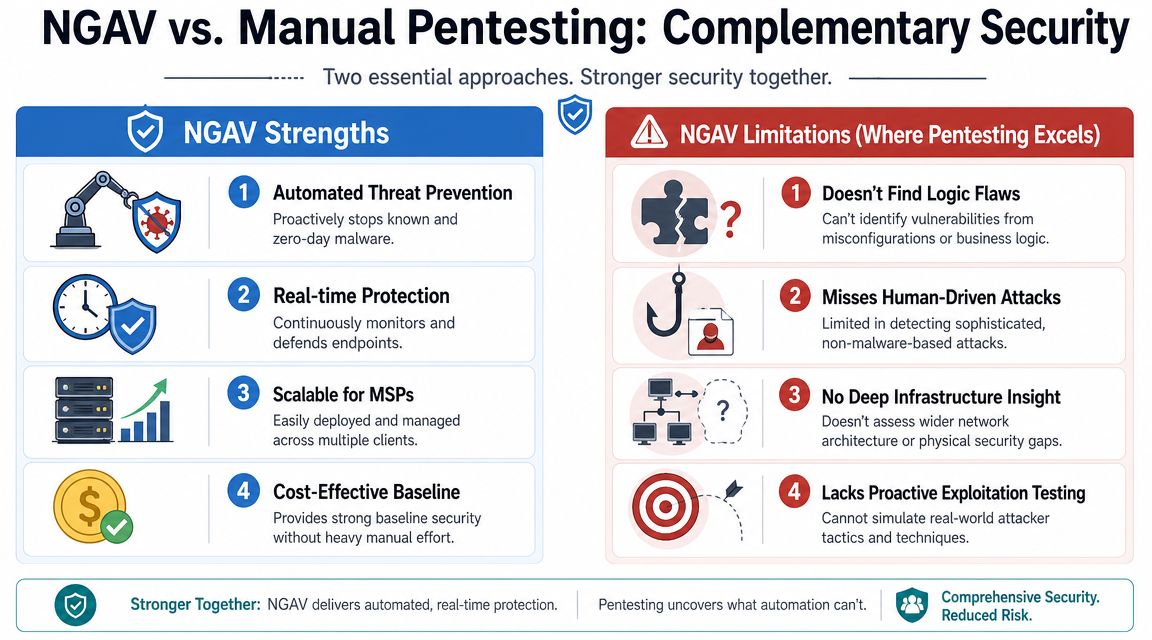
Many buyers mistakenly assume that NGAV solves all endpoint security problems. It does not. It improves prevention on the device, but it does not tell your client whether an attacker can work around controls, abuse access, or move through the environment without looking like malware.
What NGAV does well
NGAV is built to stop endpoint threats. It catches malware-like behavior, ransomware activity, fileless techniques, and suspicious execution patterns far better than legacy antivirus.
That gives your MSP a stronger baseline. It does not give you proof that the client is hard to breach.
What it does not prove
Sophos explains the gap clearly. Where NGAV leaves residual risk includes attack paths, misconfigurations, identity abuse, and lateral movement. Those are the areas buyers miss when they focus only on the endpoint agent.
Your client still needs answers to questions like these:
- Can an attacker chain minor weaknesses into a working breach path?
- Did a misconfigured service or remote access tool create an easy entry point?
- Can stolen credentials or weak MFA controls bypass the endpoint stack?
- Can a user with excessive permissions move into sensitive systems?
- Can unmanaged tools or shadow IT create exposure outside the NGAV agent's view?
That last point matters more than many MSPs admit. If the client has gaps in endpoint coverage, weak policy enforcement, or loose control over RMM and device tooling, your prevention story breaks fast. This is why device management software risks and controls for MSPs belong in the same conversation as endpoint security.
Why manual pentesting still matters
Manual pentesting validates what the tool stack cannot. A skilled tester checks whether real weaknesses can be combined, whether identity controls fail under pressure, and whether business logic or trust relationships create paths that no endpoint product will flag.
That is the commercial opportunity for your MSP.
If you position NGAV as the endpoint prevention layer and white-labeled manual pentesting as the validation layer, you stop selling software in isolation and start selling evidence. Clients understand that. So do auditors, procurement teams, and security-conscious buyers reviewing your stack against outside options such as expert cyber security services.
A good penetration test gives your client something NGAV cannot provide:
- Proof of exploitability: Which weaknesses can be used.
- Attack path validation: How one small issue becomes broader compromise.
- Human judgment: Automated tools miss business context and trust abuse.
- Stronger reporting for buyers and compliance teams: Clear findings, impact, and remediation priorities.
For serious clients, use certified pentesters with credentials such as OSCP, CEH, and CREST. The letters are not the point. The point is that a trained human tested the environment instead of relying on automated detection alone.
That is where NGAV stops. Manual pentesting starts where tools run out of visibility.
Building Your Complete Client Security Package
The best client package is simple to explain. Next generation antivirus for endpoint prevention. Manual pentesting for validation. Compliance support wrapped around both.
If you're evaluating NGAV vendors, keep your checklist practical.
What to look for in an NGAV platform
- Cloud-native management: You want centralized control across tenants.
- Strong behavior-based protection: That's the whole point of moving beyond legacy AV.
- Autonomous response: SentinelOne highlights that advanced NGAV agents can use on-device machine learning to detect and block threats even when an endpoint is offline, which is a big deal for remote users and intermittent connectivity. Their explanation of offline-capable NGAV protection is especially relevant for MSP operations.
- Operational fit: The product has to work at MSP scale, not just look good in a demo.
Then pair that stack with human-led validation. A penetration test, pen testing, or broader pentesting engagement shows clients that you aren't just installing software and hoping for the best.
A lot of firms also benefit from reviewing outside perspectives on layered defense and advisory support. If you want another example of how providers frame broader security support, Wisenet Security Ltd offers a useful overview of expert cyber security services.
For MSPs already standardizing endpoint controls and broader IT operations, your device stack matters too. A tighter endpoint strategy works best when it lines up with your device management software approach for MSP environments.
The smart play is straightforward. Offer modern endpoint protection as the baseline. Add affordable, fast, white label pentesting to prove where clients are still exposed. That helps you win better clients, support stronger compliance conversations, and avoid pretending one tool can do a human's job.
If you want a channel-only partner for affordable, fast, manual pentesting, we run pentests that carry your logo and help MSPs, vCISOs, GRC firms, CPAs, and resellers deliver white-labeled penetration testing without competing for the client relationship. Our certified pentesters hold OSCP, CEH, and CREST credentials, and we focus on practical reporting, quick turnaround, and partner-first delivery. Contact us today to add scalable pen test and penetration testing services to your security offering.
%20(1).png)
.avif)
.png)
.png)
.png)

