
Your clients are asking harder questions than they did a year ago. They want penetration testing, they want help with SOC 2, HIPAA, PCI DSS, and ISO 27001, and they want answers fast. If your MSP can't provide them, someone else will.
That’s the core issue with outsourcing cyber security. This is not just about adding another service line. It’s about keeping accounts, protecting margin, and making sure your client doesn’t go shopping for a security vendor that replaces you.
A lot of providers in this space still make the same mistakes. They charge too much, rely too heavily on scanners, drag projects out, and then treat your client like an upsell opportunity. That model is broken. A channel-only, white label pentesting partner fixes it because you keep the relationship, your client gets expert help, and the work gets done without adding headcount you can't easily hire or retain.
Why Outsourcing Cyber Security Is Non-Negotiable

Your clients are under pressure from auditors, insurers, boards, and customers. They don’t care that building an internal security team is expensive and slow. They care that you can solve the problem now.
That’s why outsourcing cyber security has moved from nice-to-have to required. The cybersecurity outsourcing market is projected to reach $21.2 billion by 2027, driven in part by a 15% increase in data breaches in 2023 and the cost of running security in-house, according to Girl Power Talk’s outsourcing trends analysis.
Clients need answers now
A client pursuing SOC 2 or dealing with HIPAA obligations won’t wait while you hire a security engineer, train them, build methodology, buy tooling, and figure out reporting. They’ll find a provider that already has the people and process.
That’s why smart MSPs expand through partners, not payroll. If you want a broader view of what clients now expect from providers, this guide on cybersecurity for MSPs is worth reading.
Practical rule: If a client asks for a pen test, a risk assessment, or compliance evidence and you can’t deliver, you’re already in a competitive sales cycle whether you admit it or not.
In-house security sounds good on paper
On paper, building in-house sounds clean. In reality, it’s a grind. You need experienced people, consistent methodology, quality control, report writing, remediation guidance, and availability when the client needs work done on a deadline.
Then there’s the channel reality. Most MSPs don’t need a giant internal security bench. They need reliable access to certified specialists who can step in when a deal requires manual pentesting, a formal penetration test, or a deeper compliance review.
Here’s the blunt recommendation. Keep strategy, account ownership, and client trust in-house. Outsource specialized execution to experts who already do this every day.
Decoding Common Cyber Security Outsourcing Models
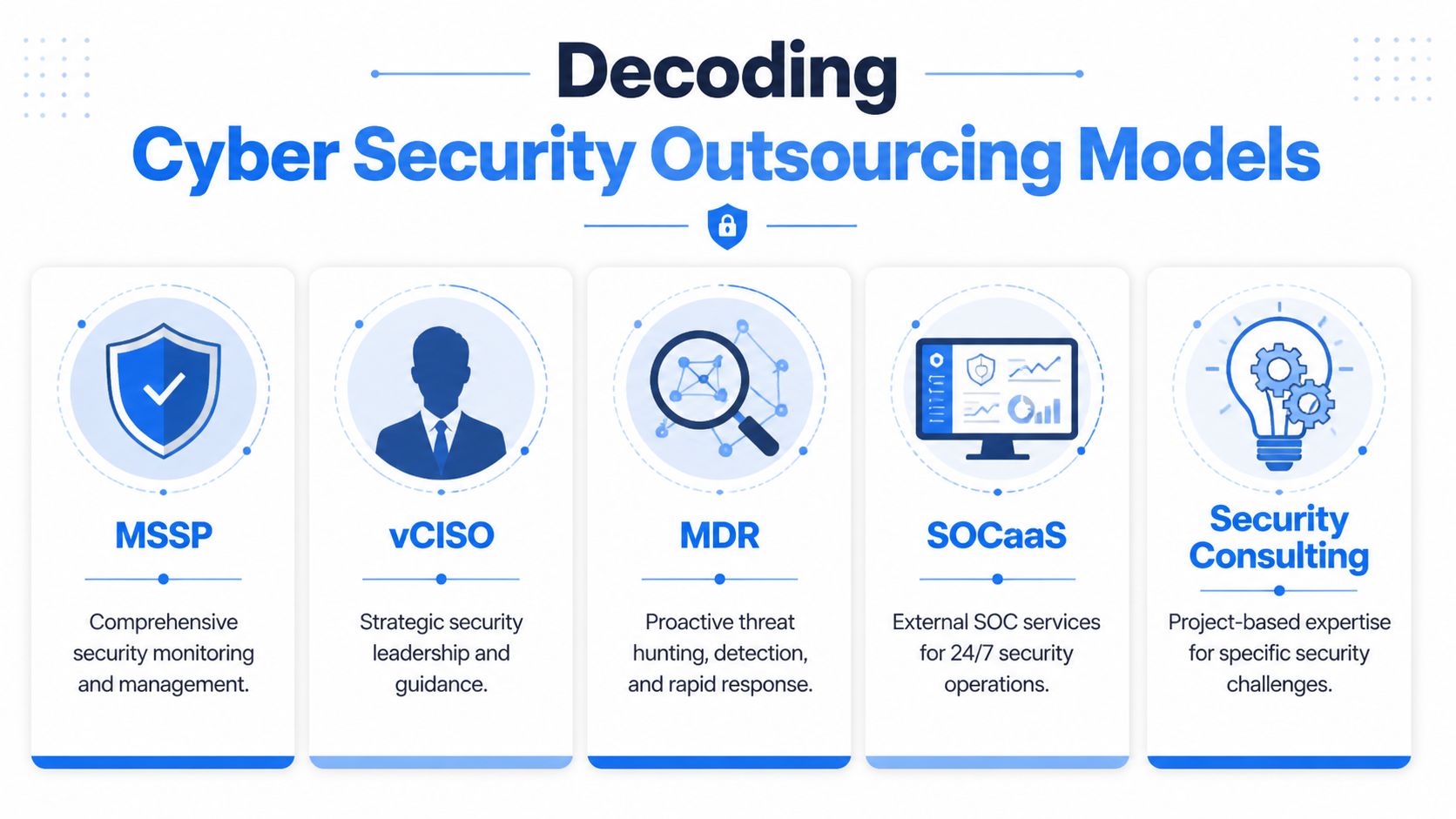
Most MSPs hear a pile of acronyms and get sold on whatever sounds most complete. That’s a mistake. Different models solve different problems, and some of them create channel conflict fast.
77% of enterprises now outsource some cybersecurity functions, and organizations face nearly 1,900 cyberattacks per quarter, according to Growth Acceleration Partners on IT outsourcing trends. Outsourcing is common. Choosing the wrong model is also common.
What each model really means
| Model | What it does | Channel risk |
|---|---|---|
| MSSP | Ongoing security monitoring and management | Often medium to high if they sell direct |
| vCISO | Strategic leadership, policy, risk, and compliance guidance | Lower if scoped well, higher if they also deliver direct services |
| MDR | Detection and response focused on active threats | Medium if they become the primary security contact |
| SOCaaS | External security operations center support | Medium, especially if communication goes around you |
| Pentesting provider | Point-in-time or recurring pen test and penetration testing work | Low if truly white label and channel-only |
If you want a broader comparison of managed security structures from a leadership angle, AuditReady's guide for security leaders gives useful context.
The real difference is ownership
An MSSP may be a fit when a client needs broad operational coverage. A vCISO works when the client lacks internal security leadership. MDR and SOCaaS help with monitoring and response. But none of those automatically solve the MSP problem of preserving brand control.
That’s where many providers fail. They say they support partners, but their sales team still wants direct access to your account. They present under their own logo, bill under their own name, and slowly become the security brand your client remembers.
A partner who wants your client relationship is not a partner. They’re a future competitor with temporary manners.
Why pricing and scope matter
A lot of confusion starts with unclear packaging. If you don’t know exactly what is included, your margin disappears and your client gets frustrated. This breakdown of managed security service pricing helps MSPs think more clearly about how outsourced services should be structured.
For resellers, the safest model is simple. Use broad outsourced security services where needed, but handle penetration testing through a partner that stays behind the curtain and supports your brand.
Key Benefits and Hidden Risks of Outsourcing

Outsourcing cyber security gives you reach you probably can’t build internally without pain. You get access to specialists, a more predictable delivery model, and a way to take on projects that would otherwise leave your pipeline.
But outsourced security also creates risk. The biggest one is simple. You are giving another company access to systems, data, and trust that your client gave to you.
What you gain
A good outsourcing arrangement helps you sell and deliver services that clients already want. That includes risk assessment, compliance support, and manual pentesting that internal IT generalists usually aren’t equipped to perform well.
The upside is practical:
- Specialized expertise: You can bring in OSCP, CEH, or CREST certified talent without hiring each role yourself.
- Cleaner delivery: Mature partners already know how to scope web apps, cloud environments, internal networks, mobile apps, and social engineering.
- Stronger compliance support: Good reports help clients prepare for SOC 2, HIPAA, PCI DSS, and ISO 27001 reviews.
What can go wrong
A critical risk in outsourcing is the expanded attack surface from third-party access, which can increase breach probability by up to 50%. The same source notes that this risk is mitigated by working with providers that hold SOC 2 Type II and ISO 27001 certifications, as outlined by SuperStaff’s cybersecurity outsourcing overview.
That’s the technical risk. The business risk is just as serious.
- Brand erosion: Your client starts seeing the vendor as the expert and you as the middleman.
- Slow service: The provider takes forever to scope, schedule, or report. Your client blames you.
- Weak methodology: They run a scanner, rename the file, and call it a penetration test.
- Sales conflict: They pitch adjacent services directly to your account.
If the provider’s process is opaque, expect trouble. You need to know who talks to the client, how data is handled, and what happens when findings are disputed.
The solution isn’t avoiding outsourcing. The solution is outsourcing to the right structure. That means clear contracts, defined SLAs, limited access, and a provider that respects the channel.
Why White-Label Pentesting Is an MSP's Best Bet

If you’re an MSP, vCISO, CPA firm, or GRC reseller, you do not need another vendor trying to own the client conversation. You need a delivery partner that stays invisible, does strong work, and makes you look organized.
That’s why white label pentesting is the cleanest outsourcing model for the channel. You keep the account. Your client gets a real pen test. The partner handles the specialized work behind the scenes.
White label fixes the partner problem
A white label model works because it aligns incentives. The provider is there to execute, not to cross-sell your account. That matters when your reputation depends on response time, report quality, and whether the tester can explain findings in plain English.
The market already shows the need. 52% of companies outsource vulnerability assessments, yet there is still a major gap in guidance for MSPs that want specialized, manual pentesting from OSCP or CREST certified experts with fast reporting, according to Virtual Employee’s review of cybersecurity outsourcing trends.
Manual pentesting beats checkbox testing
Many providers disappoint the market by selling automated scanning as if it were a full penetration test. It isn’t.
A scanner can find known issues. A human tester can chain weaknesses together, validate impact, test business logic, and show what an attacker could do. That difference matters for clients trying to pass audits, satisfy customers, or defend a budget request.
Here’s what to insist on in a white label penetration testing partner:
- Manual methodology: Scanners can support the work, but they can’t be the work.
- Certified testers: Look for OSCP, CEH, and CREST credentials.
- Fast reporting: You need findings and remediation guidance while the project is still urgent.
- Broad environment coverage: Internal, external, web, mobile, cloud, physical, and social engineering should all be available.
- Partner-safe delivery: Reports, communication, and branding should support your client relationship, not weaken it.
The right white label pen testing partner should make your service catalog bigger without making your sales risk bigger.
Compliance buyers care about proof
Clients chasing SOC 2, HIPAA, PCI DSS, or ISO 27001 need more than reassurance. They need evidence. A real pentest gives them documented findings, remediation priorities, and a stronger story for auditors and customers.
This is also where data handling matters. If you’re sorting through jurisdiction, client obligations, or regulated environments, this explainer on what is data sovereignty is useful context for scoping outsourced security work.
One example in this category is MSP Pentesting, which provides channel-only, white-labeled pentest, pen test, and penetration testing services across web applications, cloud, internal networks, mobile apps, physical environments, and social engineering, using certified testers and fast report delivery.
Your Checklist for Choosing a Pentesting Partner
The wrong partner creates rework, client friction, and unnecessary risk. The right one makes your MSP look sharp and keeps delivery moving.
This isn’t a price-shopping exercise. It’s a partner-selection process.
Use this shortlist before you sign
For MSPs serving SMBs, vendor lock-in and data sovereignty are major risks. IBM’s 2024 report put the average US breach cost at $9.36 million, which is why choosing a provider with clear SLAs and a proven methodology matters, as noted by Meriplex on cybersecurity outsourcing in 2025.
Use this checklist:
Confirm channel-only terms
Ask one direct question. Will they ever market, sell, or present services directly to your client? If the answer is anything but a clean no, move on.Verify certifications
You want named certifications tied to the people doing the work. OSCP, CEH, and CREST are strong signals that the team takes testing seriously.Review methodology in plain language
Ask how they handle scoping, validation, exploitation, proof collection, and remediation notes. If the answer sounds like “we run tools and generate reports,” that’s not enough.Inspect the report format
The sample report should be readable by technical teams and useful for compliance conversations. It should show severity, business impact, reproduction steps, and practical remediation.
Watch for operational red flags
A partner can look good in a sales call and still be painful to work with. These warning signs usually show up early:
- Slow scoping: If basic scoping drags, delivery will drag too.
- No SLA clarity: If they can’t explain response times, escalation, and delivery windows, expect confusion later.
- Rigid service boundaries: If they can’t support the environments your clients run, you’ll need a second vendor.
- Client-facing ego: If they want to “lead the relationship,” they are telling you exactly who they are.
A good partner should also fit your workflow. They should support your account team, your vCISO process, your GRC documentation needs, and your client cadence.
Grow Your MSP with a True Channel Partner
MSPs don’t lose deals because clients hate outsourcing. They lose deals because the outsourced option is overpriced, slow, sloppy, or competitive with the partner who brought the business.
That’s why a true channel partner matters. You need affordable delivery, strong communication, certified testers, and manual pentesting that stands up to scrutiny. You also need a provider that understands one simple rule. The client is yours.
A white label model gives you room to grow without turning your vendor into your rival. You can add penetration testing, strengthen risk assessment offerings, support SOC 2 and HIPAA projects, and serve more regulated clients without trying to build a full security bench from scratch.
If you’re building out a partner-led security practice, this overview of channel sales for security services is a useful next step.
The industry doesn’t need more recycled scans, inflated pricing, and bloated timelines. It needs partners who do clean work, move quickly, and respect the channel. That’s the model worth building around.
If you want a channel-only partner for white-labeled pentesting, pen testing, and penetration testing services, learn more about our pentest partner program. We help MSPs, vCISOs, GRC firms, CPAs, and resellers deliver affordable, manual pentests under their own brand, without channel conflict. Contact us today.

.avif)
.png)
.png)
.png)

