

Your clients need penetration testing for security and to meet rules like SOC 2 or HIPAA. But for most Managed Service Providers (MSPs) and vCISOs, the typical process of penetration testing is a headache. You face high prices, long waits for reports, and basic scans that miss real threats. This broken system puts your clients at risk and holds your business back.
Why the Pentesting Process Fails MSPs
As your client's trusted security advisor, you're stuck. They need a penetration test for compliance with rules like SOC 2, HIPAA, or PCI DSS, but your choices are bad. Big security companies charge a fortune and take months. Cheap automated tools don't find the serious flaws and often don't meet compliance needs anyway.
This makes you look bad and leaves your client unsafe. It's a huge problem in the industry that stops you from serving your clients well.
You need a partner who has your back, not one who tries to steal your clients. We are a 100% channel-only company. This means we only work with partners like you and never sell to your clients. Our pen test process is designed to fix everything that's wrong with the old way of doing things.
- Affordable Pricing: We offer fair, clear pricing. This lets you build a profitable reseller service without overcharging your clients.
- Fast Turnaround: Don't wait months for a report. Our fast process delivers detailed results in days, so you can start fixing problems right away.
- Real Manual Pentesting: Our expert pentesters hold top certifications like OSCP, CEH, and CREST. They perform deep manual pentesting to find the complex flaws that automated tools always miss.
- White Label Reports: Our reports are fully white label pentesting documents. You add your brand, making you the security expert in your client's eyes.
The need for skilled ethical hacking is growing. The global penetration testing market is expected to grow from USD 5.95 billion to USD 9.95 billion by 2034. This is because cyberattacks are getting smarter and more than 75% of companies now require a pen test for compliance. You can read the full detailed market research. Partnering with us helps you turn this demand into your own success.
Think of a typical penetration testing provider as a clumsy contractor who overcharges and misses every deadline. We are the expert team you hire to get the job done right, fast, and under your brand, making you the hero.
This guide explains each step of our simple penetration testing process. You will see how we make an expensive, slow service into a smooth, profitable part of your GRC and risk assessment offerings.
Ready to fix the broken pentesting model for your clients? Contact us today.
Scoping Your Client's Penetration Test
Every good penetration test begins with a solid plan. Think of this first step like creating a blueprint for a house. Here, you, your client, and our testing team agree on the goals, what we will test, and the rules of the project.
Getting this right is very important. It prevents confusion and makes sure the pen test focuses on the biggest risks to your client’s business.
The old way of pentesting makes this simple step long and frustrating. It’s common to wait weeks just for a price, which annoys clients and leaves security holes open. We fixed this by making our scoping process quick and easy, so you can show your clients value right away.
These are the exact problems our streamlined approach helps you and your clients avoid.
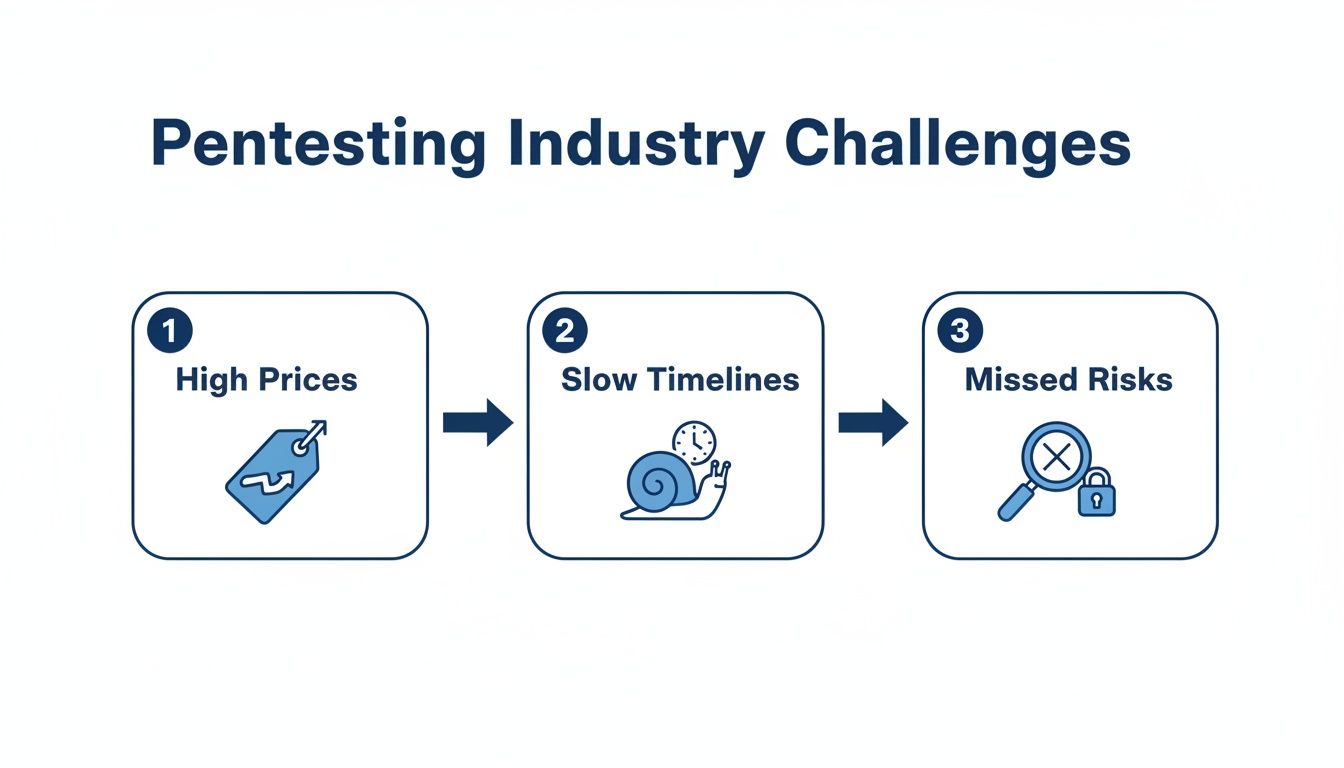
High prices, slow delivery, and missed risks are the biggest complaints we hear. Our efficient scoping and manual pentesting process was created specifically to solve these issues for MSPs and their clients.
Defining Clear Goals and Scope for a Pentest
The first talk is always about what your client wants to achieve. Are they trying to meet a SOC 2 or HIPAA compliance deadline? Or are they worried about a specific threat like ransomware? The answer guides the entire penetration testing project.
Next, we define the scope, which is just the list of targets. It is a clear breakdown of all the systems and applications our ethical hackers are allowed to test.
- Network Penetration Test: This could include a list of IP addresses, certain internal servers, or the company Wi-Fi network.
- Web Application Pen Test: This would focus on a website’s URLs, customer login pages, and the servers it runs on.
It is just as important to define what is not in scope. This protects your client’s important systems from any accidental problems and keeps the pen testing team focused on the right targets. A clear scope also stops the project from growing bigger for no reason, which drives up costs and delays results.
A well-defined scope is like a GPS for the penetration test. It gives our certified experts a clear destination, making sure they test the paths an attacker would actually use instead of getting lost.
Establishing Rules and Legal Agreements
Once the scope is set, we agree on the rules. This includes the official testing schedule (the exact dates and times for testing) and how everyone will communicate. This is like the formal permission slip that gives our team the legal right to perform simulated attacks.
This step is vital for protecting you, your client, and our team. It is written proof that everyone agrees to the work being done.
Our process makes this part simple. We use a clear agreement that gets your client’s pen test scheduled quickly, which is a huge benefit for any MSP or vCISO needing to move fast.
Our affordable, expert-led approach is a powerful addition to your reseller offerings. You can learn more about the different stages in our guide on the steps in a penetration test.
Gathering Intelligence Like a Real Attacker

Once the rules are agreed upon, our ethical hackers begin their work. This stage in the process of penetration testing is all about gathering information. Think of our certified pentesters as detectives studying a building, collecting every clue they can find before trying to get inside.
This is where you see the huge difference between a cheap automated scan and a real manual pentesting project. An automated tool just follows a simple checklist. Our experts think like real attackers, mapping out your client’s digital footprint to find all possible weak spots.
Passive and Active Reconnaissance in a Pen Test
Our pentesters use two main methods to build a complete picture of the target. Both are crucial for a successful penetration test, and each one finds different kinds of information.
Passive Reconnaissance: This is like looking through public records. Our team searches for information that is already available online without directly touching your client’s systems. They look at websites, social media, and employee profiles to find details that could be used later.
Active Reconnaissance: Now we start probing the systems. Our team actively scans the network and applications to see what responds. This helps us find live computers, open network ports, and running services, all of which are potential entry points for an attacker.
This detailed, human-led method is how we find security holes that automated scanners always miss. It helps the team focus on the most likely targets and prepares them for the next phase: exploitation.
Think of it this way: an automated scan is like a guard who only checks for unlocked doors on the first floor. Our manual pentesting team is like a spy who studies the building plans, learns the guard’s schedule, and finds the one unlocked window on the top floor that no one else saw.
Why Manual Pentesting Matters for Your MSP
As an MSP or vCISO, you need to provide more than just checkbox compliance. Your clients trust you for a real risk assessment, and that requires a deep, hands-on look at their specific weaknesses. Our OSCP, CEH, and CREST certified pentesters deliver exactly that.
Our information gathering isn't just about finding technical bugs. We look for clues that can be used in social engineering attacks, spot mistakes in cloud setups, and find business logic problems in applications. These are the serious issues that lead to major data breaches, and they are invisible to automated tools.
This careful intelligence gathering is what makes our affordable white label pentesting so valuable. We provide the deep analysis that helps your clients meet strict compliance rules like SOC 2, HIPAA, and PCI DSS. At the same time, we give you the proof needed to justify security improvements.
Exploiting Vulnerabilities to Prove Risk
This is where the action happens. After mapping out your client's systems, our team shifts from looking around to actively trying to break in. This is the exploitation phase, and it’s what makes a real penetration test different from a simple vulnerability scan.
Think of it like this: a scanner might tell you a door is unlocked. Our ethical hackers will open that door, go inside, and see what they can access. We are not there to cause damage; we are there to prove what a real attacker could do.
This is the key step that gives you, the MSP or vCISO, clear proof of risk. It’s the evidence you need to convince clients to invest in security and to satisfy auditors for rules like SOC 2 or ISO 27001.
Simulating a Real-World Data Breach
During this phase, our pentesters try to get around security controls using the weaknesses they already found. It is a safe and controlled process designed to answer one question: "How would this actually impact the business?"
Our certified experts use their skills and custom tools to perform actions such as:
- Gaining a Foothold: This could be as simple as guessing a weak password or using a flaw in a web application to get initial access.
- Elevating Privileges: Once inside, they try to increase their access from a regular user to an administrator with full control.
- Moving Laterally: From there, they move across the network to find sensitive data, customer files, or other critical systems.
This process finds the kind of complex, multi-step attacks that automated tools cannot see. It gives your client a realistic look at their security, making it the foundation of a true risk assessment.
Why Manual Exploitation is Not Optional
As an MSP or vCISO, showing real-world risk is how you get security budgets approved. Clients are much more likely to act when they see real proof of a problem, not just a line on a scanner report.
The industry is catching on. You can learn more about how manual testing provides this value from these penetration testing statistics.
It is one thing to tell a client they have a weakness. It is another to show them a screenshot of their own customer data being accessed through that exact weakness. That is the power of manual testing. It changes the conversation from technical talk to business risk, which is what drives compliance with HIPAA and PCI DSS.
A vulnerability scan tells you that a window latch might be broken. Our manual pentesting team picks the lock, opens the window, and proves that you need a better lock.
This evidence-based approach makes your job easier. You are no longer just suggesting security fixes; you are presenting a documented business case that is impossible to ignore.
Manual Pentesting vs. Automated Scanning
It is easy to be tempted by a cheap, automated "pentest." The price looks great, but the results are very different. While an automated scan can find simple problems, it cannot think like a human attacker. Here is what that means for you and your clients.
| Feature | Manual Pentesting (Our Approach) | Automated Scanning |
|---|---|---|
| Detection Method | Human-led discovery using creativity from experts like our OSCP, CEH, and CREST certified testers. | Relies on pre-defined signatures and checklists. |
| Vulnerability Scope | Finds business logic flaws, complex attack chains, and human error. | Limited to known, common vulnerabilities. |
| False Positives | Findings are manually verified to confirm they are real, exploitable risks. | Creates a lot of false alarms, wasting your time. |
| Business Context | Proves the actual business impact of a vulnerability, like stolen data. | Reports technical issues without showing real-world risk. |
| Reporting | A clear, simple report with actionable steps to fix issues. | A huge, confusing list of potential problems. |
| Compliance | Meets requirements for SOC 2, PCI DSS, HIPAA, and cyber insurance. | Often fails to meet compliance rules that require a real penetration test. |
An automated scan just checks a box. A manual penetration test provides the security confidence your clients actually need, giving you the proof to drive action and show your value.
Delivering Actionable White-Label Reports

The hacking is finished. You have proof of risk. Now it’s time to turn those findings into a powerful tool that makes your client act. A penetration test is only as good as its report, and ours are made for you—the MSP or vCISO—to deliver as your own.
A report should never be a 100-page document that no one understands. It needs to be a clear roadmap for improving security. This is a vital part of the process of penetration testing, and it is a step we have perfected.
What Goes Into a Great White-Label Report
Our reports are built to be understood by both business leaders and technical teams. This ensures everyone gets what they need to act, making your job as a trusted advisor much easier.
We deliver these reports with unmatched speed, usually within one week of the test finishing. This is a core part of our service. It lets you and your client address risks immediately instead of waiting months. Here’s what’s inside:
- Executive Summary: A short, plain-English summary for leaders. It explains the overall risk and highlights the most important findings without technical jargon.
- Technical Findings: A detailed breakdown of each vulnerability with risk ratings (Critical, High, Medium, Low) and proof, like screenshots.
- Remediation Guidance: Clear, step-by-step instructions on how to fix every issue, written for the IT team doing the work.
This structure helps you connect a technical problem to a business decision. This is essential for getting the support needed for compliance goals like SOC 2 or ISO 27001.
A good pentesting report is like a doctor's diagnosis. It clearly explains the problem, shows you the x-rays for proof, and gives you a precise treatment plan to get healthy again.
The Power of White-Label Pentesting for Resellers
Here is the best part: our reporting is 100% white-label. As a channel-only partner, our name never appears on the final report. You add your brand and present our expert findings as part of your risk assessment or GRC services.
This immediately builds your authority and deepens client trust. You are not just reselling a service; you are delivering a high-value security assessment under your own brand. Our affordable, manual pentesting service, performed by OSCP, CEH, and CREST certified pros, becomes your own in-house team. You can even check out our guide on creating a penetration testing report template to see how to structure these for maximum impact.
This final report is what turns a technical project into a strategic business talk. It gives your clients the clear, actionable information they need to secure their systems and satisfy compliance auditors for rules like HIPAA and PCI DSS.
Retesting to Ensure Continuous Security
A penetration test isn’t finished when you deliver the report. The final phase, retesting, is where you lock in the value. It’s about confirming that the fixes worked and creating a cycle of continuous security improvement.
This is the step that proves to your client that their money was well spent. It closes the loop, turning a list of problems into a real improvement in their security.
The Importance of Validating Fixes
Think about it this way: a doctor gives you medicine but never checks to see if you got better. That would be bad practice. Retesting is the follow-up appointment for your client’s security.
Our OSCP and CEH certified pentesters go back and try to break the same things they broke the first time. If the exploit fails, the fix is confirmed. This isn’t just a nice-to-have; for many compliance frameworks, it is a requirement.
An auditor for PCI DSS or SOC 2 doesn't just want a report of problems you found. They need documented proof that you fixed them. A successful retest report is that proof.
This confirmation gives your client’s leaders confidence that their security budget produced real results and strengthens their overall risk assessment program.
Turning One-Time Fixes into Recurring Revenue
For an MSP or vCISO, this final phase is a huge opportunity. It’s how you change the conversation from a one-time project to an ongoing security partnership, securing your role and creating recurring revenue.
Threats are always changing, so your client's defenses must too. A successful retest is the perfect time to schedule the next annual or semi-annual penetration testing project.
Here’s how this helps you as a reseller:
- Builds Client Stickiness: You become a key part of their annual security and GRC strategy, making your services essential.
- Creates Predictable Revenue: You can build a reliable income stream around annual white label pentesting services.
- Demonstrates Ongoing Value: You are not just a vendor who sold a one-time project. You are a strategic partner invested in their long-term security.
Our affordable, fast, and manual pentesting services are designed for this exact cycle. We handle the expert testing and reporting, and you manage the client relationship. This loop of testing, fixing, and retesting is the foundation of any modern security program. To learn more about setting up this model, check out our guide on continuous pentesting.
Your Top Questions About Offering Pentesting
If you're an MSP, vCISO, or GRC firm, you are on the front lines. Your clients depend on you for security advice, and you likely have questions about adding penetration testing to your services. Here are some straight, simple answers.
We know the pentesting industry is often slow, complicated, and overpriced. We built our entire model to be the opposite: fast, affordable, and 100% focused on you, our channel partner.
How Long Does a Pentest Take?
We have all experienced it. The biggest problem with old-school pentesting is the slow timeline. Some firms take weeks just to give you a quote.
We got rid of that model. Scoping takes a few days. The actual pen test, where our experts actively search for weaknesses, usually lasts one to two weeks. The best part? You get the final, detailed report within one week of the test ending.
We believe speed is a security feature. Getting a high-quality, manual pentesting report quickly means you can guide clients to fix issues faster, closing security gaps before an attacker finds them. This speed is a huge advantage for you.
Once retesting is done, this process helps your clients build and test their resilient incident management procedures. Our penetration testing finds weak spots before they can become a real incident.
Can I Resell This Under My Brand?
Yes, absolutely. In fact, that is the only way we do business.
Our model is 100% channel-only. We will never sell directly to your clients or compete with you. Period. Our white label pentesting service was built for you to sell as your own. You get a professional report, and you can easily add your own logo and branding.
It’s your service, powered by our certified experts. This lets you add our pentesting directly into your security offerings, making you the clear security authority for your clients.
Is Manual Pentesting Really Better?
Yes, and it is not even close.
Think of an automated scanner as a security guard who only knows how to jiggle doorknobs. It finds obvious issues but also creates many false alarms and has no understanding of business context.
Our manual pentesting is done by people who think like attackers—experts with certifications like OSCP, CEH, and CREST. They do not just run a tool.
- They find critical business logic flaws that a scanner would never understand.
- They chain multiple "low-risk" vulnerabilities together to create a high-impact breach.
- They manually prove every finding is a real, exploitable risk, so you no longer chase false positives.
A scanner just checks a box. A manual pen test provides the real-world risk assessment you need to pass tough compliance audits like SOC 2 and PCI DSS.
How Does This Help My Clients With Compliance?
For rules like PCI DSS, HIPAA, SOC 2, and ISO 27001, penetration testing is not optional—it is a requirement.
Auditors don't just want to hear that you have security controls; they demand proof from an independent third party that those controls work. A formal pen test report is that proof.
When you offer a strong penetration testing service, you are not just selling another item. You are giving your clients a vital part of their GRC strategy and helping them pass their audits. This makes your MSP or vCISO services essential and locks you in as their long-term partner.
Ready to turn the broken process of penetration testing into your competitive advantage? MSP Pentesting is your 100% channel-only partner, providing the affordable, fast, and manual pentests you need to grow your business. Contact us today to learn more.

.avif)
.png)
.png)
.png)

