
A client asks for more than a standard pentest. They don't want another checkbox report. They want to know whether an attacker could get in, move around, stay hidden, and reach something that matters.
That's where a lot of MSPs, vCISOs, GRC firms, and IT resellers get stuck. You can see the demand, but the usual options are ugly. Traditional firms are expensive, slow to quote, slow to deliver, and sometimes way too comfortable building direct relationships with your client.
You need a cleaner model. Red teaming services give you a way to move upmarket, protect the client relationship, and add a higher-value security offer without hiring a full offensive security team in-house.
Why Your Clients Need Red Teaming Services
Your clients already know a basic penetration test has limits. A pen test, penetration test, or penetration testing project can show exposed weaknesses. That's useful. But mature clients, especially those dealing with SOC 2, HIPAA, PCI DSS, or ISO 27001, eventually ask a harder question. Can we detect and stop a real attacker?
That's why this service category is growing. The global Red Teaming Services market was valued at USD 1.92 billion in 2024 and is projected to reach USD 5.53 billion by 2033, with a 13.7% CAGR, according to Growth Market Reports on the red teaming services market. Buyers are putting real budget behind offensive security that goes beyond routine compliance testing.
What clients are really buying
A client asking for red teaming usually wants one of three things:
- Proof of resilience: They want to know whether their tools, staff, and processes work under pressure.
- Board-level confidence: They need a credible answer when leadership asks whether security controls are effective.
- Better compliance conversations: They want stronger evidence for auditors, customers, and insurers than a shallow vulnerability scan.
Remote and hybrid work pushed this even further. If your clients have distributed users, cloud apps, and employees logging in from everywhere, the attack surface gets messy fast. That's one reason legal and compliance teams keep revisiting remote work cybersecurity risks.
Practical rule: If a client has already paid for endpoint tools, cloud controls, and awareness training, they're ready to test whether those investments hold up against an objective-driven attack.
The channel has another problem. Advanced security testing is often overpriced, wrapped in vague consulting language, and delivered with lead times that kill momentum. Worse, some vendors treat your account as their future direct customer.
That's why white label pentesting and white-labeled red teaming make sense for the channel. You keep control. Your client gets a stronger service. You don't have to build a specialized red team from scratch just to answer one security request.
Red Teaming Versus Penetration Testing Explained
A simple way to explain this to clients works every time.
A penetration test is like checking every door and window in a building to see what's accessible. A red team exercise is like hiring a mock burglar to steal one specific item without getting caught. One looks for lots of openings. The other tests whether your alarm system, cameras, and guards can stop a determined intruder.
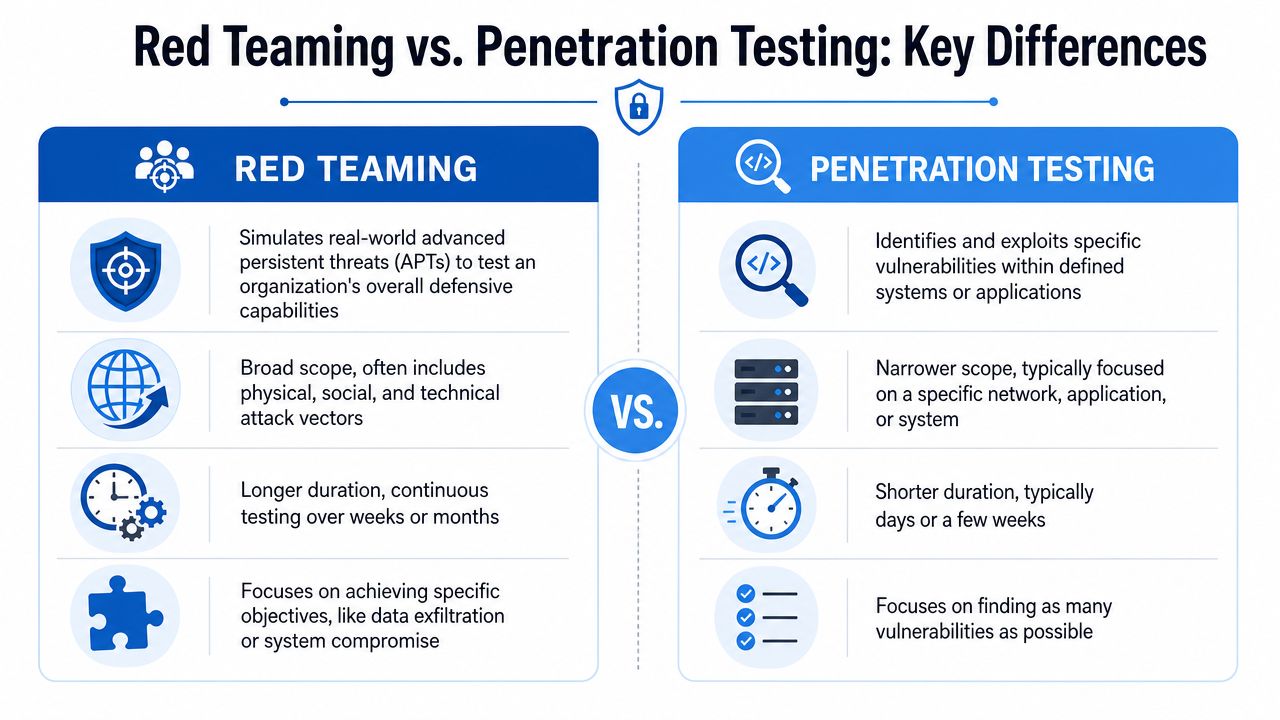
Red teaming is defined by its objective-driven, black-box approach and by engagements that run for weeks rather than days, according to Redscan's explanation of red team operations. The point isn't to rack up a giant list of findings. The point is to find one viable path to a real objective, such as data access or privileged control, and see whether the organization notices.
Where pentesting fits
That doesn't make pentesting less valuable. It just means it answers a different question.
| Service | Main question | Typical focus |
|---|---|---|
| Pen test / penetration test | What vulnerabilities can be found and exploited? | Specific systems, apps, or networks |
| Red teaming | Can an attacker achieve a goal without being stopped? | People, process, and technology together |
A lot of buyers still blur the line between the two. If you need a plain-English resource to help clients understand standard ethical hacking assessments, that can help frame the conversation before you move them into red teaming.
For channel partners, the practical answer is this: sell penetration testing when the client needs scoped validation. Sell red teaming when the client wants to test actual detection and response. If you want a clean baseline explanation first, this overview of what penetration testing is is a useful starting point.
A pentest finds cracks. Red teaming shows whether someone can use those cracks to reach the crown jewels.
Understanding Common Red Team Engagement Types
Not every client needs the same kind of engagement. That's good news for MSPs and vCISOs because it gives you a usable service catalog instead of one giant custom project.
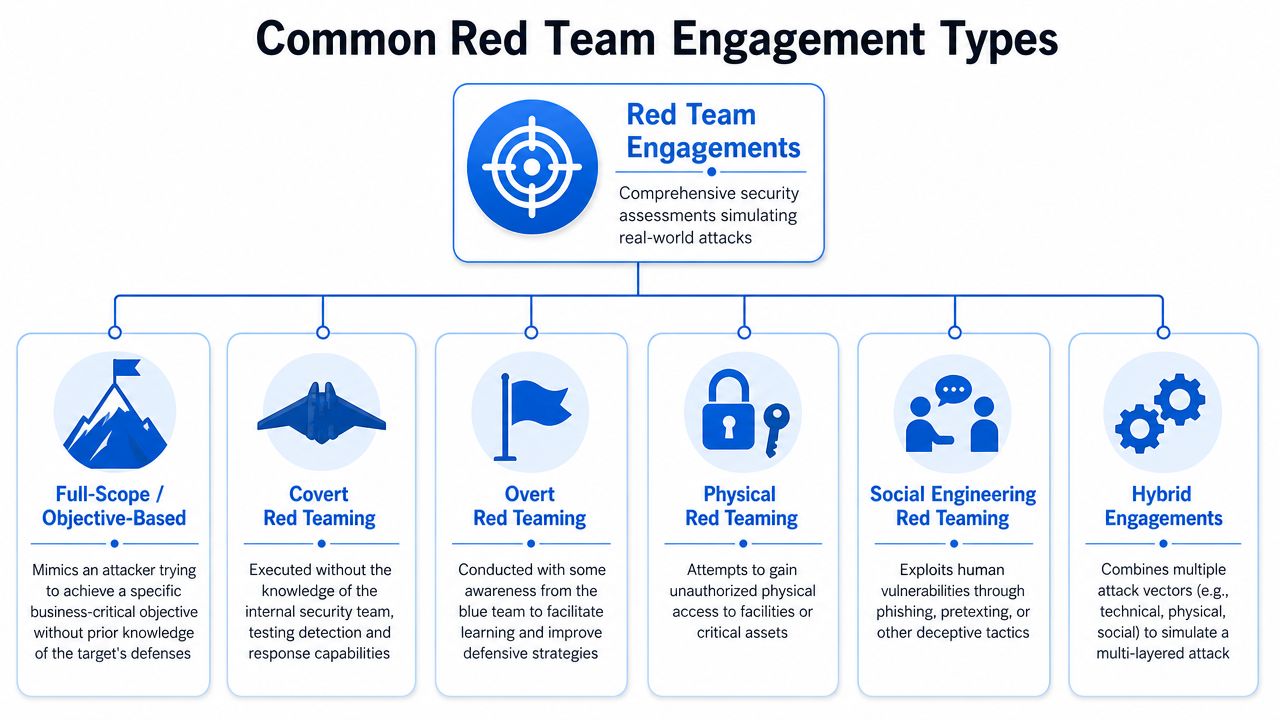
Strong engagements should be grounded in threat intelligence and real-world scenarios. CREST says expert red teaming should reflect real adversary tactics, techniques, and procedures, as described in CREST's red teaming standards overview. That matters because fake realism is useless. If the scenario doesn't match how attackers operate, the result won't help your client.
Engagements clients understand quickly
Some offers are easy to position:
- Adversary emulation: Good for clients in regulated industries or clients worried about a specific threat profile. You're not just poking at systems. You're modeling how a relevant attacker might operate.
- Physical red teaming: Useful when a client has offices, warehouses, server rooms, or badge-controlled areas. Physical access can still break a lot of digital security assumptions.
- Cloud red teaming: Best for clients deep in AWS, Azure, or GCP who need more than a cloud risk assessment. This tests access paths, privilege mistakes, and monitoring gaps in modern environments.
Human-focused testing still matters
Other engagements expose the human layer, which most tools can't solve.
- Social engineering campaigns test whether employees, contractors, or admins can be manipulated into handing over access.
- For MSPs, this often pairs well with ongoing security awareness programs because it turns vague “training” conversations into measurable outcomes.
- Verified benchmark data from MSP360's write-up on penetration testing for MSPs notes 15% to 30% success rates for email-based phishing attempts in predefined mock attack campaigns.
That kind of exercise is useful for clients trying to tighten compliance posture around SOC 2 or HIPAA because it tests actual operational behavior, not just policy language.
The Business Case for Reselling Red Teaming
Most MSPs shouldn't build this capability internally first. That's the blunt answer.
Hiring senior offensive security talent is expensive, hard to scale, and painful to keep utilized. Reselling is the faster play, especially if you want to protect margins and stay focused on your core managed services business.

Why the channel model works
The economics are already clear on the pentesting side. Manual penetration testing for MSP channel partners costs a fraction of the $12,000 to $25,000 traditional firms charge end clients directly for an external network assessment, based on pricing data for affordable penetration testing. Pricing depends on scope. Request a quote for exact figures. That gap matters because inflated pricing kills reseller opportunity.
Here's what that translates to in practice:
- Better margin control: You can package offensive testing without swallowing enterprise consulting prices.
- Faster go-to-market: You don't need to recruit a team of specialists before you add the service line.
- More account control: A true channel partner doesn't try to turn your project into their direct sales pipeline.
Business advice: If a security vendor won't clearly commit to a channel-only model, don't bring them into your accounts.
There's also a positioning benefit. A lot of MSPs get trapped selling only commodity services. Red teaming lets you move from “IT provider” to strategic security advisor. That's especially valuable for a vCISO, GRC consultancy, or reseller that needs stronger answers during client board meetings, audit prep, or renewal cycles.
For a channel-focused delivery model, pentesting for the channel shows how these services fit under a reseller structure without forcing you to hand off your client relationship.
How to Choose Your Red Teaming Partner
Most buyers ask the wrong first question. They ask about tools. You should ask about business behavior.
A red teaming partner can have strong technical talent and still be a bad fit for the channel if they're slow, vague, or willing to compete with you later.
The questions that actually matter
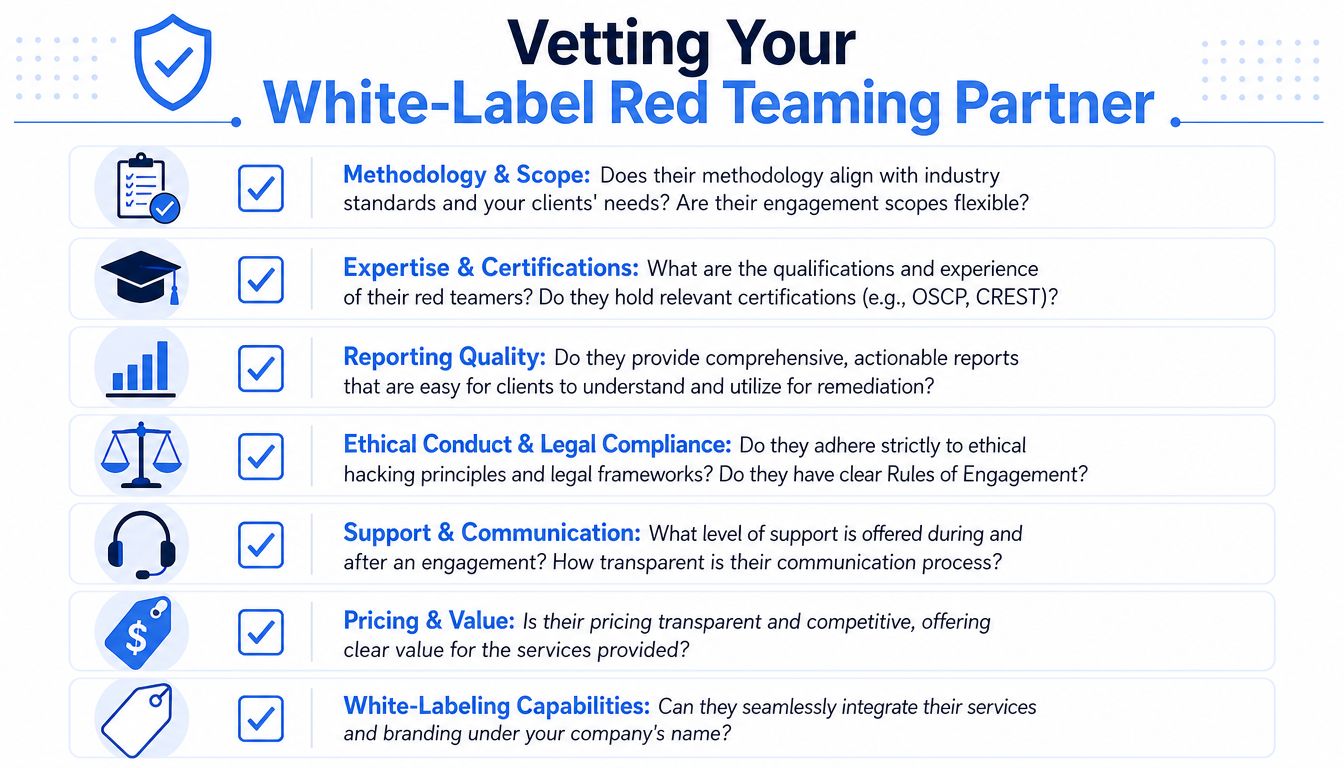
Use this checklist when you vet any provider:
- Are you channel-only: If the answer is fuzzy, move on.
- Who performs the work: You want manual operators, not a tool stack with a consultant wrapped around it.
- What certifications do the testers hold: Verified credentials matter because they show hands-on capability.
- How clean are the reports: A technical report that your client can't act on is dead weight.
- Can you quote quickly: If getting a proposal takes multiple meetings and a bloated scoping ritual, expect delivery to be slow too.
Verified data from MSP Pentesting's LinkedIn company profile states that certified pentesters holding OSCP, CEH, and CREST credentials conduct the manual testing methodology required to bypass automated tool limitations. Those certifications matter because offensive security is not a slide deck business. You need people who can think through exploitation paths, privilege escalation, and lateral movement by hand.
What a strong partner looks like
One option in the market is MSP Pentesting's pentest partner program, which offers white-labeled pentests and red team exercises for channel partners. The bigger point is the model. You want a partner that stays behind the scenes, supports your brand, and delivers manual pentesting through certified testers.
If the vendor talks more about their logo than your client relationship, they're not built for the channel.
For compliance-driven clients, also check whether the provider understands how to support risk assessment conversations tied to SOC 2, HIPAA, PCI DSS, and ISO 27001. Security testing is only half the job. The other half is helping your client turn findings into useful remediation and audit evidence.
Start Offering Red Teaming Services Today
Your clients are already asking for stronger security validation. They may not always call it red teaming. Sometimes they ask for a deeper pentest. Sometimes they ask whether their team could catch a real attacker. Sometimes they ask for a compliance-friendly way to prove resilience. It's the same need.
You don't need to overcomplicate the response. Offer red teaming services through a white-label, channel-safe model. Keep control of the client. Add a profitable service line. Use certified testers. Deliver manual work, not scanner output dressed up as consulting.
The MSPs, vCISOs, GRC firms, and resellers that move first on this win in two ways. They create new revenue, and they become harder to replace. That's a better business than racing to the bottom on commodity managed services.
If you want affordable, fast, channel-only support for red teaming, pentest work, pen testing, and broader penetration testing needs, act now. Build the service line before your client asks someone else.
If you want a channel-only partner for white label pentesting and red teaming services, get a fast pentest quote. We help MSPs, vCISOs, GRC firms, and resellers deliver affordable, manual security testing under their own brand. Contact us today to learn more.

.avif)
.png)
.png)
.png)

