
A client calls because an auditor asked for a system security plan by Friday. Or a contract is on the line, and someone just realized the client has policies, tools, and screenshots, but no document that ties it all together.
That moment feels like a fire drill. For an MSP or vCISO, it can also become a high-value service line.
Most clients don't need another lecture about compliance. They need someone who can translate technical reality into an assessable document, keep scope under control, and prove the controls work. That's where the business opportunity sits. The SSP isn't just paperwork. It's a reason for clients to buy guidance, remediation support, risk assessment, and penetration testing under one engagement.
Turn Compliance Headaches Into Business Opportunities
When a client suddenly needs an SSP, the first instinct is often to treat it like low-margin admin work. That's the mistake. The provider who helps shape the system boundary, collect the right evidence, and coordinate validation becomes much harder to replace.
Why SSP work sticks clients to you
An SSP sits close to everything a client already pays you for. Asset inventory. Security tooling. Change management. Access control. Log review. Vendor coordination. If you already run or advise those functions, you already own most of the inputs.
That makes SSP support a practical add-on service, not a random side quest.
- Advisory revenue: You can package scoping workshops, documentation support, and control mapping.
- Technical follow-on work: Clients usually uncover gaps during SSP drafting, which leads to remediation projects.
- Recurring validation: Once the document exists, it has to stay aligned with the environment.
A lot of firms miss this because they assume compliance buyers only want a document. They don't. They want fewer surprises during audit and fewer expensive rework cycles.
Practical rule: If your team already manages the environment, you should also help define how that environment is described and defended.
There's also a trust angle. When a client asks for help with an SSP, they're really asking, "Can you help me tell the truth about my security program in a way an assessor can follow?" If you do that well, you're no longer just the IT vendor.
For MSPs building broader compliance offerings, this usually pairs well with structured IT compliance services that cover documentation, control support, and technical validation together.
The profitable move is simple. Don't sell the SSP as a document. Sell it as the operating map that drives advisory, remediation, and ongoing assurance.
What Is a System Security Plan Really
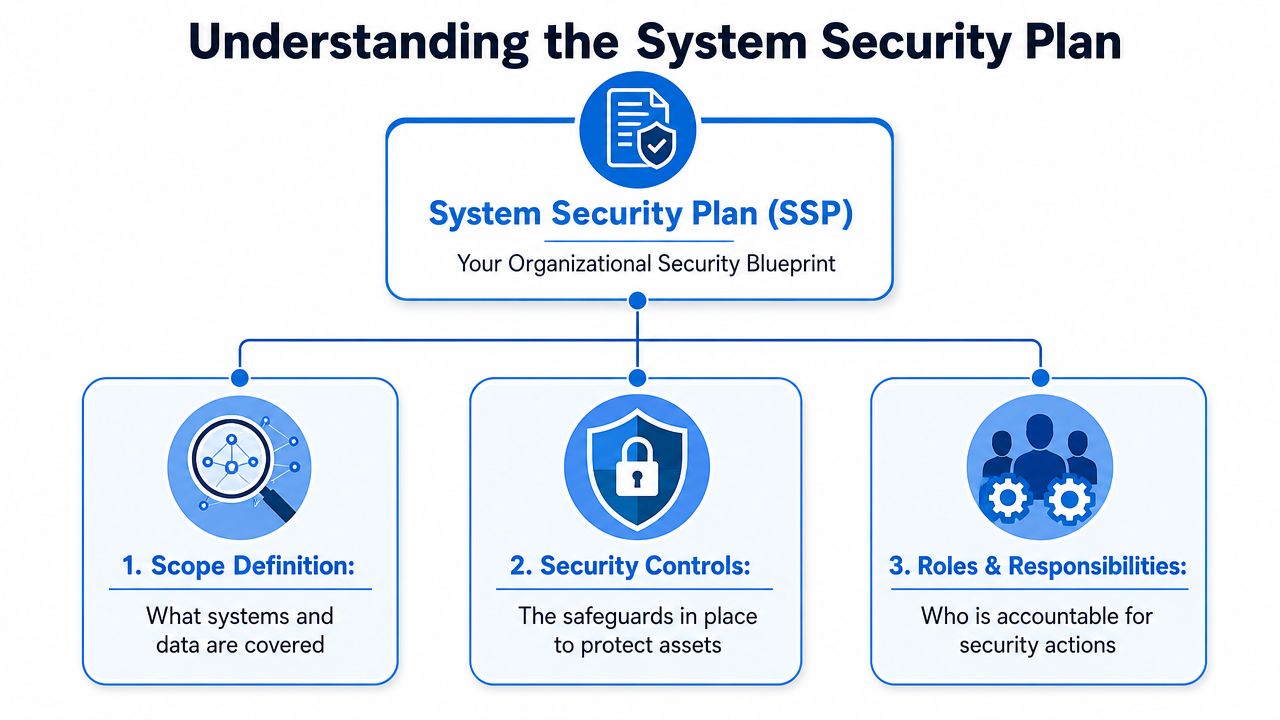
A system security plan is the blueprint for how a specific system is secured. Not the marketing version. Not the policy-only version. The actual version.
NIST defines a system security plan as a formal document that describes an information system's security requirements and the controls in place or planned to meet them, including system boundaries, the operational environment, how each requirement is implemented, and connections to other systems, as described in the NIST SSP glossary entry.
The blueprint analogy works
Think about a commercial building. A real blueprint doesn't just say "this place is safe." It shows the walls, doors, locks, alarms, exits, power rooms, and who can access restricted areas.
An SSP does the same for an information system.
- System boundary means what is in scope and what is out.
- Operational environment means where the system runs and what supports it, such as cloud platforms, endpoints, software, and administrators.
- Security controls are the safeguards used to protect the system.
- Interconnections are the outside doors and hallways, including SaaS apps, vendors, APIs, and managed services.
What a useful SSP actually says
A weak SSP says, "MFA is enabled."
A useful SSP says who uses MFA, where it's enforced, what systems depend on it, and who owns exceptions. It turns architecture into something an assessor can test.
That's why generic templates fail so often. They may look complete, but they usually don't match the client's actual environment.
An SSP should read like a system-specific operating record, not like a recycled policy binder.
For MSPs and advisors dealing with NIST-heavy clients, it helps to understand how SSP language connects to control families and implementation detail. A working knowledge of NIST 800-53 security controls proves beneficial, even if the engagement is centered on a different framework.
A good SSP answers practical questions fast. What handles sensitive data? Where does it move? What protects it? Who maintains those protections? What changed since the last review?
If the document can't answer those questions, it won't carry much weight when audit pressure hits.
Connecting the SSP to Major Compliance Frameworks
Clients rarely ask for an SSP because they enjoy documentation. They ask because a contract, audit, or customer questionnaire forced the issue.
In government and cloud authorization contexts, the SSP is a primary review document. FedRAMP-oriented guidance emphasizes that a well-written SSP lets a reviewer follow the system architecture, data flows, security control implementations, and authorization boundary, which is why it acts as a gatekeeping document for markets like federal contracting, as summarized in this FedRAMP SSP overview.
Why clients outside federal work still care
Even when a client is pursuing SOC 2, HIPAA, PCI DSS, or ISO 27001, the same operational problem shows up. Auditors and customers want a coherent story. They want to know what system is in scope, what controls protect it, and whether those controls are managed.
The SSP concept helps you give that story structure.
For app companies and regulated software teams, this becomes easier when they understand how auditors think about evidence and controls. A practical outside reference is this guide to SOC 2 for regulated apps, which helps frame why documentation and control mapping matter beyond federal programs.
How MSPs should explain it to clients
Don't pitch the SSP as "required paperwork." Pitch it as the document that prevents confusion during assessment.
Use language like this:
Client questionBetter SSP framingWhy do we need this?It tells the assessor what system they're reviewing and how it's protected.Can't we just send policies?Policies say what you intend. The SSP shows how the system actually operates.Why is scope such a big deal?If scope is fuzzy, control applicability becomes fuzzy too.Why does this affect revenue?Deals stall when buyers or assessors can't trace controls to the real environment.
For firms supporting assurance programs, this also ties into the evidence side of SOC 2 security controls. The framework may change, but the business problem stays the same. Clients need one document that makes the environment legible.
That's why the SSP matters. It cuts through ambiguity, and ambiguity is what slows audits, renewals, and contract reviews.
The Essential Components of a Strong SSP
A strong SSP is detailed in the places that matter and disciplined in the places that tend to sprawl. It doesn't try to impress with length. It tries to remove doubt.
For organizations handling Controlled Unclassified Information, the SSP is central to NIST SP 800-171 compliance because it documents how the 110 security controls are implemented, and any gaps belong in a POA&M, as outlined in this overview of SSP requirements for CUI environments.
What has to be in the document
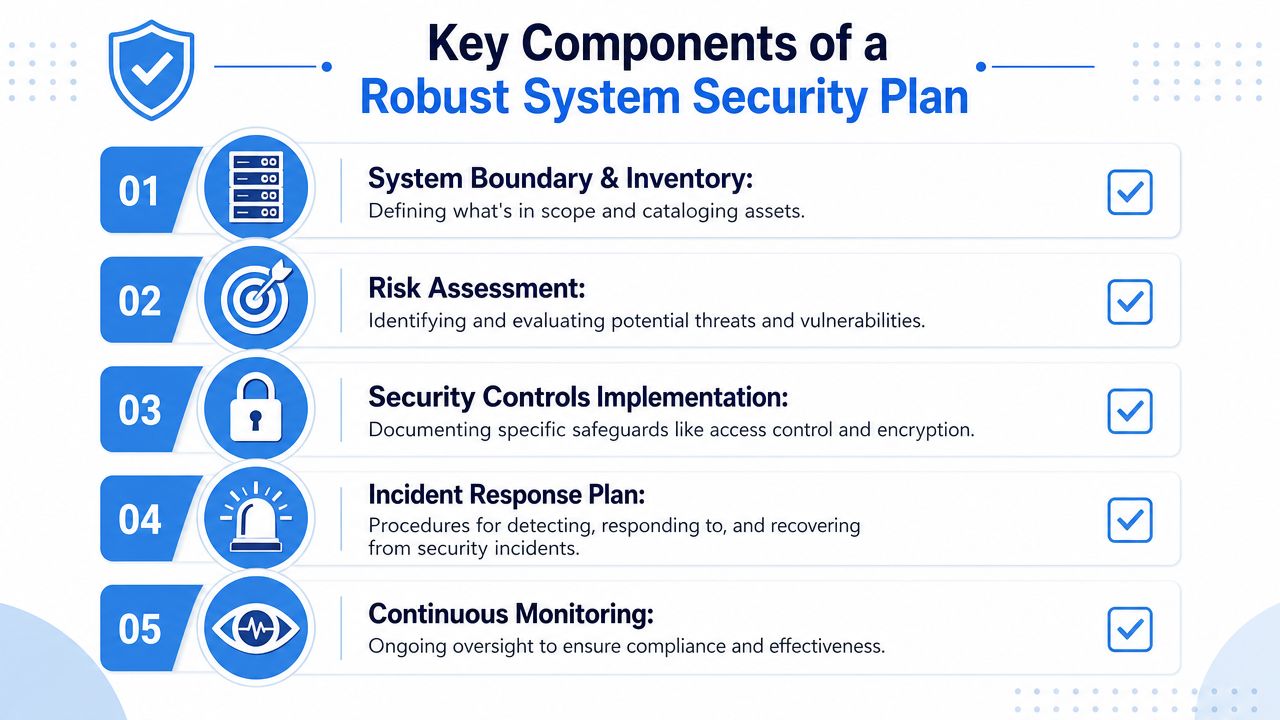
At minimum, an MSP or vCISO should expect to nail down these items:
- Boundary and inventory: What systems, users, devices, and services are in scope.
- Control implementation detail: How each applicable safeguard works in practice.
- Roles and ownership: Who approves access, who patches, who reviews logs, who handles incidents.
- Interconnections: External services, vendors, integrations, and inherited controls.
- Evidence references: Policies, configurations, tickets, logs, and diagrams that support the claim.
Many teams go vague. They write "strong passwords are enforced" instead of documenting the actual policy settings and where they apply. They write "logging is enabled" instead of identifying what gets logged, where it goes, and who reviews it.
Where the POA&M fits
The Plan of Action and Milestones, or POA&M, is not the place to hide failures. It's the place to document them.
If a control isn't fully implemented, the SSP should not pretend otherwise. Put the gap in the POA&M with an owner and remediation path. That usually protects the client better than trying to pad the narrative.
A clean SSP with a realistic POA&M is more credible than a polished SSP that claims everything is done.
A practical way to review an SSP draft is to test every major statement with one question: could an assessor ask for proof right now? If the answer is no, the narrative is too abstract.
For reseller and GRC partners, that's good news. It means your value isn't just writing prose. Your value is helping clients connect the words to evidence, ownership, and operational reality.
Using Penetration Testing to Prove SSP Claims
An SSP is a set of claims. A pentest, pen test, or penetration test is one of the fastest ways to pressure-test whether those claims hold up.
If the SSP says external exposure is restricted, an external network pentest can test that. If the SSP says segmentation limits lateral movement, an internal penetration testing engagement can challenge that assumption. If the client says a web app protects sensitive workflows, application pentesting can validate the controls around auth, session handling, and input security.

What pentesting validates well
Here are the claims that commonly benefit from manual validation:
- Network exposure claims: The SSP says only approved services are reachable.
- Segmentation claims: The client says production, admin, and user networks are separated.
- Identity claims: The SSP says privileged access is limited and protected.
- Application security claims: The document says customer-facing systems enforce proper access control and session security.
- Monitoring claims: The client says suspicious activity would be visible and actionable.
Automated scanning helps, but it doesn't replace a human tester following logic, chaining weaknesses, and testing how controls behave under pressure. That's why manual pentesting matters when the document is going to be scrutinized.
Why this becomes a service line for MSPs
An MSP can turn compliance effort into margin. You don't just hand over a document. You offer document-backed validation.
For example:
SSP claimValidation serviceExternal attack surface is controlledExternal network penetration testInternal access is segmentedInternal pentestWeb portal access controls workWeb application pen testCloud controls match design intentCloud configuration review plus pentesting
For partners that don't want to build a testing team in-house, white label pentesting fills the gap. MSP Pentesting is a channel-only provider offering manual pentesting and white-labeled delivery for MSPs and advisors, with pentesters holding certifications including OSCP, CEH, and CREST. That model fits firms that want to add penetration testing without hiring specialists or competing with their own clients.
Field advice: If the SSP makes a strong security claim, assume someone should validate it before an assessor or customer does.
This also sharpens your sales motion. Instead of selling pentesting as a generic annual checkbox, you sell it as evidence support for SOC 2, HIPAA, PCI DSS, ISO 27001, and broader compliance efforts. That lands better with buyers because it ties testing to a document they already need.
Keeping the SSP Alive and Profitable
The biggest SSP failure usually isn't the first draft. It's drift.
FedRAMP and NIST-aligned guidance emphasizes that SSPs must stay consistent with the system's current operational state, and a major source of compliance failure is undocumented change, as highlighted in the FedRAMP SSP playbook.
The simple lifecycle that works
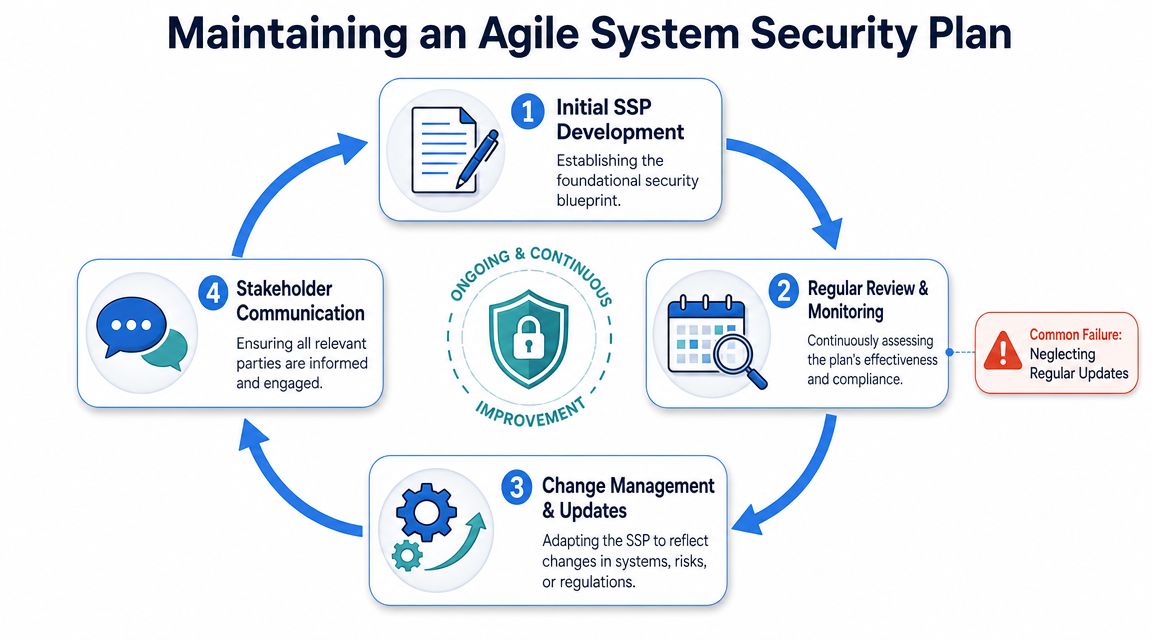
The model that works for most MSP and vCISO teams is straightforward:
- Document the environment as it exists.
- Validate the important claims with reviews, testing, and evidence checks.
- Update the SSP when the client changes infrastructure, vendors, access models, or workflows.
That sounds basic because it is. The hard part is assigning ownership and tying updates to real operational events.
A few triggers should always force review:
- Cloud changes: New tenant architecture, new security tools, or new SaaS dependencies
- MSP changes: Tool swaps, remote management changes, admin workflow changes
- Business changes: New offices, acquisitions, new products, or new regulated data flows
- Security events: Incidents, major findings, or remediation that changed control operation
How to keep it from going stale
The easiest fix is to anchor the SSP to the systems your team already uses.
Map revisions to tickets. Review it alongside inventory updates. Compare it to network diagrams during quarterly reviews. If the client outsources development or platform work, make sure those vendors feed change details back into the compliance record. In fast-moving environments, even adjacent staffing decisions matter. If a client is scaling product work in new areas, resources like this guide on finding Web3 and AI development talent can be useful because new delivery teams often introduce new systems, integrations, and trust boundaries that need to be reflected in security documentation.
This is also where recurring revenue becomes cleaner. Clients need help maintaining alignment, not just creating a static file once.
Keep the SSP close to change management. If updates depend on memory, the document will drift.
For MSPs, vCISOs, CPAs, and reseller partners, the profitable motion is clear. Package the SSP lifecycle as ongoing governance. Pair documentation support with risk assessment, periodic review, and white label pentesting for the validation step. That keeps your advisory work attached to technical evidence, which is where clients get real value.
If you want a channel-only partner to help you validate SSP claims with white-labeled, manual pentest, pen test, and penetration testing services, our risk assessment service can support your team without competing for your client relationship. Contact us today to learn about our reseller-friendly partner program.

.avif)
.png)
.png)
.png)

