
If you're an MSP owner, you already know the problem. A client suddenly needs a penetration test for SOC 2, HIPAA, PCI DSS, or ISO 27001, and they need it fast. If you can't deliver, somebody else will. That "somebody else" might be a pentest firm that also wants the rest of your client account.
This is why tactics techniques and procedures TTP matter to your business. They aren't just threat intel language for big SOC teams. They give you a practical way to understand attacker behavior, explain risk clearly, and package white label pentesting as a service that protects client retention, margins, and compliance deadlines.
Why MSPs Must Understand Attacker TTPs
Most MSPs lose security opportunities for one simple reason. They treat penetration testing like a specialty add-on instead of a core business protection tool.
Your clients don't care whether a threat is called phishing, credential access, or lateral movement. They care whether you can explain the risk, reduce it, and help them pass an audit. If you can't do that, a different provider will step in and look a lot more strategic than you do.
TTP knowledge protects revenue
When you understand attacker behavior, your client conversations get better fast. You stop saying vague things like "you should improve security" and start saying, "an attacker could use stolen credentials, move through shared admin tooling, and reach sensitive systems before your team notices."
That shift matters for retention. It also matters for upsell. An MSP that can connect security findings to real attacker workflows looks like a long-term advisor, not just a help desk with extra services.
- Client stickiness increases: Security services tie you deeper into compliance, governance, and executive decisions.
- Margins improve: You can sell higher-value assessments instead of commodity monitoring alone.
- Audit readiness gets easier: Clear attack-path reporting helps vCISO, GRC, and CPA partners explain controls in plain English.
Practical rule: If a client asks for a risk assessment and you only offer scanner output, you're making it easy for another provider to replace you.
A lot of MSPs are already pushing deeper into security because clients expect it. If that trend is hitting your book of business, this guide on cybersecurity for MSPs is worth reading alongside your service planning.
TTPs are business language too
TTPs help technical teams detect attacks, but they also help business owners sell security in a way buyers understand. That's a substantial opportunity. You can turn technical depth into a repeatable reseller service that supports compliance and keeps your client relationship intact.
What Are Tactics Techniques and Procedures
The easiest way to explain tactics techniques and procedures TTP is with a bank robbery.
The tactic is the goal. Steal money.
The technique is the method. Crack the safe.
The procedure is the exact action. Use a specific drill on a specific safe model in a specific way.
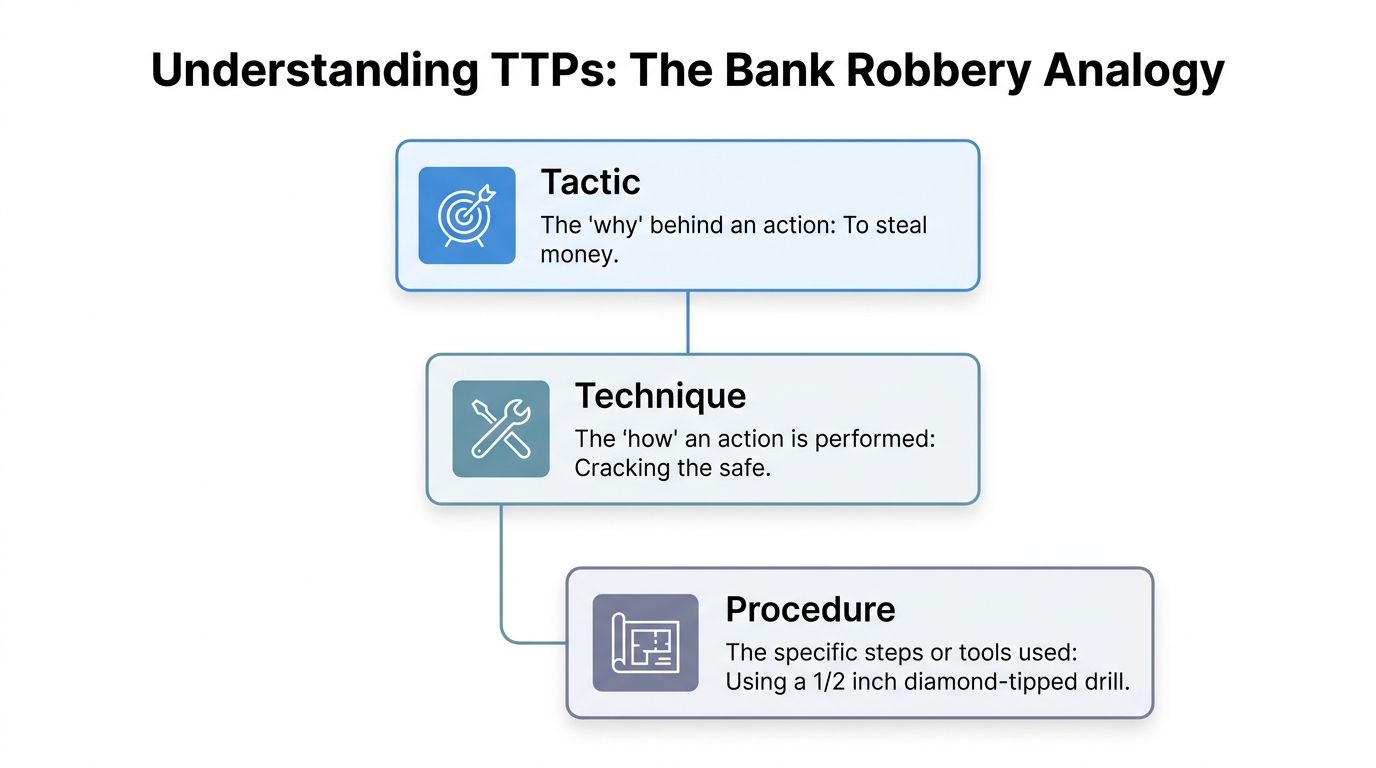
In cybersecurity, it works the same way. A tactic is the attacker's objective, such as initial access or data exfiltration. A technique is the general method, like phishing, brute force, or pass-the-hash. A procedure is the exact script, tool use, command sequence, or workflow the attacker follows.
Why the hierarchy matters
A lot of MSPs stop at the technique level. They see "phishing" or "credential dumping" in a report and think that's enough. It isn't.
If you only know the broad method, you still don't know how the attack specifically played out inside the client environment. That missing detail is where good risk assessment turns into weak reporting.
According to Mandiant's discussion of tracking threat actor TTPs, mapping TTPs enables a 10-fold increase in threat detection specificity. The same source explains that spotting a technique like pass-the-hash without the related procedure, such as specific Mimikatz function calls, makes it harder to separate normal authentication behavior from a real compromise.
A simple way to explain it to clients
Use this structure in client meetings:
LevelWhat it meansExampleTacticWhy the attacker is actingGain access to sensitive recordsTechniqueHow the attacker tries to do itPhishing an admin userProcedureThe exact steps usedFake login page, stolen credentials, then use of admin access
That makes your reports easier to read and easier to defend in front of executives, auditors, and compliance teams.
A scanner can tell a client that a door exists. A TTP-driven assessment shows how an attacker opens it, walks through it, and what they can reach next.
Where MSPs usually get this wrong
They oversimplify the finding. The result is a generic report that doesn't help with SOC 2, HIPAA, or PCI DSS conversations because it doesn't connect the weakness to business impact. TTPs fix that. They give you a storyline clients can understand and act on.
Connecting TTPs to The MITRE ATT&CK Framework
Once you understand TTPs, the next step is using a common language. That's where MITRE ATT&CK comes in.
It gives security teams, auditors, and clients a shared framework for describing attacker behavior. Instead of every provider using their own labels, ATT&CK maps tactics and techniques into a standard model that people across the industry already recognize.

Why ATT&CK gives your reports more weight
A penetration test report tied to ATT&CK looks more credible because it places findings inside known attack patterns. That helps when your client's security lead, auditor, or board asks the obvious question: "How serious is this, really?"
The answer becomes clearer when you can show where the weakness fits in an attacker playbook.
According to SANS on TTP-based hunting, more than 80% of major cybersecurity organizations had adopted the MITRE ATT&CK framework by 2023, and organizations that actively mapped security controls against TTP datasets reported a 40% reduction in average time to detect advanced persistent threats.
Why this matters for MSP and GRC work
For an MSP, ATT&CK improves consistency. For a vCISO or GRC team, it improves reporting quality. It also makes it easier to connect technical findings to control frameworks like ISO 27001, SOC 2, and PCI DSS because you're not just listing flaws. You're showing attacker intent and attack path context.
Here's where ATT&CK helps most:
- Standardized reporting: Different clients, industries, and auditors still see a familiar structure.
- Better prioritization: Findings tied to real attacker behavior are easier to rank than flat scanner lists.
- Stronger purple teaming: Defensive teams can test controls against known behaviors instead of abstract risk statements.
If your clients are also building validation exercises around detection and response, this guide on purple team cybersecurity pairs well with ATT&CK-based assessment planning.
ATT&CK is not just for big enterprises
Smaller MSP clients often assume these frameworks are too advanced for them. That's a mistake. ATT&CK gives even mid-market organizations a practical way to understand how a breach would unfold inside their environment, especially when they rely on shared admin access, remote tools, and cloud services.
How Certified Pentesters Use TTPs in Assessments
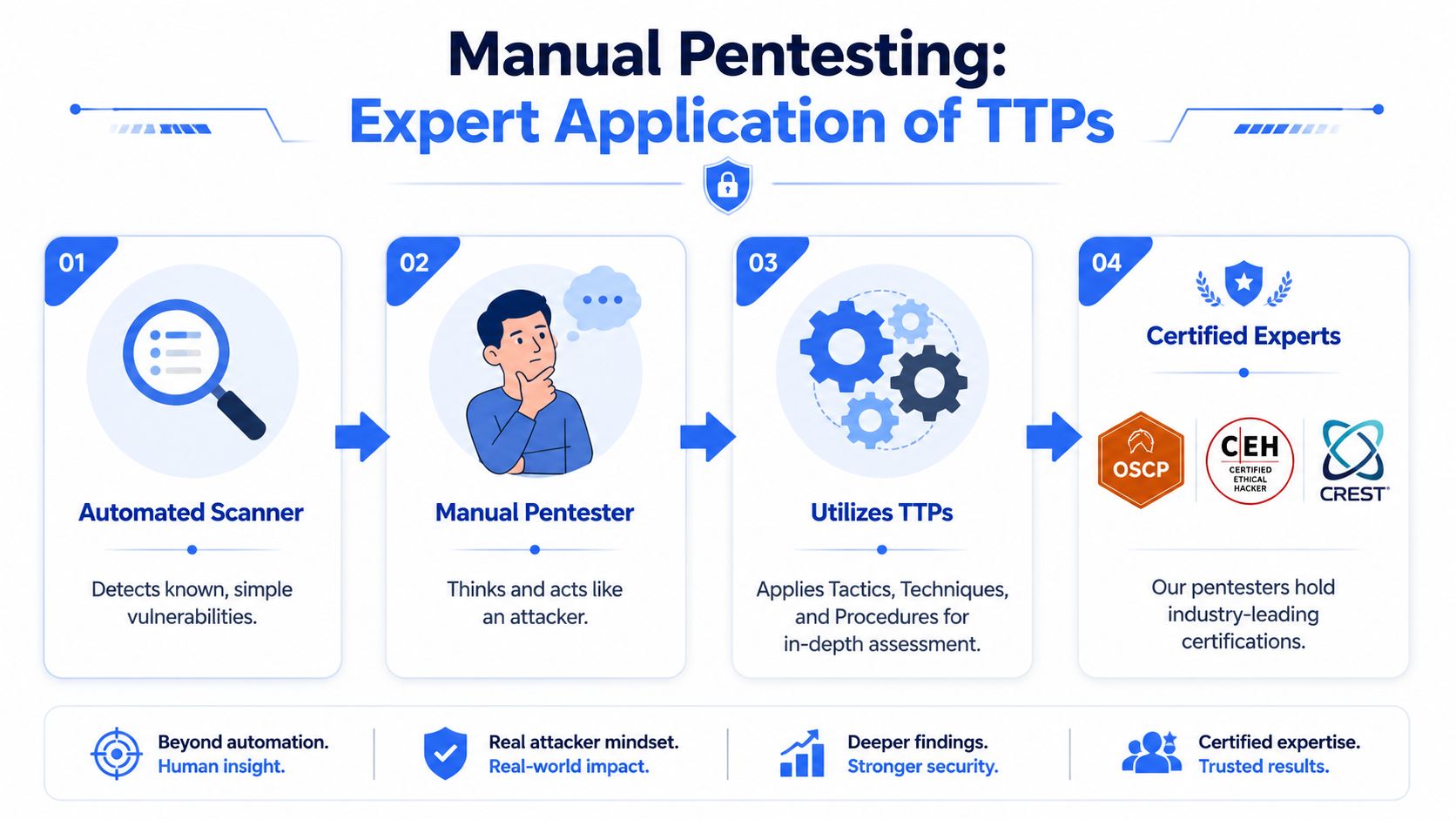
An automated scanner looks for common weaknesses. A skilled tester asks a harder question. "If I were the attacker, how would I chain these small issues into a real breach?"
That's the difference between cheap-looking output and useful manual pentesting.
What certified pentesters actually do
Pentesters with OSCP, CEH, and CREST certifications don't just run tools and export a spreadsheet. They use TTPs to simulate realistic attacker behavior across web apps, internal networks, cloud environments, mobile apps, and social engineering paths.
That means they may start with one access point, test privilege escalation, evaluate lateral movement, and validate whether business logic or trust assumptions create deeper exposure. That's how real attackers operate. Good pen testing should mirror that.
A few examples of TTP-driven manual work:
- Credential abuse testing: Reviewing whether exposed credentials can be used across management systems and internal services.
- Attack chaining: Combining several moderate findings into one serious compromise path.
- Procedure-level validation: Confirming whether specific attacker steps are effective in the client environment, not just whether a control looks weak on paper.
Why manual pentesting beats scan-only delivery
Bargain vendors often lead to pitfalls for MSPs. The report looks long, but half the findings are noise, duplicates, or low-value issues nobody can act on.
According to the National Academies material cited for manual penetration testing effectiveness, manual penetration testing reduces false positive rates by up to 90% compared to automated tools, which matters when you're trying to deliver affordable and fast white-labeled services clients will trust.
Key takeaway: Fewer false positives don't just help engineers. They protect your margins because your team spends less time defending bad findings and more time solving real problems.
This matters even more in environments where anti-automation defenses hide meaningful behavior from basic tooling. If you want a useful example of how modern protections complicate testing workflows, Scrapfly's guide to learn anti-bot bypass techniques shows why human-led testing still matters when applications don't respond predictably to bots and scanners.
What to look for in a pentest partner
You wantAvoidCertified experts with OSCP, CEH, and CRESTGeneric "security analysts" with no clear testing credentialsManual penetration testingScan-only engagements dressed up as pentestsActionable reportsGiant exports with little validationProcedure-level detailBroad labels with no attack path explanation
Building Your White Label Pentesting Service with TTPs
You don't need to build an in-house red team to offer serious security services. In most cases, that's the wrong move. Hiring, tooling, management overhead, and utilization risk crush margins fast.
A white label pentesting model is the smarter path for most MSPs, vCISOs, and GRC firms. You keep the client relationship. Your partner does the technical work. The client gets a quality penetration testing service under your brand.
Why speed matters to compliance buyers
The compliance market has a timing problem. Audits don't wait because a pentest vendor is booked out.
According to Splunk's overview of TTPs and pentest timelines, the average lead time for traditional penetration testing services ranges from 4 to 8 weeks, while MSP-focused providers turn reports around far faster, helping vCISOs and GRC companies meet urgent deadlines for SOC2 and ISO 27001.
That gap is huge for your business. If a client needs a report this month and your option takes over a month just to start, you don't have a service. You have a referral.
Why TTP-based delivery improves the service
A generic penetration test often turns into checklist work. A TTP-based pen test is more useful because it shows how an attacker would move through the environment, not just what a scanner spotted.
That improves the service in practical ways:
- For compliance: Reports are easier to map into control discussions for SOC 2, HIPAA, PCI DSS, and ISO 27001.
- For account management: Clients understand what they're paying for because the findings tell a real attack story.
- For margins: Faster delivery and cleaner findings reduce rework and back-and-forth.
How the white label model should work
The process should be simple.
- Your client requests a pentest for compliance, due diligence, or a broader risk assessment.
- You scope the engagement under your brand and keep ownership of the relationship.
- A manual pentesting partner performs the work using certified testers and TTP-driven methodology.
- You receive a branded report that you can present confidently to the client.
The right white label model makes you look bigger, faster, and more capable without forcing you to build a costly internal team.
If you're evaluating that channel approach, our white-label penetration testing page gives a practical picture of how MSP partnerships are usually structured.
What MSP owners should stop doing
Stop outsourcing security work to firms that also chase direct business. Stop selling scan reports as if they were full penetration tests. Stop accepting long lead times that force clients to look elsewhere.
If you want retention, better margins, and stronger compliance positioning, TTP-based white label delivery is the cleanest option.
Partner for Affordable TTP-Based Penetration Testing
Understanding tactics techniques and procedures TTP is useful. Turning that knowledge into a service is what pays off.
Trying to build your own pen testing team from scratch is expensive and slow. Most MSPs don't need that burden. They need a channel model that gives them affordable, manual pentesting, fast turnaround, and reports strong enough to stand up in front of clients, auditors, and internal stakeholders.
What a good partner model should guarantee
According to Sparta's guidance on white-labeled penetration testing, white-labeled penetration testing allows MSPs to offer pen testing under their own brand name without marketing competition, and a channel-only model prevents the provider from stealing MSP clients.
That point matters more than most providers admit. If your pentest partner also markets directly, you're introducing a competitor into your own account base.
A serious partner model should give you this:
- Channel-only delivery: Your clients stay your clients.
- Certified testers: OSCP, CEH, and CREST matter because credentials signal testing depth.
- Manual penetration testing: Better findings, less noise, stronger trust.
- Fast turnaround: Needed for compliance windows and executive deadlines.
- Reseller-friendly positioning: You should be able to expand services without crushing your margins.
The best pentest partnership doesn't replace your brand. It strengthens it.
If you're serving MSP, vCISO, GRC, CPA, or broader reseller clients, this is the practical move. Offer the service under your name. Keep the relationship. Deliver reports that help clients with SOC 2, HIPAA, PCI DSS, ISO 27001, and broader security risk assessment work without waiting on overpriced vendors.
Need a channel-only partner for white label pentesting, fast penetration testing delivery, and certified manual pentesting? We deliver risk assessments you can resell and help MSPs, vCISOs, and resellers offer pentest, pen testing, and penetration test services under their own brand without channel conflict. Contact us today to learn more.
.png)
.avif)
.png)
.png)
.png)

