
Managed IT services stopped being a side purchase a while ago. MarketsandMarkets projects the managed services market will reach USD 705.22 billion by 2031, up from USD 412.72 billion in 2025, with an 8.9% CAGR. If you're an MSP or vCISO, that tells you one thing fast. Your clients expect a broader stack, and your competitors are already packaging it.
Building that stack in-house is where margins get crushed. Cloud operations, security monitoring, compliance support, and specialized work like a pen test, penetration test, or risk assessment all require different skills, tools, and delivery processes. That's why the strongest resellers don't try to hire for every service line. They build around proven providers, then plug in channel-only specialists where trust, speed, and margins matter most.
The modern buyer also isn't just shopping for a help desk anymore. They want centralized monitoring for clients, cloud support, security coverage, and help with SOC 2, HIPAA, PCI DSS, and ISO 27001 requirements. If you can package those services cleanly under your brand, you keep the account and expand wallet share. If you can't, someone else will.
This list focuses on what top managed IT services providers bring to the table. More important, it shows where a reseller should borrow capability instead of building it. That matters most in security and compliance, where white label pentesting, manual pentesting, and fast delivery can turn a one-off ask into recurring revenue and stronger client retention.
Dataprise for Packaged Managed IT
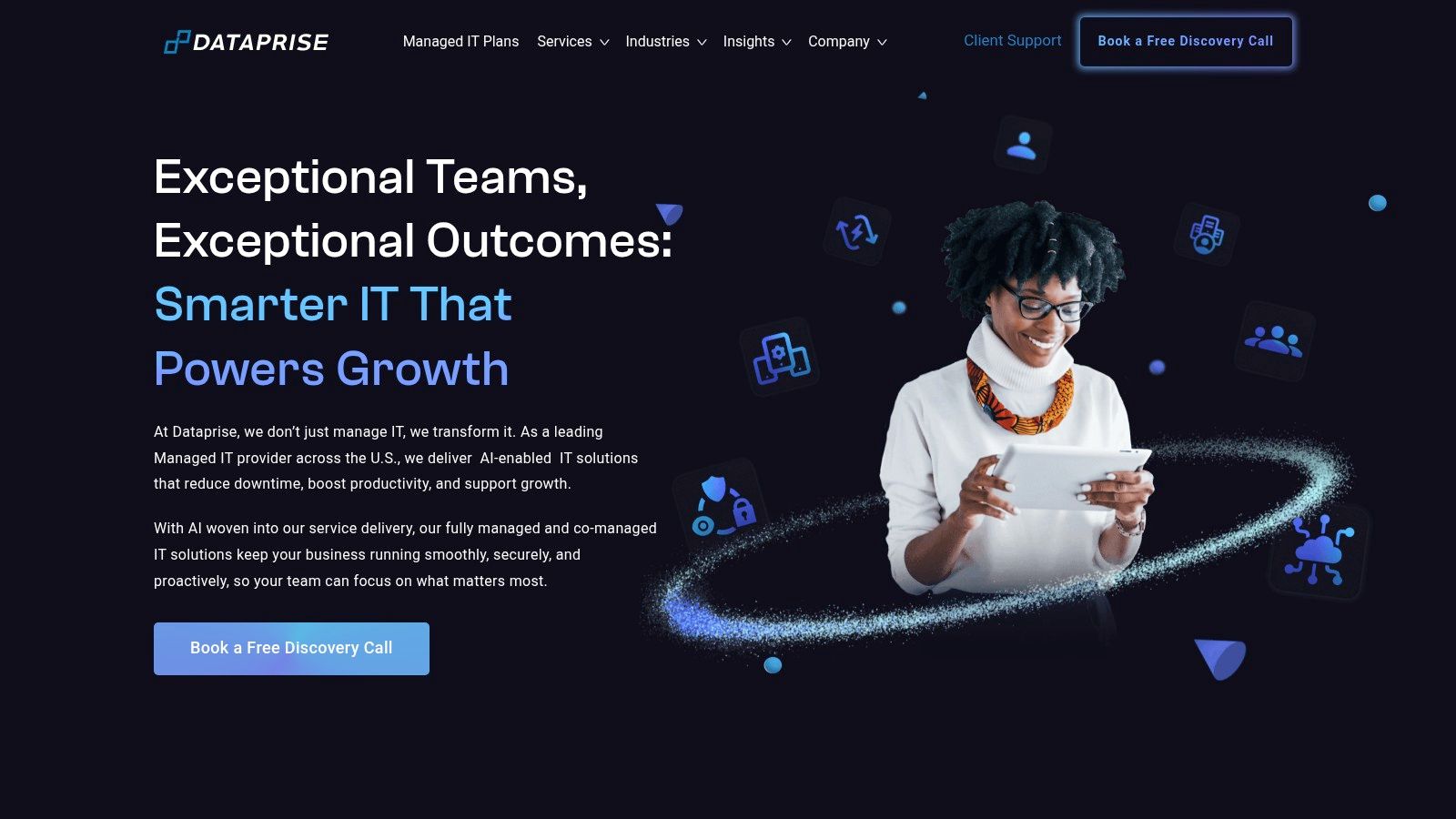
Dataprise is the kind of MSP that makes budgeting easier for buyers and easier for resellers to benchmark against. Its packaged approach around Foundation, Fortify, and Comply gives clients a simple ladder from core support into security and compliance. That's smart packaging, and it sets the expectation that managed IT should feel like a business service, not a pile of tickets.
For MSPs and vCISOs, that matters because packaged services shorten sales cycles. When a prospect understands what's included, you spend less time defending scope and more time selling outcomes.
Where Dataprise fits best
Dataprise is a strong fit for organizations that want fully managed or co-managed IT with a mature operating model. The platform centers on 24/7 support, proactive monitoring, patching, asset management, backup, disaster recovery, and advisory support. That combination works well for clients that need daily operations handled without building an internal bench.
A few things stand out:
- Packaged tiers: Scope is easier to explain, budget, and renew.
- Security included: The security stack moves beyond antivirus into more serious controls and awareness training.
- Advisory layer: vCIO support helps push conversations from support into planning.
Practical rule: If a provider can't explain where core IT ends and compliance support begins, your client will eventually discover the gap during an audit.
Dataprise is less ideal for very small organizations because the published positioning is geared toward larger teams. It also doesn't publish standard public pricing, so expect a quote-led process rather than fast self-service comparison.
For resellers, this is also where the gap appears. Dataprise can handle broad managed services, but clients with SOC 2, HIPAA, or customer security review pressure often need a formal penetration testing path too. That's where a white label pentest partner for MSPs adds margin without forcing you to build an offensive security team.
See the provider at Dataprise.
Synoptek for Complex Mid Market Estates
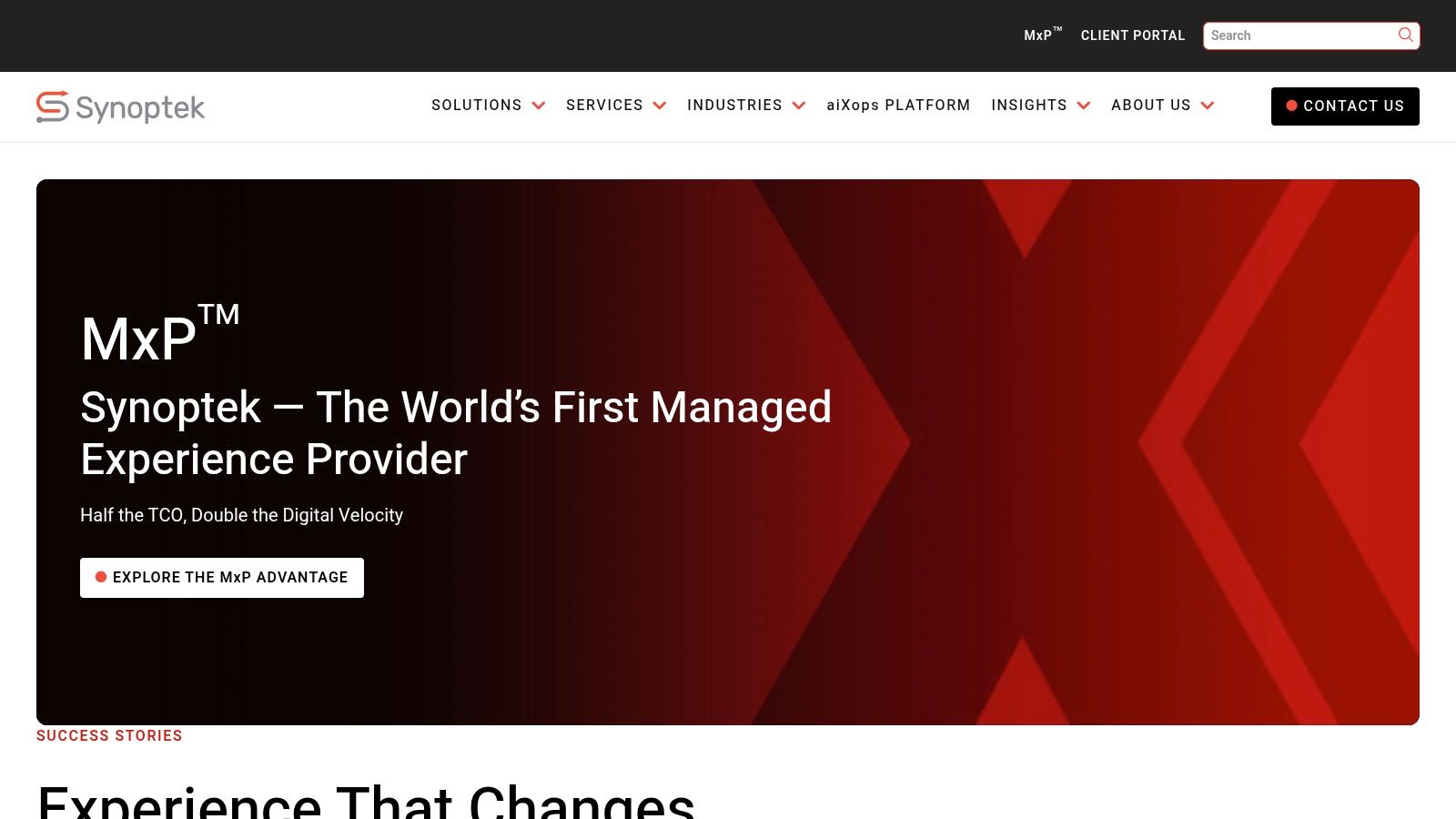
Synoptek is built for clients with moving parts. If your prospect has cloud sprawl, app complexity, data challenges, and a security program that doesn't live in one tool, Synoptek is the type of provider that can absorb that complexity without blinking.
Its pitch around managed experience also matters. Plenty of MSPs still sell infrastructure outputs. Synoptek pushes closer to business outcomes, which is where larger accounts expect the conversation to go.
What resellers should notice
This is a broad service stack. Infrastructure, applications, data, security, and multicloud all sit under one roof. If you support Microsoft-heavy customers, Synoptek's Azure alignment is useful because it reduces translation friction between strategy and operations.
The upside is clear:
- Breadth across disciplines: Fewer vendors to coordinate for complex clients.
- Cloud and app depth: Better fit for modernization projects than a pure help desk MSP.
- AI-assisted operations: Good signal for clients asking how automation shows up in service delivery.
The tradeoff is just as clear. Smaller SMB accounts may not need this much provider muscle, and bespoke pricing means your sales team still has to scope carefully.
Global demand is also moving toward cloud-centered managed services. S&P Global estimates cloud managed services were just under USD 11 billion in 2021 and are projected to reach USD 26 billion by 2026 at a 19.8% CAGR. If you sell into clients shifting workloads to Azure, AWS, or GCP, cloud operations should be a headline offer, not an add-on.
That still leaves one high-margin hole. Most broad MSPs can operate cloud, but far fewer can turn around affordable pen testing, penetration testing, and a manual validation workflow under your brand. If you want a cleaner picture of where that service fits, read this overview of the managed services provider model.
See the provider at Synoptek.
Integris for Regulated SMB Accounts
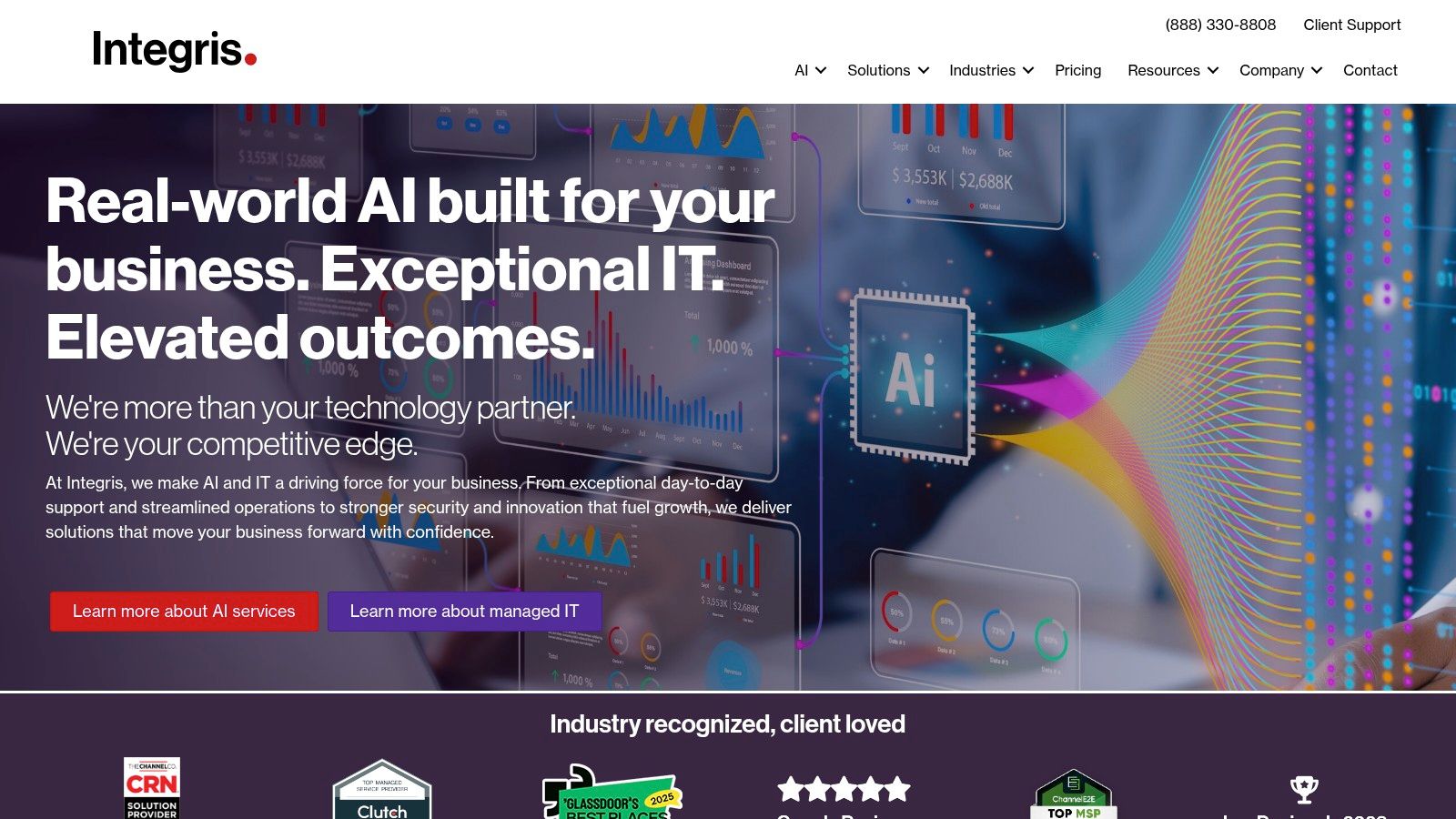
Integris stands out because it does something many providers avoid. It gives buyers a pricing estimator early in the process. That won't replace discovery, but it does reduce friction for SMB and mid-market clients that want a rough commercial frame before they invest more time.
That move matters for regulated industries. Banks, law firms, and other compliance-heavy buyers don't just want support. They want to know whether the provider understands operational reality, response expectations, and governance.
Why Integris works for compliance-led sales
Integris is a practical fit when your target account cares about managed IT, cloud, and compliance support in one place. The company positions well for regulated organizations, and that usually means better conversations around documentation, controls, and business risk than you get from generic local MSPs.
Here's the key advantage for resellers:
- Estimator-first motion: Lowers buyer resistance at the start.
- Regulated industry focus: Better fit for firms with audit pressure.
- Co-managed options: Helpful when the client has some internal IT muscle.
Ask every serious provider how they handle retention, staffing stability, insurance, third-party audits like SOC 2, and incident responsibility in the SLA. Those signals usually tell you more than the feature list.
That buyer discipline is worth applying across your stack. A useful guide to MSP selection puts emphasis on customer retention, turnover, management stability, insurance, audits, and incident-response accountability in contracts, which is exactly the kind of maturity many glossy listicles skip when evaluating a managed services provider.
Integris is still quote-driven in practice, and on-site support coverage should be checked if your clients are spread across less dense regions. If you pair this kind of regulated IT support with branded penetration testing, you close a common compliance gap. This breakdown of top managed security service providers is useful if you're deciding where external testing should live in your service catalog.
See the provider at Integris.
Thrive for Compliance Heavy Environments
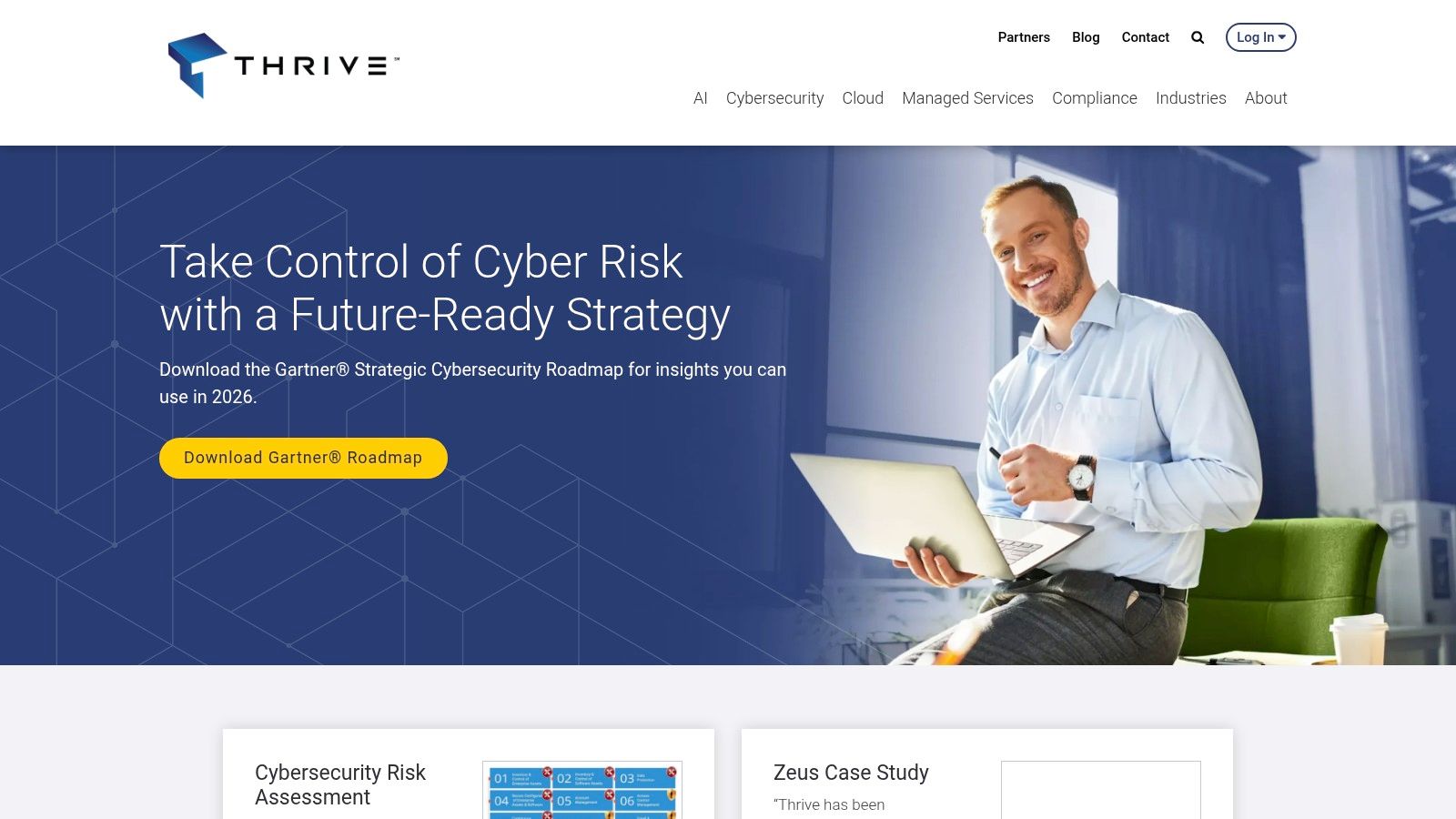
If your clients live under regulatory pressure, Thrive deserves a serious look. Its stack leans into managed cybersecurity, hybrid cloud, Microsoft 365, disaster recovery, and formal service management. That's a strong combination for buyers who need operational support plus audit-ready discipline.
The strength here isn't just breadth. It's the way Thrive connects operations with compliance language that regulated buyers already use.
Best use case for Thrive
Thrive fits organizations that need structured ITSM, managed security, and compliance mapping without stitching together several niche firms. That's useful in healthcare, finance, and other sectors where uptime, documentation, and response ownership matter every month, not just at renewal time.
Its practical advantages include:
- NOC and SOC coverage: Better alignment between operations and security.
- Compliance-oriented delivery: Useful for clients dealing with frameworks and assessments.
- Cloud and recovery services: Strong fit for resilience conversations.
There's a reason this segment keeps growing. Fortune Business Insights says the global managed services market was valued at USD 330.4 billion in 2025 and is projected to reach USD 1.1182 trillion by 2034, with North America holding 43.20% of the market in 2025. Buyers in North America are spending heavily here, which means your clients are already comparing mature providers, not just local shops.
The downside is weight. Smaller firms may find this stack more enterprise-shaped than they need, and pricing remains consultative. If you're building around Thrive or a similar provider, keep your specialty revenue clean. Handle broad managed services through the larger MSP layer, then attach services like white label pentesting and compliance-linked risk assessment work as your margin engine.
For firms also reviewing channel software and operational add-ons, some teams compare adjacent options like Zoho Thrive licenses alongside service delivery tooling.
See the provider at Thrive.
Ntiva for Co Managed IT Teams
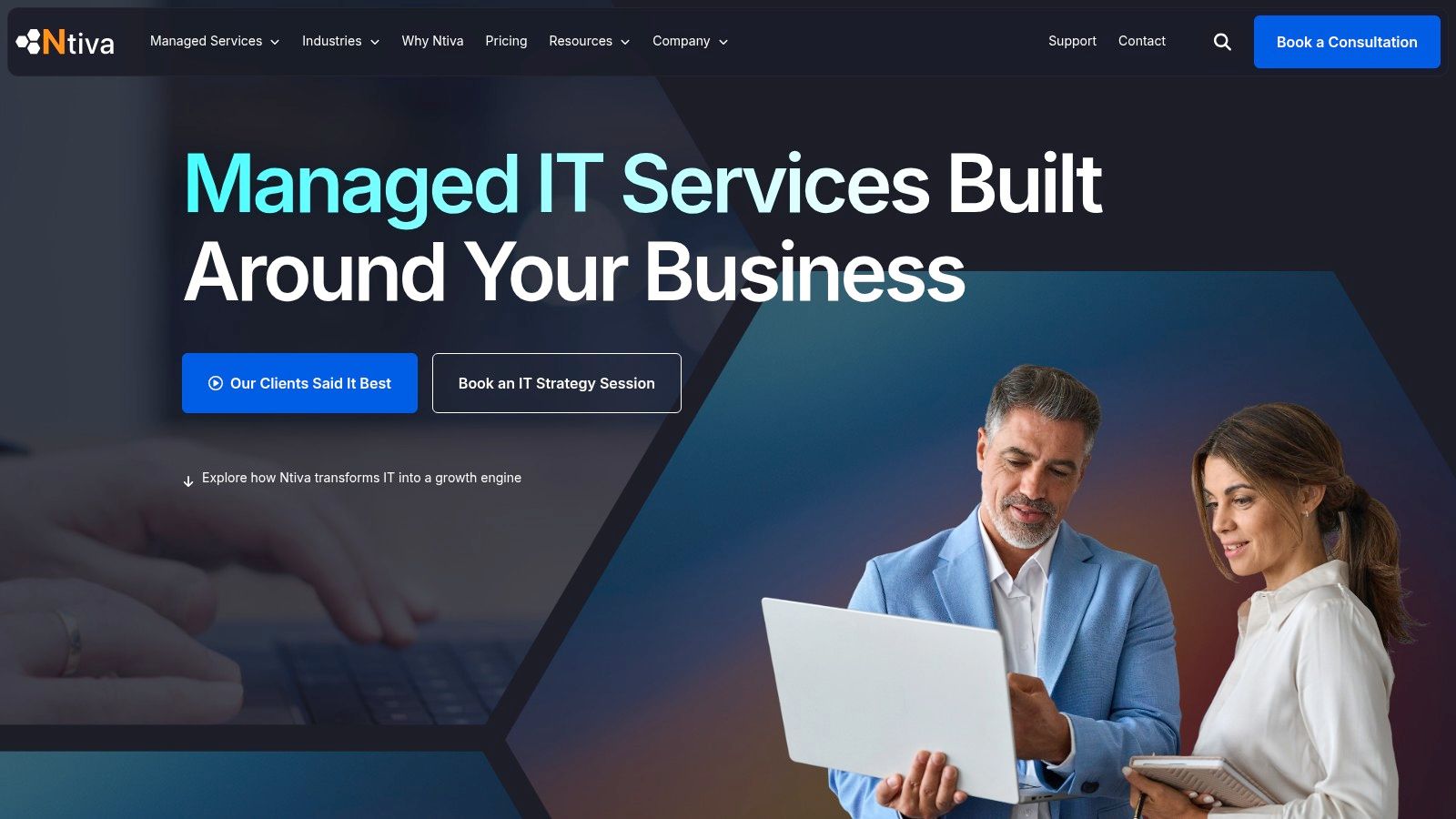
Ntiva makes sense when the client already has internal IT and just needs more hands, better coverage, or deeper specialization. That's a common account type for MSPs and vCISOs. The client doesn't want to rip and replace internal staff. They want to stop drowning in operational work.
Co-managed service design matters. A provider that can support endpoints, servers, networks, cloud, and security without stepping on the internal team usually wins trust faster.
Why Ntiva is easy to position
Ntiva's value is straightforward. It offers 24/7 help desk support, managed IT operations, cloud support, cybersecurity services, and co-managed options for companies that need augmentation instead of full outsourcing.
That creates three strong sales angles:
- Surge capacity: Good fit when internal teams are overloaded.
- National scale with local feel: Useful for multi-site organizations.
- Broad standardization: Easier to align IT, cloud, and security under one operating model.
When a client says, “We already have IT,” that usually means they need co-managed support, after-hours coverage, or specialist services they can't hire fast enough.
The caution is simple. Ntiva is still a consultative sale, and physical support expectations should be validated outside major metros. Also, broad providers like this often handle vulnerability management and security operations, but that doesn't automatically cover a proper penetration test for PCI DSS, customer due diligence, or a board-requested pen test.
That distinction matters in renewals. If you can add separate manual pentesting under your own brand, you solve the client's compliance ask without inviting another security firm into the account.
See the provider at Ntiva.
All Covered for Multi Location Clients
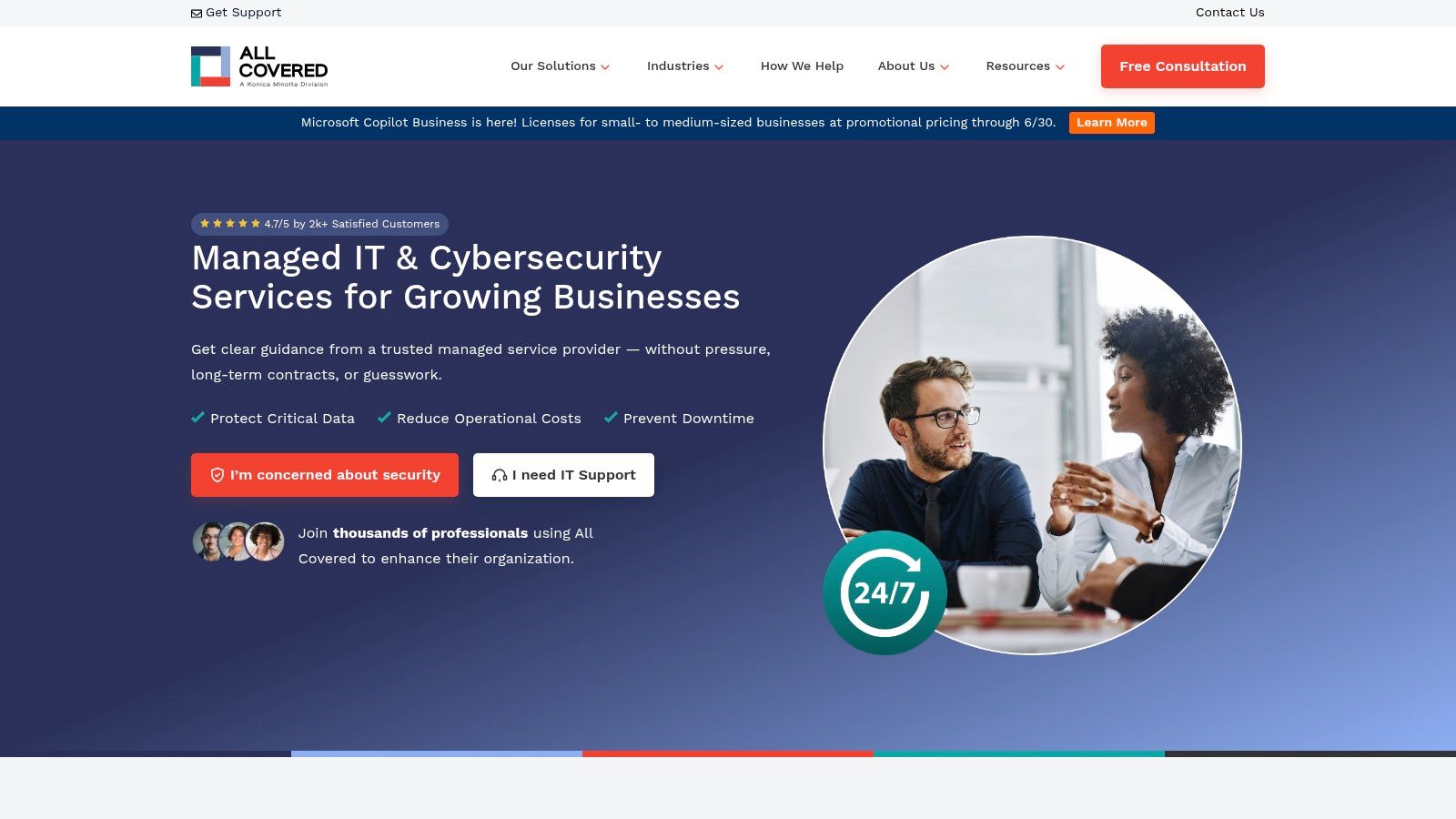
All Covered benefits from Konica Minolta scale, and that gives buyers a different kind of comfort. For multi-location organizations, continuity matters almost as much as technical capability. They want to know the provider can support offices, devices, communications, cloud services, and security operations across a larger footprint.
This is a practical option for education, healthcare, legal, government, and financial services environments where coverage breadth matters.
Where All Covered earns attention
The service catalog runs wide. Managed IT, managed security, vulnerability management, awareness training, Microsoft 365, device lifecycle work, cloud services, and unified communications all show up. For larger distributed environments, that's useful because fewer providers means fewer contracts and fewer blame games.
The strengths are pretty clear:
- Strong parent-company backing: Good sign for continuity.
- Wide service catalog: Helpful for standardization across locations.
- Industry-specific delivery: Better fit for regulated or process-heavy sectors.
The risk is complexity. A large portfolio can create overlap if scope isn't locked down tightly. Push hard on service definitions, escalation ownership, and who handles what during an incident.
Market direction supports that security-first posture. In KPMG's 2024 global managed services research, 86% of leaders said cybersecurity and privacy are a top priority, while 62% said AI and generative AI are a top priority. That means clients aren't just buying support anymore. They're buying a provider's ability to operationalize security and automation.
For resellers, this is another reminder to pair broad managed operations with a separate branded penetration testing offer. Security awareness and vulnerability management are good. They are not substitutes for a scoped pen test when the client has a compliance requirement.
See the provider at All Covered.
Insight for Documented Enterprise Governance

Insight is the governance-heavy option on this list. If your client wants documented service definitions, formal transitions, structured SLAs, and reassurance around managed operations in regulated environments, Insight is built for that conversation.
Some buyers don't need that much process. Others absolutely do. If you're selling into healthcare, finance, or any environment where procurement and security teams review every line item, this style of provider can make the deal easier.
Why Insight closes careful buyers
Insight covers managed cloud, workplace and endpoint operations, Microsoft 365, infrastructure, and managed security. The standout is operational maturity. Buyers that care about process discipline usually respond well to a provider that publishes service definitions instead of keeping everything vague until late-stage scoping.
Its strongest points:
- Clear governance model: Useful for clients with mature procurement.
- Documented SLAs and transitions: Fewer surprises during onboarding.
- Compliance-friendly posture: Better fit for regulated buyers.
This also lines up with broader buying patterns in major regions. Statista reports that EMEA accounted for over 57% of global IT services revenue in 2024, and the United States accounted for over one-third of the global information and communication technology market in 2023. Large, enterprise-heavy markets keep pushing managed services toward more formal operations, stronger security posture, and more accountable delivery.
That said, smaller teams can find Insight heavyweight. Pricing is typically customized, and highly structured delivery can feel slower if the client just wants basic support. For resellers, Insight-style governance is valuable. Just don't confuse mature process with complete security coverage. You still need a fast path for white label pentesting, penetration testing, and compliance-driven risk assessment work if you want to keep the full account under your brand.
See the provider at Insight.
Top 7 Managed IT Services Comparison
| Provider | Implementation complexity | Resource requirements | Expected outcomes | Ideal use cases | Key advantages |
|---|---|---|---|---|---|
| Dataprise | Moderate, tiered packages simplify rollout | Per-user packaging, 50+ user minimum, partner integrations | Predictable operations, proactive support, improved security at higher tiers | Mid-sized organizations needing predictable budgeting and managed security | Clear packaged tiers, 24/7 help desk, DRaaS partner ecosystem |
| Synoptek | Moderate–high, multicloud and app scope | Mid-market scale, Azure expertise, AI monitoring tools | Experience-focused outcomes, automated anomaly detection and remediation | Mid-market firms with complex cloud/app estates, Microsoft-centric environments | Broad cloud/app/data services, Azure Expert MSP, AI-enabled operations |
| Integris | Low–moderate, discovery/estimator streamlines start | SMB/regulatory expertise, verify on-site coverage | Early cost transparency, compliance-aligned managed IT | SMBs and regulated organizations (banks, law firms) seeking clarity | Online cost estimator, long-tenured regulated-sector references |
| Thrive (Thrivenextgen) | High, enterprise ITSM and compliance stack | ServiceNow ITSM, 24/7 NOC/SOC, advanced security tools | Strong compliance posture, integrated NOC/SOC operations | Regulated U.S. sectors needing SOC 2/ISO/other compliance | Deep compliance coverage, standardized ITSM, AI-aided detection |
| Ntiva | Moderate, flexible co-managed integration | Local + national support, surge capacity for multi-site | Augmented internal teams, consistent multi-site operations | IT-mature organizations seeking augmentation or surge capacity | Co-managed model, national scale with local support |
| All Covered (Konica Minolta) | Moderate–high, broad portfolio and procurement processes | Enterprise backing, industry-tailored programs, device lifecycle services | Scalable managed IT/security, industry-specific compliance support | Education, healthcare, government, legal, financial services with multiple locations | Backed by Konica Minolta, wide industry coverage, 24/7 NOC/SOC |
| Insight | High, governance and documented SLAs | Mature managed-services organization, compliance certifications | Documented SLAs, strong governance, regulated-buyer reassurance | Enterprises and regulated buyers needing formal processes and certifications | Detailed service definitions, HITRUST and ITIL-aligned practices |
Partner with a Channel Only Pentesting Specialist
Broad MSPs are useful. They cover the foundation your clients expect, including cloud, support, endpoint management, recovery, and security operations. But broad coverage is not the same as specialized assurance. When a client needs penetration testing for PCI DSS, ISO 27001, SOC 2, or internal risk review, that request exposes a gap for many MSPs and vCISOs.
That gap is where margin lives.
If you build an in-house pen test practice, you take on hiring delays, certification requirements, methodology design, QA, reporting standards, and delivery risk. That's expensive, slow, and hard to scale. It also pulls your team away from the recurring managed work that keeps the business healthy.
A white label pentesting partner fixes that problem cleanly. You keep the client relationship. You keep the account strategy. You add a specialized service under your own brand without inviting a competitor into the room.
The right model is simple:
- Certified testers: Your clients want confidence in the team doing the work. Credentials like OSCP, CEH, and CREST matter.
- Manual pentesting: Automated scanning has a place, but a real penetration test needs human validation and useful findings.
- Affordable delivery: If the service is overpriced, your clients delay it. If it's affordable, it becomes easier to attach to compliance and annual security planning.
- Fast turnaround: Security reviews and audits don't wait. Slow delivery kills momentum and makes your client look unprepared.
- Channel-only alignment: This is essential. Your partner should never compete with your MSP, vCISO, GRC, CPA, or reseller relationship.
That's why many resellers separate their stack into two layers. Layer one is broad managed IT. Layer two is specialized security and compliance services delivered through channel partners. That model protects your client relationship and expands revenue without bloating payroll.
If you need a provider for the second layer, MSP Pentesting is one relevant option. MSP Pentesting works with partners on white labeled pentests, including web applications, internal networks, mobile apps, cloud environments, external networks, social engineering, and red teaming. The team includes certified pentesters with OSCP, CEH, and CREST credentials and focuses on affordable, manual pentesting with quick turnaround.
Your clients already need these services. The only question is whether you'll deliver them under your brand or watch another firm use them to get inside your accounts. Contact us today to learn more about the reseller program.
Want to add affordable, fast, white label pentesting to your MSP, vCISO, or GRC offering without competing against your own clients? Talk with us about our channel-only partner program to add certified penetration testing and manual pentesting under your brand.

.avif)
.png)
.png)
.png)

