
Your client asks a simple question. “Do we really need a penetration test, or is our firewall enough?”
At the same time, a competitor is pitching that same client on compliance support, risk assessment services, and a bundled pen test. If you don’t have a clear answer, you’re not just missing revenue. You’re leaving room for someone else to become the trusted advisor.
That’s where understanding what is a black hat hacker matters. Not as a buzzword, and not as a movie stereotype. MSPs, vCISOs, GRC firms, CPAs, and IT resellers need to explain the threat in plain English, tie it to compliance and business risk, and offer a practical fix that clients can afford.
Understanding The Real Black Hat Hacker
A client asks whether a firewall is enough. Meanwhile, an attacker is testing exposed remote access, bought credentials, and a polished phishing lure generated in minutes with AI. That attacker may not be a gifted exploit developer. They are often an affiliate using rented ransomware infrastructure and a playbook built to hit businesses like your clients.
That is the practical definition MSPs need. A black hat hacker is someone who gains unauthorized access to systems for theft, fraud, extortion, or disruption. The locksmith comparison works well with clients. A security professional checks the lock with permission. A black hat tries the side door, the old VPN account, the reused password, the forgotten admin panel, and any user willing to click.
For MSPs, the important point is not the label. It is the intent and the business model behind it. Black hat activity has matured from isolated break-ins into an organized service economy. Ransomware crews sell access, tooling, payloads, and support to affiliates. AI lowers the skill barrier again by speeding up phishing, reconnaissance, and social engineering. That combination puts smaller clients at risk because attackers no longer need rare technical talent to run a damaging campaign.
The older public image was a lone intruder making headlines. Kevin Mitnick became one of the best-known early examples of unauthorized access crossing from experimentation into serious legal and business risk, as outlined in Wikipedia’s overview of black hat computer security. The current threat is less romantic and more dangerous for service providers. It is repeatable, packaged, and profitable.
That shift matters to MSPs because your clients are reachable through shared tools, remote management paths, vendor portals, email, and identity systems. Attackers look for the fastest route to money. If a client can be extorted, if operations can be halted, or if your access can be abused to move downstream, they are in scope.
Clients also need to hear this clearly. Black hats do not target only large enterprises. They target organizations with weak exposure management, inconsistent identity controls, and no one validating whether defenses hold up under human testing.
That is why I advise MSPs to explain attacks as a sequence of actions, not a single event. Reconnaissance, initial access, privilege escalation, lateral movement, and impact each create chances to detect or stop the intrusion. The cyber kill chain for service providers gives you a simple framework for that discussion. It also leads naturally to the service clients will understand and buy. Manual pentesting shows where a black hat can get in before a criminal proves it the hard way.
The Modern Black Hat Hacker Toolkit
Today’s black hat ecosystem looks more like a service economy than a lone criminal at a keyboard.
The biggest shift is industrialization. Attackers don’t always need to discover deep technical flaws themselves. They can rent tools, buy templates, reuse stolen credentials, and launch campaigns that look polished enough to fool real users and slip past weak defenses.
RaaS lowered the skill barrier
Ransomware-as-a-Service, usually called RaaS, means the attack business has packaging now. Infrastructure, payloads, templates, and operator support can be handed to people who don’t have elite exploit development skills.
That matters because your clients are no longer just dealing with rare, highly specialized attackers. Emerging AI-powered tools like WormGPT are enabling non-experts to launch advanced attacks, and non-experts now comprise 65% of ransomware deployers, with RaaS platforms offering customer support and MSP-targeted templates, according to McAfee’s black hat hacker overview.
Here’s what that means in practice:
- More volume: More people can run attacks.
- Better packaging: The phishing email, fake login page, or ransom workflow can look professional.
- More pressure on MSPs: Your stack becomes a path into multiple clients if segmentation, hardening, and testing are weak.
AI makes bad operators more dangerous
AI doesn’t magically turn a novice into a top operator. It does make mediocre attackers faster. They can clean up phishing copy, generate scripts, mimic internal language, and build believable lures without much effort.
Cheap attack tooling changes the math. Defenders can’t assume low skill means low impact.
That’s one reason automated security hygiene by itself doesn’t hold up well anymore. A black hat using prebuilt tools can still hit cloud apps, user workflows, and external attack surfaces in ways that basic scanning won’t fully model.
Black White And Grey Hat Differences
The easiest way to explain hacker types is a locksmith analogy.
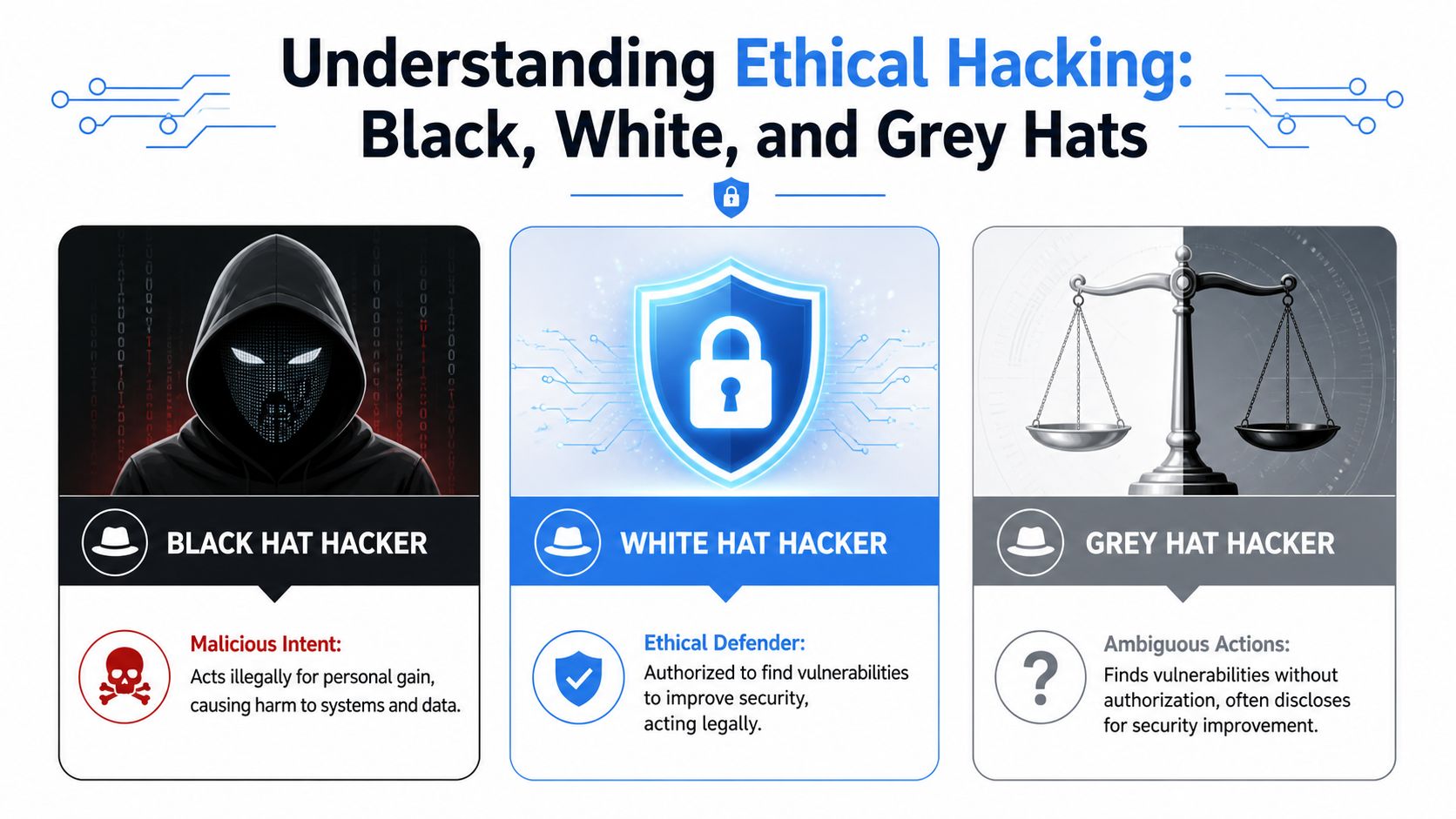
A black hat is the burglar. A white hat is the locksmith you hire to test your locks and show you what needs fixing. A grey hat is the stranger who picks your lock without permission and then tells you they found a problem.
The simple comparison
| Type | Permission | Intent | Business impact |
|---|---|---|---|
| Black hat | No | Personal gain, profit, disruption | Breach, extortion, downtime, data loss |
| White hat | Yes | Improve security legally and ethically | Clear findings, remediation guidance, better compliance posture |
| Grey hat | No | Mixed motives, sometimes disclosure | Legal risk, uncertainty, and poor trust boundaries |
Why this matters to clients
Clients often hear “ethical hacker” and “hacker” in the same sentence and get nervous. That’s normal. The important distinction is authorization.
A real penetration test has scope, rules of engagement, approvals, evidence handling, and reporting. That’s why penetration testing, pen testing, and formal pentest work belong in professional security and compliance programs, especially for SOC 2, HIPAA, PCI DSS, and ISO 27001 readiness.
Grey hat activity might sound helpful on paper, but it still starts without consent. For an MSP, vCISO, or reseller, that lack of permission is exactly the line you don’t cross.
Business Risks Black Hats Create For Clients
Most clients don’t buy security because they love security. They buy it because they want fewer surprises, cleaner audits, and less chance of business interruption.
Black hat activity creates risk in ways clients immediately understand. Systems go down. Data gets exposed. Staff lose time. Customers ask questions. Regulators and auditors start looking closer. Even when the root issue is “just” a misconfiguration or weak workflow, the business consequence is still real.
Where MSP clients get hit hardest
Small and midsize organizations usually don’t fail because of one dramatic movie-style exploit. They fail because several ordinary weaknesses stack together. A weak password policy, an exposed application, poor segmentation, untested incident response, and overconfidence in tooling are enough to create a bad day.
That’s why risk conversations should stay tied to operations and compliance:
- SOC 2 pressure: Clients need evidence that security controls aren’t just written down.
- HIPAA concerns: Healthcare-related data handling raises the stakes on access control and response.
- PCI DSS expectations: Payment environments require more than assumptions about security.
- ISO 27001 maturity: Policies help, but auditors still expect proof that controls are effective.
The hidden client conversation
Many MSPs focus on perimeter tooling and endpoint coverage because those are easier to package. The harder conversation is whether the client’s real-world workflows are secure. User behavior, exposed portals, mobile access, and messaging habits often create gaps that no dashboard fully explains.
If a client relies on texting for sensitive workflows, it helps to point them to resources on uncovering text message security flaws so they understand where convenience can create risk.
Security programs fail quietly when nobody tests how people, apps, and processes behave together.
That’s also the business risk for the MSP. If you don’t bring up these issues first, another provider will. And they’ll position themselves as the one who understands compliance, risk assessment, and real security validation.
Counter Black Hat Tactics With Manual Pentesting
A client gets hit through a path their tools never flagged. The attacker buys initial access, uses an AI-assisted phishing lure to capture one account, pivots through weak permissions, and hands the win to a ransomware crew running a polished RaaS operation. That is the threat MSPs are up against now. Hacking has become faster to launch, easier to scale, and more profitable to repeat.

Automated scanners still matter. They catch known issues, help with coverage, and make routine checks efficient. But RaaS affiliates and AI-assisted attackers do not work from a single finding at a time. They chain weak MFA handling, exposed services, excessive permissions, brittle workflows, and missed detection gaps into one practical route to impact.
Manual pentesting tests those routes the way an operator would. A skilled tester examines application logic, trust relationships, privilege boundaries, identity flows, and how one low-severity issue turns into domain access, data exposure, or ransomware deployment.
What tools miss
Scanners are good at identifying known CVEs, outdated components, and obvious misconfigurations. They are weak at judging reachability, exploitability, and business context. An MSP owner does not need another PDF full of findings with no priority. They need to know which path a black hat can use against this client, this stack, and this set of user habits.
That matters more now because industrialized attackers optimize for speed. RaaS groups split the work across brokers, affiliates, malware operators, and extortion teams. AI helps them write better phishing content, adapt malware, and test code faster. Manual testing is how you pressure-test the gaps between your tools before that assembly line finds them first.
Why manual testing works better
Manual penetration testing is better suited for cases like these:
- Attack-chain validation: Human testers can prove how separate issues combine into one workable compromise path.
- Business logic abuse: A portal or workflow can behave exactly as designed and still let an attacker bypass controls.
- Identity and privilege review: SSO, MFA, password reset, role assignment, session handling, and lateral movement need human judgment.
- Cloud and hybrid exposure: Tenant settings, IAM roles, remote access paths, APIs, and inherited trust rarely fit a simple scan result.
- Ransomware impact testing: A good tester can show whether an attacker can move from foothold to privileged access fast enough to matter.
Teams shipping AI-assisted code also need closer review. Generated code often introduces insecure assumptions, weak validation, or risky auth logic that passes basic checks. An AI code security audit can complement broader security validation by focusing on how AI-produced logic and implementation choices introduce risk.
Automated scanning gives you coverage. Manual pentesting gives you attacker context.
What buyers should look for
MSPs should buy pentesting the same way they buy any serious security control. Look at outcome, depth, and channel fit.
- Real manual work: If the provider mainly runs tools and formats the output, you are buying a scan, not a pentest.
- Clear attack narrative: The report should show what was reachable, how issues chained together, and what to fix first.
- Practical remediation guidance: Clients need actions their internal team or MSP can execute without guesswork.
- Third-party credibility: Independent validation helps with client trust, insurance conversations, and compliance evidence.
- Channel-safe delivery: The provider should strengthen your client relationship, not compete for it.
For MSPs that need credible offensive testing without building an internal red team, attested third-party manual pentesting services give you a practical benchmark for what a serious assessment should include. Affordable manual testing is not a luxury add-on anymore. It is one of the few reliable ways to find the paths black hats will use against your clients, and to turn that work into a stronger security offering under your own brand.
Offer Affordable White Label Penetration Testing
Many MSPs want to add security assessments, but the market makes it harder than it should be. Prices get inflated. Lead times drag out. Some providers oversell automated testing as if it were full manual work. Others compete directly for the same client relationship you worked to build.
That’s why white label pentesting is such a practical model for MSPs, vCISOs, GRC firms, CPAs, and resellers. You keep the client relationship. You expand your service catalog. You offer a real pentest, pen testing, or penetration test under your own brand without building an internal offensive security team from scratch.

What a good channel model should include
Not every partner model is built for the channel. The right one should be simple and protective of your business.
- Channel-only delivery: The provider shouldn’t compete with your MSP, vCISO, or reseller practice.
- Affordable pricing: You need room to package services profitably without shocking the client.
- Fast turnaround: Security work loses momentum when reports take too long.
- Certified testers: Clients trust reports more when qualified professionals perform the work.
- Broad coverage: Internal, external, cloud, mobile, web app, and social engineering support matters.
Why this helps you grow
A strong white-label model does more than plug a service gap. It helps you keep accounts longer.
When you can pair managed services with risk assessment, compliance guidance, and real manual pentesting, your offering becomes harder to replace. The client stops seeing you as the team that manages tickets and starts seeing you as the team that protects the business.
If you want a clearer picture of how the model works in practice, this guide to reselling pentests under your own brand is a good place to start.
If you want a channel-only partner that helps you deliver affordable, fast, certified manual pentesting without competing for your clients, talk to us about selling pentests under your own brand. We help MSPs, vCISOs, GRC firms, and resellers offer white-labeled penetration testing that strengthens compliance, protects client relationships, and creates new revenue. Contact us today to learn more.
%20(1).png)
.avif)
.png)
.png)
.png)

