
Your client just added a cloud app, rolled out remote access, connected a warehouse device network, and opened a new API for a vendor. Nothing about that stack is simple anymore. It's a patchwork of systems that don't naturally talk to each other, and the weak spot is usually the thing joining them together.
That thing is often a gateway.
If you're an MSP, vCISO, or GRC advisor, this matters for two reasons. First, gateways are prime attack paths. Second, gateway reviews and penetration testing are easy to position as high-value work because they sit directly between business systems, users, and the internet.
Your Clients Have Gateways Everywhere
A typical client network isn't one neat box. It's office users on a LAN, Microsoft 365, cloud workloads, VPN users, remote sites, security cameras, IoT gear, payment systems, and vendor integrations. Somewhere between each of those zones, a gateway is making traffic move.
That's why the question what is a gateway isn't basic networking trivia. It's a sales and security question.
Where MSPs usually miss the risk
Most clients know they have firewalls. Fewer understand their gateways. They may call the same device a firewall, router, VPN appliance, default gateway, reverse proxy, or edge box, depending on who set it up. That confusion is where risk hides.
If your client also has a segmented network or a public-facing zone, it helps to understand how the gateway sits near exposed assets. A quick refresher on a DMZ in networking often makes the conversation easier with non-technical stakeholders.
Gateways are often the place where “internal” meets “external.” That makes them one of the first things an attacker will probe.
Why this creates a service opportunity
Clients rarely ask for a gateway assessment by name. They ask for help with SOC 2, HIPAA, PCI DSS, third-party risk, remote access hardening, or internet exposure reviews. Gateway testing fits naturally inside all of those conversations.
For an MSP, that means you can package gateway assessment work as part of:
- Compliance readiness for SOC 2, HIPAA, PCI DSS, and ISO 27001
- Risk assessment work before an audit or cyber insurance review
- Pen test scoping for external attack surface validation
- White label pentesting delivered under your own brand
That's profitable because the problem is easy to explain and the business impact is obvious.
Explaining Gateways in Simple Terms
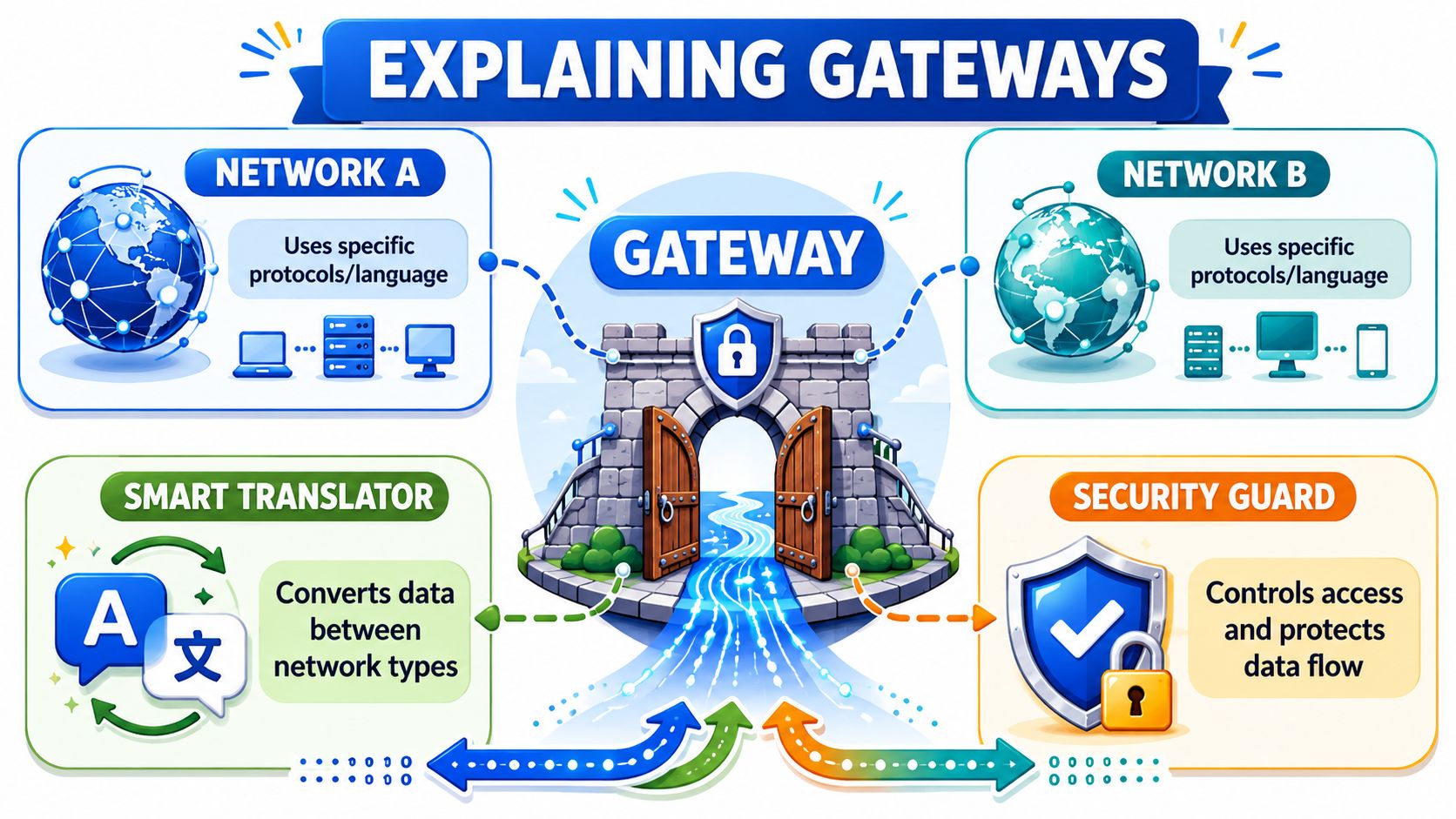
A gateway is a translator at the border between two systems that don't speak the same language. A router usually forwards traffic between similar IP networks. A gateway can do more. It can translate protocols, change how data is handled, and enforce control at the boundary.
What a gateway actually does
Lenovo defines it clearly: in networking, a gateway is the system boundary that connects dissimilar networks or protocols and performs protocol translation so traffic can move between environments that would otherwise be incompatible. It can also alter packet handling, address mapping, and application payload interpretation, which makes it a critical control point in the environment, as noted in Lenovo's gateway glossary.
That's the technical answer to what is gateway. The practical answer is simpler. A gateway lets one environment reach another when direct communication wouldn't work cleanly on its own.
Why MSPs should care about the difference
When a device only forwards traffic, your review focuses on routing and exposure. When a device also translates traffic, applies NAT, filters sessions, terminates VPN connections, or inspects app-layer requests, your review gets more serious.
That's because the gateway isn't just moving packets. It's interpreting them.
Practical rule: The more a gateway understands the traffic, the more damage a bad configuration can cause.
This is why gateway testing should never be treated like a basic port scan.
Discovering the Different Types of Gateways
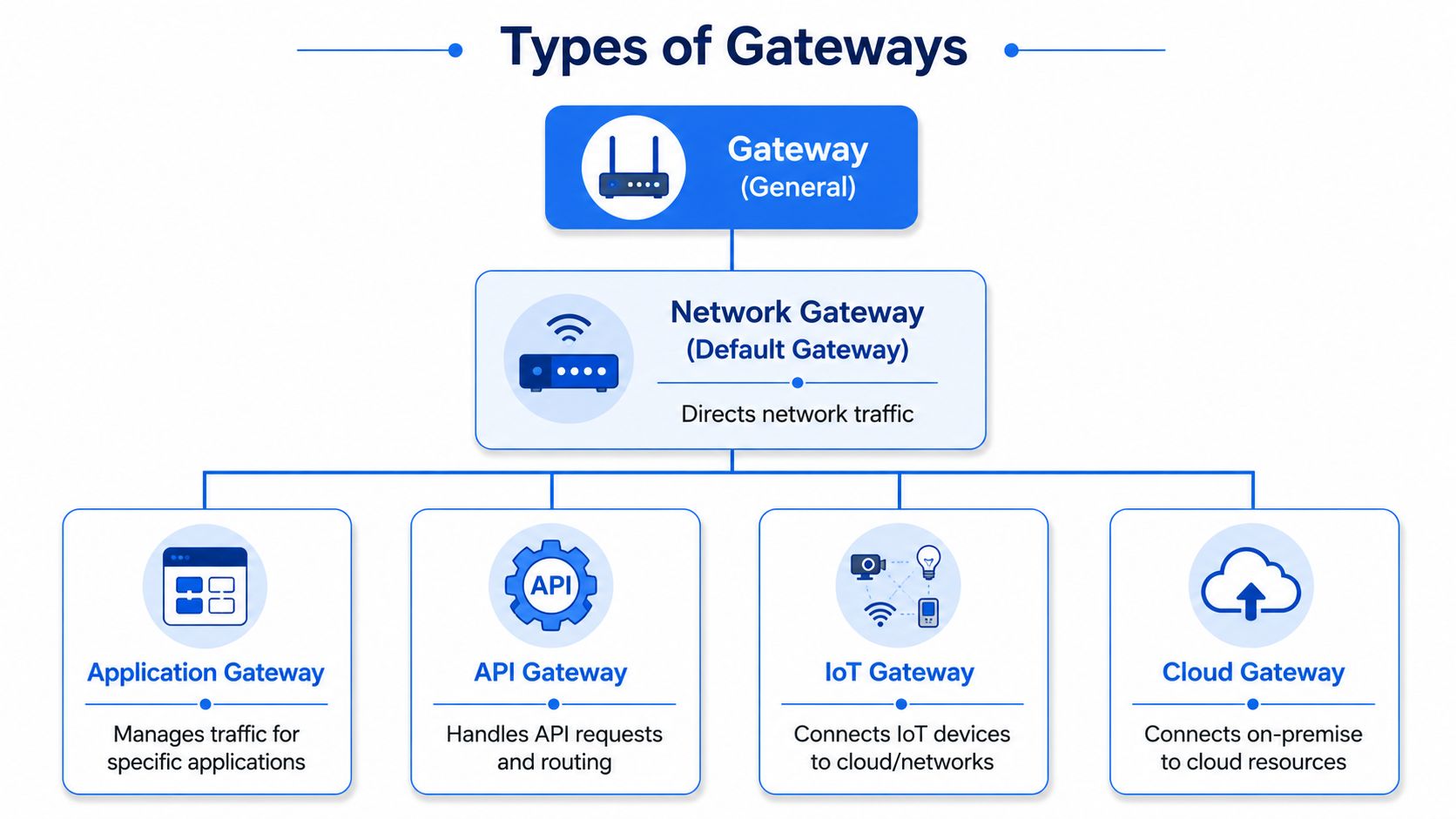
Not every gateway looks like a perimeter firewall. Some are obvious. Others are buried inside applications, cloud services, or payment workflows. If you want to sell the right service, you need to recognize the type of gateway in front of you.
The gateway types MSPs see most
Here's the short version.
| Gateway type | What it does | MSP example |
|---|---|---|
| Network gateway | Connects networks and may translate or enforce policy | Office network reaching the internet |
| Default gateway | Sends local traffic to outside destinations | User devices sending outbound traffic |
| API gateway | Central entry point for APIs | Customer portal calling backend services |
| Cloud gateway | Connects on-prem systems to cloud resources | Legacy file workflow using cloud storage |
| IoT gateway | Aggregates and relays device traffic | Sensors in a warehouse or clinic |
| Application gateway | Manages traffic for specific apps | Web app delivery and request control |
| Payment gateway | Handles transaction flow | Ecommerce or billing platform |
HPE points out an important distinction many people blur: a network gateway is the protocol translator, while a default gateway is the outbound next hop. In practice, the same device can serve both roles and may also include security filtering, NAT, logging, and policy enforcement, which HPE explains in its overview of network gateway functions.
Why this matters during scoping
If your engineer hears “gateway” and thinks only “router,” the scope will be weak. An API gateway needs a different penetration test than a branch firewall. An IoT gateway introduces device trust and telemetry concerns. A payment gateway conversation naturally raises PCI DSS.
In telecom-heavy or multi-tenant environments, billing and access control can also run through gateway-adjacent systems. That's why operational resources like this guide on mastering MikroTik RADIUS billing are useful context when you're reviewing how access, policy, and service delivery intersect.
The sales takeaway
Don't ask clients if they want a gateway assessment. Ask where traffic crosses boundaries, where translation happens, and where external users or systems enter the environment. That gets you to the key assets fast.
Uncovering Common Gateway Security Risks
Gateway failures are rarely exotic. Most of the time, attackers get in because someone left management exposed, skipped updates, trusted the wrong source, or deployed broad rules that nobody revisited.

The issues that show up again and again
A weak gateway usually falls into one or more of these buckets:
- Bad configuration such as default credentials, insecure remote admin access, unnecessary services, or loose firewall rules
- Missing patches that leave known vulnerabilities exposed to anyone who can reach the device or service
- Authentication problems including bypasses, weak MFA design, poor session handling, or over-trusted internal sources
- Injection and input handling flaws in API gateways and web application gateways
- Logging gaps that stop the client from seeing brute force attempts, policy violations, or lateral movement
- Over-permissive NAT and policy rules that make segmentation look stronger on paper than it is in reality
For security teams that need a broader operational baseline, Clouddle's guide to network security is a useful companion for discussing hardening fundamentals with clients.
Why the business impact is bigger than the technical issue
A gateway sits in a privileged position. If an attacker controls it, they may gain visibility into traffic, pivot between zones, abuse trust relationships, or expose regulated data. That's why gateway flaws quickly become compliance problems.
For a client under HIPAA or SOC 2, this isn't just an IT clean-up task. It becomes evidence that access control, monitoring, change management, and security testing weren't strong enough.
If the client already relies on alerting and device telemetry, your review should also ask whether those events are even reaching the monitoring stack. This is where understanding what SNMP traps are helps, because a silent gateway is often just as dangerous as a vulnerable one.
A gateway can fail securely, or it can fail quietly. Quiet failures are worse because nobody responds until the attacker is already inside.
What to tell the client
Keep it simple. Tell them the gateway is one of the few systems that can expose internal assets, broker external access, and hide bad traffic all at once. That's why it deserves direct testing, not assumptions.
How Gateway Penetration Testing Protects Clients
A gateway review without a real attack simulation is incomplete. Config audits help. Vulnerability scans help. Neither tells the client what an attacker can do with the weakness in front of them.
That's where a penetration test earns its place.
Why a pen test changes the conversation
A proper pen test shows whether a gateway flaw is theoretical or exploitable. Can an attacker bypass authentication? Reach admin interfaces? Abuse trust relationships? Pivot to an internal service? Pull sensitive data through an exposed API path?
Those answers matter to vCISO teams because they tie technical findings to business risk. They also matter to resellers because exploitability is easier to sell than a generic “high-risk configuration.”
Advisor view: If a gateway touches internet access, remote access, cloud connectivity, APIs, or cardholder data flow, it deserves penetration testing.
Why manual pentesting wins here
Gateway assessments need human judgment. A scanner can list versions and misconfigurations. It won't think like an attacker testing session flow, access control logic, trust boundaries, or weak segmentation.
That's why manual pentesting is the right model for gateway work, especially when your client is dealing with ISO 27001, PCI DSS, or contract-driven security reviews. If the broader project includes tenant moves or identity changes, operational planning resources like this article on avoiding M365 migration disaster can help frame how access and cutover issues create new edge risks during transitions.
A channel-friendly option for this kind of work is MSP Pentesting, which provides white-labeled pentests across external networks, cloud, web apps, internal environments, and related attack surfaces for resellers.
Your Practical Gateway Pentesting Checklist
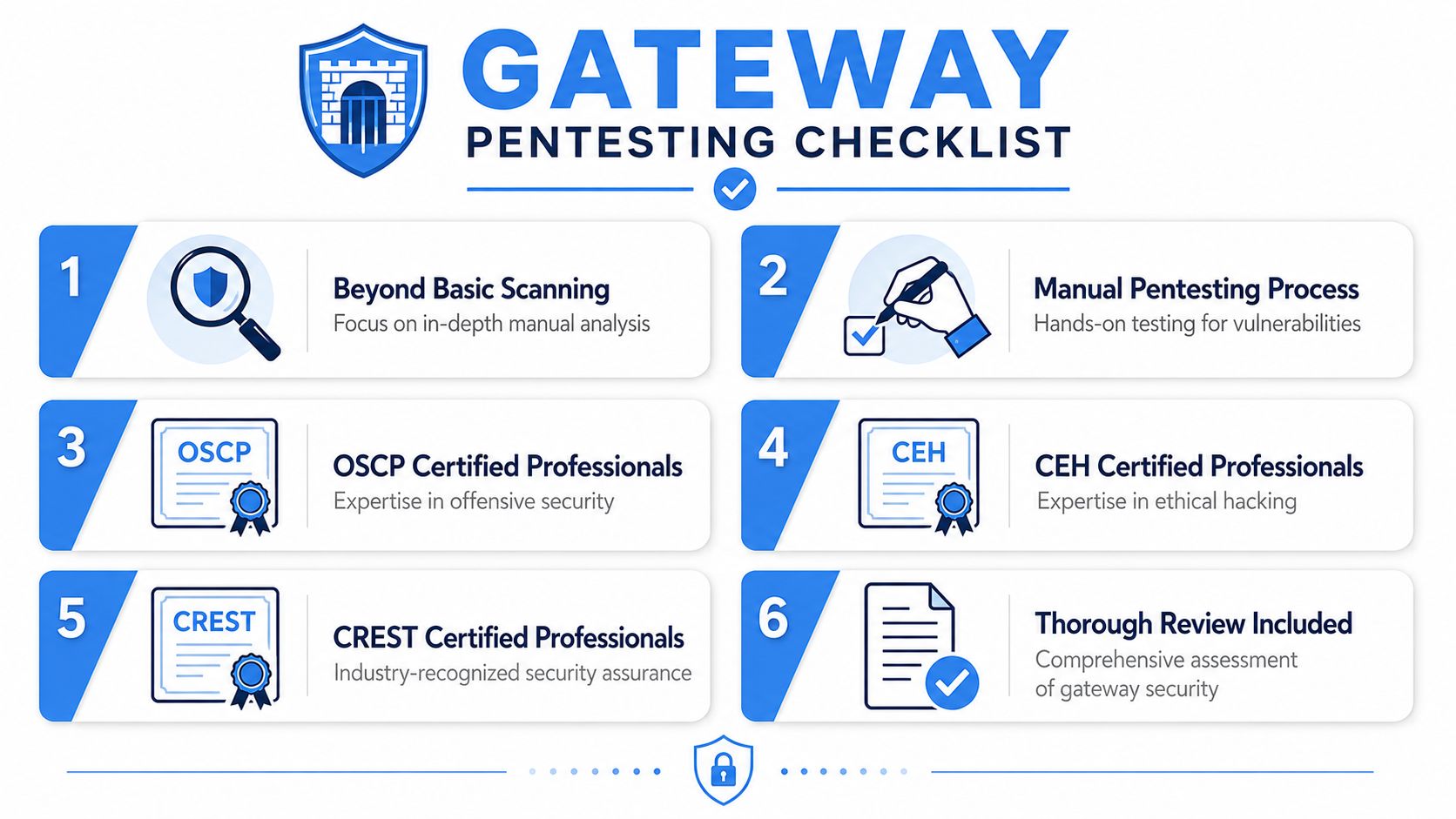
If you're going to offer gateway pentesting, your checklist needs to be stronger than “run a scanner and export the report.” Clients pay for clarity. You need a process that finds real exposure and produces remediation the client can act on.
What to review during a gateway pen test
Use this as a practical starting point:
- Configuration review checks for default settings, weak admin paths, old protocols, exposed services, and risky rule design.
- Authentication testing looks at login controls, MFA flow, session handling, lockout behavior, and trust assumptions.
- Access control validation confirms users, systems, and networks can only reach what they should.
- Vulnerability analysis focuses on outdated firmware, unsupported components, and exposed management interfaces.
- Input validation testing matters for API and application gateways where request handling can break in dangerous ways.
- Logging and monitoring review verifies the client can detect abuse, failure, and suspicious admin activity.
Who should perform the work
Certifications aren't everything, but they do matter when you're selling security services to serious buyers. For gateway assessments, use testers with OSCP, CEH, and CREST backgrounds who can handle both infrastructure and application-layer behavior.
A good penetration testing partner should also produce findings that map cleanly into remediation and compliance evidence. That makes the service easier for an MSP, reseller, or GRC advisor to package.
How to position the offer
Don't sell “a gateway test” as a one-off technical task. Sell it as a scoped risk assessment tied to real business triggers:
- Audit prep before SOC 2, HIPAA, PCI DSS, or ISO 27001 reviews
- Change validation after firewall replacement, VPN rollout, API launch, or cloud migration
- Exposure testing for internet-facing services and remote access paths
- Recurring assurance for clients with regulated or high-trust environments
That framing closes better because it connects the work to a deadline, a control requirement, or a known business event.
Partner with Us for White Labeled Pentesting
The penetration testing market has a pricing and delivery problem. Too many firms are slow, expensive, scanner-heavy, and awkward for partners who want to keep client ownership. That model doesn't work for modern resellers.
A better model is simple. Use a channel-only partner that works behind the scenes, delivers white label pentesting, and never competes with your MSP, vCISO, or GRC relationship.
What MSPs should demand from a partner
Pick a partner that offers:
- Manual pentesting instead of checkbox scanning
- Affordable delivery that still supports healthy margins
- Testers with OSCP, CEH, and CREST certifications
- Fast turnaround so clients can hit compliance and renewal deadlines
- White-labeled reporting that keeps your brand front and center
If that's the direction you're building, our white label penetration testing is worth reviewing before you choose your delivery model.
The slow, bloated competition makes gateway security harder to sell than it should be. Keep it lean, keep it manual, and keep the client relationship under your control.
If you want to offer gateway assessments, perimeter pentests, or fully white-labeled penetration testing without building an in-house team, talk to us about external network pentesting. We work with MSPs, vCISOs, and resellers who want fast, manual, channel-only delivery that helps them close more security and compliance work.

.avif)
.png)
.png)
.png)

