
Your client passes vuln scans all year. Then a SOC 2 review, a customer questionnaire, or a real penetration test uncovers an XML parser issue nobody was watching. Now the app team is confused, the compliance team is nervous, and you have to explain why a basic file upload or API endpoint became a business risk.
That's where XXE keeps catching MSPs, vCISOs, GRC firms, CPAs, and IT resellers off guard. It doesn't look dramatic at first. It often hides behind ordinary features like document uploads, integrations, or legacy XML-based workflows. But once it's exploitable, it can expose files, trigger requests into internal systems, and create audit problems that are expensive to clean up.
The good news is this is a very winnable problem. The risk is real, but the remediation is usually straightforward when a team finds the flaw and validates the parser settings by hand. That makes pentesting, pen testing, and penetration testing around XXE a strong service for any MSP that wants affordable, fast, white-labeled security work without taking on delivery risk alone.
What Exactly Is an XXE XML Attack
A client uploads a document to a cloud app, the workflow completes, and nobody notices that the XML parser just followed attacker-supplied instructions behind the scenes. Weeks later, a pentest finds that the same feature can read server files or send requests into internal services. That is how XXE usually shows up. Subtly, inside normal business functions that looked harmless during routine scanning.
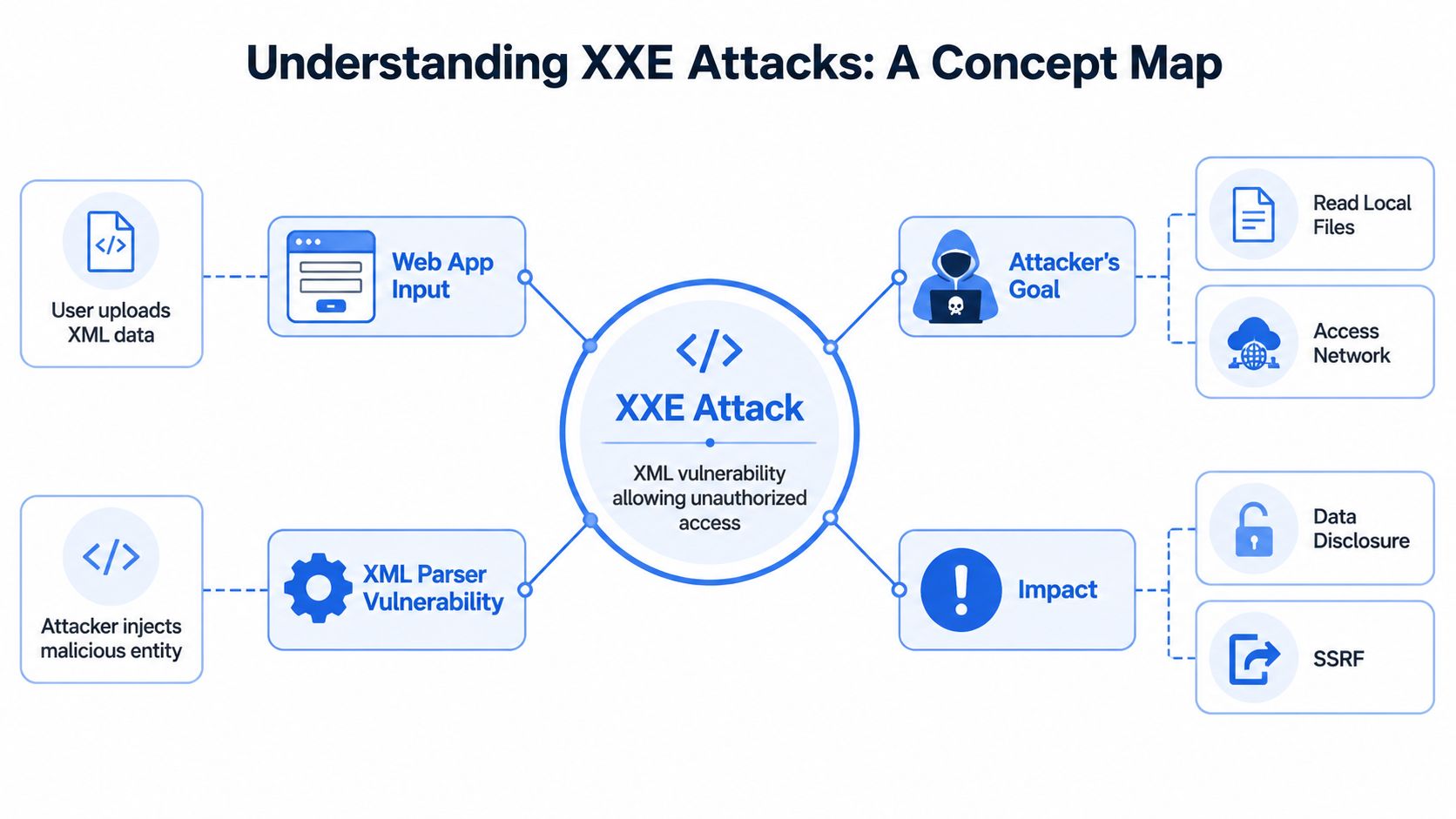
XML External Entity injection, or XXE, happens when an application parses XML from an untrusted source and allows external entities or related features that should have been disabled. In plain terms, the app treats hostile XML as instructions, not just data. The attacker then gets the server to fetch local files, query internal endpoints, or process external resources on their behalf.
How the attack works in practice
XML supports document type definitions and entity references. Those features were built for legitimate parsing tasks, but they also give attackers a way to plant instructions inside submitted XML. If the parser accepts them, the application does the dangerous part itself.
Basic XXE gets attention because it can expose files like configuration data. More dangerous variants are harder to spot and far more relevant for modern client environments. Attackers use blind XXE to trigger out-of-band callbacks, XXE-to-SSRF paths to reach cloud metadata or internal APIs, and parser behaviors that slip past weak WAF rules because the payload sits inside valid XML. That is why automated scanners miss real exposure. A clean scan does not mean the parser is safe.
Practical rule: If an app accepts XML from users, partners, mobile apps, or backend integrations, assume manual validation is required.
Why MSP owners should care
XXE is not just a developer bug. It is a business control failure. One parser setting can turn a routine upload, API call, or integration job into unauthorized data access.
For clients preparing for audits, vendor reviews, or SOC 2 penetration testing services, that creates a problem fast. The app may look polished, the WAF may be in place, and the vulnerability scanner may show very little. A manual tester still finds a path from XML input to sensitive systems, and now your client is asking why nobody caught it earlier.
That is why XXE testing sells well as a white label pentest service. The finding is easy to explain, remediation is often straightforward, and the service creates immediate value for firms building a cyber risk program. For an MSP, this is a profitable offer when delivery sits with a partner who knows how to test the stealthy XXE cases that default tooling skips.
How XXE Attacks Create Business and Compliance Risk
Your client launches a new XML-based upload or partner integration on Friday. By Monday, the same parser is reading local files, touching internal services, or exposing regulated data through a request path nobody expected. The bug looks technical. The fallout is commercial.

An XXE flaw means the application accepts XML that contains instructions the parser should never trust. Once that happens, the server can disclose sensitive files, make requests into internal environments, or expose details that help an attacker move deeper into the client's stack. In business terms, a normal app workflow becomes a path to unauthorized access.
That risk is larger than basic file theft. Modern XXE attacks can stay quiet, blend into valid XML, and abuse backend connections your client already trusts. That is why cloud apps, API-driven workflows, and B2B integrations deserve manual review. A clean scanner report does not reduce the business impact when the parser still accepts dangerous entity processing.
The business version of the exploit
The easiest way to explain XXE to a client is direct. Their application is processing a normal-looking XML request. Hidden inside it are instructions that tell the server to fetch something else, return something sensitive, or contact a system it should never reach.
For an attacker, that can mean configuration files, internal service responses, or credentials exposed through backend requests. For a client, it means preventable exposure tied to a routine feature such as document upload, API ingestion, SSO metadata handling, or supplier data exchange.
That is a serious revenue conversation for an MSP. The finding is easy for decision-makers to grasp, remediation is often clear, and the value of a pentest becomes obvious fast.
Where compliance gets hit
Compliance teams do not care whether the bug sits in an obscure parser option. They care that protected data, internal systems, or security controls were reachable through the application.
XXE commonly creates pressure in three areas:
- Control weakness: Auditors and assessors will question secure configuration, application security testing, and change control when XML input can trigger unauthorized file access or backend requests.
- Expanded review scope: One vulnerable parser in an upload form or API endpoint can pull more systems into scope, especially if the app can reach storage, metadata services, or internal APIs.
- Weak audit evidence: A client that only shows automated scan output looks unprepared if a manual test later proves the application could expose sensitive data anyway.
That problem shows up fast for healthcare, fintech, ecommerce, and SaaS clients answering security questionnaires or preparing for SOC 2 penetration testing requirements. Assessors want evidence that someone tested real attack paths, not just whether a scanner ran on schedule.
If you help clients with governance and audit readiness, TekRecruiter's article on building a cyber risk program gives useful context for placing application-layer flaws inside ongoing risk management instead of treating them as one-off technical issues.
A good penetration test turns XXE from an abstract parser flaw into a concrete business finding. It shows what data was reachable, what systems were exposed, how likely detection was, and what the client needs to fix first.
Auditors rarely care that a parser setting was obscure. They care that the weakness existed, was reachable, and could affect protected data.
Finding Hidden XXE Flaws with Manual Pentesting
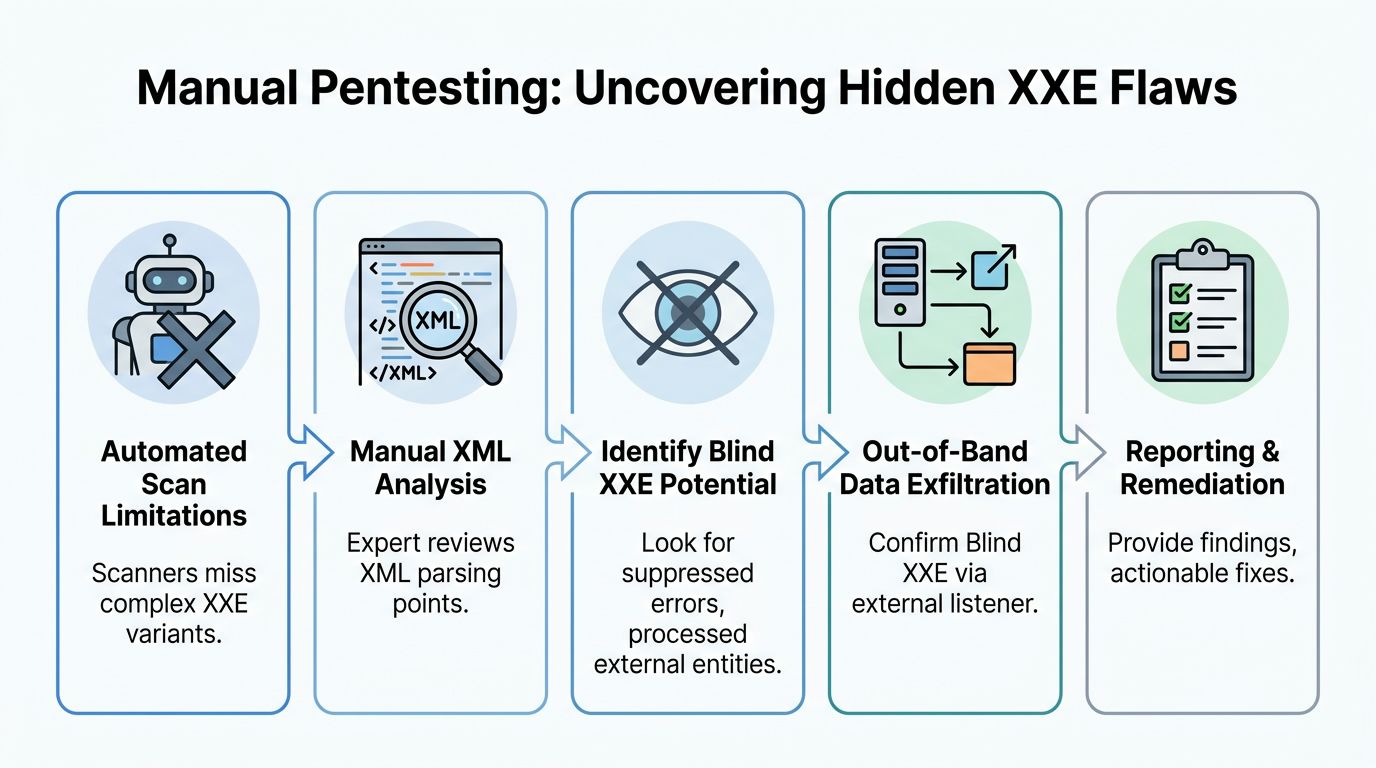
Most XXE content stops at basic file retrieval. That's old thinking. The modern problem is blind XXE, where the attacker doesn't need the application to print the stolen data back in the response.
In these cases, the application stealthily sends data or requests outward through an out-of-band channel. That's why automated tools miss it. They're waiting for visible proof in the response, while the app is leaking data elsewhere.
Why scanners and WAFs miss it
A lot of teams assume the WAF or automated scanning stack will catch XML parser abuse. That assumption breaks down fast with blind XXE.
As Invicti's out-of-band XXE write-up notes, 65% of blind XXE exploits used OOB channels to bypass WAFs that only filter in-band traffic. That matters for cloud apps, APIs, and hybrid environments where the dangerous behavior happens behind the front door.
A WAF sees the front-end request. It does not always see the parser making a secondary request or discreetly resolving an external entity somewhere else.
What manual pentesting does better
Manual pentesting demonstrates its worth. A good tester doesn't just throw payloads at endpoints and wait for obvious errors. They map where XML is processed, test edge cases, and watch for indirect behavior.
Manual pen testing is especially useful when the XML entry point is disguised as something routine, such as:
- File processing paths: SVG, office documents, media metadata, and import functions.
- Legacy APIs: SOAP services and older integrations that still parse XML under the hood.
- Backend workflows: Converters, validators, and middleware services that never show raw parser output to the user.
If you work with clients doing cloud migrations or tenant changes, Ollo has a useful perspective on Secure Microsoft 365 migrations. The practical takeaway is broader than migrations alone. Any infrastructure change can expose hidden trust assumptions, and XML handling often slips through because everyone is focused on identity, mail flow, or endpoint security.
Why certifications matter here
For XXE, you want humans who know how attackers think. OSCP, CEH, and CREST certified testers are useful because they've been trained to validate exploit paths, not just produce scanner screenshots.
That matters when you're selling a penetration testing service to clients under compliance pressure. A scanner-only approach may generate noise. A skilled tester working through a web application penetration testing process can identify whether the issue is theoretical, reachable, blind, and business-relevant.
The dangerous XXE findings are usually the quiet ones. If a test only looks for data in the server response, it can miss the attack entirely.
For an MSP, that creates a profitable opening. You can offer higher-value pentests that clients already need for compliance and security reviews, while keeping delivery risk low by using a trusted white label partner with manual methodology.
Secure Configurations to Prevent XXE Vulnerabilities
The cleanest fix is usually not complicated. Disable dangerous XML behavior, reject risky input, and stop treating parser defaults like a security strategy.
According to Bright Security's XXE overview, over 90% of XXE vulnerabilities can be prevented by using and properly configuring a secure XML parser while ensuring input validation. The same source also notes a documented XXE issue in WordPress versions 5.6.0 to 5.7.0, patched in 5.7.1, showing how file upload functionality can expose XML parsing weaknesses.

The parser settings that matter
PortSwigger's remediation guidance is direct. The most effective prevention approach is to disable external entity resolution and XInclude support in the parser configuration.
For common languages, the hardening examples are clear:
PlatformSecure actionJavaSet XMLConstants.FEATURE_SECURE_PROCESSING to truePHPUse libxml_disable_entity_loader(true) for older behavior noted in the source, with the default changing in PHP 8.0Python lxmlSet resolve_entities=False
Those aren't optional nice-to-haves. They're baseline hardening steps.
Better architecture beats cleanup
If the client doesn't need XML, stop using it. Bright's guidance makes the strategic point plainly: switching to JSON eliminates this vulnerability class because JSON has no equivalent to DTD or entity expansion features.
Here's the advice I give clients during a risk assessment:
- Disable what you don't use: If DTDs and external entities aren't a business requirement, block them.
- Constrain parser behavior: Don't rely on library defaults to stay safe forever.
- Reduce file access: Even if parsing fails, limited filesystem permissions shrink the blast radius.
- Simplify data formats: If JSON works, move to JSON.
That last point is often the cheapest fix in the long run.
Reporting XXE for Remediation and Client Trust
A bad report makes a good pentest feel useless. If the write-up only says “XXE found,” the client's dev team still has to guess what was exposed, how it was reached, and what to change.
Good reporting does three jobs at once. It explains the business impact in plain English, shows enough technical proof to support remediation, and gives developers precise fixes they can apply without a scavenger hunt.
What the report should include
For XXE, the report should spell out:
- Attack path: Where the XML was accepted and how the parser processed it.
- Business impact: What the attacker could access or trigger.
- Remediation guidance: Which parser settings, input handling, or architectural changes should be made.
- Retest criteria: What needs to be validated after the fix.
That's where white label penetration testing becomes useful for MSPs and vCISO firms. You need reports your team can hand to a client without rewriting everything. A practical penetration testing report template helps set the right expectation for clarity and format.
Why default-safe thinking keeps failing
One of the biggest mistakes in XXE remediation is trusting “secure by default” claims. As Contrast Security's XXE parser analysis points out, the assumption that modern parser defaults are sufficient protection is flawed, leading to a 40%+ recurrence rate of XXE in patched systems.
That's a serious issue for any MSP, GRC advisor, or vCISO serving clients who assume a library upgrade closed the problem. It may have reduced risk, but unless somebody validates the parser behavior manually, the weakness can come back in an edge case, a framework change, or a new code path.
A report should help the client fix the issue once. It shouldn't create a second project just to interpret the findings.
Partner with Us for White Label Pentesting
Your clients already need penetration testing for security reviews, customer trust, and frameworks like SOC 2, HIPAA, PCI DSS, and ISO 27001. If you don't offer a strong option, they'll buy it somewhere else.
The channel has a pricing and delivery problem. Too many firms charge inflated rates, rely on weak methodology, and take too long to deliver. The better model is affordable, fast, manual pentesting performed by OSCP, CEH, and CREST certified pentesters, delivered as a true white label service for MSPs, vCISOs, GRC providers, CPAs, and other resellers.
We're channel-only. We never compete with our partners. You keep the client relationship, your brand stays front and center, and you get dependable pentests, pen tests, and penetration tests without building an internal offensive security team from scratch.
If you want a fast, affordable, fully manual, white-labeled way to offer pentesting to your clients, learn how we deliver pentests that carry your logo.
.png)
.avif)
.png)
.png)
.png)

