
A client asks a simple question during a sales call: "Is our encryption set up right for SOC 2?"
If your answer gets fuzzy, you lose ground fast. Clients hear hesitation and assume you're guessing. That hurts trust, weakens your risk assessment, and makes it harder to sell the right penetration testing service.
You don't need to be a cryptographer. You do need to understand the different types of ciphers well enough to spot weak setups, explain business risk clearly, and know when a scan isn't enough. For MSPs, vCISOs, GRC firms, and resellers, that knowledge turns into better advisory work, cleaner compliance conversations, and more profitable security offerings.
If you're building a stronger security practice, this broader guide to cybersecurity for MSPs helps frame where encryption fits in the bigger picture.
Why MSPs Must Understand Encryption Basics
Encryption comes up everywhere. SOC 2, HIPAA, PCI DSS, and ISO 27001 all push clients to protect sensitive data, but most buyers don't ask for a lecture on cryptography. They ask whether their systems are safe, whether they'll pass an audit, and whether they're overspending.
That's why MSPs need the plain-English version. A cipher is just a method for scrambling data so unauthorized people can't read it. The business problem starts when teams use the wrong method, keep old methods alive too long, or bolt "custom encryption" into an app and assume that counts as security.
Why this matters in real client work
A vulnerability scan can tell you a service is exposed. It usually won't tell you whether encryption is poorly implemented, whether keys are mishandled, or whether a developer made choices that create a real attack path.
That gap matters during:
- Compliance prep: Auditors care that encryption controls are appropriate, current, and consistently applied.
- Client proposals: When you explain cipher risk clearly, you sound like an advisor, not a box-checker.
- White label pentesting sales: You can position a pen test or penetration test as validation of real controls, not just another report.
Practical rule: If a client says "we built our own encryption," treat that as a finding until proven otherwise.
Where MSPs make money with this knowledge
Clients don't buy "cipher education." They buy confidence. They want someone who can tell them whether their portal, mobile app, VPN, cloud workload, or legacy device is using modern protection or outdated junk.
That creates an easy sales path for affordable manual pentesting and penetration testing:
| Client concern | What you should say |
|---|---|
| "Our vendor says data is encrypted" | Ask what cipher is used, how keys are stored, and where encryption starts and ends |
| "We passed a scan" | Explain that scanners don't validate every crypto implementation or business logic issue |
| "We only need this for compliance" | Remind them bad encryption can still fail a real-world attack even if paperwork looks fine |
MSPs that understand encryption basics sell better because they can connect technical risk to operational risk. That's what buyers remember.
The Old School Classical Ciphers
Classical ciphers are the crypto version of a decoder ring. They're old, simple, and useful for learning how encryption works. They're also a good reminder that "encrypted" does not automatically mean "secure."

The two big categories are substitution and transposition. Substitution ciphers swap one letter for another. The Caesar cipher is the classic example, where letters shift by a fixed number of positions. Transposition ciphers keep the same letters but rearrange their order.
According to the American Cryptogram Association, classical ciphers include over 40 standardized pen-and-paper variants, and examples range from Playfair and Baconian to BAZERIES, Digrafid, and Grille formats with specific length constraints for solvability in puzzles and historical analysis, as documented in the ACA's cipher type reference.
Why these old ciphers still matter
You won't see a serious modern SaaS app intentionally using a Caesar cipher. But you will find systems that repeat the same bad idea in a new wrapper. A developer shifts characters, swaps values, or builds a "lightweight" obfuscation routine and calls it encryption.
That's not a quirky coding choice. It's an attack surface.
Classical ciphers have been breakable for centuries, and classical-inspired routines still show up in IoT firmware and legacy MSP networks. If you support old appliances, embedded systems, industrial gear, or inherited line-of-business apps, you should assume this risk exists until a real pen test proves otherwise.
What to watch for in client environments
These issues show up in ugly places:
- Legacy IoT firmware: Vendors hide credentials or config data with home-brewed encoding
- Old internal apps: Teams reuse outdated routines because "it still works"
- Export tools and backups: Sensitive files get "scrambled" instead of encrypted with modern standards
Weak custom crypto is usually worse than no crypto, because it gives teams false confidence.
A manual pentest matters here because the tester has to inspect behavior, review data handling, and validate whether the implementation is actual encryption or just disguise. Automated tools often miss that difference.
Symmetric Ciphers The Workhorses of Encryption
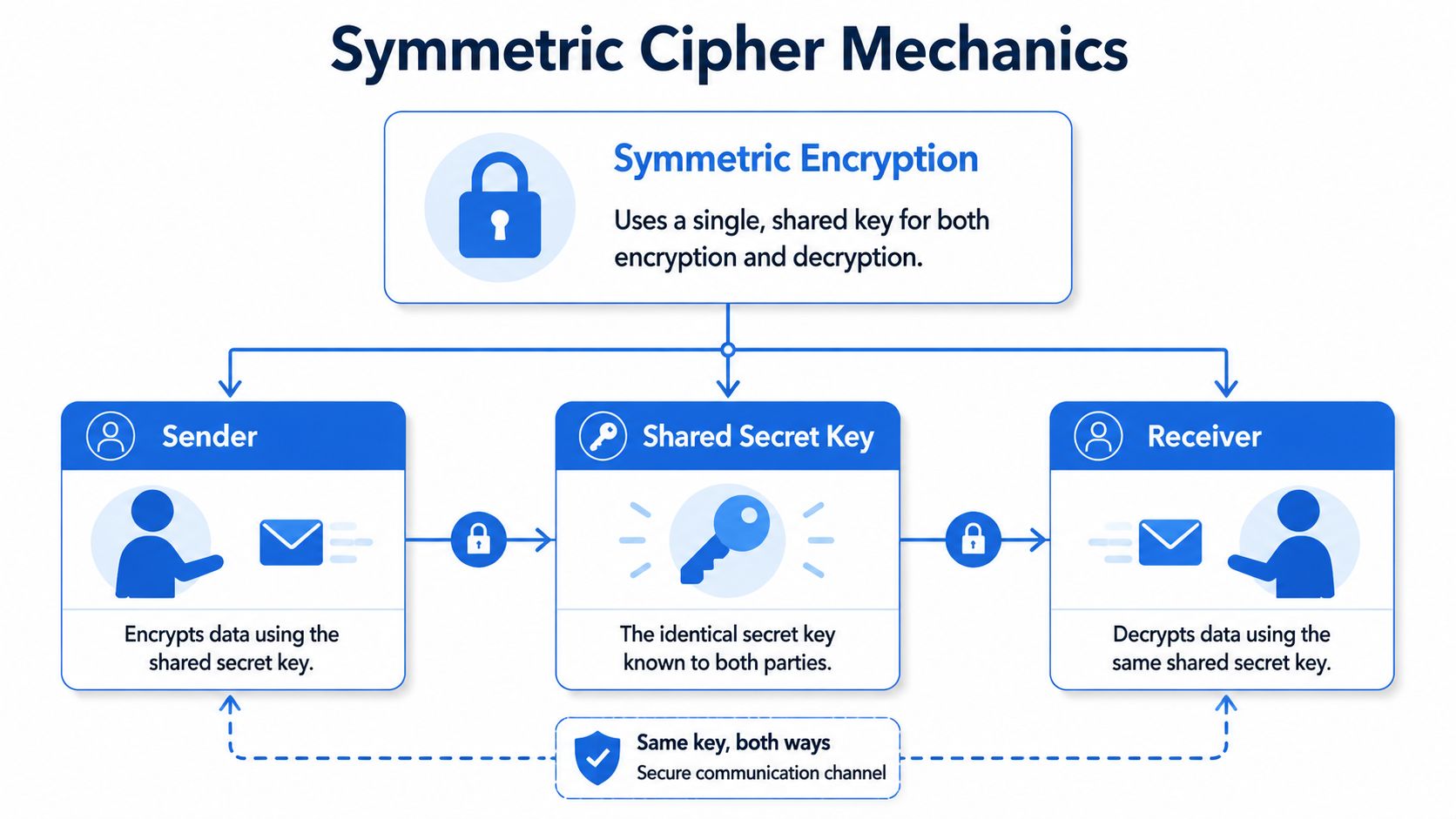
If classical ciphers are history class, symmetric ciphers are the systems doing the actual work today. They use one shared secret key to encrypt and decrypt data. Same key going in. Same key coming out.
That model is fast, practical, and everywhere. The broad modern split between cipher families is outlined in this cipher overview, which separates symmetric and asymmetric cryptography and explains why symmetric methods dominate bulk data protection.
Block ciphers and stream ciphers
There are two main flavors MSPs need to understand.
Block ciphers process data in fixed-size chunks. Think of the message as a stack of locked boxes, all the same size. AES is the big one here. It encrypts 128-bit blocks and supports 128, 192, and 256-bit keys. In plain terms, AES is the baseline for serious modern encryption.
Stream ciphers work on a continuous flow of data. Think of feeding information through an encrypting tape machine, bit by bit, instead of loading fixed boxes. This can be a better fit for real-time traffic or constrained devices.
Why AES is the baseline
For MSPs, the recommendation is simple. If a client asks what "good encryption" looks like in a modern environment, AES should be part of the answer for data at rest and many data-in-transit use cases.
The same cipher overview notes that AES replaced DES after DES became obsolete. DES was standardized in 1977 with a 56-bit key, and the 1999 RSA contest broke it in 56 hours using 100,000 machines. That's why nobody serious should still tolerate DES remnants in production.
Here's the business takeaway:
- SOC 2 and ISO 27001 conversations: AES is the safe default reference point
- HIPAA risk assessment work: You want current, recognized encryption, not improvised controls
- PCI DSS scoping: Payment environments should not rely on obsolete cipher support anywhere in the stack
Stream ciphers and mobile performance
Stream ciphers matter because not every environment behaves the same. Mobile apps and lower-power systems often benefit from ciphers tuned for speed and efficiency.
The clearest example is ChaCha20. According to this stream cipher breakdown, ChaCha20, used in TLS 1.3, processes data at 4-7 cycles per byte versus AES-GCM's 10+ on mobile devices. That matters when your client has an iOS or Android app and cares about battery life, responsiveness, and secure sessions at scale.
There's a flip side. RC4 is the old warning label. The same source notes RC4 had biases that allowed attackers to recover information in seconds. If your penetration testing team finds RC4 anywhere, the recommendation shouldn't be nuanced. Remove it.
What MSPs should recommend
Use this simple decision frame with clients:
| Scenario | Better recommendation |
|---|---|
| Data at rest in servers and databases | AES |
| Modern web and app sessions | Current TLS with modern cipher support |
| Mobile-heavy app environments | ChaCha20 in appropriate modern implementations |
| Legacy systems with RC4 or DES | Replace or isolate fast, then schedule a pen test |
Don't argue for "good enough" crypto. Crypto ages badly. What was acceptable years ago becomes a liability quietly, then all at once.
If you're selling white label pentesting, this is a strong value point. You're not just checking if encryption exists. You're verifying whether it's modern, appropriate, and implemented correctly.
Asymmetric Ciphers The Key to Secure Exchange
Symmetric encryption has one annoying problem. Both sides need the same secret key. So how do they share that key safely in the first place?
That's where asymmetric ciphers come in. They use two keys. A public key is meant to be shared. A private key stays secret. The mailbox analogy works well here. Anyone can drop a message into a locked mailbox slot, but only the person with the private key can open the box.

If you want a deeper primer for client conversations, this plain-language guide to public key and private key encryption is a useful resource.
Why asymmetric crypto exists
Asymmetric crypto is slower than symmetric crypto. That's the tradeoff. You don't use it to encrypt everything all the time. You use it to start trust safely, exchange secrets, validate identity, and support secure sessions.
That's why website security works the way it does. A secure connection typically uses asymmetric cryptography to establish trust and exchange a session key, then switches to faster symmetric encryption for the rest of the traffic.
For MSPs, that matters in:
- Web application pentesting
- External network penetration testing
- PCI DSS reviews for payment-related traffic
- Certificate and key lifecycle audits
RSA still matters
The landmark example is RSA, created in 1977. It needs much longer keys than symmetric systems to deliver equivalent protection. The key point for client advisory work is simple: key length and age matter, and old standards stick around longer than they should.
According to the cipher overview linked earlier, a 1024-bit RSA key was cracked in 2010, and 2048-bit or higher is now the standard for 99.9% of SOC 2 compliant systems. That's not a trivia fact. It's a practical screening rule during a risk assessment.
What bad asymmetric setups look like
You'll see the same repeat offenders:
- Old certificates with weak key sizes
- Private keys stored carelessly on servers or in repos
- Broken trust chains that users click past
- Hybrid environments where modern TLS fronts an outdated internal system
The goal isn't to memorize crypto theory. The goal is to recognize when a client is using secure exchange correctly and when they're faking it with old defaults.
A proper penetration test checks the full story. Not just whether HTTPS exists, but whether certificates, key lengths, cipher negotiation, and fallback behavior all hold up under pressure.
How We Find Weak Ciphers During a Pen Test
Pentesting earns its keep in this capacity. Anyone can run a scanner and export a list. That doesn't prove encryption is strong, current, or implemented safely.
A real pen test, penetration test, or penetration testing engagement looks at how crypto behaves in the application, on the network, and in the surrounding controls. That means manual validation by people who know what weak cipher use looks like in the wild.

If you want the process view, this guide to methodology for penetration testing gives a useful framework for how mature engagements are scoped and executed.
What testers actually check
Strong pentesters don't stop at "encryption enabled." They test the implementation and the surrounding hygiene.
A typical workflow includes:
- Protocol review: Check for obsolete TLS support, downgrade paths, and weak cipher suite acceptance
- Certificate inspection: Validate key sizes, trust chains, expiration handling, and mismatches
- Application behavior testing: Look for hardcoded keys, predictable secrets, unsafe storage, and weak custom routines
- Traffic analysis: Inspect whether encryption leaks useful patterns or mishandles session setup
- Cloud and mobile review: Validate how apps handle keys, tokens, local storage, and transport encryption
The manual work scanners miss
Scanners are fine for speed. They're bad at nuance.
For example, a scanner might confirm that a web app uses HTTPS. A manual tester might discover the mobile app stores keys insecurely, the API still accepts weak fallback behavior, or the server negotiates settings that fail under a downgrade scenario. That changes the finding from "looks compliant" to "exploitable."
Here's how I'd explain the difference to a client:
| Scanner result | Manual pentest question |
|---|---|
| TLS present | Is it configured safely across all endpoints and fallback paths? |
| Encryption claim in documentation | Is the real implementation using modern ciphers and sane key handling? |
| No obvious issue in automated output | Can an attacker still recover secrets through logic flaws, reuse, or exposure? |
Field advice: If the report never discusses key management, fallback behavior, or implementation details, it probably wasn't much of a penetration test.
Why key management matters more than teams think
Even strong ciphers fail when teams handle keys badly. A client can deploy modern encryption and still lose because of hardcoded secrets, reused material, weak rotation, or sloppy storage.
The cipher overview cited earlier notes that 60% of breaches came from poor key management in 2024. That's exactly why crypto findings belong in a serious risk assessment and not just a checkbox spreadsheet.
Quantum readiness is no longer optional
Most firms still treat post-quantum risk like a future problem. That's lazy. Good advisors start inventorying where clients rely on long-lived encryption today, especially in cloud and regulated environments.
A future-facing view of this shift is covered in this post-quantum cipher discussion. It matters because many firms still aren't testing what's coming next.
For MSPs, vCISOs, and GRC partners, the practical move is straightforward:
- Identify where clients rely on long-term confidentiality
- Map where RSA and other current approaches are embedded
- Flag cloud misconfigurations and nonce or key handling issues early
- Build quantum-readiness checks into ongoing compliance reviews
That's not hype. It's good advisory work.
Partner With Us for Affordable Pentesting
Knowing the different types of ciphers helps you ask better questions. The next move is turning that into a service your clients will buy.
A lot of MSPs, vCISOs, and GRC firms lose penetration testing deals for stupid reasons. The quote is too high. The scope is bloated. The turnaround drags. The tester hides behind automation and drops a report full of filler. Clients hate that, and you end up defending a service that doesn't feel worth the cost.
Why the channel model matters
If you're a reseller or compliance advisor, you need a partner that won't compete with you. That's the whole point of a channel-only model.
The right white label pentesting partner should give you:
- Affordable delivery: Easier to attach to SOC 2, HIPAA, PCI DSS, and ISO 27001 engagements
- Manual pentesting: Better findings than scan-only shops
- Fast turnaround: So deals don't stall in procurement or audit windows
- White-labeled reporting: So you stay in front of the client
That matters outside pure security verticals too. If you support accountants, for example, this article on addressing IT challenges for busy accounting firms is a good reminder that regulated clients care about practical risk reduction, not buzzwords.
What this does for your margins
You don't need to build a full internal offensive security team to sell penetration testing well. You need a reliable way to deliver it under your brand, tie it to compliance, and explain why the findings matter.
That improves profitability because you can:
- Attach pentesting to broader risk assessment work
- Support audit readiness without hiring a large specialist bench
- Keep clients from shopping competitors for security validation
- Offer a cleaner path from assessment to remediation planning
Buyers don't want a giant crypto lecture. They want a straight answer, a credible test, and a report they can use.
If your clients keep asking about encryption, secure apps, PCI DSS, SOC 2, or cloud risk, that's your opening. Don't hand those opportunities to another firm.
If you want a channel-only partner for affordable, manual, white label pentesting, talk to us about pentests delivered under your logo. Our OSCP, CEH, and CREST-certified pentesters help MSPs, vCISOs, GRC firms, CPAs, and resellers deliver fast, credible penetration testing without competing for the client relationship. Contact us today to learn more.
%20(1).png)
.avif)
.png)
.png)
.png)

