
The insider threat that hurts your business most often starts with a valid account, not a malware alert. For MSPs, vCISOs, and GRC firms, that means the risk is tied directly to client trust, contract value, and service credibility.
Insider incidents are difficult to detect and difficult to stop early. DTEX's 2025 Insider Risk Investigations Report found that organizations continue to struggle with visibility into insider behavior, especially when normal admin access, contractor activity, and approved tools can hide misuse in plain sight.
That problem gets worse in the channel. You are not protecting one environment. You are protecting many client environments, shared admin workflows, privileged tooling, and sensitive service data. If one employee, contractor, or partner mishandles access, copies reports, or abuses a trusted account, the impact can spread across multiple customers at once. That creates churn risk, audit pressure, and expensive cleanup work.
The exposure is even higher if your team handles penetration testing scopes, findings, screenshots, credentials, evidence, or remediation plans. Those assets can reveal weaknesses across client systems and expose exactly where to attack next. If your client delivery model includes domain administration or identity reviews, regular Active Directory security audits for client environments should be part of how you reduce that risk.
The eight indicators below matter because they show where insider activity starts, how it spreads, and what will cost your firm money if you miss it.
Unusual Access Patterns And Privilege Escalation

The first sign is often simple. Someone starts touching systems they don't normally use, at times they don't normally work, with permissions they don't normally need.
In a client environment, that can look like a technician logging into backup infrastructure after hours, a project engineer accessing a report repository unrelated to their accounts, or a contractor probing administrative shares across several tenants. In a pentest workflow, it can look like a team member opening findings from clients they weren't assigned to.
What To Watch In Access Logs
Track role-based baselines first. Good insider threat indicators are tied to context, not just raw activity. Public guidance on insider indicators warns that many signals are weak on their own unless they are correlated with role context, sensitive data, and changes over time, as explained in the CDSE insider threat indicators job aid.
Focus on these patterns:
- After-hours access: Logins that fall outside the user's normal shift or project schedule.
- Scope drift: Access to systems, clients, or folders outside assigned job duties.
- Permission jumps: Sudden elevation into local admin, domain admin, root, or service account access.
- Failed authentication spikes: Repeated attempts against systems the user doesn't usually touch.
Practical rule: Don't alert on odd logins alone. Alert when odd logins line up with sensitive assets, privilege changes, or a shift in normal behavior.
MSPs should also map access to active statements of work. If someone is touching a client environment with no current ticket, project assignment, or approved maintenance window, treat it as high priority. That one step removes a lot of noise.
If you're tightening visibility in Windows-heavy environments, a structured Active Directory audit process gives you a better starting point than guessing from raw event logs.
Data Exfiltration And Unusual File Transfers
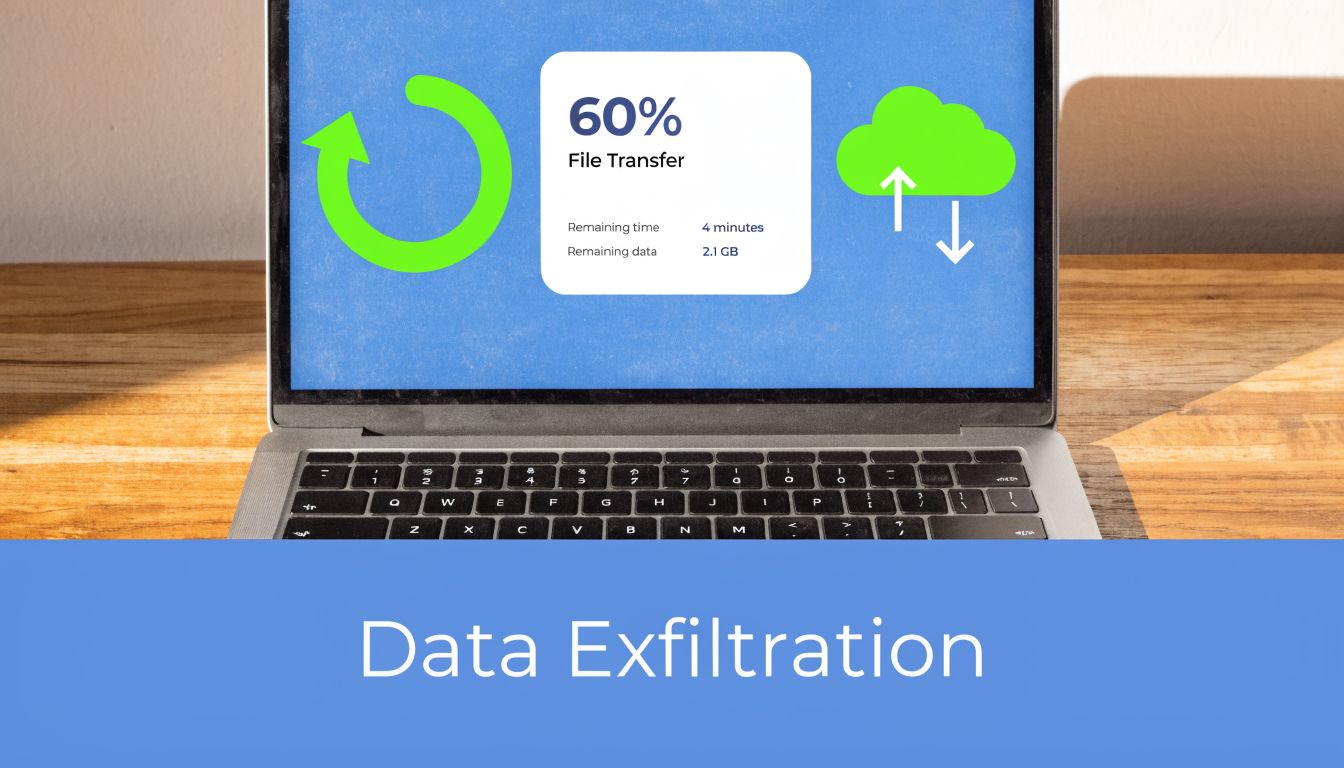
Most insiders don't begin with destruction. They begin with collection.
That makes file movement one of the clearest insider threat indicators to monitor. In channel businesses, the high-value targets aren't just customer PII or finance records. They're also penetration test reports, network diagrams, credentials, screenshots, architecture notes, remediation plans, compliance evidence, and proposal templates.
High Risk Data Movement Patterns
One common scenario is a departing employee syncing client folders to personal cloud storage before offboarding. Another is a consultant emailing vulnerability findings to a personal inbox so they can "work later." Both are bad. Both happen.
Watch for these transfer patterns:
- Mass downloads: Large pulls from SharePoint, report portals, file servers, or ticket attachments.
- Personal storage use: Uploads to consumer cloud apps that aren't approved by policy.
- USB copy activity: Sensitive files moved to removable media.
- Outbound email attachments: Reports, spreadsheets, or exports containing client data, credentials, or findings.
The market's shift toward integrated platforms matters here because detection gets stronger when data movement, identity, and behavior signals sit in one place. Mordor Intelligence estimates the insider threat management market at USD 3.03 billion in 2025, projected to reach USD 6.32 billion by 2030 at a 15.80% CAGR, and reports that cloud deployment held 71.7% of market share in 2024 according to Mordor Intelligence market analysis. For MSPs, that supports one practical decision. Stop relying on disconnected point tools when client data is spread across cloud platforms.
Encrypt report storage. Block personal sync tools. Monitor outbound attachments. Add watermarking to sensitive documents where possible. If you offer white label pentesting, classify reports and evidence as high-sensitivity data by default.
Behavioral Red Flags And Personnel Changes

Some of the best warning signs show up before the technical abuse starts. Financial pressure, personal crises, and visible changes in behavior can create the earliest detection window.
According to the 2025 Insider Threat Matrix research, organizations using behavioral risk analytics focused on the Motive theme achieved 65% effectiveness in pre-empting data breaches through early detection of preparation-phase indicators, and the same research says financial distress stands out as the most significant driver of insider risk. It also notes that 74% of global housing markets experienced price increases in 2024, increasing employee financial pressure, according to the 2025 Insider Threat Matrix behavioral analytics research.
Human Changes That Deserve Attention
This doesn't mean profiling people or punishing employees for hard times. It means paying attention when human stress lines up with access to sensitive systems.
Examples include a staff member facing debt issues who suddenly asks unusual questions about billing systems, a contractor nearing the end of an engagement who starts pulling client contact lists, or a frustrated employee requesting proposal templates, pricing sheets, or pentesting methodologies that don't match their role.
The DISA Cyber Awareness Challenge 2025 report, referenced in that same insider risk research, highlights difficult life circumstances such as divorce, death of a spouse, substance misuse, untreated mental health issues, and financial difficulties as important indicators.
The right response isn't surveillance first. It's support, tighter access review, and better coordination between HR and security.
Train managers to document objective changes, not gossip. Use structured offboarding. Review access before disciplinary action or termination. If your risk assessment process ignores people factors, you're missing one of the earliest chances to stop a breach.
Unauthorized System Changes And Hidden Persistence

Insiders with technical access don't always steal data right away. Sometimes they plant access so they can come back later.
That can mean creating a hidden admin account, disabling logs, changing endpoint policies, dropping a remote access tool, or adding an API key nobody approved. In an MSP setting, a bad actor may only need one quiet change in an RMM policy, firewall rule, or identity provider setting to create lasting risk across clients.
Changes You Should Treat As Urgent
A legitimate change should leave a trail. If there's no ticket, no approval, and no maintenance record, assume the change is unauthorized until proven otherwise.
Prioritize alerts for:
- New privileged accounts: Local admins, cloud admins, emergency accounts, or service principals.
- Logging suppression: Audit settings disabled, retention reduced, or forwarders changed.
- Remote access installs: New remote tools, web shells, packet sniffers, or unauthorized agents.
- Config drift on critical systems: Firewall rules, EDR exclusions, IAM policy changes, and backup settings.
A strong internal penetration testing process helps validate whether those controls catch persistence, privilege abuse, and unsafe configuration drift before an insider does.
Use Tripwire, AIDE, Auditbeat, native cloud change logs, and immutable logging where possible. Change control only works if someone checks that reality still matches the approved state.
Credential Misuse And Authentication Abuse
Credential misuse is the insider threat that hurts channel firms fastest. One reused admin password, one stale token, or one undocumented service account can give a staff member or contractor quiet access to client systems long after they should be locked out. For MSPs, vCISOs, and GRC firms, that is not a technical nuisance. It is a direct threat to client trust, pentest confidentiality, and recurring revenue.
The risk gets worse in multi-tenant environments. A single identity can touch RMM tools, cloud consoles, ticketing systems, documentation portals, and vaults that hold sensitive findings. If you manage pentest evidence, exploit paths, screenshots, or remediation notes for clients, weak authentication controls turn that data into an easy target.
Authentication Problems That Signal Insider Risk
Shared admin accounts still exist because they feel convenient. They also destroy accountability. If three engineers use the same privileged login, you cannot prove who accessed a client tenant, pulled a report, or changed a policy.
Watch for these indicators first:
- Shared credentials: The same privileged account is used by multiple staff, shifts, or contractors.
- Dormant account activity: An inactive account suddenly authenticates to sensitive systems, portals, or client environments.
- MFA removal or bypass: A privileged user loses MFA, switches to weaker factors, or starts authenticating through exception paths.
- Cross-client misuse: One identity accesses multiple client environments outside assigned scope or approved work.
- Service account abuse: Non-human accounts log in interactively, access data stores, or authenticate outside expected hours and hosts.
- Token and session anomalies: Refresh tokens persist too long, old sessions stay valid after role changes, or impossible travel appears across admin logins.
Fix the root problem. Put every privileged user on phishing-resistant MFA. Remove shared logins. Rotate service account secrets on a schedule you can prove. Require just-in-time access for admin tasks, and tie that access to tickets, approvals, and session logs. Store secrets in a vault, not in chat threads, spreadsheets, or PSA notes.
Network telemetry helps catch misuse that identity logs miss. Suricata intrusion detection for managed environments can help flag odd authentication traffic, lateral movement attempts, and connections from systems that should never be handling admin sessions.
This also applies to off-platform communication. If an employee starts masking contact methods while requesting resets, forwarding codes, or routing calls through alternate numbers, treat it as an investigation lead. Teams already investigating Google Voice anonymity understand how alternate calling paths can complicate attribution and incident review.
A good manual pentest should test this directly. Ask your partner to validate stale accounts, inherited admin rights, weak MFA recovery flows, exposed API keys, and service account sprawl across client tenants. That gives MSPs and vCISOs a simple path to reduce insider risk before it turns into a breach they have to explain to every client on Monday morning.
Communication Patterns And Suspicious Interactions
Technical logs matter, but intent often leaks out in conversations first. That makes communication changes one of the more useful insider threat indicators when handled carefully.
You don't need to read every message to find risk. Focus on channels where sensitive information moves, and on changes in communication behavior that line up with access anomalies. That could be an employee suddenly forwarding client architecture notes to an external address, discussing job offers while requesting broad file access, or using side channels to move remediation documents outside approved tools.
Monitor The Movement Of Sensitive Information
Modern insider detection has to account for cloud apps, distributed work, and identity sprawl. Current guidance stresses unusual access patterns, new devices and IPs, long-term behavior profiling, and correlation across UEBA, SIEM, and contextual data in hybrid environments, as covered in Progress guidance on modern insider threat detection.
That matters for channel firms because your teams often work across email, Teams, Slack, ticketing systems, documentation portals, and file-sharing platforms all day.
Strong controls here include:
- Keyword and pattern matching: Flag outbound messages that include client names, credential formats, or vulnerability details.
- External contact review: Watch for sudden communication with unknown third parties around sensitive projects.
- Exit-stage monitoring: Review outbound communication activity during resignations, layoffs, or contract end periods.
- Privacy-aware scoping: Monitor risky data flows, not general employee chatter.
If you need better network visibility for lateral traffic and suspicious communications, Suricata intrusion detection system guidance is a solid technical complement. For nontraditional channels and alternate identities, even issues like investigating Google Voice anonymity can matter when teams are tracing suspicious contact patterns.
Asset Inventory Gaps And Resource Anomalies
Not every insider event starts with a login. Sometimes it starts with a laptop that never comes back, a rogue wireless access point, or printed material that disappears after an employee exits.
This category gets ignored because it feels operational, not security-driven. That's a mistake. In managed services and reseller environments, physical and logical assets overlap. A missing device may contain pentest evidence, VPN profiles, cached browser sessions, local report copies, or stored client credentials.
Small Inventory Issues Become Big Security Issues
One realistic example is an engineer who signs out a laptop before resigning and delays return for several days. Another is a field technician who removes testing gear from a client site without proper check-in. A third is a contractor who installs an unauthorized access point "for convenience" and leaves it behind.
Future Market Insights projects the insider risk management market will grow from USD 3.2 billion in 2025 to USD 10.3 billion by 2035 at a 12.5% CAGR, and says large enterprises held 62.7% of the enterprise-size segment in 2024, according to Future Market Insights on insider risk management growth. The practical takeaway is simple. As environments scale, manual tracking gets weaker and hidden asset risk grows.
Missing hardware is never just an inventory problem when that hardware can open the door back into a client network.
Use barcode or RFID tracking if you can. Require sign-in and sign-out records. Tie equipment assignment to HR status and access control. Add asset return verification to every offboarding process, especially for staff involved in pen testing, pentest delivery, and compliance evidence handling.
Separation Of Duties Breakdowns And Approval Bypasses
Separation of duties failures destroy client trust faster than almost any other insider control gap. If one engineer can approve their own access, pull sensitive pentest data, change a client deliverable, and close the ticket, your process is built for abuse.
Channel firms feel this risk harder than internal IT teams. MSPs, vCISOs, and GRC providers often move across many client environments, handle privileged tools, and store evidence that can damage a client relationship if it is altered, released early, or covertly removed. A bad approval path does not just create security exposure. It creates billing disputes, failed audits, lost renewals, and expensive cleanup work.
Approval Shortcuts Create Insider Opportunity
The warning sign is simple. A control exists on paper, but one person can bypass it in practice.
That shows up in familiar ways. A senior admin gets standing global access because approvals slow down support. A consultant drafts and sends a final pentest report without independent review. An operations lead changes a vendor record or payment destination without a second approver. A vCISO signs off on an exception, then implements it personally, with no separate review of the resulting access.
CISA's Insider Risk Mitigation Guide stresses separation of duties, least privilege, and formal approval workflows as core practices for reducing insider abuse and limiting damage when trust breaks down, according to CISA guidance on insider risk mitigation. That advice matters even more in channel operations, where one staff member may touch several clients in a single day.
Focus on the points where your team can both approve and act. Those are the weak spots that matter.
Tighten these controls first:
- Require dual approval for sensitive access. One person requests. A different person approves. No exceptions for senior technical staff.
- Split report production from report release. The person who writes or edits a pentest or compliance deliverable should not be the only person who can publish it to the client.
- Set expiration on exception-based access. Temporary admin rights should end automatically unless someone renews them through a documented review.
- Separate financial changes from operational authority. Anyone who can change client tooling, vendors, or service scope should not be able to approve the related billing or payment updates alone.
- Review admin actions against tickets and approvals. If the work performed does not match the approved request, treat it as an incident, not a process miss.
For SOC 2, HIPAA, PCI DSS, and ISO 27001 programs, this is basic control design. For channel firms, it is also margin protection. Clean approval paths reduce internal abuse, protect sensitive client data, and give you a simple answer when a client asks who approved what, when, and why.
If you want to keep trust, stop relying on hero admins and informal exceptions. Build approval paths that hold up under pressure.
8-Point Insider Threat Indicators Comparison
| Indicator | Implementation complexity | Resource requirements | Expected outcomes | Ideal use cases | Key advantages |
|---|---|---|---|---|---|
| Unusual Access Patterns and Privilege Escalation | Moderate, baseline profiling and SIEM integration | Centralized logging, behavioral analytics, analyst tuning | Detect off-hours/atypical access and privilege elevation; audit trails for forensics | MSPs monitoring multi-client access and privileged accounts | Automatable detection; strong compliance/audit evidence |
| Data Exfiltration and Unusual File Transfer Activity | High, DLP, network monitoring and policy enforcement | DLP, EDR, network sensors, storage, policy management | Block/alert large or suspicious transfers; prevent data leakage | Protecting pentest reports, preventing competitive intelligence theft | High visibility in DLP; can stop transfers before exfiltration |
| Behavioral Red Flags and Concerning Personnel Changes | Moderate, HR processes plus manager training and monitoring | HR programs, manager training, EAPs, reporting channels | Early warning of risk; opportunity for intervention before technical abuse | Employee performance shifts, exit/termination contexts | Early non-technical detection; cost-effective prevention |
| Unauthorized System Configuration Changes and Backdoor Installation | High, FIM and configuration management across systems | File integrity monitoring, CM tools, immutable logging, skilled analysts | Detect unauthorized installs/config changes and persistent backdoors | Critical system integrity protection and persistence detection | Clear forensic evidence; consistent automated alerts |
| Credential Misuse and Authentication Abuse | Moderate, strong auth controls and analytics | MFA, conditional access, SIEM, credential vaults | Detect and block suspicious authentications; improve attribution | Environments with many remote users or shared service accounts | Objective timestamped logs; integrates for real-time response |
| Communication Pattern Analysis and Suspicious Interactions | High, content/metadata analytics with legal controls | Email gateways, chat analytics, legal/compliance support | Reveal planning, motive, and external coordination before action | Detect collusion, recruitment, or sensitive info sharing via comms | Early insight into intent and networks; contextual evidence |
| Asset Inventory Discrepancies and Resource Anomalies | Low–Moderate, asset tracking and periodic audits | RFID/barcode systems, inventory DB, physical audits, access logs | Identify missing equipment or unauthorized hardware removal | Tracking pentesting tools, client hardware, and portable devices | Clear physical evidence; easier investigation and accountability |
| Separation of Duties Violations and Access Control Bypasses | Moderate, policy, workflow and technical enforcement | Access control systems, approval workflows, regular reviews | Reduce single-user abuse; enforce checks and balances | Organizations requiring strong segregation for sensitive ops | Prevents unilateral misuse; fundamental for compliance |
Partner With MSP Pentesting To Secure Your Clients
Monitoring insider threat indicators is only part of the job. You also need proof that your controls work when a real person inside the environment starts abusing trust, access, or process.
That's where many providers get stuck. They know clients need better validation, but the market is crowded with overpriced vendors, slow delivery, shallow testing, and firms that go direct the moment they see a good account. That hurts your margins and your client relationships.
MSP Pentesting solves that problem for the channel. We are a channel-only partner. We don't compete with MSPs, vCISOs, GRC firms, CPAs, or other resellers. We support your business behind the scenes so you can offer white label pentesting, penetration testing, and security validation under your own brand.
Our team includes OSCP, CEH, and CREST certified pentesters who perform affordable, manual pentesting with fast turnarounds. That matters when a client needs a pen test for SOC 2, HIPAA, PCI DSS, ISO 27001, cyber insurance, or a broader risk assessment tied to compliance. It also matters when you need a real partner who can move quickly without sacrificing quality.
We cover the environments your clients run. Internal networks, external infrastructure, web applications, mobile apps, cloud environments, physical testing, and social engineering. If you need a penetration test to validate insider-related exposure like privilege abuse, segmentation gaps, credential misuse, report repository access, or weak internal controls, we can help you deliver it.
This is also a straightforward growth play. When you can package pentesting, compliance support, and remediation guidance together, you become harder to replace. You stop sending opportunities elsewhere. You stop risking clients finding another firm that offers more depth than you do.
If you're an MSP, vCISO, GRC advisor, or security reseller, don't leave this service gap open. Strengthen your offering, protect client trust, and deliver better outcomes with a partner built for the channel.
Our channel-delivered risk assessments help MSPs, vCISOs, GRC firms, and resellers offer affordable white label pentest, pen test, penetration testing, and manual pentesting services without competing for client relationships. Contact us today to expand your services, validate client controls, and deliver faster security outcomes under your brand.
%20(1).png)
.avif)
.png)
.png)
.png)

