
Your client calls on a Monday morning. Files are encrypted. Staff can't log in. The firewall didn't stop it, the antivirus didn't flag it, and your RMM only shows the damage after the fact.
That's the problem with weak visibility. You can manage endpoints all day and still miss the attacker moving between servers, cloud apps, VPN sessions, and internal systems. If you're an MSP, vCISO, GRC advisor, CPA firm, or IT reseller, that gap puts your clients at risk and puts your reputation on the line.
Network security monitoring fixes that. It gives you eyes on the network itself, not just the devices you manage. Done right, it also becomes a strong recurring service tied to SOC 2, HIPAA, PCI DSS, ISO 27001, and broader compliance work. Pair it with pentesting, pen testing, and a smart response process, and you move from commodity IT support to real security leadership.
Why NSM Is Your Next Big Service Offering
A lot of MSPs still treat security like a stack of point products. EDR here. Firewall there. Email filter somewhere else. That model breaks down when an attacker gets one foothold and starts moving stealthily inside the client environment.
That's why network security monitoring matters. It watches traffic patterns, packet activity, and logs so you can catch behavior that endpoint tools miss. In plain terms, it's the difference between checking the lock on the front door and watching every hallway camera in the building.
A Cisco ESG study on NSM coverage found that 64% of organizations experienced a security breach in the past two years, and 47% of them lacked complete NSM coverage, which enabled attackers to move laterally undetected. That should get every MSP owner's attention.
Why clients will pay for it
Clients don't buy monitoring because they love dashboards. They buy it because they need proof that someone is watching for real threats, not just patching machines and hoping for the best.
Three client groups usually respond fast:
- Compliance-driven buyers: Companies chasing SOC 2, HIPAA, PCI DSS, or ISO 27001 need stronger evidence for their risk assessment and response processes.
- Mature SMBs: These are firms with internal IT staff that know endpoint-only visibility isn't enough.
- Advisory-led accounts: A vCISO or GRC consultant can position NSM as a core control, not an add-on.
Practical rule: If you're already responsible for uptime, patching, and security tooling, clients will assume you're also responsible when an attacker moves across the network unseen.
Why it's a better MSP service
NSM is sticky. Once a client depends on your alerting, reporting, and incident response workflow, they don't switch providers casually. It also creates a natural path into penetration testing, penetration test retesting, compliance consulting, and managed remediation.
The MSPs that win in the next phase of the market won't just resell tools. They'll own visibility and response.
Understanding Key NSM Telemetry Data Sources
If network security monitoring is the security camera system, telemetry is the footage, badge logs, and call records. Without the right evidence, your team can't tell normal behavior from attack behavior.
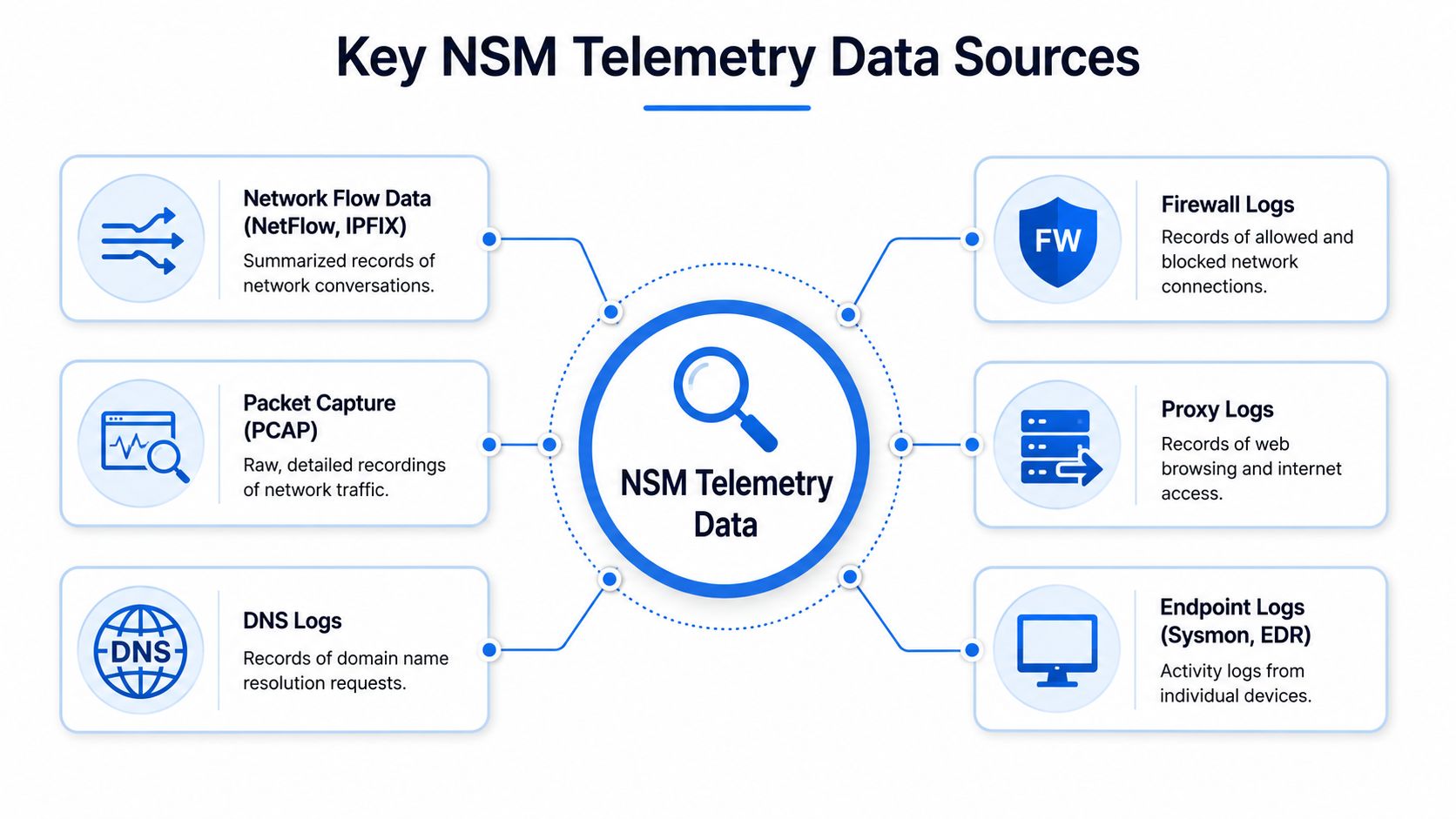
Kentik's NSM overview puts it clearly. NSM relies on three data pillars: full packet captures (PCAP) for forensic detail, flow data for transaction records, and logs for context. Without PCAP, organizations lose the ability to reconstruct complex attacks.
Flow data shows who talked
Flow records such as NetFlow and IPFIX summarize conversations across the network. They tell you which system talked to which other system, when the session happened, and how long it lasted.
That makes flow data great for spotting odd patterns. A finance workstation suddenly talking to a server it never touched before is a clue. So is a cloud workload making strange internal connections at night.
If you already work with switch and device telemetry, this background on SNMP traps and network alerts helps connect operational monitoring with security monitoring.
PCAP shows what actually happened
Packet capture is the detailed record. It's the closest thing you have to replaying the traffic after the fact.
When a client asks, “What did the attacker do?” flow data gives the outline. PCAP gives the detail. That matters during investigations, root cause analysis, and a post-incident risk assessment.
Logs explain the surrounding story
Logs fill in the context that raw traffic can't. Firewall logs, DNS logs, proxy logs, Windows events, Sysmon, and EDR alerts help you answer basic questions fast:
- Was access allowed or blocked
- Did a user log in around the same time
- Did the endpoint launch a suspicious process
- Did DNS resolution point to something unusual
Good NSM teams don't argue about whether flow, PCAP, or logs matter most. They collect all three because each one covers a different blind spot.
What MSPs usually miss
A lot of providers collect logs but skip packet capture. Others keep packet data in only one segment and assume that's enough. That creates coverage holes attackers can use.
For an MSP, the takeaway is simple:
- Collect flow data broadly
- Capture packets where investigation depth matters
- Pull logs from the systems that explain user and application behavior
That mix gives you evidence, context, and speed.
Choosing The Right Monitoring Architecture
Many MSPs often ruin both effectiveness and margins. They keep buying more security tools, then wonder why analysts are buried in noise and clients still feel exposed.
The architecture decision matters more than the product demo. You need a monitoring design your team can run profitably.
A Bitsight reference on NSM tool sprawl notes that most MSPs deploy 5–7 NSM tools, and that this sprawl reduces detection accuracy by 40% and increases false positives by 35%. That's not a scaling strategy. That's a margin killer.
SIEM versus NDR versus IDS IPS
Here's the simple version.
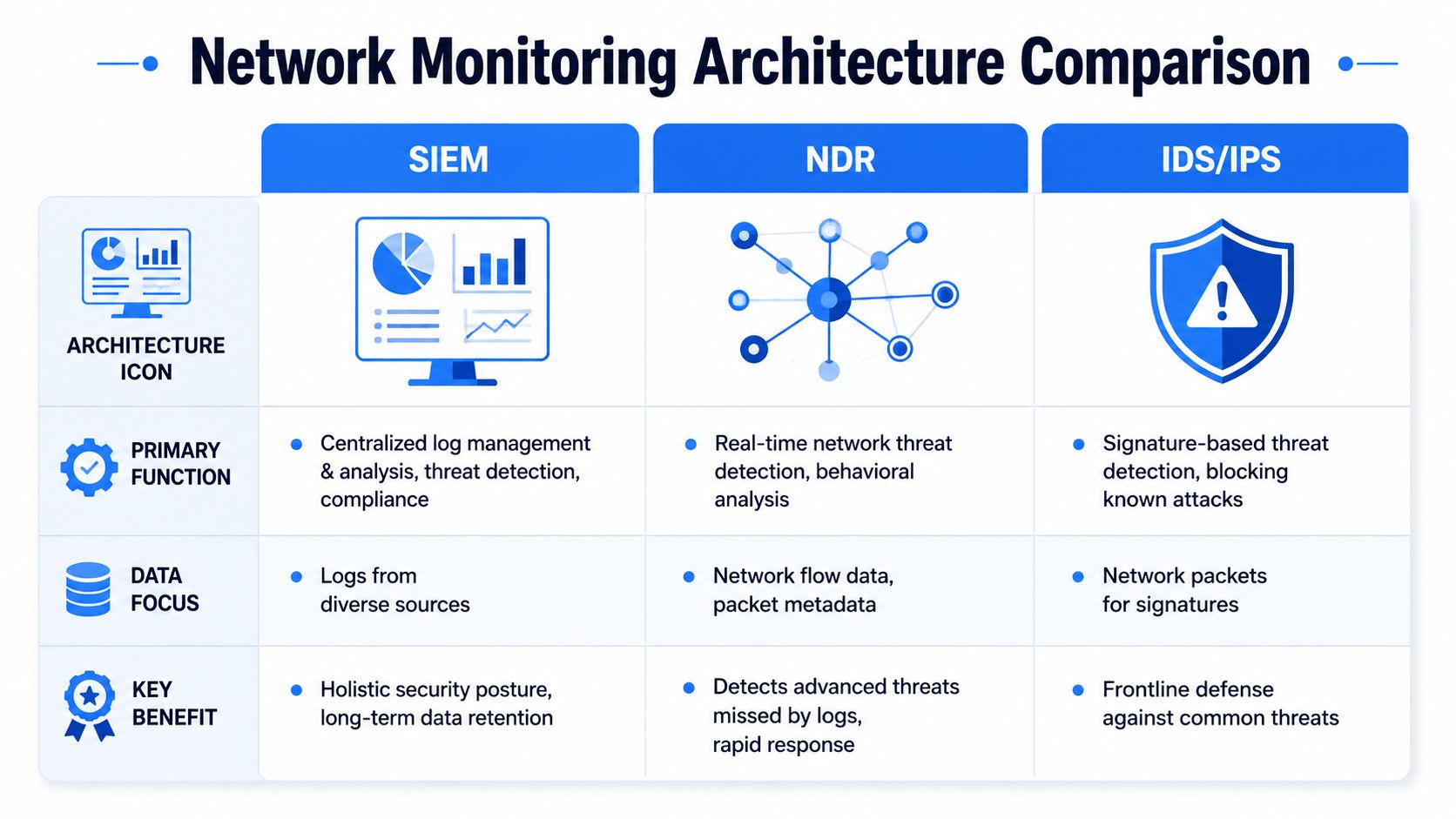
ArchitectureBest atWeak point for MSPsGood fitSIEMCentral log collection, correlation, compliance reportingCan get expensive and noisy without tuningCompliance-heavy clients, broad reporting needsNDRNetwork behavior analysis and threat detectionNeeds strong sensor coverage and tuningClients with lateral movement risk and hybrid environmentsIDS/IPSSignature-based detection and blockingMisses behavior that doesn't match known patternsFrontline control, not the whole strategy
SIEM works well when the client needs reporting across many systems and wants a central place for evidence. That's useful for SOC 2, HIPAA, PCI DSS, and ISO 27001 conversations.
NDR is where many MSPs should focus if they want stronger network visibility without pretending every client needs a giant SOC. It's purpose-built for finding suspicious behavior in traffic, not just storing logs.
IDS/IPS still matters, but don't build your whole managed service around it. It's a gate guard, not an investigator.
How to avoid tool sprawl
A lot of MSPs bolt together products because one handles logs, one handles packets, one does alerts, and another does reporting. Then nobody trusts the output because the data conflicts.
Use this filter when choosing architecture:
- Pick a primary platform: Decide what system becomes the source of truth.
- Reduce duplicate alerts: If two tools detect the same event, decide which one owns it.
- Standardize onboarding: Every client should follow the same telemetry and escalation model unless there's a strong reason not to.
- Protect analyst time: If the stack creates more triage than real investigation, it's the wrong stack.
For MSP leaders sorting out normalization, retention, and cross-client data pipelines, these enterprise data engineering solutions are a useful reference point for thinking through how data architecture affects security operations.
A managed SIEM can still play a role when you need centralized reporting and log retention. If that's part of your roadmap, this guide to managed SIEM service models is worth reviewing.
The best MSP architecture is not the one with the most features. It's the one your team can support cleanly across many clients without drowning in alerts.
Using Detection Engineering to Find Threats
Buying a tool is easy. Making it useful is hard. That's what detection engineering is for.
Detection engineering means turning raw telemetry into alerts your team can trust. It's part technical work, part attacker mindset, and part business discipline because every bad alert costs analyst time and client confidence.
Start with normal behavior
You can't spot suspicious activity if you don't know what normal looks like. Every client has routine patterns. Backup jobs. Remote access windows. Domain controller chatter. Cloud sync traffic. Vendor integrations.
Good detection engineering starts by baselining those patterns, then writing rules and hunts around meaningful deviations. If payroll systems suddenly communicate with a development environment, someone should ask why.
Encrypted traffic is a blind spot
A lot of MSPs still monitor around encrypted traffic instead of through it. That's not acceptable anymore.
NetWitness guidance on SSL and TLS inspection states that 60-80% of modern attack traffic is encrypted, and without SSL/TLS inspection, threats like malware and command-and-control communications remain invisible. If you're not inspecting encrypted flows where policy and client consent allow, you're leaving a major blind spot.
Human tuning is the difference
Prebuilt detections help, but they don't know your client's business. A generic rule may trigger on a legitimate admin tool or ignore a subtle lateral movement pattern in a healthcare client subject to HIPAA or a processor dealing with PCI DSS.
That's why serious NSM work needs analysts who can tune detections based on environment, client risk, and attacker behavior. The same logic applies in adjacent areas like ethical internal threat prevention, where real-time signal quality matters more than dumping every possible event into a queue.
A practical detection stack
Don't overcomplicate this. A usable detection program usually includes:
- Behavioral rules: Catch changes from known-good patterns
- Threat-informed logic: Map detections to common attacker techniques
- Encrypted traffic review: Inspect or analyze encrypted flows so malware doesn't hide in plain sight
- Feedback loops: Every false positive should teach the system something
If your team can't explain why an alert exists, what data feeds it, and what action it should trigger, the rule probably shouldn't be in production.
Turning Alerts Into Action With Playbooks
An alert without a response plan is just a blinking light.
One client gets a suspicious outbound traffic alert late on a Friday. Without a playbook, your tech scrambles, the client panics, nobody knows whether to isolate the host, and valuable logs get overwritten while people argue in chat. That's how small incidents turn into ugly ones.
What a good playbook looks like
A playbook should be short enough to use under pressure and specific enough to prevent guesswork. It needs owners, decision points, and evidence handling steps.
Here's a simple format that works well for MSPs:
- Validate the alert against supporting telemetry
- Contain the risk if the signal looks credible
- Notify the right contact on the client side
- Preserve evidence for investigation and compliance
- Escalate to security leadership if the impact grows
Common playbooks MSPs should build first
Start with the incidents you'll see most often.
- Potential ransomware activity: Isolate the affected system, verify with the user, preserve logs, and check nearby hosts for similar behavior.
- Suspicious remote access: Confirm whether the session is approved, review source patterns, and restrict access if the activity can't be validated.
- Unusual east-west traffic: Review server roles, user context, and recent admin actions before deciding whether to segment or isolate.
Field advice: Write playbooks for the first fifteen minutes, not the perfect investigation. Your team needs immediate actions before they need elegance.
Why clients notice the difference
Clients can tell when your team is improvising. They can also tell when your team has a calm process, clear communication, and evidence ready for compliance reviews or a formal risk assessment.
Playbooks turn NSM from a technical feed into a managed security service. They're also a major trust builder for vCISO relationships, because they prove your operation can respond consistently under pressure.
Validating Monitoring With Penetration Testing
Monitoring is a claim. Penetration testing is the proof.
You can tell a client their environment is watched 24/7, but until someone actively tries to bypass controls, move laterally, and trigger your detections, you don't know whether the service works. That's why pentesting, pen test exercises, and continuous monitoring belong together.

A proper penetration test tells you more than whether a vulnerability exists. It shows whether your NSM stack catches the attack chain, whether your alerts are actionable, and whether your response playbooks hold up under pressure.
What pen testing proves
A solid manual pentesting engagement can answer hard questions fast:
- Did the monitoring stack detect access attempts
- Could an attacker move across internal systems without triggering alerts
- Did the response team act quickly and correctly
- Do the logs support forensics and compliance review
That's why penetration testing isn't separate from monitoring. It validates monitoring.
Why affordability matters for MSPs
The market often operates unreasonably. A review of penetration testing vendor pricing shows how widely quotes can swing between providers for the same kind of work. For MSPs trying to package white label pentesting into a broader service, that spread can crush margins or stall deals. Pricing depends on scope. Request a quote for exact figures.
That's also why channel-friendly delivery matters. You need affordable, fast, manual pentesting that supports your brand, your client relationship, and your compliance goals. Certifications matter too. Clients pay more attention when the work is performed by pentesters with credentials like OSCP, CEH, and CREST.
The talent pipeline is changing too. If you want a feel for how the market describes offensive security roles, this example of a no-degree pen tester position shows how skills-first hiring is shaping the field.
If you offer internal and external validation services, this overview of network penetration testing fits naturally beside a managed network security monitoring service.
Good monitoring should catch a good tester. If it doesn't, you found a gap before a criminal did.
Your Checklist for a Managed NSM Service
You don't need to build a giant SOC to launch a credible managed network security monitoring service. You do need discipline. Most failed offerings break because the provider skipped scope, telemetry planning, client communication, or service packaging.
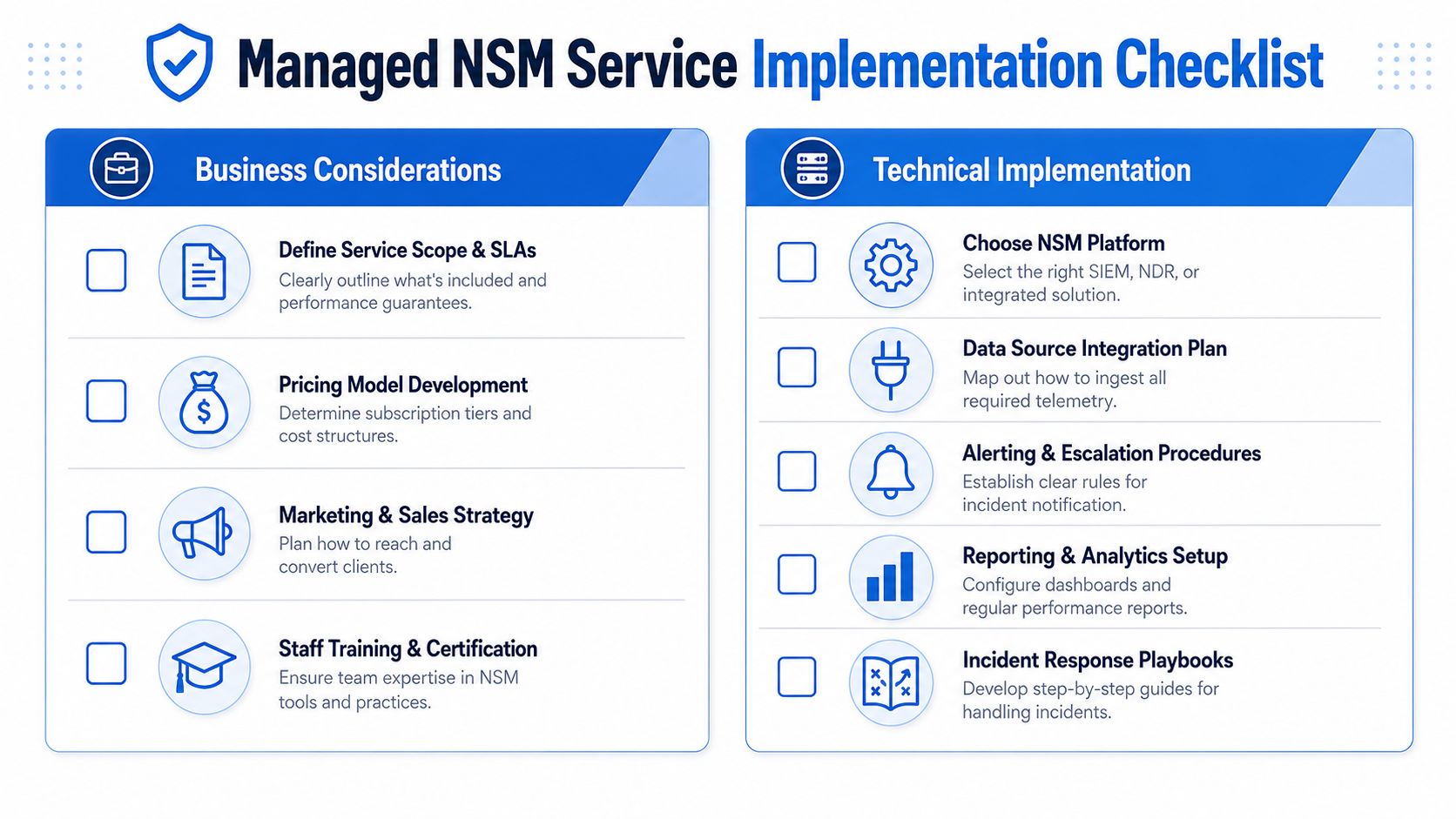
Use the checklist below like a launch standard, not a suggestion.
Business decisions that protect margins
Before you buy another tool, decide what you're selling.
- Define the scope: Decide whether the service covers alerting only, response support, compliance reporting, threat hunting, or all of the above.
- Build tiers that make sense: One tier may fit SOC 2 and ISO 27001 reporting needs, while another is built for deeper operational security.
- Set realistic SLAs: Promise response actions your team can deliver, especially after hours.
- Package with advisory services: NSM becomes easier to sell when a vCISO, CPA, or GRC partner can tie it to audits, policy, and risk assessment work.
Technical choices that improve outcomes
A managed service works only if the telemetry, detection logic, and response paths are consistent.
Use a short decision framework:
AreaWhat to decidePlatformWhether SIEM, NDR, or a blended stack is your primary systemTelemetryWhich logs, flow sources, and packet capture points are mandatoryEscalationWho gets notified, in what order, and under what conditionsReportingWhat the client receives monthly, quarterly, and after incidents
Operational habits that clients trust
In this aspect, mature providers separate themselves from dashboard resellers.
- Standardize onboarding: Every client should have the same core deployment checklist unless there's a documented exception.
- Create client-facing reports: Reports should show meaningful findings, actions taken, open risks, and compliance relevance.
- Train your team: Monitoring quality depends on analyst judgment, not just tooling.
- Test the service: Pair NSM with pentest, pen testing, and penetration testing to prove the detections work.
Where channel partners fit
You don't need to do every part yourself. In fact, trying to do everything in-house too early is one of the fastest ways to lose money.
A good channel-only approach helps you:
- Launch faster: You don't have to build every process from scratch
- Stay affordable: You avoid bloated staffing and overpriced one-off projects
- Expand services: You can add manual pentesting, reporting support, and remediation guidance without hiring a full offensive security team
- Protect the relationship: The client stays yours, which matters for every MSP and reseller
For HIPAA, SOC 2, PCI DSS, and ISO 27001 work, this model is especially useful because the client usually needs more than one service. They need monitoring, documentation, testing, and credible reports. Bundle those under one managed offering and you stop looking like a basic IT vendor.
Partner With Us to Secure Your Clients
If you're an MSP, vCISO, GRC firm, CPA, or IT reseller, this is the opening in front of you. Clients need better visibility. They need help with compliance. They need proof that someone can detect and respond when endpoint tools miss the attack.
The market still has the same ugly problems. Inflated prices. Weak testing methodology. Slow delivery. That creates room for firms that can offer a cleaner service model built around network security monitoring, response playbooks, and white label pentesting.
The smartest move is to build the client relationship and offload the specialized testing work to a channel-only partner that doesn't compete with you. That gives you a faster path to a credible service, stronger margins, and better client retention. It also gives your clients access to affordable, manual pentesting delivered by certified pentesters with OSCP, CEH, and CREST backgrounds.
If you want to grow beyond commodity managed services, this is the lane. Own visibility. Own the response process. Validate it with real penetration testing. Then package it in a way your clients can understand and buy.
If you want a channel-only partner for white label pentesting, fast turnaround, and affordable manual pentests that help support your managed security and compliance services, we deliver testing you can resell under your logo. We work only through partners, never compete for your clients, and help MSPs, vCISOs, and resellers deliver credible penetration testing, pen test, and pentesting services under their own brand. Contact us today to learn more.

.avif)
.png)
.png)
.png)

