

You're setting up a firewall, VPN gateway, bastion host, or internet-facing service for a client. The hardware choice matters. The firewall rules matter. The hardening checklist matters. But the operating system under all of it is the essential foundation.
That choice affects client security, compliance evidence, and your team's daily workload. It also affects whether your next pentest, pen test, or penetration testing engagement finds a tight build or a mess of exceptions, weak defaults, and patching headaches.
For MSPs, vCISOs, GRC firms, and resellers, the OpenBSD vs FreeBSD debate isn't a hobbyist argument. It's a business decision. Pick the wrong platform and you create more tickets, more exceptions, more audit friction, and more unbillable engineering time.
Choosing Your Foundation for Client Security
If you manage regulated or security-sensitive clients, your OS decision should come from risk, not personal preference. A medical practice thinking about HIPAA and a SaaS company preparing for SOC 2 both need a stable, defendable platform. They don't need a pet project.
Use this simple lens early.
Decision areaOpenBSDFreeBSDDefault postureMore opinionated and security-firstMore flexible and performance-orientedPackage breadthSmaller, curated ecosystemLarger software baseHardware fitBetter for narrow, dedicated rolesBetter for mixed hardware environmentsAdmin styleStrong if you want fewer moving partsStrong if you want more features and tuningBest MSP useFirewalls, bastions, simple security appliancesGeneral servers, larger service stacks, broader deployments
That table gets to the point. OpenBSD is the stricter tool. FreeBSD is the broader tool.
What MSPs should care about first
A BSD rollout should support three things at the same time:
- Security control clarity so your team can explain the build to auditors and client leadership
- Operational sanity so your engineers aren't fighting packages, drivers, or weird edge cases
- Validation readiness so the environment stands up well during a risk assessment, manual pentesting review, or broader compliance audit
If your process is still fuzzy, this comprehensive guide to IT risk assessment is a useful framework for deciding which systems need the most hardened baseline and the most validation effort.
Strong infrastructure choices make audits easier because your team has fewer exceptions to explain.
The right answer isn't always the most secure-sounding OS. It's the one your team can deploy cleanly, maintain consistently, and defend during PCI DSS, ISO 27001, SOC 2, or internal risk assessment reviews.
Core Philosophies and Why They Matter
The split between these projects matters because it still shows up in how they behave today. FreeBSD's first official release was on 1 November 1993, while OpenBSD was first released on 5 October 1995, making FreeBSD about 23 months earlier in this part of BSD history. The same comparison notes that OpenBSD prioritizes security and code simplicity, while FreeBSD emphasizes performance, flexibility, and broader hardware support. That's why OpenBSD built its reputation around security hardening and audited code, while FreeBSD became the more general-purpose server platform for larger deployments, according to this FreeBSD and OpenBSD comparison.

That sounds abstract until you manage client infrastructure for a living. Then it becomes very concrete.
OpenBSD favors control through restraint
OpenBSD's worldview is simple. Keep the base system tighter. Reduce complexity. Prefer correctness over feature sprawl. Remove or limit things that create attack surface.
For an MSP, that usually means fewer moving parts in the base install and fewer opportunities for a rushed admin to leave something exposed. That's good for clients where the system has one job and security failure would be expensive to explain.
FreeBSD favors control through capability
FreeBSD takes a different route. It gives you a more expansive platform with more room to tune, extend, and support broader workloads. That's useful when the client wants one platform to support multiple services or when your team needs more software flexibility.
That flexibility comes with responsibility. Your standards matter more because the OS won't save you from every weak choice.
Consultant view: If your team is disciplined, FreeBSD gives you more room to build strong systems. If your team is inconsistent, OpenBSD can save you from some of your own habits.
A lot of MSP security strategy now centers on layered access, segmentation, and service minimization. If that's your direction, this guide on how to implement zero trust security fits well with how you should evaluate BSD deployments.
Why philosophy becomes operational burden
Philosophy shows up in ticket volume. It shows up in build consistency. It shows up when a client wants one more package, one more agent, one more integration.
Choose OpenBSD when the client needs a narrowly scoped appliance and your team wants fewer opportunities to make a bad decision. Choose FreeBSD when the client needs a serious general-purpose platform and your team is capable of hardening it properly.
That's the main split.
Comparing Security Models and Defaults
Security teams love to talk about “secure by default” as if all defaults are equal. They aren't. In the OpenBSD vs FreeBSD conversation, this is the most important practical difference.

OpenBSD is the more opinionated security platform. It's built around the idea that safer defaults and tighter code reduce the damage from admin mistakes. That matters because many real incidents don't start with exotic malware. They start with a service that never should have been exposed, an unnecessary package, or a rushed change.
FreeBSD can absolutely be secured to a high standard. The difference is that it behaves more like a toolkit. You have more knobs, more deployment patterns, and more room to build exactly what you want.
OpenBSD helps by saying no
For compliance-heavy clients, “no by default” is often a strength. Fewer enabled services. Smaller base expectations. Simpler stories for auditors and assessors.
That doesn't mean OpenBSD automatically makes you compliant. It means your baseline is easier to defend when an auditor asks why a host exists, what it runs, and how you reduced unnecessary exposure.
This is useful in environments where you expect later penetration testing, formal manual pentesting, or recurring control reviews. Cleaner systems are easier to explain and easier to validate.
FreeBSD helps by giving you tools
FreeBSD is strong when your team knows how to use its security features well. You can create tightly segmented workloads, build more capable service stacks, and support more demanding client needs without leaving the BSD ecosystem.
That's a good fit for mature MSPs and vCISOs who already enforce build standards, change control, patch discipline, and hardening templates across clients.
- For ISO 27001 readiness, OpenBSD often makes scope control easier because the platform pushes toward minimalism.
- For broader service delivery, FreeBSD is often easier to fit into existing client requirements because it can support more varied workloads.
- For repeatable GRC evidence, either can work if your team documents the baseline, patching, access controls, and exceptions well.
A secure operating system doesn't replace governance. It gives governance less chaos to manage.
What matters during a penetration test
A good penetration test doesn't grade marketing claims. It looks at exposed services, weak segmentation, stale software, unnecessary trust paths, poor access control, and misconfigurations.
From that perspective, OpenBSD often reduces some classes of avoidable problems because the platform encourages restraint. FreeBSD often wins when the environment requires more complex service delivery and the admins are good enough to keep that complexity under control.
My advice is blunt. If the client's tolerance for admin error is low, pick OpenBSD for narrow roles. If the client needs a richer platform and your team is competent at secure builds, pick FreeBSD and harden it with discipline.
Networking Performance and Firewalling
A client site goes down at 2:10 a.m. The VPN is saturated, the firewall is dropping legitimate traffic, and your on-call engineer needs a fix that works fast and stands up in the morning review. In that moment, OS philosophy matters less than operational behavior under load.

FreeBSD usually makes more sense for MSPs that need higher network throughput, broader service density, or firewall hosts that also carry other infrastructure duties. OpenBSD usually makes more sense for narrow security roles where the main goal is to reduce exposed functionality, reduce change frequency, and keep audit scope easier to explain.
That distinction affects billable work. It also affects risk.
Pick the OS that matches the box's job
If the system is a dedicated firewall, bastion, or VPN gateway, OpenBSD remains one of the clearest choices in the BSD family. Its reputation in firewalling is tied to a restrained design approach, conservative defaults, and a culture that favors simplicity over feature sprawl. For MSPs supporting regulated clients, that usually means cleaner hardening standards, fewer exceptions in audit evidence, and less room for an admin to turn a security appliance into a multipurpose problem.
If the host needs to push more traffic or carry more mixed workloads, FreeBSD is the better business decision. It is often the easier fit for busy edge services, network-heavy application hosts, and environments where performance margin reduces incidents. MSPs feel that difference in ticket volume, maintenance windows, and how often a client outgrows the original design.
Firewalling is also a compliance design choice
vCISOs should treat firewall platform selection as part of control design, not just systems engineering. Auditors care about segmentation, access paths, administrative boundaries, change control, and whether the implemented design matches the documented one. A simpler OpenBSD deployment can make that story easier to defend. A stronger-performing FreeBSD deployment can make service delivery easier to sustain.
Neither result is automatic.
Your team still needs a clear rulebase, documented exceptions, logging standards, and a DMZ layout that separates internet-facing services from management and internal trust zones. If you need a framework for that design work, review this guide to firewalls and DMZ architecture.
A lot of SMB clients also need firewall planning tied to growth, remote access, and vendor access control. This overview of the future of network firewalls for SMBs is useful because it treats firewalling as a service design decision with long-term support implications.
My recommendation for MSP service delivery
Use OpenBSD when you want the firewall to stay a firewall. Use FreeBSD when the client expects that same system to do more and your team can manage the added complexity without cutting corners.
- Choose OpenBSD for dedicated gateways, bastions, VPN concentrators, and tightly scoped perimeter roles.
- Choose FreeBSD for high-throughput edge systems, multi-service infrastructure, and network-heavy client environments where performance headroom lowers operational pain.
- Avoid mixed intent on security boundary hosts unless you have strict build standards and change control that your team adheres to.
The practical rule is simple. If you are optimizing for minimal exposure and cleaner audit narratives, pick OpenBSD. If you are optimizing for throughput, flexibility, and fewer infrastructure bottlenecks, pick FreeBSD.
Packages Hardware and Operational Reality
An MSP usually feels this decision during onboarding, not architecture review. The client wants a secure internet-facing service live this week, on whatever hardware is already in the rack, with monitoring, backup agents, and a few ugly legacy dependencies. That is where FreeBSD usually creates less operational drag.
Package breadth matters because unsupported software becomes custom work, and custom work becomes recurring risk. FreeBSD generally gives your team more room to meet client requirements without building odd exceptions into the stack. OpenBSD's narrower package set is useful when you want to keep a host tightly scoped, but it is a poor fit for roles that keep expanding as clients add tools, integrations, and reporting requirements.
For an MSP or vCISO team, that trade-off shows up in three places:
- Service standardization: FreeBSD is easier to standardize across different client environments because it supports a wider range of software roles.
- Audit evidence: OpenBSD is easier to explain in audits when the host has a single clear purpose and very few installed components.
- Engineer time: Every package gap or compatibility issue turns into manual validation, exception handling, and more change control overhead.
Hardware support changes the economics too. FreeBSD is usually the safer choice for mixed fleets, repurposed hardware, lab systems, and edge deployments where you do not control every component. OpenBSD works best when you already know the hardware, the role is fixed, and your team can keep the build narrow.
That matters for compliance as much as convenience. SOC 2 and similar frameworks reward consistency, documented change control, and repeatable patching. A platform that forces one-off fixes across clients raises the odds of drift and weak evidence. If your team is building a repeatable service, your operating system has to fit your patch management policy and validation process, not fight it.
OpenBSD's restraint is a strength only when the client's requirements are restrained too.
My recommendation is straightforward. Use OpenBSD for appliance-style roles with fixed hardware and a tightly limited software footprint. Use FreeBSD when the client needs broader package support, less hardware friction, and a platform your team can operate repeatedly across many accounts without creating a pile of exceptions.
Recommended Use Cases for MSP Clients
Here's the advice I'd give an MSP team making client recommendations today.
Choose OpenBSD for narrow high-trust roles
OpenBSD is the better choice when the system has a focused security function and very little reason to grow sideways.
Use it for:
- Firewalls and VPN gateways where a tighter default posture matters more than broad software options
- Bastion hosts where you want a lean system with fewer unnecessary components
- Security appliances in environments with strong control expectations such as PCI DSS or HIPAA
- Internet-facing utility servers that should do one thing well and nothing extra
If the client's biggest risk is misconfiguration, OpenBSD is appealing because it reduces temptation. Your engineers have less room to improvise badly.
Choose FreeBSD for broad client infrastructure
FreeBSD is the better fit when the client needs one platform to do real business work across multiple roles.
Use it for:
- High-traffic web and application servers
- File services and storage-oriented roles
- Larger internal service stacks
- Virtualization and containment-focused builds
- Mixed environments where broader software and hardware support lowers friction
This is usually the right answer for MSPs that need to standardize across many client types. One consistent platform with better package breadth and stronger performance is easier to operate at scale.
Quick decision checklist for vCISOs and GRC teams
Ask these questions before you approve the build:
- Is the host a dedicated security appliance or a general service platform?
Dedicated usually points toward OpenBSD. General service usually points toward FreeBSD. - Will the client need broader software support later?
If yes, FreeBSD is safer from an operations standpoint. - Is admin error a bigger threat than raw performance limits?
If yes, OpenBSD deserves a hard look. - Will this environment face formal compliance review?
Both can work for SOC 2, ISO 27001, HIPAA, and PCI DSS, but the cleaner and more explainable build usually wins the day.
Don't force a philosophical answer onto a practical problem. Match the OS to the client's risk, your team's skill, and the service you plan to support.
Your Decision Matrix and Next Steps
You don't need a dramatic answer here. You need a repeatable one.
If the client needs a secure, focused, appliance-like system, choose OpenBSD. It's the better pick when simplicity, restraint, and a tighter default posture reduce the chance of mistakes.
If the client needs a high-performance, flexible, broadly deployable server platform, choose FreeBSD. It's the stronger choice when you need package depth, hardware flexibility, and room to scale.
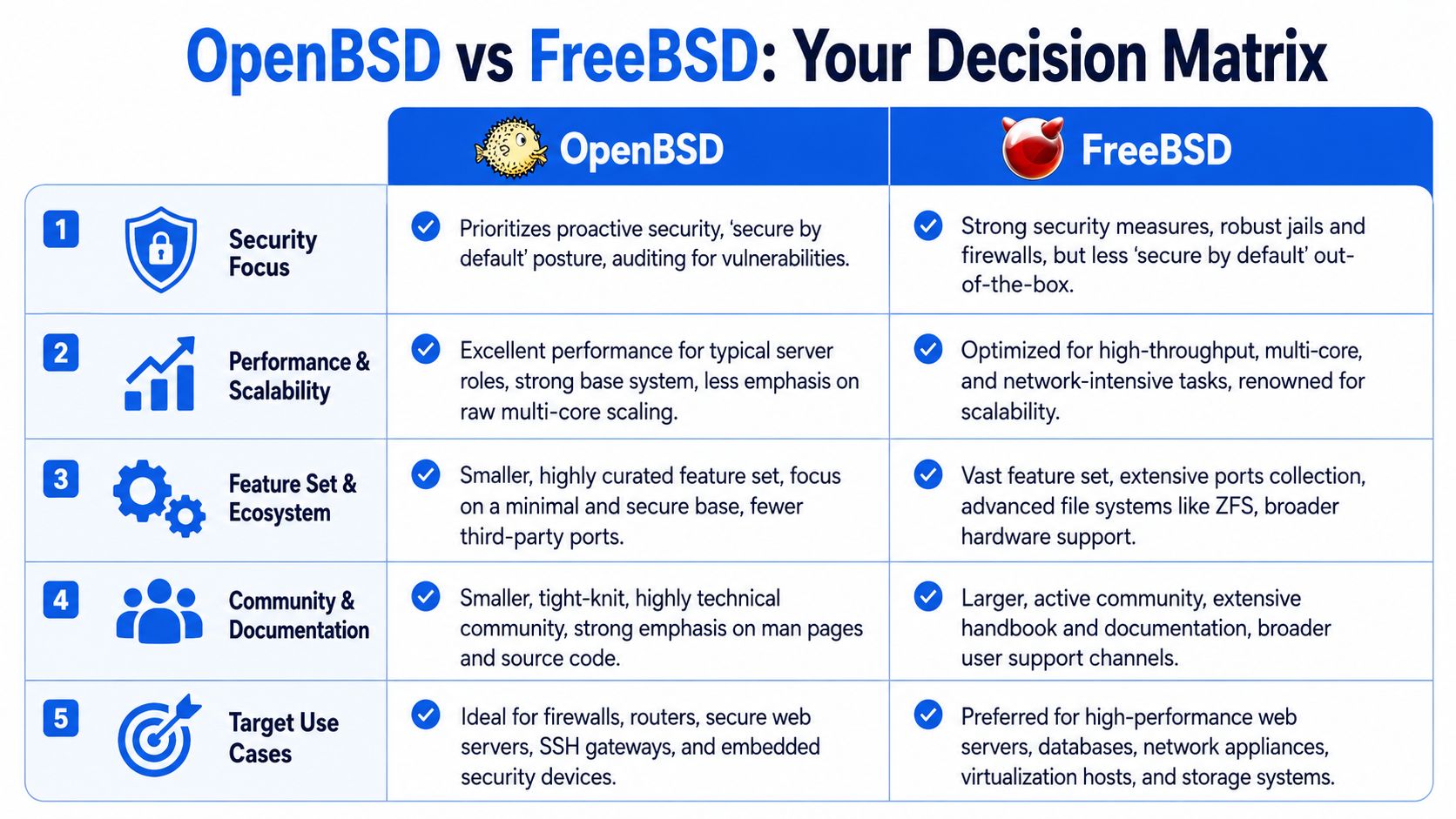
The fast version
Client needBest fitFirewall, bastion, locked-down gatewayOpenBSDBroad server use, larger deploymentsFreeBSDLowest tolerance for admin mistakesOpenBSDBetter package and hardware flexibilityFreeBSDEasier fit for mixed MSP environmentsFreeBSD
This decision also affects what happens after deployment. A strong OS choice gives you a cleaner base, but it doesn't prove the environment is secure. That proof comes from validation.
That's where penetration testing, pen testing, and manual pentesting matter. If you're supporting clients through SOC 2, HIPAA, PCI DSS, or ISO 27001, the right assessment doesn't just check a box. It shows whether your hardening choices, segmentation, access controls, and patching standards hold up under real review.
Good architecture reduces risk. Good testing verifies it.
For MSPs, vCISOs, and GRC partners, the winning model is straightforward. Choose the OS that fits the role. Standardize the build. Document the controls. Validate the environment with a real penetration test. That's how you turn infrastructure decisions into secure, billable, defensible service delivery.
If you need a channel-only partner to validate client environments after deployment, MSP Pentesting helps MSPs, vCISOs, GRC firms, and resellers deliver white label pentesting without account conflict. Our team includes certified pentesters with OSCP, CEH, and CREST credentials, and we focus on affordable, manual pentesting, fast turnaround, and white-labeled reporting that supports compliance efforts like SOC 2, HIPAA, PCI DSS, and ISO 27001.

.avif)
.png)
.png)
.png)

