
A cashier swipes a card. The terminal looks routine. In the Target breach, that ordinary moment became the collection point for one of the most important cyber incidents every MSP should study.
If you sell IT, compliance, or security advice, the Target data breach 2013 is not old news. It's a live blueprint for how weak vendor controls, poor segmentation, and shallow testing turn into business damage.
The 2013 Target Breach A Cybersecurity Wake-Up Call
In late 2013, Target suffered one of the most consequential retail cyberattacks in U.S. history. According to the U.S. Senate's Kill Chain analysis, attackers first gained access in November 2013 and exfiltrated sensitive data to a server in Eastern Europe. Target publicly confirmed on December 19, 2013 that about 40 million credit and debit card accounts had been exposed, and the Senate report said the broader incident also involved personal information for up to 70 million customers, bringing the total impacted population to as many as 110 million people.
That's why the Target data breach 2013 still matters. It wasn't just a retail story. It forced security leaders, auditors, payment providers, and service partners to rethink how they handle vendor access, card environments, and incident response.
Why MSPs should care
Most MSP owners look at Target and think “enterprise problem.” That's the wrong read. The lesson is simpler. A trusted third party became the path in, and once attackers landed, internal security controls didn't contain them.
If your clients deal with PCI DSS, SOC 2, HIPAA, or ISO 27001, they're already facing the same basic risk categories. Different size. Same attack logic.
Practical rule: If a client has vendors, remote access, flat networks, or weak alert triage, they already have the conditions that made this breach possible.
This is also where governance stops being paperwork. Teams that care about complying with data protection laws need to treat access control and monitoring as operational controls, not policy shelfware.
The business case is straightforward. Your clients don't need more generic awareness training slides. They need proof that their environment can resist the kind of path an attacker takes. That's why breach case studies should feed directly into services like a cost of data breaches review, vendor access assessments, and penetration testing plans.
The Attack Chain How Hackers Got Inside
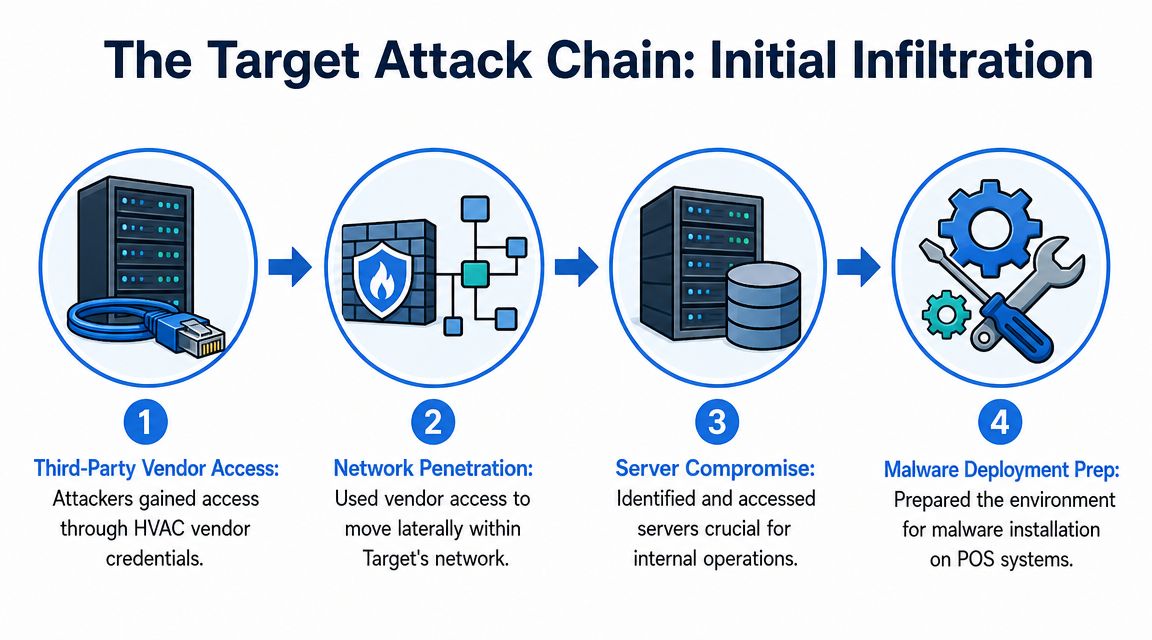
The first step wasn't flashy. Attackers got in through compromised credentials tied to Fazio Mechanical, an HVAC vendor. That matters because it shows how often the weak point sits outside your client's employee directory.
Public analysis often talks about the vendor credentials, but the bigger failure was operational. Brian Krebs' reporting notes that the attackers first entered with compromised Fazio Mechanical credentials, then moved laterally because Target lacked effective network segmentation in the areas that mattered most, as described in Inside Target Corp. Days After 2013 Breach.
What lateral movement means in plain English
Think of a building with a side door for contractors. That door should open only to a utility room. In Target's case, attackers got through the contractor door and kept finding interior doors that weren't properly locked.
That's lateral movement. An attacker lands in one spot, then pivots from system to system until they reach something valuable.
The controls that were missing
For MSPs, a risk assessment has to get more specific than “vendor account exists.” You need to ask:
- What can the vendor reach once authenticated
- Whether access is segmented away from payment, identity, and server environments
- How alerts are triaged when access patterns change
- Which admin paths exist between ordinary systems and sensitive systems
A lot of clients think MFA alone solves third-party risk. It doesn't. MFA helps, but it doesn't fix excess trust, weak segmentation, or broad internal pathways.
The lesson isn't “vendors are dangerous.” The lesson is that unmanaged vendor access becomes internal access fast.
This is exactly why MSPs should package third-party access review into onboarding and recurring security work. A useful starting point is a documented third-party risk management process tied to actual network validation, not just questionnaires.
If you're a vCISO, this breach gives you a blunt talking point for leadership. Don't ask whether a vendor is trusted. Ask whether their trust is technically contained.
How POS Malware Stole Millions of Cards
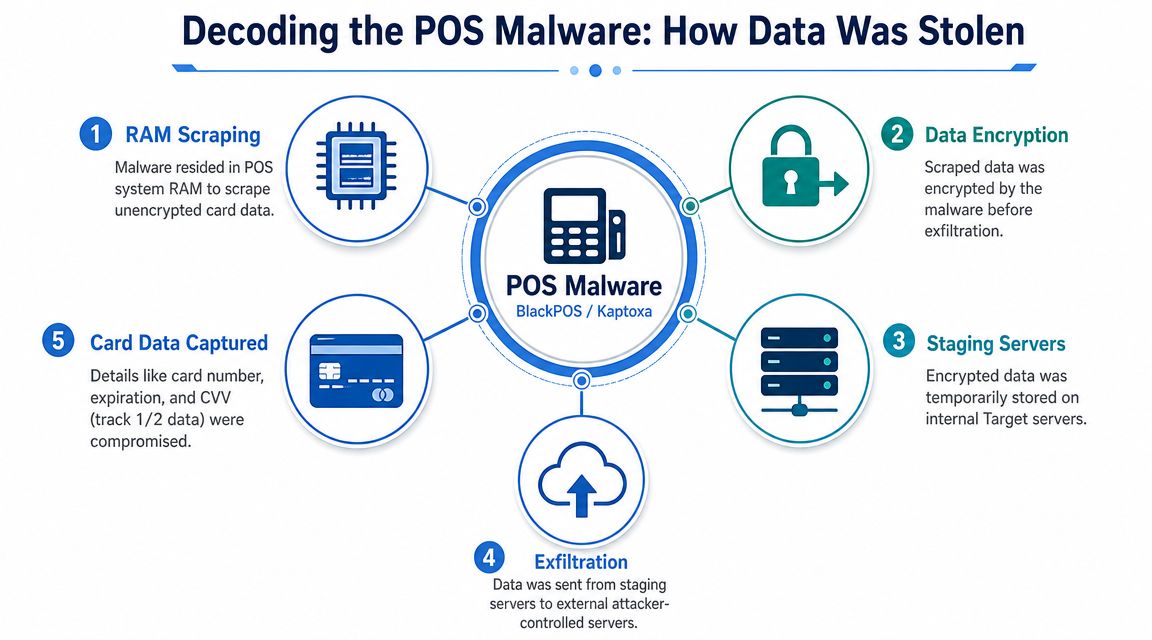
The heart of the Target data breach 2013 was POS malware. Not a giant database dump. Not a dramatic smash-and-grab. Malware sat where card data briefly passed through memory during live transactions.
Academic and investigative sources describe the malware, often associated with BlackPOS or Kaptoxa, as targeting point-of-sale memory to capture track data during card-present transactions and then exfiltrating it after collection. A Columbia case study reports the attackers installed Kaptoxa on about 40,000 of Target's roughly 60,000 POS machines and ultimately exfiltrated card data from about 40 million customers, as detailed in the Target case study paper.
Think of it as a digital skimmer
A gas pump skimmer grabs card data at the moment of use. Memory-scraping malware does the same thing inside the checkout system. The card gets read, the data sits in memory for a moment, and the malware grabs it before downstream protections help.
That's why perimeter security isn't enough. If malicious code reaches the endpoint that handles the transaction, it can steal the data inside the trusted environment.
What this means for your security stack
This type of attack pushes MSPs beyond basic AV and firewall checklists. You need layered controls inside the client environment, especially where payment, healthcare, or regulated data is involved.
A practical control stack includes:
- Application allowlisting on POS and locked-down endpoints
- Network segmentation so payment systems can't talk freely to the rest of the environment
- Restricted admin tools to cut down abuse paths
- Anti-malware tuned for memory-scraping behavior
- Traffic anomaly alerting for unusual POS-to-internal-server movement
Automated scanners won't tell the full story here. A real penetration test, pen test, or penetration testing engagement should examine whether an attacker can move internally, abuse trust paths, and reach the systems where sensitive data lives. That's also why clients evaluating endpoint controls should understand how tools like next-generation antivirus fit into a broader defense, rather than treating them as a complete answer.
The Business Impact and Regulatory Fallout
Here, technical failure becomes executive pain.
When a breach hits payment systems, the damage doesn't stay in the SOC. It moves into board conversations, legal review, customer trust, contract renewals, and compliance scrutiny. PCI DSS becomes more than a checklist. It becomes evidence that someone either validated controls properly or treated them as paperwork.
Why compliance teams should care
The Target breach pushed a hard lesson into the market. If a client stores, processes, or transmits card data, then segmentation, access control, logging, and endpoint security aren't abstract best practices. They shape whether a compromise stays contained or spreads.
For vCISOs, GRC advisors, and compliance-focused resellers, the business takeaway is clear:
- PCI DSS scope matters
- Third-party access must be governed
- Alerting without action is wasted spend
- Security control design has to survive real-world abuse
A client can pass a meeting and still fail an attack.
The same logic carries into SOC 2, HIPAA, and ISO 27001 programs. None of those frameworks work if the client's actual environment allows broad lateral movement and weak control enforcement. Good compliance work should lead to deeper technical validation, not replace it.
MSPs that understand this can stop selling “peace of mind” and start selling concrete reduction of attack paths, audit pain, and client churn risk.
Actionable Mitigation Steps for MSP Clients
The easiest mistake after studying Target is turning it into a history lesson. Don't do that. Turn it into a service catalog.
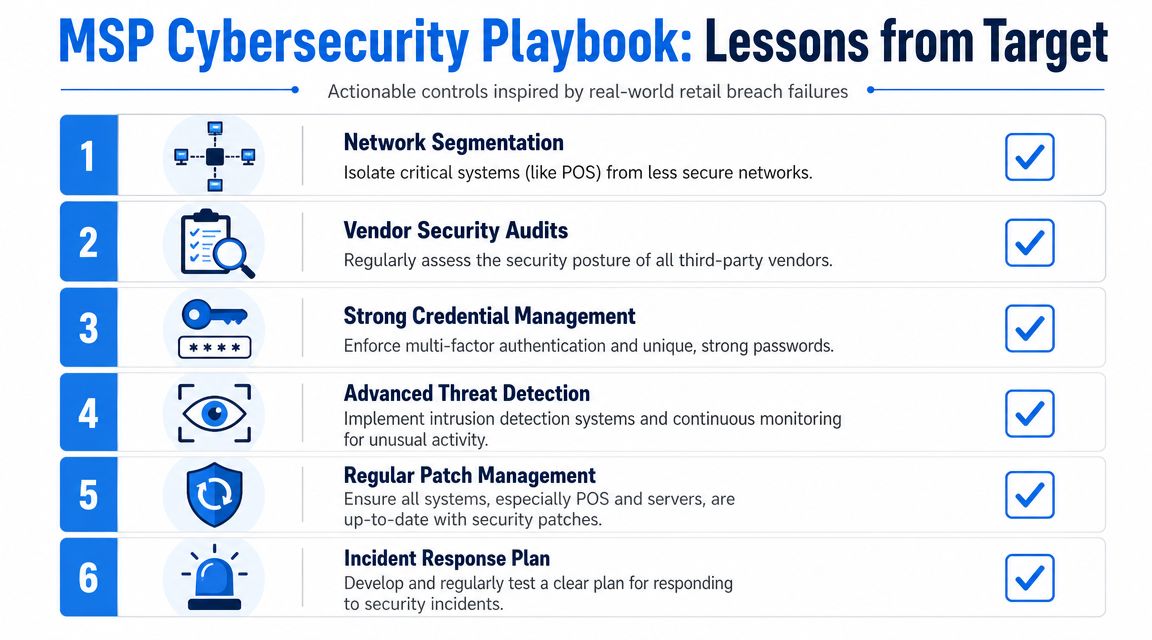
Your clients need controls that map directly to what failed: vendor access, internal trust, malware execution, alert response, and testing. If you're an MSP, MSSP, reseller, CPA-led advisory shop, or vCISO, these are sellable projects.
What to offer right now
Vendor access reviews
Map every third party with remote access. Then cut that access down to the minimum needed. If a client can't explain why a vendor can reach a system, that access is already a problem.Segmentation projects
Separate user networks, admin zones, server environments, and payment-related systems. This is one of the clearest ways to reduce blast radius.Credential hardening
Enforce strong identity controls for staff, vendors, and admins. Don't stop at password policy. Review privilege paths and stale accounts too.Continuous monitoring with response ownership
Tools create noise unless someone owns triage. Set rules for who investigates alerts, how fast, and what gets escalated.
Why pentesting belongs in the stack
A manual pentest finds things compliance interviews and automated tools often miss. It shows whether a low-privilege foothold can become internal compromise. It tests whether segmentation really works. It checks whether controls are meaningful or cosmetic.
That matters for PCI DSS, SOC 2, HIPAA, and broader compliance programs because evidence is stronger when you've validated real attack paths. A solid penetration test also gives your client language they can use with auditors, insurers, and leadership.
Here's the key difference:
| Approach | What it usually finds | What it often misses |
|---|---|---|
| Automated scanning | Known exposures, missing patches, obvious weaknesses | Chained attack paths, trust abuse, lateral movement |
| Manual pentesting | Realistic attacker behavior, access escalation, segmentation failures | It takes skilled testers, so quality matters |
Build the response plan too
Target also shows why detection without action fails. Every client should have a documented and tested incident playbook. If you need a simple starting point, this incident response plan template is a useful reference for structuring roles, escalation, and communication.
One practical option for MSPs that don't want to build an internal offensive team is using a channel-only provider such as MSP Pentesting for white label pentesting, internal network testing, external testing, cloud testing, and compliance-aligned reporting. That lets you add affordable, manual penetration testing without hiring a full bench.
Key takeaway: Don't sell a client another tool before you test whether their current controls can actually stop movement inside the network.
Become the Security Partner Your Clients Need
The Target data breach 2013 still matters because it exposed a gap that many MSPs still have today. Clients buy infrastructure support, endpoint tools, compliance help, and monitoring, but they often don't get a realistic test of how an attacker would move through their environment.
That gap is your opportunity.
What clients want from an MSP or vCISO
They want someone who can connect the dots between risk assessment, compliance, and actual attacker behavior. They want someone who can explain why third-party access matters, why flat networks are dangerous, and why a clean vulnerability scan does not equal security.
They also want speed and clarity. If your client asks for a pen test, pentest, penetration test, or ongoing penetration testing support, they don't want bloated pricing, canned reports, or month-long delays.
What a smart partnership looks like
For many MSPs and resellers, the right move is partnering with a channel-only team that never competes for the client relationship. That model works because you keep strategic ownership while adding delivery capacity.
Look for three things:
- Certified testers with credentials like OSCP, CEH, and CREST
- Manual pentesting rather than checkbox-only automation
- White label pentesting that fits your brand and your client communication model
If you're advising on SOC 2, HIPAA, PCI DSS, or ISO 27001, this isn't an optional add-on anymore. It's part of being credible.
The Target breach showed what happens when trust is broad, testing is shallow, and response breaks down. Your clients need a partner who can spot those gaps before an attacker does. Be that partner.
If you want to add white-labeled, channel-only pentesting to your service stack without competing against your own client relationships, start with our risk assessment service and learn how to deliver affordable, manual penetration testing with fast turnaround and certified testers.

.avif)
.png)
.png)
.png)

