
Your client calls because the network is slow. Another client says they're worried about security but can't explain why. Your team checks the usual dashboards, sees basic device health, and still can't answer the most important question. What is moving across the network?
That's the gap NetFlow fills.
For an MSP, a vCISO, or any reseller offering security and compliance services, network visibility isn't a nice extra. It's the difference between guessing and advising with confidence. When you can show a client which systems are talking, when traffic spikes happen, and where bandwidth is going, you stop sounding like a help desk and start sounding like a security partner.
That matters for client retention. It also matters for revenue. Visibility creates conversations about risk assessment, compliance, and the next service the client needs. In many cases, that next service is a pentest, pen test, or full penetration testing engagement to answer the questions NetFlow can't.
Your Client's Network Is a Black Box
Most MSPs have seen this pattern. A client reports slowness, odd behavior, or vague security concerns. Your team can confirm the complaint is real, but you can't always prove the cause fast enough to look decisive.
That's where NetFlow changes the conversation. It gives you a practical way to see how traffic moves between systems without drowning in raw packet data. Instead of telling a client, “We're still investigating,” you can say, “This server is generating unusual outbound traffic, and this application is consuming bandwidth during business hours.”
Why visibility changes your position
When you answer traffic questions clearly, your role shifts.
- From support to advisor because you're explaining business impact, not just ticket status
- From reactive to proactive because you can spot strange patterns before a client files a complaint
- From commodity provider to trusted partner because you're tying technical findings to security and compliance decisions
Clients pay more attention when you can connect network behavior to risk. That's especially useful when they're preparing for SOC 2, HIPAA, PCI DSS, or ISO 27001 work and need more than a checklist.
A smart place to start is with a broader network architecture review. If the environment is poorly segmented or traffic flows don't match business intent, NetFlow data will expose the symptom. The review helps explain the cause.
Practical rule: If you can't see traffic patterns, you can't confidently advise on security maturity.
The business angle most providers miss
A lot of firms treat visibility tools as internal operations tools. That's too narrow.
NetFlow helps you justify higher-value services. If a client's network behavior looks messy, exposed, or inconsistent, you now have evidence to recommend a deeper risk assessment or penetration test. That's how monitoring turns into revenue. Not by hard-selling. By showing the client what's happening and what still needs validation.
What Is NetFlow and Why It Matters
A client calls because the internet is slow, their cloud bill jumped, and nobody can explain why a finance server is talking to an unfamiliar external IP at 2:13 a.m. If your team cannot answer fast, you look reactive. If you can answer with evidence, you move into a higher-value conversation.
NetFlow gives you that evidence.
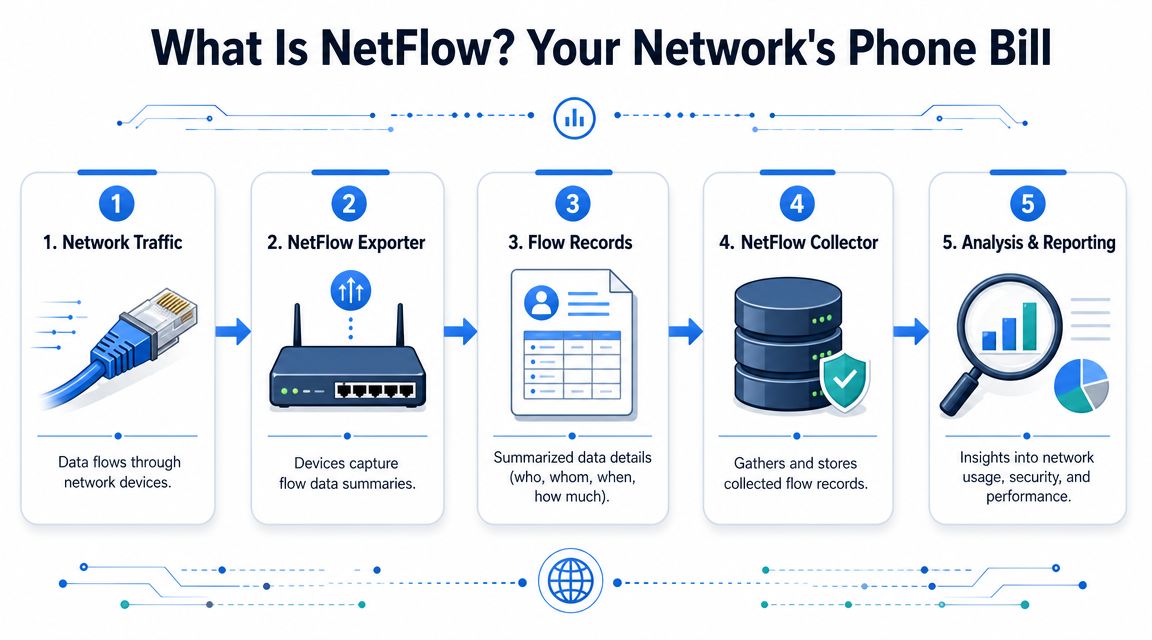
At a practical level, NetFlow records traffic metadata rather than the contents of each packet. You see who communicated, when the connection started and ended, which protocol and ports were used, how much data moved, and which interface handled it. Cisco's NetFlow v5 defines a flow using seven key fields (Wikipedia NetFlow overview).
That distinction matters for an MSP. Full packet capture is useful for deep forensics, but it is heavier to collect, store, and review. NetFlow gives you enough visibility to monitor patterns across many client environments without turning every network into a storage problem.
The three parts that matter
Keep the architecture simple. Three components drive the result.
ComponentWhat it doesWhy you careExporterA router, switch, firewall, or other device creates flow recordsTraffic summaries originate hereCollectorReceives and stores the recordsThis centralizes visibility across the environmentAnalyzerTurns records into dashboards, reports, and alertsYour team uses this to investigate issues and explain findings to clients
The exporter creates the summary. The collector stores it. The analyzer turns raw records into something your engineers can act on and your clients can understand.
For MSP operations, that works best alongside strong remote IT management systems so monitoring, response, and client communication stay aligned.
NetFlow shows behavior patterns. It does not show packet payloads.
Why MSPs should care
NetFlow matters because it gives you a fast, repeatable way to answer questions clients already ask.
- Who is using the bandwidth
- Which systems are communicating
- When traffic patterns changed
- Whether a new connection deserves investigation
That helps your service desk resolve issues faster. More importantly, it gives your account team a reason to recommend security work that goes beyond monitoring.
Here is the business point. NetFlow does not prove a breach, and it does not replace a penetration test. It gives you enough evidence to show a client that something needs validation. That is how visibility turns into revenue. You identify unusual communication paths, exposed assets, or suspicious outbound behavior, then recommend the next logical service: a deeper security assessment or white-labeled penetration test.
Common NetFlow Use Cases for Your MSP
NetFlow becomes valuable when you stop treating it like a dashboard and start treating it like a service enabler.
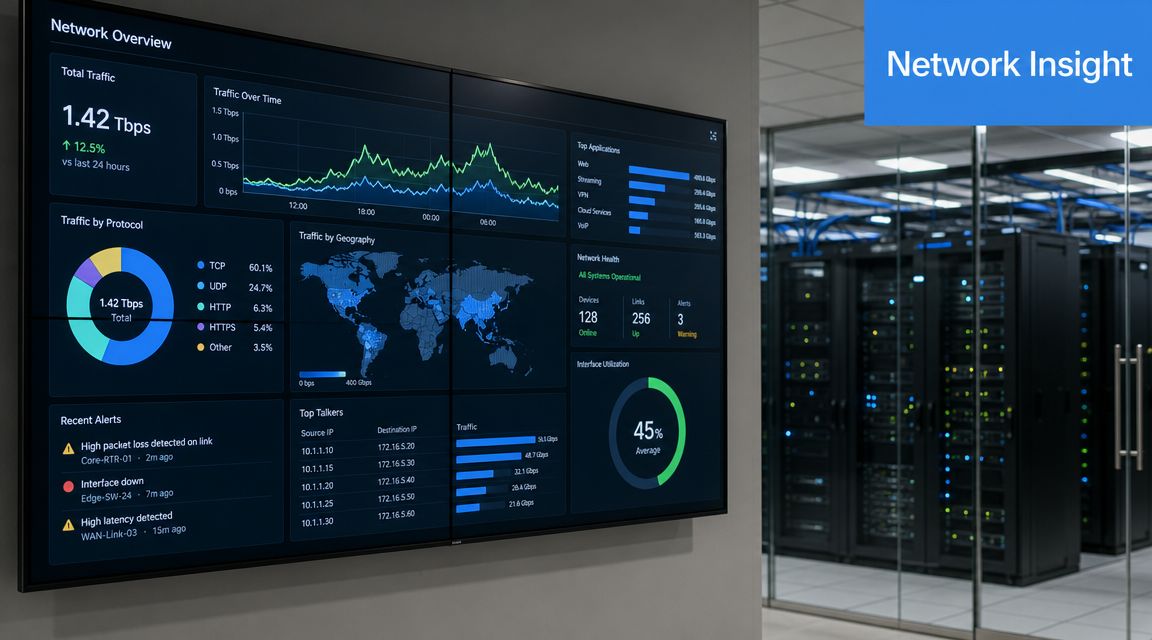
Network monitoring that clients understand
Clients don't care about abstract telemetry. They care that the network is slow and users are complaining.
NetFlow helps your team identify bandwidth-heavy systems, chatty applications, and odd timing patterns. That means faster troubleshooting and stronger client communication. Instead of generic updates, you can explain what traffic pattern is driving the issue.
This works even better when it's paired with solid remote IT management systems that help your team coordinate monitoring, response, and client support from one operational view.
Security analysis that opens doors
NetFlow is also useful for security analysis. Strange outbound connections, unusual spikes, or unexpected communication paths can tell you that something deserves attention.
That doesn't mean NetFlow proves compromise. It means it surfaces suspicious behavior quickly enough to investigate before the client learns about it the hard way.
Use it to support services like:
- Baseline reviews that show whether traffic patterns match business expectations
- Risk assessment engagements tied to suspicious or unmanaged communication flows
- Compliance preparation for clients that need better visibility before audits
Capacity planning with evidence
Clients often delay upgrades because they think you're just trying to sell hardware or a bigger contract. NetFlow gives you hard operational context. You can show recurring congestion, traffic concentration, and timing patterns that justify architectural changes.
That strengthens your retention because you're not pushing random recommendations. You're showing the client why the recommendation exists.
What NetFlow cannot do
This is the part many providers gloss over. NetFlow exports metadata rather than packet payloads, and it cannot replace packet capture for deep forensic review or payload inspection. The telemetry is summarized flow metadata, not full packets (Kentik's NetFlow overview).
That limitation is not a weakness in your service model. It's an opportunity.
If NetFlow shows that something strange is happening, but not what the attacker did or whether a vulnerability is exploitable, the next logical service is penetration testing.
Comparing NetFlow with sFlow and IPFIX
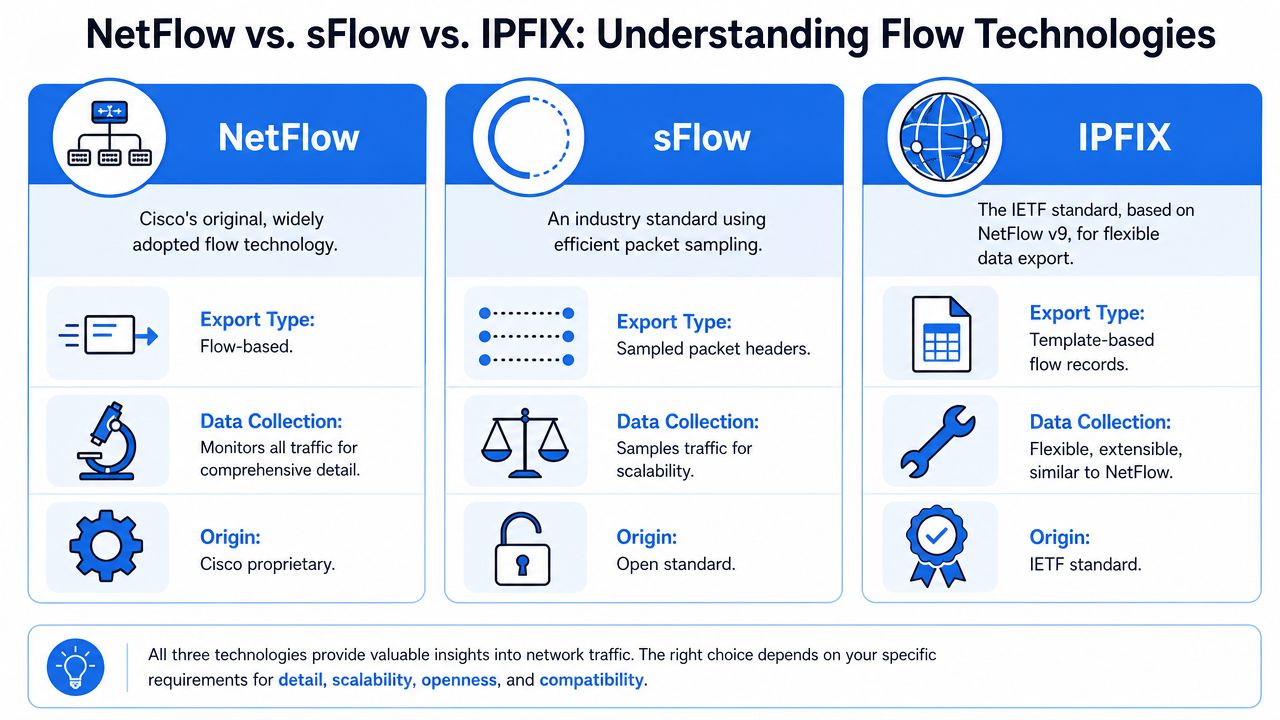
MSPs don't live in single-vendor environments. One client has Cisco. Another has mixed switching. Another has cloud-heavy infrastructure. So you need to know the difference between the names you'll see in the field.
The practical comparison
NetFlow was created by Cisco in the mid-1990s and later influenced the broader IPFIX standard, which the IETF codified by 2008 as a vendor-neutral flow-export framework based on NetFlow v9 concepts. That standardization helped networks compare traffic patterns across different vendors (LiveAction on NetFlow history and troubleshooting).
Why IPFIX matters in mixed environments
If you manage modern client networks, interoperability matters more than brand loyalty.
NetFlow v9 introduced a template-based export format, which made the protocol extensible by allowing collectors to interpret new fields without changing the core export mechanism. The IETF notes that devices export flows to external collectors and that the format supports granular resource-usage accounting such as IP addresses, packet and byte counts, timestamps, ToS, and input and output interfaces (RFC 3954 NetFlow v9 specification).
For an MSP, that means you should think in terms of flow telemetry strategy, not just “do we support Cisco NetFlow.”
The recommendation
Keep it simple.
- Use NetFlow terminology when clients already know the Cisco name
- Standardize on IPFIX-capable tooling when you want flexibility across vendors
- Expect to encounter sFlow in environments where sampling is already part of the network stack
The goal isn't picking a favorite acronym. The goal is consistent visibility across the client base.
Using NetFlow Data to Justify Penetration Testing
A client calls after seeing unusual outbound traffic from a server that should have been quiet overnight. Your monitoring stack already has the pattern. Repeated connections, odd destinations, unusual timing, and traffic volume that does not fit the client's normal behavior.

Many MSPs stop at the alert. They document the anomaly, block an IP, tighten a firewall rule, and close the ticket. That protects nothing if the underlying weakness is still there. It also wastes a sales opportunity.
NetFlow gives you evidence strong enough to change the conversation. You can show the client which systems communicated, when the activity started, how often it happened, and whether the pattern suggests command-and-control traffic, data staging, shadow IT, or lateral movement. That is enough to justify a focused security review.
The recommendation is simple. Use flow anomalies to open a penetration testing conversation.
Turn visibility into a paid security engagement
Clients do not buy pentests because you say “security matters.” They buy when you can connect suspicious behavior to a real business question.
Ask the question directly: if a server is making unexplained outbound connections after hours, do you want to assume it is harmless, or do you want proof?
That framing works because NetFlow shows symptoms, while penetration testing checks whether an attacker can exploit the environment in practice. A manual tester can validate exposure, trace likely attack paths, and determine whether the activity points to a real security gap or routine noise.
Use that position in client meetings:
- NetFlow identified behavior outside the client's normal baseline
- The client needs to know whether that behavior maps to an exploitable weakness
- A pentest gives them evidence they can act on, not just another alert
This is strong advisory work for vCISO services, compliance accounts, and security-conscious SMB clients. It also creates a clean path to sell a scoped network penetration testing engagement under your guidance instead of sending the client elsewhere.
Why this matters commercially
Monitoring alone is hard to differentiate. Plenty of MSPs can forward alerts and summarize logs. Few can take network visibility, explain the risk in plain language, and convert that insight into higher-value security work.
That difference drives revenue and retention.
When you bring the client a clear case for testing, you become the advisor who found the issue and led the response. You keep control of the account. You increase average contract value. You reduce the odds that a third-party security firm gets invited in and starts pitching around you.
If your team needs stronger fundamentals before having those conversations, point them to resources like Mindmesh Academy's Security+ exam prep. Better-trained staff usually explain risk better and close more security work.
Advisor view: NetFlow shows that something happened. Penetration testing proves whether it matters.
Offer White Label Pentesting To Your Clients
Your clients already need more than monitoring.
Some need a pentest for SOC 2. Others need penetration testing to satisfy HIPAA, PCI DSS, or ISO 27001 requirements. Some just had a security scare and want proof that their environment isn't exposed. If you don't offer that service, they'll find someone who does.
That creates a real business problem. When you send a client to another firm, you risk losing control of the account. Some firms will happily take the pentest project, then pitch managed security, compliance consulting, or broader IT services right over your relationship.
Why white label matters
A white label pentesting partner solves that problem cleanly.
- You keep the client relationship because the service stays under your brand
- You expand revenue without building an in-house team
- You protect your position as the trusted advisor managing the bigger picture
This matters for MSPs, vCISO firms, CPAs, and GRC providers that need security depth but don't want delivery overhead.
What to look for in a partner
Not all pentest providers are worth putting in front of your clients. Some are overpriced. Some rely too heavily on automation. Some move too slowly for real-world sales cycles.
A strong white label model also makes compliance work easier. When a client asks for evidence that security testing was done by qualified professionals, certifications help. When they ask for speed, a partner with quick delivery matters. When they ask for value, affordable pricing helps you close.
The right partner doesn't just run a penetration test. They make your firm easier to buy from.
If you want to add this to your stack without risking your accounts, study what a proper white label penetration testing model should look like. Then package it as part of your ongoing advisory, compliance, and security roadmap.
If you want a channel-only partner for affordable, manual pentesting delivered by certified OSCP, CEH, and CREST pentesters, our white-labeled pentest delivery is built for that model. We help MSPs, vCISOs, resellers, and GRC firms offer white-labeled pentests, pen tests, and penetration testing without competing for the client relationship. Contact us today to add a faster, higher-value security service to your portfolio.

.avif)
.png)
.png)
.png)

