
Your client calls first thing Monday morning. A controller clicked a fake Microsoft 365 login page, credentials were stolen, inbox rules were changed, and now finance is asking whether vendor payment requests were real.
That moment isn't just a security incident. It's a retention test.
If you're an MSP, vCISO, GRC advisor, or compliance-focused reseller, clients expect more than endpoint management and a basic stack. They want a real answer for how to protect against phishing attacks, and they want it packaged in a way that supports SOC 2, HIPAA, PCI DSS, and ISO 27001 expectations without crushing your margins.
Why Phishing Defense Is Your Business Opportunity

Phishing keeps showing up because it works. The UK ICO reported that 91% of UK companies responding to its survey experienced at least one successful email-based phishing attack in 2022 in its retrospective review of phishing incidents. If mature companies still get hit, your clients will not accept “we did awareness training” as a complete answer.
That creates a business opening for you. Clients don't just need email filtering. They need a layered service that reduces delivery, hardens logins, improves reporting, and proves controls work.
What clients are really buying
Most buyers aren't purchasing tools. They're buying confidence that you can reduce avoidable incidents and guide them through the ones that still get through.
That matters when you're competing against other providers pitching security bundles, risk assessment services, and compliance support. If your stack stops at antivirus and a canned phishing module, you'll lose deals to firms that can speak clearly about penetration testing, social engineering, and control validation.
Practical rule: If you can't explain your phishing defense stack in plain English, a competitor will explain theirs and win the account.
Why this improves margins
Phishing defense is one of the easiest security conversations to tie to recurring service revenue. It connects directly to managed email protection, identity hardening, user reporting workflows, incident response retainers, and white label pentesting.
It also gives you a reason to sell higher-value work instead of fighting over commodity support pricing. A client who sees you as the partner protecting payroll, email, and executive access is a lot less likely to shop your help desk rate.
Implement Foundational Email Authentication Controls
Start with the mailbox. If spoofed email still lands in the inbox, everything else gets harder and more expensive.
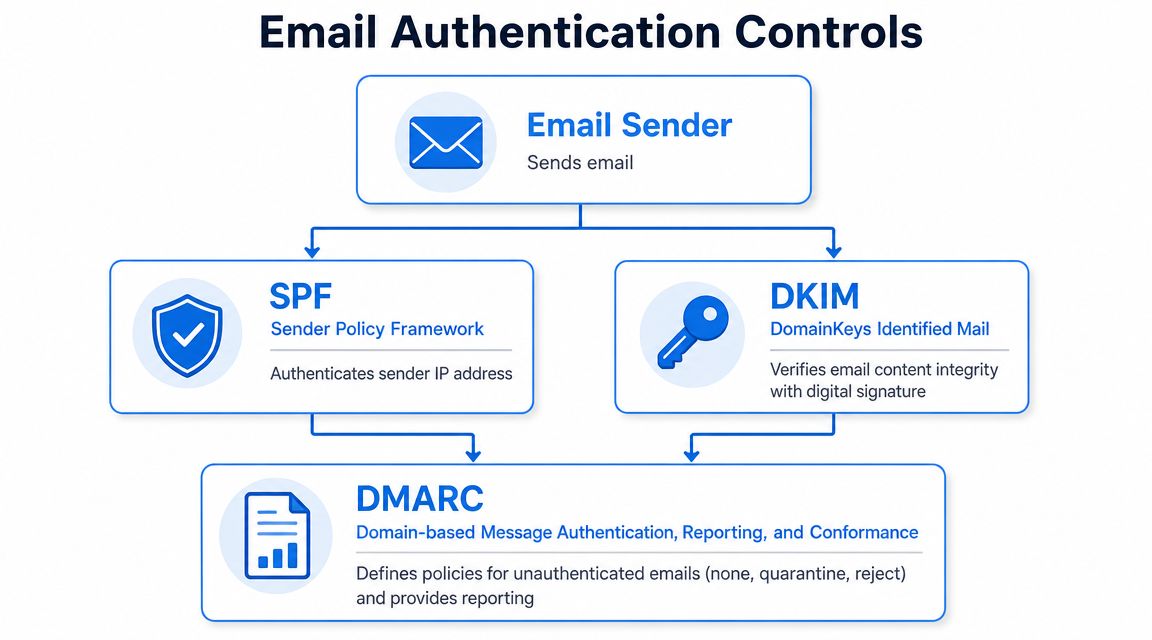
The UK National Cyber Security Centre recommends DMARC, SPF, and DKIM to make spoofing harder and says messages should be filtered or blocked for spam, phishing, and malware before they reach users, as summarized in this PMC review of anti-phishing guidance. That's the baseline, not an advanced add-on.
What each control actually does
Think of these three controls as a chain.
- SPF checks whether the sending system is allowed to send mail for the domain.
- DKIM helps verify that the message content hasn't been altered and that the message is tied to the domain.
- DMARC tells receiving mail servers what policy to apply when SPF or DKIM checks fail.
The same research summary notes that DMARC with a reject policy provides the strongest protection against spoofed email by ensuring unauthenticated messages are rejected at the mail server. That's why “we turned on SPF” is not enough.
Build this into every client standard
You should treat email authentication and filtering like seatbelts. Every client gets it. No exceptions, no “we'll phase that in later.”
A practical baseline looks like this:
- Server-side filtering first: Use a secure email gateway or equivalent mail protection so spam, phishing, and malware are blocked before users have to make a decision.
- Domain anti-spoofing next: Configure SPF, DKIM, and DMARC so attackers can't easily impersonate the client's domain.
- Reporting visibility: Use DMARC reporting to spot misconfigurations and unauthorized sending sources before they become account compromise or brand abuse.
Email protection should reduce the number of decisions users have to make, not push all responsibility onto them.
This is also where your compliance story gets stronger. For clients working toward SOC 2, HIPAA, PCI DSS, or ISO 27001, foundational email controls help show that basic preventive safeguards are in place. That makes your managed service stickier and easier to defend during audits and client reviews.
Harden Access with Modern MFA and Endpoint Controls
Basic MFA is better than passwords alone, but basic MFA isn't the finish line. Attackers have adapted.
The NSA says guidance for evolving phishing attacks includes phishing-resistant MFA, link and attachment phishing filters, protective DNS, application allow-lists, and remote browser isolation in its phishing protection guidance. That should change how you design identity protection for clients.
Basic MFA versus phishing-resistant MFA
If a client still relies on passwords plus one-time codes, you're reducing risk, but you're not closing the gap attackers target today. A stronger approach uses phishing-resistant MFA, where the login method is designed to resist fake sites and session theft.
For MSPs serving regulated clients or higher-risk executives, that distinction matters. “MFA enabled” sounds good in a sales deck. “Phishing-resistant MFA deployed for privileged users” sounds like an actual security program.
For a practical layered model, review this guide on security in layers. It fits the reality of phishing better than any single-control pitch.
Put a safety net under user mistakes
People will still click. That doesn't mean your stack failed. It means your stack needs depth.
Use endpoint and network-side controls that can stop the next step after the click:
- Protective DNS: Block known malicious destinations before the browser session goes anywhere useful for the attacker.
- Application allow-lists: Prevent unauthorized executables and scripts from running on managed endpoints.
- Remote browser isolation: Keep risky web content away from the endpoint for clients with higher exposure.
- Link and attachment filtering: Inspect the payload before the user opens it.
A lot of providers still sell awareness training as the centerpiece. That's backwards. The better model is hardened identity, controlled endpoints, and then user education on top.
Build a Human Firewall Through Smart Training
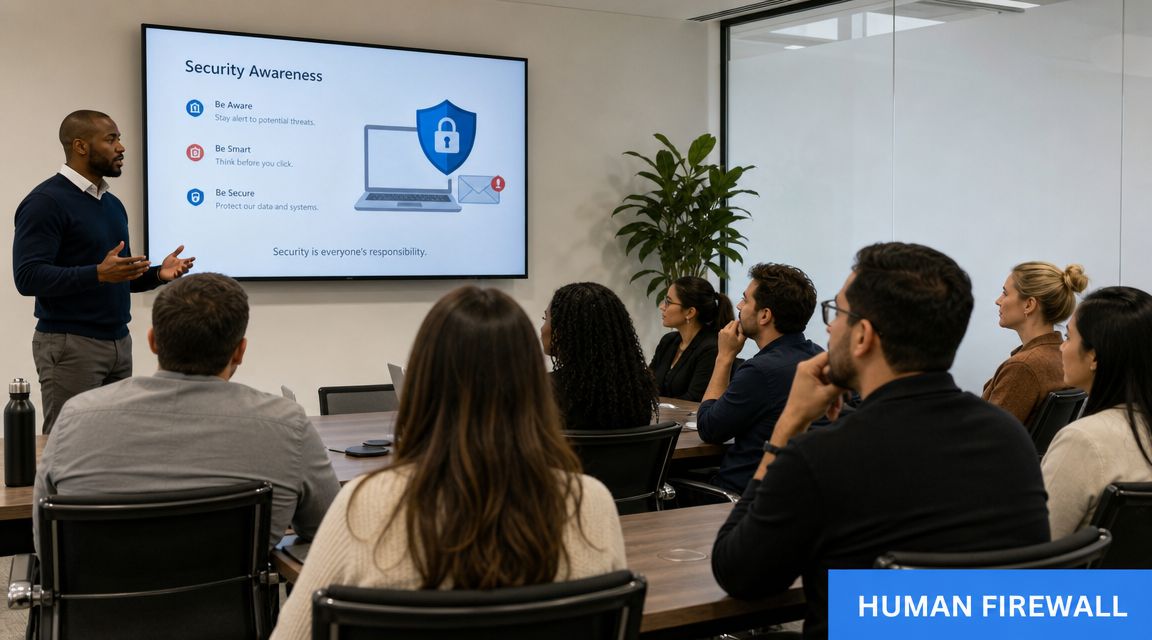
User training matters, but most programs are weak because they focus on blame instead of behavior. Users don't need a lecture. They need simple habits, an easy reporting path, and repetition.
The UK NCSC's phishing guidance recommends helping users identify and report suspicious messages, verifying important requests through a second channel, and using security logging to detect phishing the user didn't notice in its phishing defense recommendations. That's the right mindset for MSPs. Reduce friction, increase visibility.
Train for action, not trivia
A good training program should teach users what to do in the moment:
- Pause on requests involving money or credentials: Payment changes, password resets, and urgent approvals should be verified out of band.
- Use a second channel: Call, text, or message the requester using known contact details instead of replying to the email.
- Report suspicious messages fast: A one-click report button beats asking users to guess whether something is “serious enough.”
If you want examples to use in client education, this breakdown of types of phishing is useful for showing how attacks differ across email, voice, and impersonation scenarios.
Validate the human layer with pentesting
The value of social engineering pen test work is evident. Training says users understand the policy. A penetration test shows whether that understanding holds up under pressure.
A manual pentest is especially useful here because humans review context, craft believable scenarios, and document where the process breaks. That's far more useful than a checkbox campaign that only tells the client someone clicked a template.
The goal of a phishing simulation or social engineering pen test isn't to embarrass staff. It's to find weak approval paths, weak reporting habits, and weak escalation rules before an attacker does.
For vCISO, reseller, and GRC teams, that gives you evidence you can use in governance reviews, board reporting, and compliance discussions. It also gives your clients something concrete they can improve, not just another training completion report.
Create an Effective Incident Response Playbook
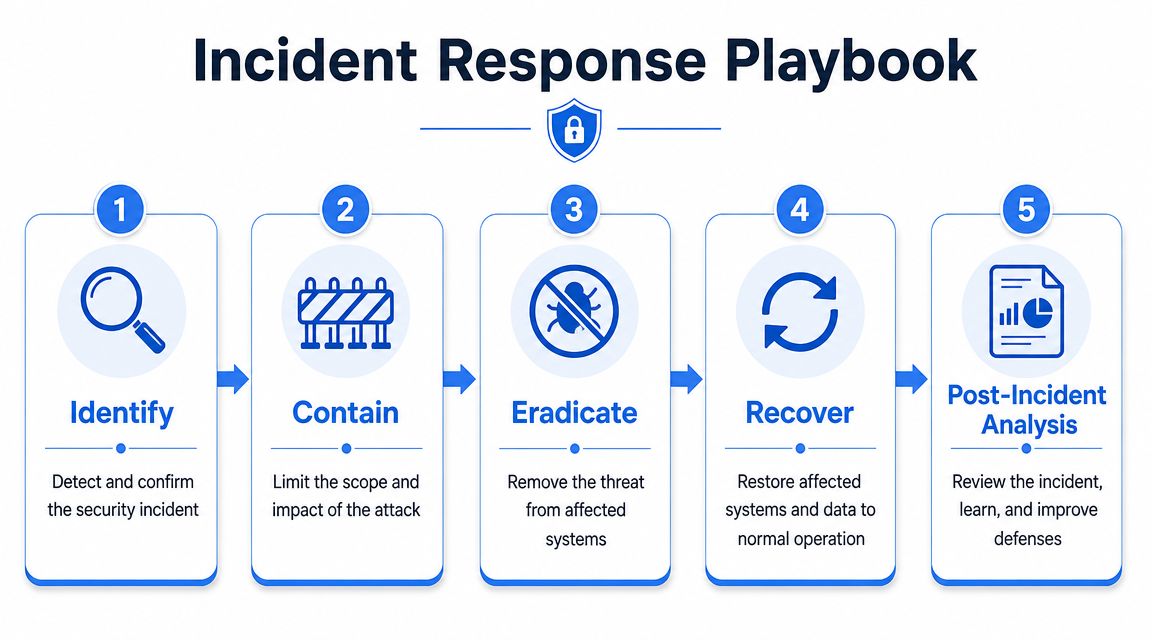
Every client needs a simple playbook for the moment someone clicks. Not a binder. Not a policy nobody reads. A short set of actions people can follow under stress.
Industry guidance recommends an immediate containment sequence: disconnect the device from the network, switch to a clean device, change affected passwords, and run a full malware scan in this incident response overview for phishing events. Speed matters more than elegance here.
Give users a short script
Your frontline instruction should be plain enough for a nontechnical user to follow:
- Stop interacting with the message. Don't click again. Don't reply. Don't forward it around casually.
- Report it immediately. Use the mail client's reporting function if available.
- Delete it after reporting. That prevents accidental re-opening.
- If a file was opened or credentials were entered, isolate the device.
- Move to a clean device and reset affected accounts.
That's the handout. Your internal team playbook can be deeper, but the end-user steps must stay simple.
Tie response to managed detection
A phishing incident isn't finished when the user reports it. Your team should check whether credentials were used, whether mailbox rules changed, whether suspicious sessions appeared, and whether other users received the same lure.
For clients that need more maturity around detection and escalation, the concept of the cyber kill chain helps explain why early reporting and containment matter. If you interrupt the attack early, the attacker has fewer chances to move from access to impact.
Fast containment protects more than the original user. It can stop inbox rule abuse, secondary credential theft, and follow-on fraud.
This is also a strong place to align your service with PCI DSS and ISO 27001 expectations around incident handling, logging, and controlled recovery. Clients don't need perfect prevention. They need a provider who can keep a bad click from becoming a business crisis.
Offer Phishing Defense as a Profitable Service
Don't sell phishing defense as a random pile of tools. Sell it as a managed security outcome.
The offer is straightforward. You reduce delivery with email filtering and authentication. You reduce account takeover with stronger authentication and endpoint controls. You improve detection with user reporting and logging. Then you validate the whole thing with pentesting, pen testing, and social engineering exercises.
Package the service so clients understand it
A clean offer for MSPs and resellers usually includes:
- Core protection: Email filtering, anti-spoofing controls, MFA policy, endpoint hardening, and reporting workflows.
- Advisory layer: Executive guidance, policy review, approval-path fixes, and a recurring risk assessment conversation.
- Validation layer: Social engineering, phishing simulation, and manual pentesting to test whether the controls hold.
That last piece is where many firms get stuck. Pentest pricing is often inflated, timelines drag, and the methodology can be weak. When that happens, you either avoid offering penetration testing or you outsource to a vendor that confuses your client and competes with you for the relationship.
Use channel-safe white label pentesting
A better model is a channel-only partner that supports your brand and your client relationship. MSP Pentesting provides white label pentesting for MSPs and resellers, including social engineering and other penetration testing environments, with certified pentesters holding OSCP, CEH, and CREST credentials. The service is structured for partners that need affordable, manual pentests with quick turnaround and without handing their account to a competitor.
That fits the core business pain for MSPs, vCISOs, and compliance firms. You need services you can resell under your own brand, tied to SOC 2, HIPAA, PCI DSS, and ISO 27001 conversations, without blowing up delivery costs or waiting forever for reports.
If you're serious about client retention, margins, and differentiation, phishing defense should be a productized service. And white label pentesting should be part of how you prove that service works.
If you want a channel-only partner that won't compete for your accounts, our white-labeled pentest delivery can help you add affordable, manual pentest, pen testing, and penetration testing services to your stack under your brand. Contact us today to learn more.

.avif)
.png)
.png)
.png)

